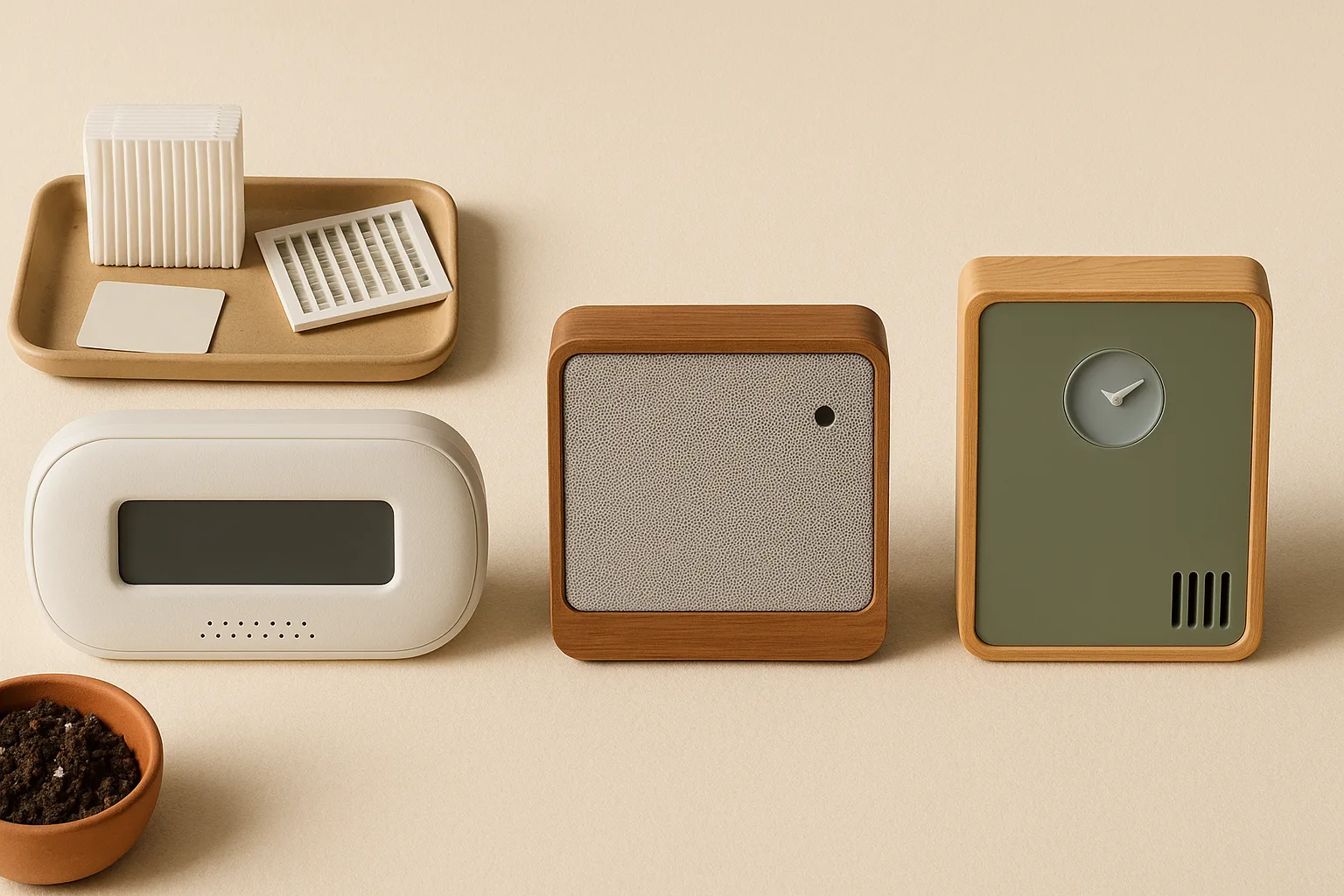
Indoor air quality monitors do not all measure the same thing — and the gap between what they track versus what they ignore can matter a lot depending on why you bought one. The useful ones measure particulate matter (PM2.5), humidity, temperature, and sometimes VOCs, CO2, or radon. Plenty of consumer devices do a solid job of showing trends over time but cannot produce lab-grade exposure data. Before you spend $40 to $300 on a sensor, it's worth knowing exactly which pollutants each device watches and which ones it skips entirely.
What an indoor air quality monitor measures in a real home
A monitor's value depends entirely on which sensors are inside it. There are two categories of measurements to understand: health-relevant readings and comfort readings.
Health-relevant readings include PM2.5 (fine particles from wildfire smoke, cooking, or dusty HVAC systems), volatile organic compounds (VOCs, from paint, furniture, and cleaning products), carbon dioxide (CO2, which spikes when ventilation is poor), and radon (a naturally occurring radioactive gas that seeps from soil and rock into basements). These matter because they correlate with real health outcomes — respiratory irritation, poor sleep, or, in radon's case, elevated lung cancer risk over years of exposure.
Comfort readings include temperature, relative humidity, and barometric pressure. These don't have the same acute health stakes, but they're still useful. A bedroom running at 70% humidity is a mold risk in the making. A baby's room swinging between 55°F and 74°F overnight affects sleep quality and respiratory comfort.
The critical point — confirmed by Airthings' own sensor documentation — is that different models have different sensor suites. You cannot assume that every monitor in a brand's lineup tracks every pollutant. The Airthings View Plus is the clearest example of a comprehensive home wellness product: it packs seven sensors into one device — radon, CO2, PM2.5, VOCs, humidity, temperature, and pressure — with a 5-minute sampling interval and sensor resolution of ±0.1°C/F for temperature, ±1% for humidity, and ±0.15 hPa for pressure. That's genuinely broad coverage. But not every monitor comes close.
Pro Tip: Before buying, list the specific problem you're trying to solve — wildfire smoke, radon in the basement, stale nursery air, or off-gassing from new furniture. That list tells you exactly which sensors you need and rules out devices that don't have them.
Airthings vs Awair vs IKEA sensor comparison table
The table below shows which sensors each major consumer monitor includes. If a sensor is absent, that's stated directly — not softened with vague language. The Airthings Wave Plus is verified by Airthings as a six-sensor radon-capable monitor, so the table below keeps that language tight instead of listing unverified individual sensors. The Awair Element is included only as a product reference point; current official sensor details were not retrieved from a Tier 1 source here, so its row is not expanded beyond what is directly verifiable from the source available at publication time.
| Sensor | Airthings View Plus | Airthings Wave Plus | IKEA Vindstyrka | Awair Element |
|---|---|---|---|---|
| PM2.5 | ✅ | Verified 6-sensor model including radon | ✅ | Current official sensor set not verified in this draft |
| VOCs (tVOC) | ✅ | Verified 6-sensor model including radon | ✅ | Current official sensor set not verified in this draft |
| CO2 | ✅ | Verified 6-sensor model including radon | ❌ | Current official sensor set not verified in this draft |
| Humidity | ✅ | Verified 6-sensor model including radon | ✅ | Current official sensor set not verified in this draft |
| Temperature | ✅ | Verified 6-sensor model including radon | ✅ | Current official sensor set not verified in this draft |
| Pressure | ✅ | Verified 6-sensor model including radon | ❌ | Current official sensor set not verified in this draft |
| Radon | ✅ | Verified 6-sensor model including radon | ❌ | Current official sensor set not verified in this draft |
Sources: Airthings View Plus specs, Airthings Wave Plus page, IKEA Vindstyrka product page. Awair Element row retained only as an unexpanded product reference because a current official spec page was not retrieved here.
Is Airthings better than Awair? For sensor breadth, yes — the View Plus is the most comprehensive smart home sensor in this comparison, with the only device here that covers all seven variables including radon and barometric pressure. For a household that doesn't need radon or pressure data, the Awair Element and even the IKEA Vindstyrka are competitive. The Vindstyrka covers PM2.5, tVOC, temperature, and humidity — which handles most allergy and wildfire scenarios — at a fraction of the View Plus price. The honest answer is that "better" depends on which sensors your home actually needs.
PM2.5 and wildfire smoke monitoring
PM2.5 — particles 2.5 microns or smaller — is the measure that matters most during wildfire season or in homes near high-traffic roads. Both the Airthings View Plus and the IKEA Vindstyrka include PM2.5 sensing, which puts both in a useful position for tracking indoor particle loads.
In practical terms: when outdoor AQI climbs above 100 on PurpleAir or AirNow and you seal your windows, a PM2.5 monitor tells you whether your indoor air is actually staying cleaner or whether particles are sneaking in through gaps. If indoor PM2.5 is rising despite sealed windows and your air purifier is running, you have a filtration problem (a clogged filter, a unit too small for the space, or leaks around doors). The monitor's reading becomes the trigger for adjusting your purifier settings or replacing the filter.
Watch Out: Consumer PM2.5 sensors are useful for trend tracking and purifier decisions, but none of the devices in this comparison claim regulatory-grade measurement or lab-certified accuracy. Use them to spot directional changes — "it went up, I should act" — not as proof of an exact exposure dose. For official outdoor AQI, cross-reference with AirNow or a nearby PurpleAir sensor.
The Airthings Wave Plus does not include PM2.5. If wildfire smoke or dust are your primary concern and you're considering an air quality monitor affiliate purchase, the View Plus or Vindstyrka are the sensible choices in the Airthings lineup — not the Wave Plus.
VOCs, cooking fumes, and off-gassing
VOC readings show up on the Airthings View Plus, Airthings Wave Plus, and IKEA Vindstyrka. All three measure total VOCs (tVOC), which is a combined reading of all detectable organic gas concentrations — not a breakdown by specific compound.
That's an important limitation to be honest about. When you cook with a gas burner, paint a room, or open a new couch from a plastic wrap, your VOC reading will spike. The monitor is telling you something real: there are more volatile compounds in your air than before. What it cannot tell you is which compounds, at what concentration, or whether they exceed any specific health threshold.
Airthings' own specification documentation notes that the View Plus needs approximately seven days of initial calibration for its VOC sensor to stabilize. That means the first week of readings should be treated as baseline-setting, not as actionable health data.
Watch Out: A tVOC spike during dinner prep is expected and transient. A tVOC reading that stays elevated overnight with no obvious source — new furniture, recent painting, or a new rug — is worth investigating with ventilation (open windows, run exhaust fans) before concluding you have a problem. Consumer VOC sensors are trend indicators, not compound-specific analyzers.
CO2 for ventilation and stale-air checks
CO2 is the most direct measure of ventilation quality in a room. Outdoor air is roughly 420 parts per million (ppm). A bedroom with the door closed and two people sleeping can push past 1,500–2,000 ppm by morning — levels that correlate with impaired sleep quality, grogginess, and reduced cognitive performance the next day. CO2 sensors let you see when a room is getting stale and give you a clear reason to crack a window or run an ERV.
The Airthings View Plus includes CO2 sensing, and Airthings' documentation ties elevated CO2 directly to poor ventilation and its effects on sleep and mental performance. The View Plus's CO2 sensor also needs about seven days to fully calibrate, so expect readings to settle after the first week.
The IKEA Vindstyrka does not include a CO2 sensor. This is one of the most important missing-sensor notes in this comparison. If you want to monitor bedroom or nursery ventilation with CO2 as your signal, the Vindstyrka will not give you that data. You need the Airthings View Plus, Wave Plus, or Awair Element instead.
Pro Tip: A good ventilation threshold to know: the EPA and ASHRAE use 1,000 ppm CO2 as a rough indicator that a space may need more fresh air. Above 1,500 ppm in a bedroom overnight, open a window a few inches or run an air exchanger. Your CO2 monitor makes that decision obvious instead of guesswork.
Humidity, temperature, and pressure for comfort and mold risk
All three devices — View Plus, Wave Plus, and Vindstyrka — measure temperature and relative humidity. The View Plus adds barometric pressure; the Vindstyrka and Wave Plus do not.
For humidity, the practical target for most US homes is 30–50% relative humidity year-round. Below 30% and you're dealing with dry skin, static, and cracked wood. Above 60% and you're in mold-growth territory, particularly in basements, bathrooms, and crawl spaces. The Airthings View Plus tracks humidity with a resolution of ±1%, which is fine for home monitoring.
Airthings notes that temperature also has a measurable effect on sleep quality — the sweet spot is around 60–65°F for sleeping and 68–72°F for working. Both numbers are worth tracking in nurseries and bedrooms where you have less control over HVAC zone settings.
Barometric pressure, available only on the View Plus, is primarily useful for tracking indoor weather patterns or correlating headache triggers with pressure changes. It's not a mold indicator or a ventilation metric — it's a comfort-layer addition.
Watch Out: No consumer IAQ monitor is a mold detector. High humidity is a condition that supports mold growth, but the monitor doesn't see mold spores or identify active colonies. If your basement consistently reads above 60% humidity and you smell mustiness, the humidity data supports calling a professional inspector — it doesn't replace one.
Radon sensors and when they matter
Radon is the second-leading cause of lung cancer in the US, according to the EPA — behind only smoking — and it's invisible, odorless, and completely undetectable without a sensor. It enters homes through foundation cracks, sump pits, and soil contact, and concentrations vary wildly by region and even by house.
Two Airthings monitors include radon sensing: the Airthings View Plus and the Airthings Wave Plus. Airthings describes the View Plus as its "air quality and radon" device and calls the Wave Plus an "award winning air quality monitor with 6 sensors including Radon." Both units are designed for placement in basements or lower-level rooms where radon concentrates.
Neither the IKEA Vindstyrka nor the Awair Element include radon sensing — period. If radon is your concern, these two devices are not appropriate purchases for that specific use case.
When does radon monitoring matter? If your home has a basement, is built on a concrete slab, or sits in a radon-prone region (check the EPA's radon zone map — Zone 1 states include Iowa, Illinois, Ohio, and much of the Mountain West), a radon-capable monitor is worth the investment.
Watch Out: An Airthings radon monitor is a long-term trend tool, not a substitute for mitigation planning. If your readings consistently show elevated radon levels, the appropriate next step is a certified radon mitigation contractor — not just watching the app graph. Consumer monitors inform the decision to act; a professional installation protects the home. The EPA action level is 4 pCi/L; readings consistently above that threshold warrant professional mitigation, not just ventilation adjustments.
What consumer air quality monitors can and cannot tell you
Airthings describes its app as providing "real-time air quality insights and personalized tips" for tracking "long-term indoor air trends and health improvements" . That framing — trends and insights — is the honest description of what consumer IAQ monitors do well.
What they don't do well is serve as proof of a specific health exposure. There is a meaningful difference between a monitor showing a PM2.5 spike during cooking and a certified industrial hygienist measuring your 8-hour time-weighted exposure to a specific particulate in a workplace. The consumer device shows you that something changed so you can respond. It does not tell you whether you exceeded a workplace threshold, whether a specific compound is present, or whether your home is safe for an immunocompromised person.
Three specific limitations matter for everyday use:
- Sensor drift: Consumer electrochemical and optical sensors can drift over time, meaning their baseline shifts and readings become less accurate without recalibration. Airthings builds a 7-day initial calibration period into the View Plus for VOC and CO2. Long-term drift specs vary by model and aren't typically published.
- Placement effects: A sensor sitting next to a heating vent, on a windowsill that gets afternoon sun, or within three feet of a stove will give misleading readings. Where you put the device shapes what it reports.
- App assumptions: Many of the colored indicators and scores in IAQ apps (Airthings' wave chart, Awair's Score) are proprietary weightings of sensor data. Two monitors in the same room can show different scores because their algorithms differ, even if their raw sensor readings are similar.
When a monitor is enough and when a lab test is better
DIY vs Pro: A consumer IAQ monitor is enough when you want to: understand general air quality trends, know when to run a purifier or open a window, track whether a radon reading warrants professional follow-up, or monitor humidity in a basement over time. You need a professional test or certified lab sampling when: you suspect a specific chemical exposure (formaldehyde from new cabinetry, asbestos from old insulation), you have radon readings consistently above 4 pCi/L, you are purchasing or selling a home and need inspection-grade documentation, or a household member has a diagnosed condition requiring clinical-grade air quality assessment. A consumer monitor surfaces the problem; a certified professional or lab test quantifies it and drives remediation decisions.
Best placement for bedrooms, nurseries, and living rooms
IKEA's product guidance suggests placing the Vindstyrka in the living room, bedroom, or other rooms where you spend significant time — which is the right general principle for any IAQ monitor. Placement that represents the air you're actually breathing matters more than a perfect shelf location.
Bedroom placement for sleep and ventilation
The bedroom is where a CO2 and VOC-capable monitor earns its keep, because it captures air quality during the hours you're most exposed to a sealed, low-ventilation environment.
Bedroom placement checklist: - Place the monitor in a part of the bedroom that reflects the air you actually breathe while sleeping. - Keep it away from direct heat, direct sunlight, and strong drafts that can skew temperature, humidity, and particle readings. - Avoid putting it in a spot where furniture blocks normal airflow around the device. - If your monitor has a light or display, face it away from the bed or use the app's night mode to avoid sleep disruption.
A CO2 spike in your overnight bedroom data is one of the clearest signals that your room needs more ventilation — crack a window an inch or add a small window fan in exhaust mode.
Nursery placement for baby-safe monitoring
In a nursery, the priority sensors are CO2 (for ventilation), humidity (for respiratory comfort and mold prevention), and temperature (for sleep safety). The Airthings View Plus covers all three. The Vindstyrka covers humidity and temperature but not CO2.
Infant-room setup guidance: - Place the monitor where it can reflect the room's general air, not in a corner where conditions are unusually stagnant. - Use the app to review trends over time rather than reacting to every brief spike. - Keep the monitor away from direct mist, whether from a humidifier or another source, so humidity readings remain representative. - Never place the monitor inside the crib or within reach of the baby.
Living room and open-plan placement
An open-plan kitchen and living room presents the most challenging placement scenario because cooking spikes PM2.5 and VOCs dramatically and briefly. If your monitor sits on the kitchen counter, it will capture every sauté session as a major event — technically accurate but not representative of the air quality where you're relaxing on the couch twenty feet away.
Place the monitor in the part of the room where you spend the most time, and keep it out of obvious hot spots or direct cooking plumes. A central seating area usually gives you a reading that reflects typical exposure, while still responding (with some lag) to cooking events that migrate through the space.
App compatibility, subscriptions, battery life, and display features
Whether a device works standalone — without the app open — and what ongoing costs you'll pay after purchase are questions most reviews bury in fine print. Here's what the verified manufacturer information shows, with honest flags where data is incomplete.
Airthings app and ecosystem compatibility
Airthings' app runs on both Android and iOS and delivers readings and air quality notifications for the Wave Plus and View Plus. The app is where you see historical trends, set thresholds, and access the dashboard for multiple rooms.
For smart home integration: Airthings has published API access and the community has built Home Assistant integrations, but Airthings has not published an official supported Home Assistant integration through the sources available at publication time. If Home Assistant compatibility is a requirement for your smart home setup, verify the current integration status at Airthings' developer documentation and the Home Assistant integrations directory before purchasing — third-party integrations can break with firmware updates.
The View Plus runs on six AA batteries (the unit weighs 360 g with batteries installed per Airthings' Help Center specs), keeping it portable and wall-plug-free. The device's built-in display shows sensor data without requiring the app, which is useful for a quick bedroom glance.
Awair app, alerts, and subscription fees
The Awair Element uses the Awair Home app for iOS and Android, with a color-coded display and Awair Score that aggregates sensor data into a single number. Awair has offered integrations with platforms including Amazon Alexa, Google Home, and IFTTT.
Watch Out: Awair's subscription model and pricing have changed over time. Authoritative spec and subscription data for the Awair Element was not available from official sources at the time of this writing. Before purchasing, check Awair's current website for app feature tiers, any premium subscription requirements, and which alerts or historical data access requires a paid plan. Do not assume the current model matches older reviews.
IKEA Vindstyrka display-first simplicity
The IKEA Vindstyrka is the most straightforward device in this comparison. According to IKEA, it "checks the air quality by monitoring harmful particles (PM2.5), temperature, relative humidity and total Volatile Organic Compounds (tVOC) in your home" — and it shows those readings directly on its face.
The Vindstyrka is also available as part of a bundled STARKVIND air purifier system, where it can automatically trigger the purifier when PM2.5 rises — a genuinely useful integration for wildfire season or heavy cooking days. It connects via Zigbee and works with the IKEA Home Smart app (DIRIGERA hub required for app control), though it can also display readings independently without app access.
No subscription fees appear in IKEA's published materials for the Vindstyrka, though you should verify current app and hub requirements at IKEA's site. The lack of CO2, radon, and pressure sensors keeps costs down and the interface simple — it's a deliberate trade-off, not an oversight.
Which monitor fits allergies, wildfire smoke, basements, and new babies
The right monitor depends entirely on your household's actual needs. Here's how to match each scenario to the correct device.
Best pick for wildfire smoke and allergy season
For PM2.5 tracking — the sensor that matters most for wildfire smoke, outdoor particulate intrusion, and airborne allergens — both the Airthings View Plus and IKEA Vindstyrka include it. The Vindstyrka's appeal here is its lower price point and its optional pairing with the STARKVIND purifier for automatic response.
Recommendation — Wildfire/Allergy Pick: - Airthings View Plus — Best if you want PM2.5 alongside CO2 and radon in one device; can cross-reference with AirNow or PurpleAir for outdoor context - IKEA Vindstyrka — Best if PM2.5, humidity, temperature, and tVOC are sufficient and you want the lowest friction entry point, especially paired with the STARKVIND purifier
Cross-reference your indoor PM2.5 readings with AirNow's outdoor AQI during wildfire events. If indoor PM2.5 stays low when outdoor AQI is high, your home is sealing and filtering effectively. If indoor PM2.5 tracks upward with outdoor conditions, check your HVAC filter and window seals.
Best pick for a moldy basement or radon concern
This is where the air quality monitor affiliate decision is clearest. Only two monitors in this comparison include radon sensing, and both are from Airthings.
Recommendation — Basement/Radon Pick: - Airthings View Plus — Includes radon, humidity, temperature, pressure, CO2, PM2.5, and VOCs; Airthings calls it its best-for-radon device; ideal for a finished basement where you spend meaningful time - Airthings Wave Plus — Six sensors including radon; a reasonable choice if you don't need PM2.5 and want a more affordable entry into radon monitoring
Do not buy the IKEA Vindstyrka or Awair Element for a basement radon concern — neither device includes radon sensing. Humidity data from any of these monitors can flag conditions that support mold risk, but remember that high humidity is a risk factor, not mold confirmation.
Best pick for a renter on a budget
The IKEA Vindstyrka is the straightforward answer for a renter who wants useful home wellness monitoring without high upfront cost or app lock-in complexity.
Recommendation — Budget/Renter Pick: - IKEA Vindstyrka — Covers PM2.5, tVOC, temperature, and humidity; no subscription found in published materials; display works without a phone app; easy to move between apartments; verify current pricing at IKEA.com before purchasing
Trade-offs to accept: no CO2 reading (can't track bedroom ventilation), no radon, no pressure. For a renter in a mild climate who wants basic wildfire and allergy season awareness, those are acceptable omissions.
What to check before you buy an indoor air quality monitor
Use this checklist before any purchase decision. Don't assume parity — verify.
Purchase checklist: - Sensor set match: List the specific pollutants you need to track. Cross-check the official product spec page, not the marketing headline. Airthings' View Plus covers seven sensors; the Vindstyrka covers four; assume nothing. - Calibration period: The Airthings View Plus requires approximately seven days for VOC and CO2 sensors to calibrate. Don't make decisions based on day-one readings. - Power source: The Airthings View Plus runs on six AA batteries. Some monitors require continuous USB or plug power. Battery-powered units are more portable; plugged-in units give continuous monitoring without battery replacement. - App dependency: Can the device display readings without the app open or installed? The Vindstyrka has a built-in display; the Wave Plus does too. Verify before buying whether you need the app for any core functions. - Subscription fees: Confirm on the current product page whether any subscription is required for historical data, alerts, or full functionality. This information changes; don't rely on older reviews. - Resale value: Check whether the model has an active secondhand market, replaceable accessories, and a recognizable brand name that may hold value if you upgrade later. - Ecosystem compatibility: If you use Home Assistant, Google Home, Amazon Alexa, or Apple Home, verify current integration support on the manufacturer's site — not third-party review articles from 2023. - Sampling interval: The View Plus samples every 5 minutes, which is typical for consumer devices. Faster sampling costs more battery; slower sampling misses transient events like cooking spikes.
Calibration, sensor drift, and accuracy claims
Consumer IAQ monitors are not laboratory instruments. The Airthings View Plus spec sheet lists sensor resolutions — ±0.1°C/F for temperature, ±1% for humidity, ±0.15 hPa for pressure — which are the minimum detectable changes, not accuracy guarantees against a traceable standard.
Both VOC and CO2 sensors on the View Plus require approximately seven days of initial calibration per Airthings' two-pack specifications. During that period, treat readings as baseline-building, not actionable data. After calibration, the sensors can drift over months or years — optical particle counters and electrochemical cells both shift with age, temperature cycling, and humidity exposure.
Watch Out: Airthings specifies that the View Plus should not be used above 85% relative humidity — operating above that threshold can permanently damage the radon sensor and affect display quality. Don't place radon monitors in unfinished basement utility rooms that flood or in crawl spaces without climate control.
No consumer IAQ monitor on this list publishes a formal recalibration schedule or third-party accuracy certification. Treat all readings as useful trend data, cross-reference with known outdoor conditions, and engage a certified professional when the stakes require verified measurements.
Subscription fees, warranties, and returns
Airthings and IKEA do not publish current subscription, warranty, or return policy details in the manufacturer documentation available at publication time. Before purchasing, check directly:
- Airthings: Visit airthings.com for current subscription tiers, warranty terms, and return policy. Historical versions of Airthings' plan have included a free tier with basic app access and paid tiers with advanced analytics.
- IKEA Vindstyrka: Check ikea.com for current return policy and any hub or app account requirements.
- Awair: Visit getawair.com for current subscription status, warranty, and return terms — these have changed over time.
Do not rely on third-party review sites or Amazon listing descriptions for warranty or return terms. Go to the manufacturer's own current policies.
Frequently asked questions about indoor air quality monitors
Can an air quality monitor detect mold?
No — not directly. Consumer IAQ monitors cannot identify mold spores, mold species, or active mold colonies. What they can detect is elevated humidity, which is a precondition for mold growth. If your monitor consistently shows humidity above 60% in a basement or bathroom, that's a meaningful warning sign that the environment supports mold — but the monitor is measuring the conditions, not the mold itself. If you smell must, see discoloration, or have an immunocompromised household member, an elevated humidity reading is reason to schedule a professional mold inspection, not a substitute for one.
Does IKEA Vindstyrka measure CO2?
No. The IKEA Vindstyrka's official sensor list covers PM2.5, temperature, relative humidity, and total VOCs (tVOC). CO2 is absent from the Vindstyrka's sensor suite. If you need CO2 monitoring for a bedroom, nursery, or home office ventilation check, the Vindstyrka will not provide that data. Choose the Airthings View Plus, Airthings Wave Plus, or Awair Element instead.
Do indoor air quality monitors need calibration?
Yes, at least for some sensors. The Airthings View Plus requires approximately seven days of initial calibration for both VOC and CO2 sensors before readings stabilize, per Airthings' specification documentation. During that initial period, treat readings as the sensor establishing its baseline — not as fully settled measurements. After initial calibration, all consumer IAQ sensors can experience drift over time as sensor materials age. The manufacturer does not publish a recommended recalibration interval for these models. If your readings start seeming implausible after months of use (CO2 stuck at outdoor levels indoors, or humidity readings that contradict your hygrometer), consider that sensor drift may be a factor.
Sources & References
- Airthings Air Quality Sensors Resource Page — Airthings' official documentation on sensor types, model-specific suites, and the principle that different models measure different pollutants
- Airthings View Plus Product Page — Sensor list, sampling interval, and comfort-factor guidance for temperature and humidity
- Airthings View Plus Two-Pack Specifications — Sensor resolution figures and 7-day calibration periods for VOC and CO2
- Airthings View Specifications (Help Center) — Dimensions, weight, operating environment including humidity limit
- Airthings Wave Plus Product Page — 6-sensor radon-capable monitor with Android/iOS app support
- Airthings Homepage — App description as real-time insights and long-term trend tracking
- IKEA Vindstyrka US Product Page — Official sensor list: PM2.5, temperature, relative humidity, tVOC; confirms absence of CO2, radon, and pressure
- IKEA Vindstyrka Philippines Product Page — Article number reference
- IKEA Vindstyrka Oman Product Page — Room placement guidance
Keywords: Airthings View Plus, Airthings Wave Plus, Awair Element, IKEA Vindstyrka, PM2.5, volatile organic compounds (VOCs), carbon dioxide (CO2), radon, relative humidity, temperature, barometric pressure, Home Assistant, PurpleAir, AirNow