Counter-depth refrigerators are a fit-first decision — but the biggest mistake buyers make is choosing one based on the flush look without accounting for what disappears from the interior. If you're replacing an aging fridge in a constrained opening and you're weighing LG, GE, or Bosch, or scanning a major appliance retailer’s refrigerator affiliate pages for a sale that includes delivery, here's the honest comparison: usable capacity, local service realities, and what actually happens on delivery day.
How counter-depth refrigerators compare for small kitchens and remodels
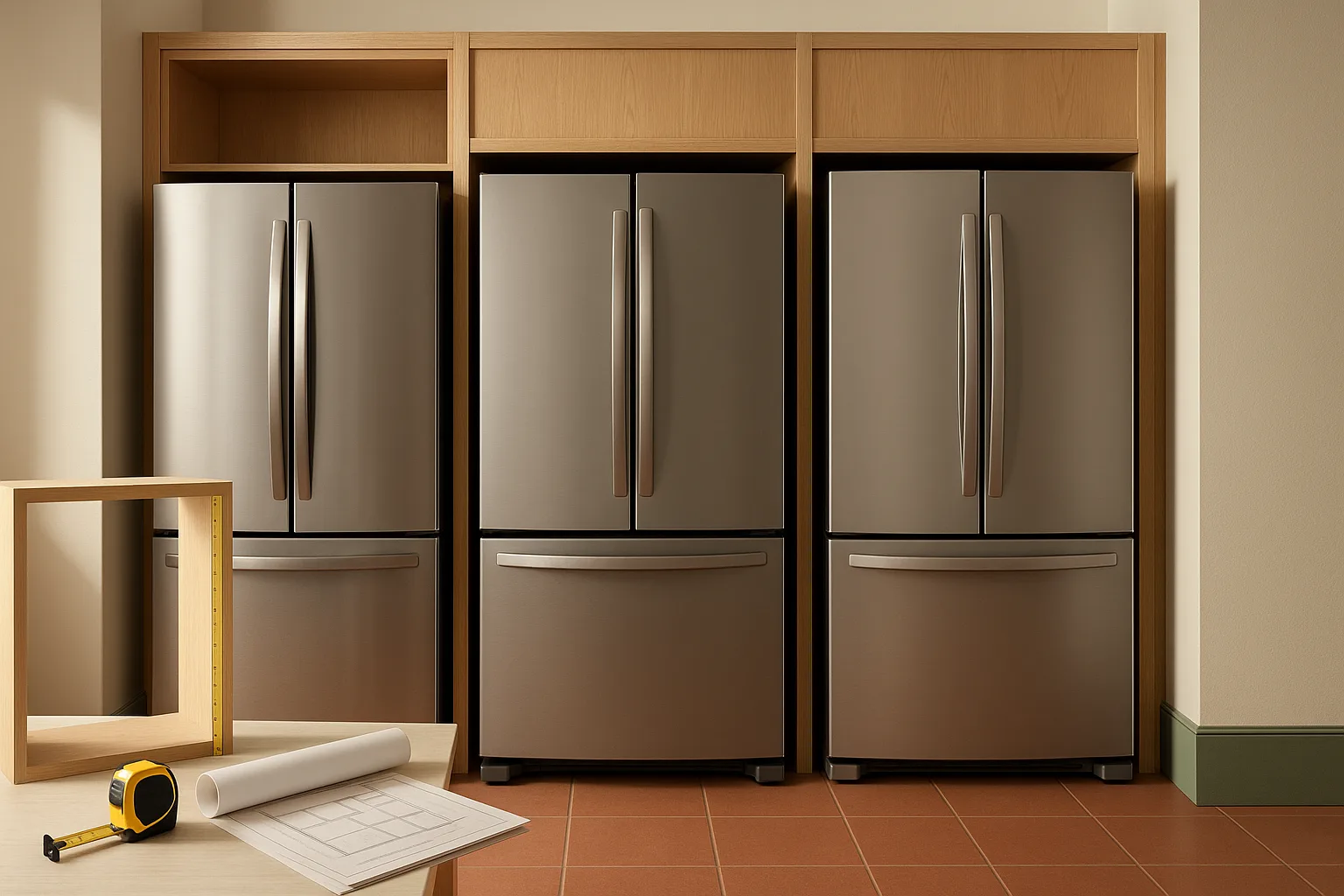
Counter-depth refrigerators are worth it when fit is the priority — specifically when your cabinet run, island clearance, or traffic flow can't absorb a standard-depth box that sticks out 6 to 10 inches past the cabinet face. As Yale Appliance puts it, "Counter-depth refrigerators used to prioritize a flush, built-in look at the expense of capacity." The category has improved, but that tradeoff still exists in most models.
At a Glance: Counter-depth buys you a cleaner cabinet line and easier walkway clearance, but you usually give up interior shelf depth and a few cubic feet unless you land on an outlier like LG's Counter-Depth MAX.
Consumer Reports notes that a typical refrigerator can extend up to 10 inches beyond kitchen cabinets. For a galley kitchen or a peninsula layout where that protrusion blocks a walkway, counter-depth isn't a luxury upgrade — it's a functional fix.
At a Glance: Counter-depth vs. standard-depth
| Factor | Counter-depth | Standard-depth |
|---|---|---|
| Typical capacity | 18–26.5 cu. ft. | 22–30 cu. ft. |
| Cabinet projection | Near-flush (0–2 in.) | 6–10 in. past cabinet face |
| Price premium | $200–$800+ more | Lower entry cost |
| Best for | Tight openings, remodels, open layouts | Maximum storage, dedicated alcoves |
If you're shopping for a counter-depth refrigerator through a major appliance retailer or a refrigerator affiliate landing page for a remodel or a constrained opening, the right pick depends more on usable interior volume and your ZIP code's service network than on brand prestige.
Counter-depth vs standard-depth: how much usable capacity you give up
Yes, a counter-depth refrigerator is smaller inside than a comparably priced standard-depth model — but the gap is narrower than it used to be, and one outlier blows the old rule apart. Yale Appliance calls it "The Capacity Trade-Off."
Yale Appliance's 2026 roundup of the largest counter-depth French-door refrigerators documents the LG Counter-Depth MAX at 26.5 cubic feet — a number that matches or beats many standard-depth competitors. That model measures 70.25 inches tall, 35.75 inches wide, and 24.75 inches deep (plus the door). At the other end, Bosch counter-depth models average about 20.8 cubic feet, according to Yale's 2026 reliability data. GE's Profile PYE22KSKSS lands at 22.1 cubic feet.
CapacityComparison: counter-depth by brand
| Brand / Model | Usable Capacity | Exterior Depth (approx.) |
|---|---|---|
| LG Counter-Depth MAX | 26.5 cu. ft. | ~24.75 in. + door |
| GE Profile PYE22KSKSS | 22.1 cu. ft. | Counter-depth spec |
| GE Profile PJE23BYWFS | 23.2 cu. ft. | Counter-depth spec |
| Bosch (avg. counter-depth) | ~20.8 cu. ft. | Counter-depth spec |
| Typical standard-depth French door | 25–30 cu. ft. | 30–33 in. + door |
That capacity gap shows up in real use as shallower crisper drawers, less front-to-back shelf depth, and more juggling of tall items and wide containers. A 20.8-cubic-foot refrigerator works for two people without a bulk-shopping habit, but it feels tight for a family of four doing weekly big-box runs. The LG MAX changes the math entirely for families who need the space — but verify the exact SKU on LG's site before ordering, because the MAX name has appeared on multiple models with slightly different dimensions.
Pro Tip: Don't assume all counter-depth models are smaller inside. Always check the published cubic-foot rating, not just the word "counter-depth" in the product title.
What a true 30-inch opening means for cabinet depth, hinge swing, and door clearance
A 30-inch opening is a nominal measurement. What you're actually dealing with is a stack of constraints that can turn a beautiful delivery into a problem that requires trimming cabinets, removing doors, or sending the refrigerator back.
Fit-check checklist before you order:
- Opening width: Measure at the floor, the middle, and above the countertop. Floors and walls aren't always square. You need the narrowest point, plus at least ½ inch of clearance on each side per most manufacturer specs.
- Opening height: Measure from floor to the underside of the cabinet above, or to the ceiling if it's an exposed run. Add 1 inch minimum clearance above the unit.
- Depth to the wall: Measure from the front of your cabinets to the wall (or baseboard). Counter-depth bodies run roughly 24–25 inches, but handles add 2–5 inches to the front. A pocket or recessed handle on Bosch's 800 Series saves that space.
- Handle projection: French-door bar handles on LG and GE models typically add 3–4 inches to the door depth. That extra depth determines whether a drawer on the opposite wall still opens fully.
- Hinge swing clearance: French-door hinges require clear space on both sides to open 90 degrees. Bottom-mount freezer drawers need 24–30 inches of pull-out clearance in front of the unit.
- Adjacent drawer clearance: Island drawers, dishwasher doors, and corner cabinet pullouts all compete for the same floor space. Map the swing arcs on paper before ordering.
- Walk-path width: The refrigerator plus an open door should leave comfortable circulation space for kitchen traffic. Check this against the actual door swing, not the closed-door footprint.
Watch Out: GE requires an anti-tip bracket on all counter-depth bottom-freezer and French-door refrigerators — it's included in the box and installation is mandatory for safety. If the installer skips it, you're liable and the fridge can tip forward when the freezer drawer is fully extended.
Plan for professional delivery and installation — detailed in the last two sections — when any of these measurements are within ½ inch of the manufacturer's stated minimum.
How we compared LG, GE, and Bosch counter-depth refrigerators
This comparison is built around the criteria that matter after delivery: usable interior capacity, documented reliability from real service-call data, local service-tech availability, and actual fit logistics — not spec-sheet bullet points.
Comparison methodology:
| Criterion | Why it matters for your decision |
|---|---|
| Usable capacity (cu. ft.) | Determines whether the fridge actually works for your household |
| Service-call rate | Predicts how often you'll need a repair tech in years 2–5 |
| Local serviceability | Determines how fast and cheap repairs will be in your ZIP code |
| Layout and organization | Affects day-to-day usability, especially in small kitchens |
| Install fit | Determines whether the unit clears your opening without modification |
Reliability framing comes from Yale Appliance's 2026 most-reliable counter-depth roundup, which is based on 33,190 real service calls — the most specific real-world data available for this category. Consumer Reports' French-door reliability ratings serve as a secondary check on brand-level trends. No brand is ranked purely on marketing claims.
Reliability and service support by ZIP code
Here's the factor most buying guides skip entirely: the best brand on paper can be the worst choice in your ZIP code if no one nearby is authorized to fix it within a reasonable window.
Yale's data, drawn from 33,190 service calls across their Boston-area stores, reflects a dense, brand-diverse service market. Rural buyers, buyers in secondary markets, and buyers in areas where one brand dominates local techs' books will see different outcomes.
Service-support decision guide:
Before you buy, check these three things: 1. Authorized service techs in your ZIP: Search each brand's service-locator tool. For Bosch, use Bosch's U.S. service portal. For GE, use GE Appliances' service scheduler. For LG, use LG's service locator. If the nearest authorized tech is more than 60 miles away, factor in travel fees or longer wait times. 2. Parts lead time: LG's linear compressor parts, Bosch's European-spec components, and GE's Profile-line electronics all have different supply chains. Ask a local appliance repair shop — not a brand's call center — how long they typically wait for parts for each brand. 3. Who covers the first year: All three brands sell through authorized dealers and big-box retailers. If your appliance dealer offers an in-house service plan on top of the manufacturer warranty, that's worth weighing if Bosch or LG techs are scarce locally.
The practical implication: Bosch has a smaller U.S. service footprint than GE in many markets, while LG often lands somewhere between the two for buyers who live near major metro service hubs. Those are observations to verify locally, not universal rules. If you live outside a metro area, GE's serviceability advantage is real and worth prioritizing over a slightly better capacity number from LG.
LG counter-depth refrigerators: biggest usable space and strong value
LG wins the capacity argument for counter-depth buyers who refuse to give up interior volume. The LG Counter-Depth MAX French-door refrigerator delivers 26.5 cubic feet — a number that, according to Yale Appliance's largest counter-depth roundup, outpaces most standard-depth competition while still presenting a near-flush exterior. If storage loss is your primary objection to going counter-depth, LG specifically addresses it.
Cost Snapshot: LG Counter-Depth MAX French-door refrigerator models typically range from $1,800–$2,800 depending on finish and configuration. Check LG's site and authorized dealers for current pricing, as LG runs frequent promotional markdowns.
LG is also the strongest value play in this comparison for households that need to feed a family of four without paying Bosch's premium. The Counter-Depth MAX hits a price-per-cubic-foot that competitors can't match at this exterior footprint.
Best LG counter-depth models for cramped kitchens
The Counter-Depth MAX line is LG's headline answer to the capacity tradeoff problem — 26.5 cubic feet in a body that measures roughly 35.75 inches wide and 24.75 inches deep before the door. For a 36-inch standard opening, that exterior width works. For anything narrower, verify the exact SKU's dimensions on LG's product page before ordering.
LG Counter-Depth MAX models are the kind of refrigerator shoppers add to a major appliance retailer cart when they need the largest counter-depth box they can get without giving up a flush look. On select MAX models, the door-in-door feature creates a secondary compartment on the right French door for frequently accessed items — canned drinks, condiments, snacks. It's a genuine space-management upgrade for small kitchens where you'd otherwise have the refrigerator door fully open while reaching to the back. The tradeoff is a slight reduction in usable door-bin depth on that side.
LG's linear compressor is the other feature worth knowing about — but primarily for service risk reasons, covered in the next section.
Pro Tip: Confirm the Counter-Depth MAX's exact model number on LG's site, because the MAX branding has appeared across multiple SKUs with different finishes, handle styles, and smart-home feature sets. The capacity and dimensions are consistent, but the handle projection varies by model and that affects your opening fit.
LG tradeoffs: service history, compressor concerns, and warranty basics
Watch Out — LG Linear Compressor: LG's linear compressor is quieter and more energy-efficient than traditional compressors, but it has a documented history of premature failures that generated class-action litigation in the U.S. Before buying, verify the current warranty terms directly on LG's U.S. support site, confirm what's covered for parts versus labor in years 2–10, and ask your local appliance dealer whether their service team has experience with LG compressor replacements. If they say they sub out LG work to a third party, get a realistic lead time for repairs before committing.
Key service caveats to verify before purchase: - Compressor warranty duration and labor coverage — confirm on LG's current warranty page; terms have changed multiple times - Whether your local authorized servicer stocks linear compressor parts — or must order them - Extended protection plan — worth pricing from the retailer if LG parts lead times are long in your area - ENERGY STAR status — most Counter-Depth MAX models qualify, making them eligible for utility rebates that partially offset the cost premium
GE counter-depth refrigerators: flexible layouts and easier dealer support
GE is the best all-around compromise for a remodel or replacement in a tight opening — specifically because its dealer and service network is the broadest of the three brands in the U.S. If you value being able to call a local tech quickly and get parts without waiting, GE wins that argument consistently. The GE Profile PYE22KSKSS at $2,346.50 and 22.1 cubic feet is a proven entry point in GE's counter-depth Profile line. It's ENERGY STAR certified and includes the Hands-Free AutoFill water dispenser — practical in a small kitchen where counter space is limited.
Cost Snapshot: GE Profile counter-depth French-door refrigerators typically run $1,900–$3,200 depending on configuration. The PYE22KSKSS at $2,346.50 is a verified current price from GE Appliances' site.
GE's counter-depth French-door line is also available through Home Depot, Best Buy, Lowe's, and independent dealers, which means you have real leverage on price and can often negotiate delivery, installation, and haul-away as part of a bundle. That appliance delivery and installation negotiation point matters more than most buyers realize — more on that in the installation section.
Best GE counter-depth models for family kitchens and remodels
GE's Profile line offers two configurations worth comparing directly for family and remodel buyers:
GE Profile PYE22KSKSS — 22.1 cu. ft., standard French-door layout, Hands-Free AutoFill, ENERGY STAR. Best for two- to three-person households that want smart-water features and clean interior organization. Handle projection is moderate; confirm clearance against your opening depth.
GE Profile PJE23BYWFS — 23.2 cu. ft., smart 4-door French-door layout, fingerprint-resistant finish. The 4-door configuration adds a lower flex drawer that can serve as a second refrigerator zone (useful for drinks, deli items, or thawing meat) without opening the main doors. For a family kitchen with counter-depth constraints, that extra flexibility compensates somewhat for the capacity reduction versus a standard-depth unit.
The PJE23BYWFS's 23.2-cubic-foot rating is the higher of the two and better suits a family of four doing weekly grocery hauls. The fingerprint-resistant finish is a genuine quality-of-life improvement in a high-traffic kitchen where stainless shows every touch.
Pro Tip: GE's Profile models across the counter-depth line are ENERGY STAR certified — check your local utility's rebate program before buying. Many utilities offer $50–$200 back on ENERGY STAR refrigerators, effectively cutting the price below what's listed online.
GE tradeoffs: feature set, service, and replacement-part expectations
GE's biggest strength — wide dealer and service coverage — is also the reason its Profile line carries a moderate feature premium over entry-level GE models. You're paying for smart-home connectivity (built-in WiFi, app control), the AutoFill dispenser, and the fingerprint-resistant finish on Profile models. If those features don't matter to you, GE's standard counter-depth line is worth considering.
On parts and service: GE refrigerators are serviced by a large network of independent appliance repair shops across the U.S., and parts are widely stocked at regional distributors. That means faster repairs and lower diagnostic fees in most markets compared to Bosch or, in some regions, LG. The anti-tip bracket included with all GE counter-depth French-door and bottom-freezer models is a small but telling detail — GE's installation documentation is thorough, and most independent techs are familiar with the hardware.
The main long-term risk with GE Profile is electronics complexity. Touch-panel controls, smart dispensers, and app connectivity add components that can fail outside the compressor warranty window. If you're the type to keep a refrigerator for 15+ years, consider whether you want a simpler mechanical model or whether a GE extended service plan is worth adding at purchase.
Bosch counter-depth refrigerators: clean fit and food-preservation focus
Bosch makes the most sense when kitchen fit is the dominant concern and you're willing to pay a premium for precise dimensions, European-engineered temperature control, and a notably quiet operation. The Bosch B36CT80SNS — an 800 Series 36-inch French-door bottom-mount refrigerator in stainless steel — is the flagship counter-depth freestanding option in Bosch's U.S. lineup and the model most recommended for modern remodels.
AffiliateProductCard: Bosch B36CT80SNS — a clean-flush 800 Series pick for remodels where the cabinet line matters and the quieter operation plus temperature control are worth the premium.
Bosch's VitaFresh technology (sealed crisper compartments with independent humidity control) is the most meaningful food-preservation differentiator in this comparison. If you buy produce frequently and throw away too much of it, Bosch's temperature zoning is a real functional difference over LG's and GE's standard crisper drawers.
Cost Snapshot: Bosch 800 Series counter-depth French-door refrigerators typically run $2,500–$3,500. The B36CT80SNS sits toward the upper end of that range. Verify current pricing on Bosch's site or through authorized dealers including Best Buy and AJ Madison.
Best Bosch counter-depth models for modern remodels
The B36CT80SNS is the right starting point for a remodel where the refrigerator is meant to visually anchor the kitchen. Bosch's 800 Series counter-depth freestanding line comes in stainless steel and black stainless. The recessed pocket handle (available on select 800 Series models) eliminates the 3–4 inch handle projection that French-door bar handles add — critical if your opening is tight or your dishwasher door swings close to the refrigerator.
One important distinction Bosch itself makes: their freestanding counter-depth models like the B36CT80SNS sit flush with cabinets but are not the same as Bosch's built-in refrigerators, which install completely flush for a true integrated look. The built-in line costs significantly more and requires different cabinet preparation. Don't conflate the two when shopping — a freestanding counter-depth Bosch at $3,000 and a built-in Bosch at $6,000+ are different products solving different problems.
For remodels specifically, confirm handle projection and hinge clearance dimensions from Bosch's product page before finalizing cabinet placement.
Bosch tradeoffs: capacity, price premium, and service availability
Bosch's average counter-depth capacity of about 20.8 cubic feet, per Yale Appliance's 2026 reliability data, is the lowest of the three brands in this comparison. For a two-person household or a household where a separate chest freezer handles bulk storage, 20.8 cubic feet works. For a family of four doing a single weekly grocery run, it will feel tight, especially in the produce and deli drawers where counter-depth models lose the most front-to-back shelf depth.
The price premium is real in Bosch's lineup, but the more defensible point is that you're paying for build quality, temperature precision, and aesthetics — not storage.
The service availability caveat is the most important Bosch-specific warning:
Watch Out — Bosch Service Network: Bosch has a narrower authorized-service footprint in the U.S. than GE. In dense metro areas (New York, Chicago, LA, the Bay Area), authorized Bosch repair is accessible. Outside those markets, wait times for authorized techs can stretch to weeks, and independent shops may not have experience with Bosch's proprietary components. Bosch's U.S. service portal for the B36CT80SNS provides manuals, authorized repair services, and spare parts access — but "available online" doesn't mean "a tech can be at your house next week." Check the actual tech availability in your ZIP code before buying.
If Bosch is your choice, buy through an authorized dealer that offers an in-house service plan rather than relying purely on Bosch's factory support network.
Delivery, haul-away, and installation details that can make or break the buy
Getting a counter-depth refrigerator from the store floor into a constrained kitchen opening is where the most preventable problems happen. The appliance can fit your opening perfectly on paper and still get damaged, scratch your hardwood, or fail a safety check if the delivery isn't planned carefully.
DeliveryInstallChecklist:
- Door removal: Measure the narrowest doorway between the delivery entrance and the kitchen. Counter-depth refrigerators are typically 35–36 inches wide — most standard 36-inch interior door frames are too tight with the appliance upright and require temporarily removing the refrigerator doors or hinges to clear. Confirm this with your retailer before delivery day; most white-glove delivery teams can handle door removal, but basic delivery tiers often won't.
- Stairs: Any step — including a single step into the home — requires equipment or crew beyond a basic two-person delivery team. Disclose stairs when scheduling.
- Floor protection: Counter-depth refrigerators are heavy (typically 250–350 lbs). Request cardboard or furniture sliders from the delivery crew if you have hardwood or luxury vinyl plank.
- Water line connection: If your new refrigerator has an ice maker or water dispenser, the water line connection requires either an existing supply valve at the back wall or installation of a new saddle valve or compression fitting. Confirm the water supply situation before delivery day — many basic delivery tiers don't include water line hookup.
- Anti-tip bracket: Required by GE on all counter-depth French-door and bottom-freezer models. The bracket ships in the box. If your delivery team doesn't install it, your refrigerator is not safely secured. Ask explicitly whether the bracket installation is included in your delivery tier.
- Old appliance haul-away: Most retailers charge $15–$30 for haul-away and may require the old unit to be empty and defrosted. Schedule a defrost day before delivery. Confirm haul-away is in your order confirmation, not just verbally promised.
- Leveling: A refrigerator that isn't level will have doors that don't close properly and a compressor that works harder. Confirm the delivery crew uses a level and adjusts the front feet before they leave.
Watch Out: Basic delivery tiers from big-box retailers (often labeled "threshold delivery" or "curbside delivery") do not include door removal, stair navigation, water line connection, anti-tip bracket installation, or haul-away. If your kitchen requires any of these, upgrade to white-glove or professional installation before ordering — not after the truck arrives.
How to measure the opening before you order
Measure five times, order once. These are the exact dimensions you need before placing any counter-depth refrigerator order:
- Opening width: Measure at floor level, waist level, and cabinet-bottom level. Use the smallest of the three numbers. You need the refrigerator's stated width plus at least ½ inch on each side.
- Opening height: Measure from floor to the underside of the upper cabinet or ceiling. Confirm this against the refrigerator's stated height, then add 1 inch minimum clearance. Some counter-depth models with top-mounted hinges need closer to 2 inches above.
- Cabinet depth (depth to wall): Measure from the front face of your cabinets to the back wall. This tells you how far the refrigerator body (not including handles) will sit relative to your counter face. Counter-depth bodies run 24–25 inches; handles project 2–5 inches beyond that.
- Handle projection depth: Find this on the product spec sheet, not the box label. Subtract it from your total depth-to-wall measurement to determine how far the handle will extend past your cabinet face.
- Walk-path clearance: Measure the open space across from the refrigerator. Subtract the expected handle projection. You need enough circulation space for kitchen traffic when a door is open.
- Delivery path width: Measure every doorway, hallway, and stairway landing between your exterior door and the final placement location. As Consumer Reports notes, a standard refrigerator can extend up to 10 inches beyond kitchen cabinets — and that extra width is also present while the unit is being moved through your house.
Write these numbers down and have them in hand when you call the retailer or configure your order online. The product spec sheet you'll need is on the manufacturer's product page, not the retailer's listing — manufacturer pages are more reliably complete.
When to pay for professional installation instead of DIY
DIY vs Pro: Counter-depth refrigerators are not a DIY install in most remodel scenarios. The appliance is heavy, the fit tolerance is tight, and manufacturer safety requirements (like GE's required anti-tip bracket) create liability if not followed. Budget $100–$250 for professional installation above a basic delivery fee when any of the following apply:
- Water line connection required (ice maker or dispenser)
- Anti-tip bracket installation required (GE counter-depth French-door and bottom-freezer models)
- Refrigerator doors need to be removed to clear a doorway
- Unit needs to be leveled and doors aligned post-placement
- Door reversal (hinge side swap) is needed for your layout
- Old appliance haul-away included — confirms the crew is staying to complete the job properly
For Bosch models like the B36CT80SNS, Bosch's service portal provides the installation manual — download it before your delivery appointment so you can confirm the delivery crew is following the manufacturer's procedure, not improvising. For GE, the anti-tip bracket installation instructions are explicit: the bracket is required and must be installed per the manual.
The short version: if you're replacing an aging refrigerator in a constrained opening, professional installation is cheap insurance relative to a damaged floor, a warranty dispute, or a tip-over incident.
Which counter-depth refrigerator should you buy?
The right pick depends on three variables: how much interior storage your household actually needs, how important service-call speed is in your ZIP code, and how much you'll pay for the flush fit.
Recommendation matrix:
| Household type | Best pick | Why |
|---|---|---|
| Family of 4+, capacity is the priority | LG Counter-Depth MAX | 26.5 cu. ft. in a counter-depth body — no other freestanding model matches it |
| Remodel buyer in a metro area, wants balanced performance and wide service access | GE Profile PJE23BYWFS | 23.2 cu. ft., 4-door flex, broad service network, competitive price |
| Two-person household, values fit precision and food preservation over raw volume | Bosch B36CT80SNS (800 Series) | Best temperature control and flush fit; service network check required |
| Budget-conscious replacement in a tight opening | GE Profile PYE22KSKSS | $2,346.50 verified price, 22.1 cu. ft., ENERGY STAR, wide parts availability |
| Rural buyer or anyone more than 60 miles from a major metro | GE Profile line | Dealer and independent-service density is meaningfully higher than Bosch or LG in secondary markets |
Yale Appliance's reliability analysis, grounded in 33,190 real service calls, is the most defensible benchmark available for this category. Their data consistently shows Bosch with lower service rates than LG in the counter-depth French-door segment, but GE's serviceability advantage outside major metros closes that gap in practical terms.
The honest summary: LG if you need the space and live near good LG service, Bosch if fit and food preservation top your list and you're in a well-served metro, and GE if you want the best balance of features, price, and service convenience across the widest range of U.S. markets. Browse the full counter-depth selection from major appliance retailers with your opening measurements in hand.
Counter-depth refrigerator questions homeowners ask before buying
Are counter-depth refrigerators worth it?
For most small-kitchen and remodel buyers, yes — but only if the fit problem is real. If a standard-depth refrigerator sticks out 8–10 inches past your cabinet face and blocks a walkway or creates a visual break you can't live with, a counter-depth model solves a genuine functional problem. If your current refrigerator fits fine and you're just attracted to the flush look, do the math on capacity loss and price premium before committing. The flush appearance is real, but as Yale Appliance notes, "Counter-depth refrigerators used to prioritize a flush, built-in look at the expense of capacity" — and some of that tradeoff still exists in most models below LG's Counter-Depth MAX.
Is a counter-depth refrigerator smaller inside?
Usually, but not always. Most counter-depth models give up 3–6 cubic feet compared to standard-depth competitors at similar price points. The LG Counter-Depth MAX at 26.5 cubic feet is the current exception — it matches or beats many standard-depth French-door refrigerators. Bosch averages about 20.8 cubic feet in their counter-depth line. The shelf depth loss is more noticeable day-to-day than the total cubic-foot number suggests, because the shallower front-to-back dimension limits how you can stack tall items and where you can store full-size pitchers and large containers.
What is the difference between counter-depth and standard-depth refrigerators?
The body of a counter-depth refrigerator is approximately 24–25 inches deep versus 30–33 inches for a standard-depth model. Counter-depth refrigerators sit roughly flush with your kitchen cabinets (typically 24 inches deep); standard-depth units project 6–10 inches beyond the cabinet face, per Consumer Reports. The difference in usable interior volume varies by model — see the capacity comparison table above.
Which brand is more reliable: LG, GE, or Bosch?
Based on Yale Appliance's service-call data from 33,190 real repairs, Bosch generally shows lower service rates than LG in the counter-depth French-door category. GE falls in the middle on service frequency but leads on service accessibility. LG's linear compressor has a documented repair history that affects long-term confidence for some buyers. The most relevant reliability measure for your situation isn't a national average — it's how quickly and cheaply a tech can get to your home and source parts. Check authorized service availability in your ZIP code for each brand before making brand reliability the deciding factor.
How much space do you lose with a counter-depth refrigerator?
The typical loss is 3–6 cubic feet compared to a standard-depth model in the same price range and width. In practical terms, that's roughly one full grocery bag worth of space per cubic foot — a family of four might lose the equivalent of one week of produce storage. That loss is concentrated in shelf depth and drawer width rather than height, so tall items (large beverages, tall condiment bottles) are often the first constraint you notice. At the extreme, the LG Counter-Depth MAX at 26.5 cubic feet narrows that gap to near zero versus many standard-depth competitors.
Sources & References
- Yale Appliance — The Best Counter-Depth Refrigerators — primary buying guide framing counter-depth as a fit-and-capacity tradeoff decision
- Yale Appliance — Most Reliable Counter-Depth French-Door Refrigerators (2026) — reliability data based on 33,190 real service calls; Bosch average capacity of 20.8 cu. ft.
- Yale Appliance — Largest Counter-Depth French-Door Refrigerators (2026) — LG Counter-Depth MAX at 26.5 cu. ft., 70.25 in. tall, 35.75 in. wide, 24.75 in. deep
- GE Appliances — GE Profile PYE22KSKSS product page — verified 22.1 cu. ft. and $2,346.50 price
- GE Appliances — GE Profile PJE23BYWFS product page — verified 23.2 cu. ft. 4-door French-door configuration
- GE Appliances — Anti-tip bracket installation instructions — required safety installation on counter-depth bottom-freezer and French-door models
- Bosch — B36CT80SNS 800 Series French-Door Bottom-Mount product page — flagship 36-inch counter-depth freestanding model
- Bosch — B36CT80SNS product service portal — manuals, authorized repair services, spare parts, and accessories
- Bosch — French-door refrigerator category (counter-depth filter) — standard and counter-depth options in U.S. lineup
- Consumer Reports — Refrigerator Buying Guide — standard refrigerators can project up to 10 inches beyond kitchen cabinets
- Consumer Reports — French-Door Refrigerator Reliability Ratings — brand-level reliability comparison for LG and GE
Keywords: counter-depth refrigerator, standard-depth refrigerator, usable capacity, French door refrigerator, Bosch B36CT80SNS, LG Counter-Depth MAX, GE Profile, Yale Appliance service rates, ENERGY STAR, anti-tip bracket, flush install, door clearance, haul-away service, appliance delivery and installation