The ENERGY STAR label is the first thing to check on any kitchen appliance — but it is not the last. Two separate labels, managed by two separate federal agencies, give you everything you need to compare models honestly before you spend a dollar. Most shoppers read one label and ignore the other, which is how a "green" fridge ends up costing more to run than the model it replaced.
What the ENERGY STAR and EnergyGuide labels mean on kitchen appliances
ENERGY STAR and EnergyGuide are not the same thing, and confusing them is the single most common label mistake in appliance shopping. The cleanest way to think about them is this: ENERGY STAR tells you the appliance cleared an efficiency threshold, while EnergyGuide tells you what it is likely to cost you to run. Use both together, because the blue star is not a substitute for the yellow tag.
ENERGY STAR is a certification managed jointly by the EPA and the U.S. Department of Energy. A product earns the ENERGY STAR label by exceeding the federal minimum efficiency standards set for its category. The blue star tells you the appliance cleared the bar — it does not tell you by how much, or whether it is the best option in its class.
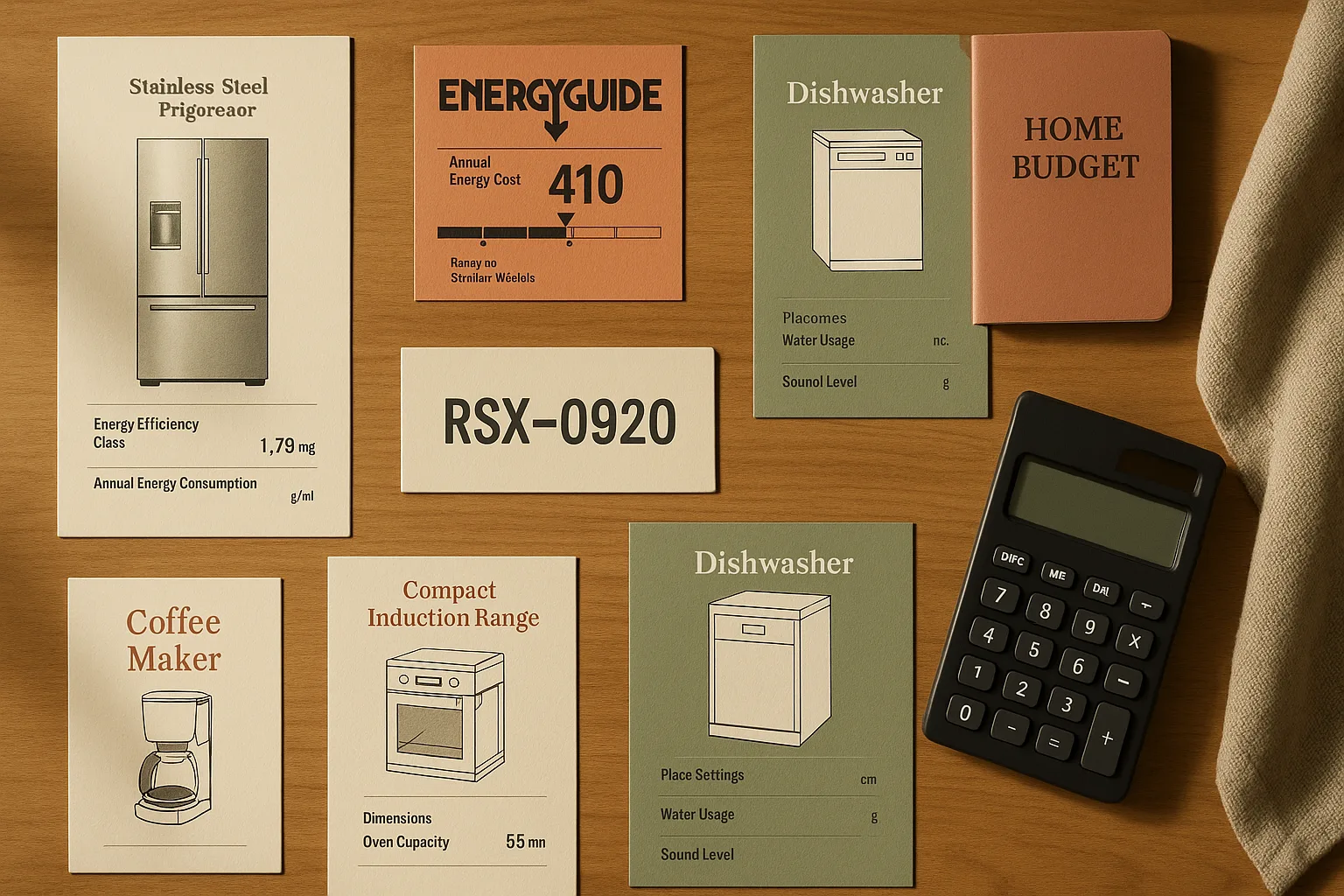
EnergyGuide is the large yellow tag you see on the appliance in the store or pictured in the online listing. It is managed by the Federal Trade Commission under the FTC Appliance Labeling Rule (formally, the Energy and Water Use Labeling rule), not by ENERGY STAR. The EnergyGuide shows estimated yearly electricity consumption, estimated yearly operating cost, the model number, and a comparison range for similar models — which makes it your actual comparison tool.
The DOE's framing is blunt and worth repeating: "The purchase price is only one of two price tags" on any appliance. The second price tag is the operating cost you pay every month for the 10 to 20 years the appliance runs. This energy-efficient appliance buying guide builds around that premise, and so does everything below — where the broad federal guidance narrows to specific decisions for dishwashers, refrigerators, and range hoods.
How to read an EnergyGuide label before you compare models
The yellow EnergyGuide tag has four fields that do the real work. The FTC Consumer Advice page on EnergyGuide labels puts it plainly: "The EnergyGuide label is the yellow tag you’ll find attached to most home appliances." Here is what each field means in practice:
| Field | What it shows | How to use it |
|---|---|---|
| Annual operating cost | Estimated dollar cost to run the appliance for one year | Compare directly across models in the same category |
| Annual electricity consumption | Estimated kilowatt-hours (kWh) per year | Lets you recalculate cost at your local rate |
| Model number | The manufacturer's exact model identifier | Use to verify you're comparing the same unit at every retailer |
| Comparison range | Bar showing where this model sits among all similar models (lowest to highest energy cost) | Quick visual for whether this model is near the efficient or inefficient end of its class |
The one catch: the FTC's EnergyGuide labels use a national average electricity rate to calculate the annual operating cost figure. If your utility charges more than the national average — as is common in New England, California, and Hawaii — your real operating cost will be higher than what the label shows. If you pay less than average, as in parts of the South and Pacific Northwest, your cost will be lower.
The math is straightforward. Find your utility's per-kWh rate on your electric bill, then multiply it by the label's annual kWh figure. That gives you your personal annual operating cost. Many home appliance retailers will show this figure in their online product comparison tools if you enter your zip code, which is a fast way to localize the label data before you visit the store.
Pro Tip: Pull up the EnergyGuide's annual kWh figure, not just the annual cost estimate, when comparing models. The kWh number is the objective efficiency metric — the cost number is a calculation that varies by location.
Annual operating cost vs upfront price: what buyers should weigh first
A higher sticker price can be the better financial choice once you account for the second price tag. The DOE states directly that "the purchase price is only one of two price tags" on any appliance, because operating cost continues over the life of the unit.
Here is a simple way to think about it: an appliance that costs $80 more upfront but saves $20 per year in electricity pays for itself in four years. If that appliance runs for 13 years — a reasonable lifespan for a refrigerator — you come out $180 ahead after that payback period. A refrigerator with a lower sticker price and a higher annual kWh figure can easily cost more over its life than the premium model. The EnergyGuide comparison range tells you quickly whether a model is near the efficient or inefficient end of its class; a model sitting near the expensive end of the range should raise the lifetime-cost question immediately.
Which kitchen appliances benefit most from ENERGY STAR
Not every kitchen appliance rewards the same level of efficiency scrutiny. This section narrows the federal guidance into category-specific buying decisions, because the right answer for a dishwasher is not the same as the right answer for a refrigerator or a range hood. Refrigerators run 24 hours a day, 365 days a year, so small efficiency differences compound meaningfully. Dishwashers run on demand and also use water, so the savings calculation is two-dimensional. Range hoods are a smaller category where efficiency is real but noise and airflow often drive the decision more than kWh. Here is how to translate label data into an actual buying decision for each, rather than treating all certified appliances the same — which is the gap that generic federal summaries leave open.
You can search any certified model through the EPA ENERGY STAR Product Finder to confirm certification status, compare annual energy use, and find rebates before you visit a major appliance affiliate or retailer.
ENERGY STAR dishwashers: when the water and electricity savings matter most
ENERGY STAR is worth it on a dishwasher, but the savings story is about more than electricity. According to ENERGY STAR, certified dishwashers consume energy to operate the machine, heat the water, and dry the dishes — and certified models address all three through a combination of soil sensors, improved water filtration, more efficient jets, and smarter dish rack designs that reduce both energy and water consumption while maintaining cleaning performance.
When comparing dishwasher models, the feature tradeoffs that matter most in practice are:
- Soil sensors — These detect how dirty the load is and adjust water and cycle time accordingly. A sensor-equipped model often uses less water and energy than a model running a fixed "normal" cycle regardless of load.
- Stainless steel tub — Stainless retains heat better than plastic, which helps the drying cycle run more efficiently. It also resists staining and odors over time. It adds cost, but it is one of the features most worth paying for.
- Sanitize cycle — Uses higher water temperatures to meet NSF/ANSI 184 sanitization standards. Draws more energy per cycle, but it is a genuine performance feature, not cosmetic.
- Third rack — Adds loading flexibility and can replace handwashing of items that previously did not fit. Not an efficiency feature, but it can reduce the number of cycles you run per week.
- Drying method — Heated dry uses more energy than condensation dry or a fan-assisted condensation system. If you want to keep energy use low per cycle, look for models that skip or let you disable the heated dry element.
Watch Out: A dishwasher running short, efficient cycles on heavily soiled loads can under-clean, which means re-washing by hand — canceling any savings. Match the cycle options to how you actually load the machine.
ENERGY STAR refrigerators: why size and configuration can change the math
ENERGY STAR certified refrigerators are about 9% more energy efficient than models that meet the federal minimum standard, according to ENERGY STAR. That baseline 9% figure, though, masks significant variation by size and layout — and those two variables can easily matter more than whether the refrigerator is certified at all.
Size: ENERGY STAR guidance is clear that larger refrigerators generally consume more energy, and the most energy-efficient certified models typically fall in the 16–20 cubic foot range. If you are replacing a 22 cu. ft. side-by-side with a 28 cu. ft. French door model because the French door was ENERGY STAR certified, you may actually pay more to run the new fridge than the old one — despite the label.
Configuration: Top-freezer models tend to use the least energy among refrigerator layouts. Bottom-freezer models use more because the compressor works harder to keep cold air down where warm air naturally rises. Side-by-side models generally use the most energy for a given capacity because the tall, narrow compartments are less efficient to cool than wider, shallower ones.
A practical comparison: a certified top-freezer model at 18 cu. ft. from a brand like GE or Whirlpool will typically show an annual energy use well below the federal minimum for that capacity class. A certified 26 cu. ft. French door model will show a higher kWh figure — potentially more than the top-freezer even though both carry the ENERGY STAR label. Look at the kWh/year number and the federal standard comparison on the EnergyGuide, not just the certification badge.
Pro Tip: On the ENERGY STAR Product Finder, you can filter the certified refrigerator list by capacity, width, and annual energy use. Download the certified refrigerator spreadsheet and sort by kWh/year within your needed capacity range — that gives you the most efficient models for your actual footprint in about two minutes.
ENERGY STAR range hoods and ventilation: what efficiency means in a smaller category
ENERGY STAR-certified range hoods and ventilating fans must meet efficiency criteria and, importantly, maximum noise levels set in the ENERGY STAR ventilating fans eligibility specification. That maximum-noise requirement matters because a quieter hood is not just more comfortable — it means you are more likely to use it consistently instead of switching it off mid-cooking.
For range hoods specifically, the ENERGY STAR label is one good reason to choose a model, but not the primary one. What should drive the decision:
- Airflow (CFM rating) — Match the CFM to your cooktop BTU output. A 60,000 BTU gas range typically needs 600 CFM or more. Undersized airflow means the hood cannot clear smoke, steam, or grease even when running.
- Noise (sone rating) — ENERGY STAR criteria include maximum sound limits. A range hood rated at 1.0 sones is near-silent; at 3.0 sones it is audible but not disruptive. Anything above 6.0 sones is loud enough that many people avoid running it.
- LED lighting — Certified hoods typically use LED fixtures over incandescent. LED consumes a fraction of the wattage and lasts far longer, which matters more for a hood light left on as kitchen ambient lighting than for pure efficiency.
- Duct vs. ductless — A ducted hood removes air from the kitchen; a recirculating (ductless) model filters and returns it. For actual pollutant and moisture removal, ducted is significantly more effective. ENERGY STAR certification does not change this physics.
The ENERGY STAR label on a range hood confirms the unit meets efficiency and sound baselines, but it does not tell you whether the CFM is right for your cooktop. Verify the CFM spec before buying.
Buying checklist for a kitchen appliance that fits your home and budget
As the U.S. Department of Energy puts it, "Selecting energy-efficient kitchen appliances can save you money in utility costs" — but only if the appliance fits your kitchen, your household, and your habits. The DOE's kitchen appliance guide emphasizes this practical fit alongside efficiency. The following checklist for any major kitchen appliance purchase covers both the energy-efficient appliance buying guide priorities and the install realities that shopping sites often skip.
Decision checklist:
- Upfront price — Set a ceiling before you start comparing so feature creep does not push you into a model you cannot justify.
- Lifetime operating cost — Use the EnergyGuide annual operating cost or annual kWh figure to estimate the total electricity bill over the appliance's full run.
- Size and capacity — Match cubic footage, tub size, or hood width to the household's real demand, not a wish list.
- Expected lifespan — Plan around roughly 10 years for a dishwasher, 13 to 17 years for a refrigerator, and a shorter cycle for range hoods if controls or motors are basic.
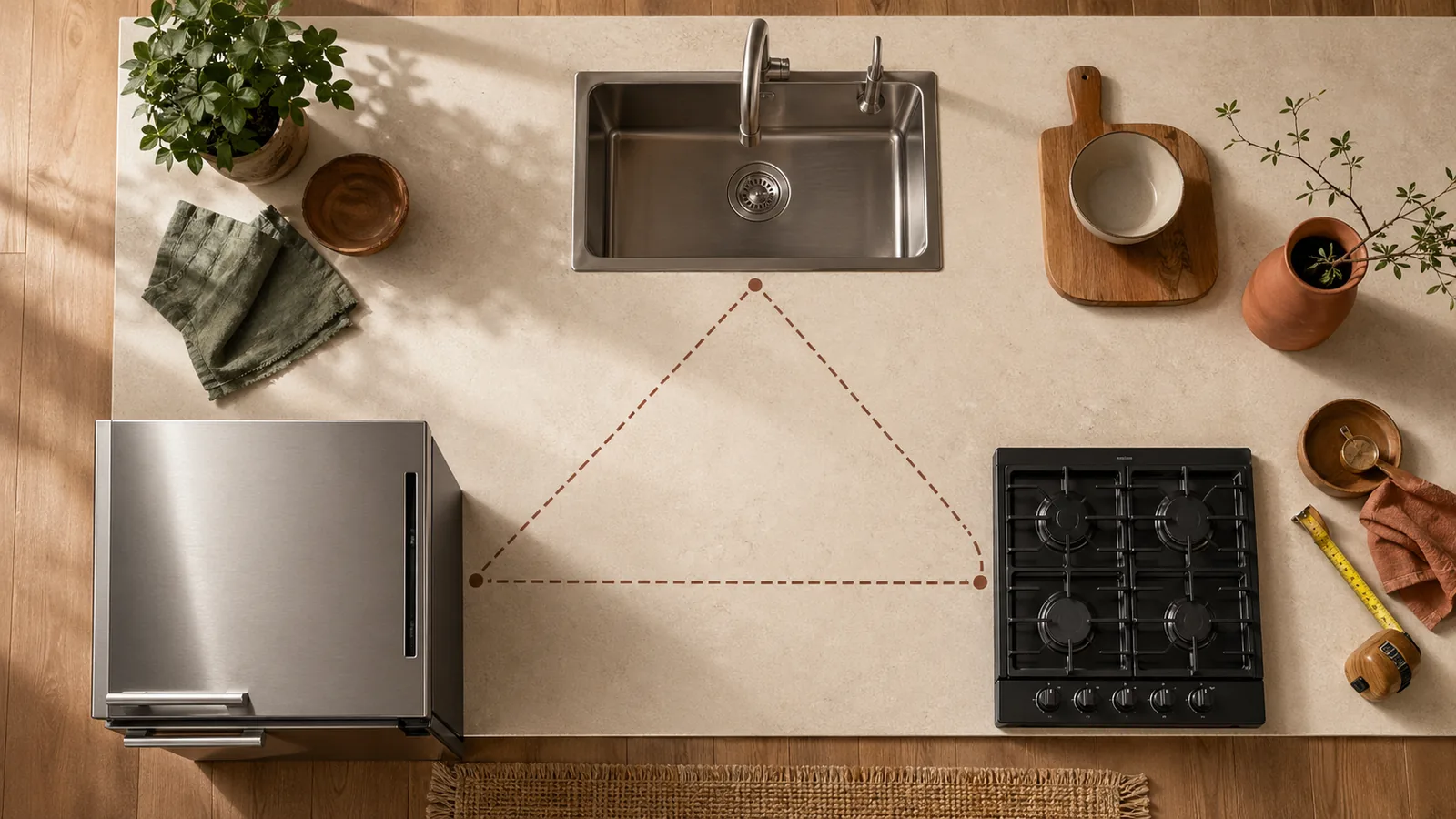
- Fit with kitchen layout and habits — Confirm opening dimensions, door swing, utility hookups, and how often your household actually uses the feature set.
Before you compare models:
- [ ] Measure the opening: width, height, and depth — including any door swing clearance
- [ ] Confirm the utility connection: dedicated circuit (refrigerator, dishwasher), gas line (range), or standard 120V outlet
- [ ] Decide on the minimum capacity you need based on household size (not aspirational loads)
- [ ] Set a realistic upfront price ceiling and a target annual kWh ceiling from the EnergyGuide
During model comparison:
- [ ] Check the EnergyGuide annual operating cost and annual kWh for each model
- [ ] Verify the model is ENERGY STAR certified on the EPA Product Finder
- [ ] Compare models within the same capacity class using the EnergyGuide comparison range — cross-category comparisons mislead
- [ ] Calculate your personal annual operating cost: label kWh × your utility's per-kWh rate
- [ ] Estimate lifetime operating cost: annual cost × expected lifespan (10 years for a dishwasher, 13–17 years for a refrigerator)
- [ ] Add the lifetime operating cost to the purchase price for a true total cost of ownership
Before checkout:
- [ ] Confirm rebates at your local utility's website or the ENERGY STAR rebate finder — availability changes by product and region
- [ ] Check federal incentive program eligibility at the relevant program page (the Inflation Reduction Act High-Efficiency Electric Home Rebate program has had rolling state-by-state availability — verify current status in your state before assuming any rebate applies)
- [ ] Match the exact model number from the store to the EnergyGuide and ENERGY STAR Product Finder entries
- [ ] Confirm the home appliance retailer's delivery and haul-away terms, because installation fit problems discovered on delivery day are expensive
Size, capacity, and install fit: the details that can override a high-efficiency label
A perfectly efficient appliance that does not fit is zero percent efficient. ENERGY STAR's own guidance recommends purchasing an appropriately sized refrigerator specifically because larger capacity generally means greater energy consumption — but the physical fit matters even before that.
Fit checklist by appliance:
- Refrigerator: Measure width, height, and depth with the door closed, then add 1–2 inches clearance on each side and above for ventilation. French door models need door swing clearance on two sides. Counter-depth models (typically 24–25 inches deep) fit flush with cabinetry but sacrifice interior volume.
- Dishwasher: Standard built-in dishwashers are 24 inches wide and fit under standard 34.5-inch counter height. Verify the cabinet cutout width and check that the door clearance does not conflict with adjacent cabinet or island. Compact 18-inch dishwashers exist for smaller kitchens but have limited certified-model options.
- Range hood: Width should match or slightly exceed the cooktop width. Wall hoods need a specific duct rough-in location; island hoods require ceiling duct routing. Confirm the duct diameter matches the hood's exhaust collar before ordering.
Household size should match capacity directly. ENERGY STAR notes that the 16–20 cubic foot range covers most one-to-three person households efficiently. A family of five buying a 17 cu. ft. refrigerator because it was the most efficient model may find it inadequate — which leads to a second mini-fridge in the garage that undoes the efficiency calculation entirely.
Features that affect real-world value: finish, noise, racks, and controls
After efficiency and fit are confirmed, features determine whether the appliance is actually a pleasure to use. Here is how to separate features that affect performance from those that are cosmetic upgrades:
Genuinely useful features:
- Stainless steel interior (dishwasher) — Better heat retention for drying, more durable than plastic over a 10-year life
- Adjustable upper rack (dishwasher) — Lets you load tall items in the lower rack without rearranging; ENERGY STAR notes that improved rack designs can reduce water and energy use by enabling more efficient water jet placement
- Soil sensor (dishwasher) — Reduces cycle time and water use on lighter loads; not a marketing feature
- Door-in-door or French door access (refrigerator) — Reduces cold-air loss on frequently accessed items, a genuine efficiency benefit for families who open the fridge often
- Through-the-door water and ice (refrigerator) — Convenient, but adds a compressor load and introduces a potential leak/maintenance point; decide based on actual usage habits, not convenience marketing
- Variable speed blower (range hood) — Lets you match airflow to the cooking task; genuinely quieter at low settings than a two-speed motor
Features that are mostly cosmetic:
- Panel-ready or custom-color finishes — Worth paying for if matching cabinetry matters to you, not for performance
- Interior LED accent lighting (refrigerator) — Minimal energy difference from standard LED
- Digital displays and connected-home features (any appliance) — Useful to some households; no impact on efficiency
Watch Out: "Wi-Fi connected" or "smart" features on appliances do draw a small standby load. For an appliance running continuously like a refrigerator, verify the standby power spec is not meaningfully raising the annual kWh figure.
When ENERGY STAR Most Efficient is worth paying extra for
ENERGY STAR Most Efficient is a separate recognition tier above standard ENERGY STAR certification — not a different label program. Products must first meet ENERGY STAR certification, then meet a stricter annual criteria set to earn the Most Efficient designation. For dishwashers, ENERGY STAR Most Efficient 2024 criteria were finalized in October 2023, with proposed 2025 criteria following in July 2024 — so the designation is reviewed and updated annually, and a model's Most Efficient status is time-bounded.
When the Most Efficient tier can make sense:
The Most Efficient tier is most defensible in three situations, and each one depends on a verified savings calculation rather than a blanket rule.
-
You are in a high-electricity-cost market. In states where electricity costs $0.25–$0.35 per kWh (California, Massachusetts, Connecticut, Hawaii as of recent rate data), a model that uses materially fewer kWh per year pays back its premium faster. Use the EnergyGuide kWh figure to calculate: if a Most Efficient model uses 50 fewer kWh per year and you pay $0.30/kWh, that is $15/year in savings — a $50 price premium pays back in about three years.
-
You plan to own the appliance for its full lifespan. Most Efficient savings are cumulative. Buying a dishwasher you plan to keep for 12–15 years rewards a higher efficiency investment. If you are renovating and plan to sell the home in 2–3 years, the payback period may not clear.
-
A rebate makes the math immediate. Occasionally, utility or retailer rebates are specifically tied to Most Efficient models rather than standard ENERGY STAR models. If a rebate eliminates most or all of the premium, the tier upgrade is close to free.
When standard ENERGY STAR is enough:
If you are budget-constrained, in a low-rate electricity market, or replacing an appliance that will be in the home for fewer than five years, a standard ENERGY STAR model that ranks near the efficient end of the EnergyGuide comparison range is the right call. Do not pay a Most Efficient premium that a realistic lifetime savings calculation cannot justify.
Where to check rebates, incentives, and product listings before you buy
The EPA ENERGY STAR Product Finder is the authoritative starting point for three tasks: confirming a model is certified, comparing its annual energy use against similar models, and finding rebates offered in your area. Use the official listing to verify current specs before visiting any home appliance retailer so you are not relying on in-store claims about certification or rebate eligibility.
Watch Out: Rebate and incentive availability changes by product type, model, state, and utility — sometimes monthly. A rebate that a neighbor received on the same model may no longer be available. Always confirm current availability directly on your local utility's rebate portal or the relevant federal program page before making it part of your budget math.
Federal incentive programs have had varying state-level rollout and eligibility windows. Do not assume any specific federal rebate applies to your purchase without checking the current program status at the official federal program page for your state.
How to compare model numbers across stores without getting misled
The model number on the EnergyGuide label is the key that ties together the store ad, the Product Finder entry, and the unit actually shipped to your door — and retail ads can obscure model differences in ways that cost real money.
The problem: Retailers sometimes list appliances under the same product page but with different model suffixes that represent different feature sets, finishes, or even different production runs with different efficiency specs. A model number ending in "-SS" (stainless steel) is not the same unit as the same base model ending in "-WH" (white), and in some cases the efficiency specs differ.
How to verify:
- Write down the exact model number from the EnergyGuide label or the retailer's product listing.
- Enter that exact model number — including every digit and suffix — into the ENERGY STAR Product Finder or the certified refrigerator download to confirm it is certified and to see its listed annual energy use, capacity, width, and federal standard comparison.
- Search the same model number on a second retailer's site. If the second listing shows a different EnergyGuide annual kWh figure or the Product Finder does not return the model, you may be looking at a different unit.
- Before placing any order, ask the retailer to confirm the model number that will appear on the delivered unit's documentation — not just the number on the website listing.
The ENERGY STAR certified residential refrigerators download includes brand name, model number, capacity, annual energy use, and the federal minimum standard — all in one file. Cross-reference a model you are considering against that file and you will immediately see whether the retailer's efficiency claims match the certified data.
ENERGY STAR appliance shopping mistakes that waste money
These are the errors that show up repeatedly in appliance forum threads and return complaints — each with a concrete correction. The FTC's comparison range on EnergyGuide labels exists to prevent apples-to-oranges comparisons, but shoppers still ignore it.
Mistake 1: Comparing labels across different capacity classes
The EnergyGuide comparison range only makes sense within the same category and size class. The FTC's Energy Labeling Rule builds the comparison range to show where a model sits among similar models — not all models. Comparing a 17 cu. ft. top-freezer refrigerator's annual operating cost to a 26 cu. ft. French door model's annual operating cost is not an apples-to-apples comparison, regardless of what the labels say.
Correction: Compare models within the same capacity bracket and configuration. Use the Product Finder to filter by cubic footage and layout, then sort by annual kWh.
Mistake 2: Assuming all ENERGY STAR refrigerators save the same amount
ENERGY STAR's own data shows that the most efficient certified models typically fall in the 16–20 cubic foot range — and that energy consumption rises with size. A 9% improvement over the federal minimum for a 28 cu. ft. model can still mean higher annual energy use than a standard-efficiency 18 cu. ft. model.
Correction: Look at the annual kWh figure on the EnergyGuide, not just the certification badge. A bigger ENERGY STAR fridge can cost more to run than a smaller non-ENERGY STAR fridge.
Mistake 3: Buying a high-efficiency appliance that does not fit the opening
A refrigerator that blocks a cabinet door or a dishwasher that will not close fully in its cutout is a return, a redelivery fee, and a week without an appliance.
Correction: Measure the opening before you research models, not after. Width, height, depth, door swing, and duct/utility clearance must all clear before efficiency comparisons begin.
Mistake 4: Counting on a rebate that has expired or does not apply to your model
The annual operating cost savings on an ENERGY STAR model are real and predictable. Rebates are not — they change by utility, region, product tier, and funding availability.
Correction: Treat any rebate as a potential bonus, not a budgeted item. Calculate the purchase and lifetime operating cost as if no rebate exists. If the rebate materializes when you check your utility's portal, it is a confirmed saving, not an assumption.
Mistake 5: Paying extra for features that do not affect efficiency or fit
Cosmetic finish upgrades (panel-ready fronts, color options) and connected-home features add cost without changing the annual kWh figure on the EnergyGuide.
Correction: Separate the feature list into "affects efficiency or fit" and "aesthetic or convenience." Pay for the first group based on your household's actual needs; pay for the second group only if the budget allows after the efficiency and fit criteria are satisfied.
Frequently asked questions about ENERGY STAR kitchen appliances
What does the ENERGY STAR label mean on appliances?
The ENERGY STAR label means the appliance meets efficiency criteria set by the EPA and U.S. Department of Energy that exceed the federal minimum standards for that product category. It is a qualification — the appliance passed a threshold. It does not mean the appliance is the most efficient model in its class, or that it is the right size, feature set, or price point for your household. The label is the starting filter, not the finishing decision.
How do you read an EnergyGuide label?
The EnergyGuide label, the yellow tag required by the FTC on most major home appliances, shows four key fields: the estimated annual operating cost (calculated at the national average electricity rate), the estimated annual electricity consumption in kWh, the model number, and a comparison range bar showing where this model sits among similar models from cheapest to most expensive to operate. To get your actual annual cost, take the annual kWh figure from the label and multiply it by the per-kWh rate on your utility bill. The FTC EnergyGuide consumer page is the official explanation of the yellow tag and its national-average cost assumptions.
Is ENERGY STAR worth it on a refrigerator or dishwasher?
For a refrigerator: yes, with a caveat about size. ENERGY STAR certified refrigerators are about 9% more efficient than the federal minimum, and refrigerators run continuously, so the savings accumulate every day. The caveat is that a larger ENERGY STAR fridge can use more electricity annually than a smaller non-certified fridge — check the kWh figure, not just the label.
For a dishwasher: yes, because the savings combine electricity and water. ENERGY STAR's dishwasher guidance explains that certified models incorporate soil sensors, improved jets, and rack designs that reduce both energy and water use without sacrificing cleaning performance. If you run a dishwasher daily, the combined savings over 10 years are meaningful.
What does the EnergyGuide label show?
Per the U.S. Department of Energy, EnergyGuide labels show the appliance's estimated yearly electricity consumption, the estimated yearly operating cost, and a comparison range for similar models. They also include the model number — which is what lets you verify you are comparing the same unit across stores, the Product Finder, and the EnergyGuide entry simultaneously. The FTC's EnergyGuide label guidance is the consumer-facing source for the yellow tag itself.
Sources & References
- U.S. Department of Energy — Shopping for Appliances and Electronics — Primary DOE guidance on EnergyGuide and ENERGY STAR labels
- FTC Energy and Water Use Labeling Rule — Federal Trade Commission's Appliance Labeling Rule requirements
- FTC Consumer Advice — EnergyGuide Labels — FTC consumer explanation of the yellow EnergyGuide tag
- FTC News Events — EnergyGuide Labels — FTC overview of the label program
- ENERGY STAR — Refrigerators — ENERGY STAR certification criteria and savings claims for residential refrigerators
- ENERGY STAR — Dishwashers — ENERGY STAR certification criteria and technology improvements for dishwashers
- ENERGY STAR — Dishwasher Key Product Criteria — Technical criteria for dishwasher certification
- ENERGY STAR — Ventilating Fans Eligibility Specification — Noise and efficiency criteria for range hoods and ventilating fans
- ENERGY STAR Product Finder — Official tool to verify certification, compare models, and find rebates
- ENERGY STAR Certified Residential Refrigerators Download — Downloadable certified model list with annual kWh, capacity, and model number
- ENERGY STAR Most Efficient 2024 Dishwasher Criteria — Final criteria for the Most Efficient designation for dishwashers
- ENERGY STAR Proposed Most Efficient 2025 Dishwasher Criteria — Proposed 2025 criteria update
- DOE — Guide to Kitchen Appliances — DOE guide on selecting energy-efficient kitchen appliances
Keywords: ENERGY STAR, EnergyGuide label, annual operating cost, annual electricity consumption, model number, comparison range, ENERGY STAR Most Efficient, FTC Appliance Labeling Rule, U.S. Department of Energy, EPA ENERGY STAR Product Finder, residential dishwasher, bottom-mount refrigerator, range hood, kWh/year, federal minimum efficiency standards