Aeron vs. Gesture: the quick answer for long workdays
The Steelcase Gesture is the better default choice for most people logging eight-plus-hour days. Wirecutter's office furniture hub, updated March 2, 2026, still says: "The impressively supportive, adjustable, and durable Steelcase Gesture is still our pick for the best office chair for most people, as it has been since 2015." That's eleven years of continuous recommendation, which is nearly unheard of in premium office furniture testing. The Herman Miller Aeron, meanwhile, earns its place as the better pick for a specific profile: someone who runs hot, fits the chair's size-based frame well, and prefers full-mesh contact over upholstered cushioning.
The fastest way to separate the two is simple:
At a Glance: - Buy the Steelcase Gesture if you want maximum armrest range, a deeply reclining back, and a chair that moves with you across multiple postures and devices throughout the day. - Buy the Herman Miller Aeron Remastered if you run warm, fit one of the three Aeron sizes (A, B, or C) well, and want a full-suspension mesh seat rather than an upholstered one. - Skip both if your budget is under roughly $1,200, you want a plush cushioned seat, or you haven't yet sat in either chair — the fit difference between these two is significant enough that buying blind is a real risk at this price point.
Neither chair is universally better. The right premium office chair is the one that fits your body proportions and work style — not the one with the bigger marketing budget or the longer forum thread.
How we compared the Herman Miller Aeron and Steelcase Gesture
This comparison evaluates both chairs on six factors that actually determine comfort during a long workday: body fit, seat and back material, armrest adjustability, recline behavior, lumbar support, and breathability. Pricing, warranty, and purchase risk round out the practical decision layer. Where possible, every claim is tied to official product documentation or verified third-party testing rather than spec-sheet copy.
The criteria used here:
- Body fit — does the chair physically match the user's proportions, including seat width, seat depth, and back height?
- Adjustability — how many dimensions can you tune, and how fine-grained are those controls?
- Arm support — height, width, pivot, and depth range for all-day keyboard and device use
- Seat and back material — mesh versus upholstered foam and fabric, and what each means for pressure and temperature
- Recline and lumbar behavior — does the chair support dynamic movement or encourage one fixed posture?
- Long-session comfort — how each chair performs after four, six, and eight hours of continuous sitting
Both chairs carry a 12-year warranty covering parts and labor — the Aeron explicitly so, and Steelcase mirrors that coverage on the Gesture. At this price tier, identical warranty length is a tie; what varies is how claims are handled, which we cover in the warranty section below.
Why body fit and work style matter more than brand prestige
Both chairs have genuine engineering behind them, but neither fits every body. The Aeron is built around a size-based system — Herman Miller sells it in size A, size B, and size C, each with different seat width and depth dimensions. If you land between sizes or have proportions that don't map cleanly to the A/B/C framework, the chair's suspension mesh may load your weight unevenly, which defeats the comfort case entirely.
The Gesture takes a different approach: it's designed to adapt to movement and posture shifts rather than to a specific body size. That's more forgiving for home office furniture buyers who don't have a showroom nearby to test fit in person.
A general starting point: smaller frames (roughly under 5'8" and lighter builds) tend to fit the Aeron A or B well. Medium to larger frames often fit the B or C. But the right move is to check Herman Miller's official size chart before buying — not to guess based on height alone — and to sit in the chair if a showroom or dealer is accessible.
Current US price range and buying reality in 2026
Expect to spend significantly more than $1,000 for either chair purchased new through authorized channels. Wirecutter's 2026 home-office guide places the Steelcase Gesture at approximately $1,660. The Herman Miller Aeron is sold through the official Herman Miller store as a configurable product — meaning price varies by size, finish, lumbar option, and armrest configuration — and you should verify current live pricing directly on the product page before budgeting.
Neither chair goes on deep sale. Occasional promotional discounts of 10–15% appear around major sales events, but consistent discounting below the $1,200 mark for a new, fully-featured configuration is rare and worth scrutinizing.
Watch Out: Prices on Amazon, eBay, and third-party furniture sites for "new" Aerons and Gestures sometimes look lower, but those listings are often refurbished units, partial configurations (missing adjustable lumbar, for example), or gray-market imports. Always verify you're buying from an authorized dealer or direct from the manufacturer's store.
Authorized retailers, office liquidators, and used-market risks
Buying either chair from an office liquidator or a Craigslist listing introduces real risk — not just cosmetic wear, but potential warranty and service dead-ends.
Watch Out — Used Chair Cautions: - Herman Miller warranty routing: Herman Miller explicitly routes all warranty and repair requests through "the dealer, retailer, or our online store where you purchased your product." If you bought the chair secondhand, you may have no valid warranty path at all. - Steelcase return requirements: The Steelcase Store return policy accepts returns only for items "in new and unused condition within 30 days of receipt with valid proof of purchase from Steelcase Store." A used chair bought on Craigslist satisfies none of those conditions. - Missing parts: Both chairs have model-specific arm pads, lumbar inserts, and tilt mechanisms. A "good condition" listing that's missing the PostureFit SL lumbar cartridge or an arm pad is more expensive to restore than most buyers realize. - Condition grading: Office liquidators use inconsistent grading. "Grade B" at one seller may mean light surface scuffs; at another it may mean worn mesh that will start fraying within a year. - Refurbishment quality: Chairs that have been reupholstered or had mesh replaced by a third party may not use OEM-spec materials. The original suspension behavior won't be fully restored.
If the used market is your plan, budget $150–$300 more than the listing price for potential repairs, and follow the inspection checklist in the buying cautions section below.
Side-by-side Aeron vs. Gesture comparison table
| Feature | Herman Miller Aeron Remastered | Steelcase Gesture |
|---|---|---|
| US price (new, 2026) | Configurable on the official US store; check live pricing before budgeting | ~$1,660 |
| Seat material | 8Z Pellicle mesh (suspension, no foam) | Upholstered cushion |
| Back material | 8Z Pellicle mesh | Upholstered with 3D LiveBack |
| Lumbar support | PostureFit SL (sacral + lumbar, adjustable) | Continuous flex with 3D LiveBack |
| Recline style | Refer to Herman Miller's current product configuration and official buying guide | 3D LiveBack with deepest recline |
| Armrests | Adjustable arms; see official Herman Miller configuration details | 4D adjustable with broad motion range |
| Seat depth adjustment | Yes | Yes |
| Size options | A, B, C (three distinct sizes) | One size with adjustment range |
| Warranty | 12 years, parts and labor | 12 years, parts and labor |
| Return window (direct) | 30 days, $99 return shipping fee | 30 days, original packaging required, shipping and handling not refunded |
Pro Tip: Both return policies have meaningful friction — a $99 shipping fee (Herman Miller) and original-packaging requirements (Steelcase). If a local showroom or dealer lets you demo either chair before buying, take that option. A 20-minute sit doesn't fully reveal all-day comfort, but it will catch obvious fit problems.
Armrest adjustability: which chair supports more positions?
The Gesture's arm system has a broader functional range for people who shift postures frequently. Steelcase describes the Gesture as supporting "the greatest range of postures in three ways: through the back, the seat and the arms" — and the arm system is specifically designed to follow the user across different device positions, from typing on a keyboard to swiping on a tablet to leaning back on a phone call.
Both chairs offer 4D armrests (height, width, pivot, and depth), but the Gesture's arm pads are designed to pivot and tilt in ways that track your forearm position across a wider arc. For someone who works across multiple screens, switches between keyboard and stylus tablet, or frequently rests their arms in lateral positions, this distinction matters in practice.
The Aeron's 4D arms handle standard keyboard and mouse positioning well and are adjustable enough for most typists. Where they fall short relative to the Gesture is in supporting non-standard positions — if you spend a significant part of your day leaning back with a laptop on your lap or turning sideways to reference a monitor to your left, the Gesture's arm range accommodates that more naturally.
If armrest freedom is your top priority for a premium office chair, the Gesture wins this category.
Seat feel and breathability: mesh vs. upholstered comfort
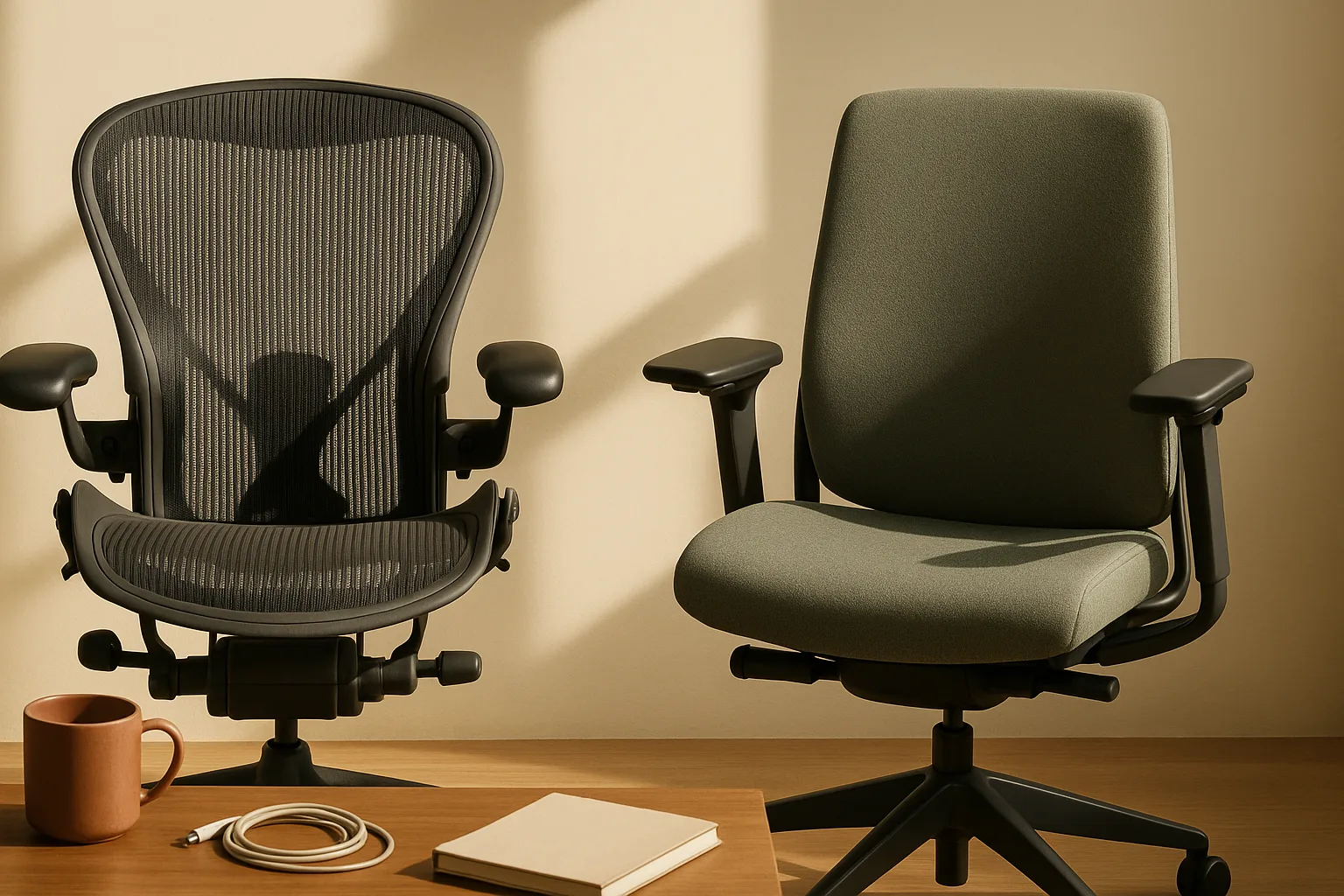
The Aeron's full-mesh seat — Herman Miller calls it 8Z Pellicle suspension — means there is no foam between you and the chair's support. The mesh suspends your weight across its surface, which distributes pressure differently than a cushion and allows significant airflow underneath you. For people who run warm or find that foam cushions create uncomfortable heat buildup after a few hours, this is a meaningful structural advantage.
The Gesture uses an upholstered seat with foam cushioning. It feels softer and more familiar in the first hour of sitting, and many people initially prefer it for that reason. The trade-off is that foam cushions retain more body heat and, over years of use, compress and lose some of their initial support.
Neither manufacturer publishes tested temperature data for their respective seat materials, so any claim about exact degrees of temperature difference is unsupported. What the material difference does establish clearly is that the Aeron's mesh seat has no foam layer to trap heat, while the Gesture's upholstered cushion does. If breathability is a deciding factor for you, the Aeron is the mesh option and the Gesture is the cushioned option.
For people who find firm mesh surfaces uncomfortable or who have found mesh chairs irritating to bare legs, the Gesture's upholstered seat is the better experience. Try both if at all possible.
Recline behavior, lumbar support, and back-pain support
The Gesture's back behavior is distinctive. Steelcase's product page describes it this way: "With 3D LiveBack®, Gesture mimics the natural motion of the spine contouring to the user, creating the deepest recline." LiveBack means the back panel flexes in multiple axes as you move — it's not a rigid surface tilting backward on a fixed axis, but a surface that follows spinal shape dynamically. For frequent recliners and people who shift posture throughout the day, this is a real functional difference.
The Aeron uses a different approach with PostureFit SL, which provides dual adjustable support at both the sacrum (the triangular bone at the base of the spine) and the lumbar (the lower back curve above it). This addresses a weakness in many ergonomic chairs that only support the lumbar curve while leaving the pelvis to tilt backward. PostureFit SL is the Aeron's official lumbar option, and for buyers who want a firmer, more structured back interface, that is the relevant detail.
For back pain specifically: the Aeron's PostureFit SL is particularly suited to people whose discomfort comes from slouching or long sessions in one position. The Gesture's LiveBack is better for people who need the chair to move with them as they shift, stretch, and recline throughout the day.
Neither chair replaces professional evaluation for serious back conditions. If your pain has a clinical diagnosis, a physical therapist or occupational therapist's recommendation should carry more weight than any chair comparison article.
Who should buy the Herman Miller Aeron
The Herman Miller Aeron Remastered is the right premium office chair for you if:
- You run warm. The full-suspension 8Z Pellicle mesh seat and back allow airflow through the chair's structure. If you've ever gotten up from an upholstered chair after two hours to find the back of your shirt damp, the Aeron's mesh contact will feel different by design.
- You fit one of the three sizes. The Aeron's ergonomic case depends on proper fit. A well-fitted Aeron distributes your weight correctly across the suspension mesh and positions the PostureFit SL lumbar support at the right spinal height.
- You prefer a structured, upright-forward sitting posture. The Aeron rewards people who sit forward, work at a desk, and want the chair to lock in correct pelvic alignment rather than invite them to slouch back.
- You want a support path that runs through the original seller. Herman Miller routes product service and repair through the dealer, retailer, or online store where you bought the chair, which makes the purchase channel part of the ownership experience.
Best Aeron fit by body type and sitting style
Herman Miller sells the Aeron in three sizes: A, B, and C. Each has a different seat pan width and depth, back height, and armrest range.
- Size A is designed for smaller frames. If you're shorter or have a narrower build and have found standard office chairs too wide in the seat or too high in the back, Size A is worth prioritizing.
- Size B is the most common fit and works for a broad range of medium builds. Most showroom demo units are Size B.
- Size C is for larger, taller frames where a standard seat pan would be too narrow or too shallow to support the full thigh.
The single most important fit check: sit depth. When you're seated with your back against the lumbar support and your feet flat on the floor, you should have a two-to-three finger gap between the edge of the seat pan and the back of your knees. Too much gap means you're in a size too large; the edge pressing into your legs means you need a larger size or more seat depth adjustment.
Check Herman Miller's official size guide with specific measurements before configuring your order.
Who should not buy the Aeron
Skip the Aeron if any of these apply:
- You want a plush, cushioned feel. The Aeron is a mesh suspension chair, not a cushioned executive chair. If you've sat in it and the firm mesh surface felt uncomfortable or irritating, that's not something the chair will break in out of — that's how it works.
- You're between sizes. Being caught between Aeron sizes is genuinely uncomfortable, and there's no configuration option to bridge the gap. A Gesture, which fits a wider range of body types without size-specific frames, may serve you better.
- You want the widest possible armrest freedom. The Aeron's adjustable arms are good — they're not the Gesture's. If you regularly work in sideways, reclined, or lateral arm positions, the Gesture's arm range is superior.
- Your budget is under $1,200. A base Aeron is a premium office chair with premium pricing. There are strong chairs at lower price points; don't buy a used, unverified Aeron to try to split the difference.
Who should buy the Steelcase Gesture
The Steelcase Gesture is Wirecutter's best-for-most-people pick for a reason that holds up under scrutiny: it fits more bodies out of the box, supports more working postures by design, and carries the most durable third-party endorsement in the category — Wirecutter's 11-year-running recommendation. At approximately $1,660, it's a premium office chair that justifies its cost for full-time remote and hybrid workers who spend the majority of their workday sitting.
Buy the Gesture if:
- You want maximum armrest adjustability. The Gesture's arm system is built to support the greatest range of postures across back, seat, and arms — Steelcase's own framing, and one that holds up in practice for multi-device desk setups.
- You recline frequently. The 3D LiveBack system gives the Gesture the deepest, most natural-feeling recline in its category. If you shift between upright focus work and reclined calls or reading throughout the day, the Gesture rewards that behavior.
- You don't want to choose a size. The Gesture's adjustable range accommodates a wider spectrum of body types than the Aeron's fixed-size frames, which reduces the risk of a poor fit on a $1,600+ purchase.
- You want a softer seat surface. The upholstered cushion seat is comfortable immediately and familiar in feel, especially if you're coming from a standard office chair.
Best Gesture fit for typing, swiveling, and reaching
The Gesture was explicitly designed for knowledge workers who use multiple devices throughout the day — keyboard, mouse, tablet, phone, second screen. Steelcase describes it as supporting "the greatest range of postures in three ways: through the back, the seat and the arms," which reflects the product's research-backed design for varied interaction patterns.
For sustained keyboard work, the Gesture's arm system is particularly useful: the arm pads can be positioned to support forearms during long typing sessions without forcing the shoulders to tense upward. The seat depth and tilt tension controls let you dial in the recline resistance so the chair stays in position during focused typing but moves easily when you lean back to think or take a call.
For swiveling to a side monitor or reaching across a desk, the Gesture's back follows your movement rather than resisting it, which reduces the torso twisting that contributes to lower-back strain over a long workday.
Who should not buy the Gesture
Skip the Gesture if:
- Cool mesh feel is your priority. The Gesture's upholstered seat retains more heat than a full-mesh chair. If you run warm and heat buildup is a chronic comfort problem for you, the Aeron's mesh seat is the better solution by design.
- You want the lightest possible chair. The Gesture is not a lightweight chair, and if you frequently move it around your space or need to transport it, its weight and bulk are worth noting. The Gesture is built around movement support and durability, not portability.
- You need size-specific structural support. The Gesture's adaptive design works well for a wide range, but very petite users who need a smaller seat pan may find the Aeron Size A a more precise fit.
Warranty, trial period, and return policy checks before you buy
Both chairs carry identical 12-year warranties on parts and labor — a meaningful advantage over lower-tier ergonomic chairs that offer two to five years. But warranty length is only part of what matters. The terms of return and the practical path to service matter just as much when you're spending $1,600 or more on a home office chair.
Herman Miller Aeron: - 12-year warranty including parts and labor, with service cost covered when performed in the US or Canada - Returns accepted, but Herman Miller charges a $99 return shipping fee for branded performance seating - Warranty service is routed through the original dealer, retailer, or Herman Miller's online store
Steelcase Gesture: - 12-year limited warranty on parts and labor - Returns accepted within 30 days for items in new and unused condition with valid proof of purchase from Steelcase Store; returns must be in original packaging, and shipping and handling fees are not refunded
Watch Out: Neither return policy is buyer-friendly for the "try it for a month" approach. Herman Miller's $99 return fee stings less than the full shipping cost, but it's still a friction charge. Steelcase's packaging requirement means if you've broken down the box, you've forfeited the return option. If there's any way to sit in either chair before committing, do it.
Why dealer policies matter more than a random listing
When something goes wrong with your chair — a gas lift fails, an arm pad cracks, the tilt mechanism needs service — Herman Miller's customer service explicitly routes you back to "If you need product service or repair, please contact the Herman Miller dealer, retailer, or our online store where you purchased your product." The dealer makes the final determination on whether the issue is covered.
That means buying from an authorized dealer or directly from hermanmiller.com or steelcase.com is not just a price question — it's a service infrastructure question. A chair purchased from an unauthorized reseller or a liquidator creates ambiguity about who handles warranty service. Steelcase's return policy is similarly keyed to "valid proof of purchase from Steelcase Store" — a receipt from a random third-party listing doesn't satisfy that requirement.
Buy direct or from a clearly listed authorized dealer. Keep your receipt in a folder you'll find in five years.
Used Aeron and Gesture buying cautions
The used market for both chairs is active — office liquidators clear them regularly when companies downsize, and they show up on Craigslist, Facebook Marketplace, and eBay at prices that look tempting next to $1,600+ retail. The savings are real; so are the risks.
The core issue is simple: both Herman Miller and Steelcase route warranty and service support through the original purchase channel. Herman Miller says they "will be able to make the final determination whether the issue is specifically covered under the warranty." A chair that came through a corporate fleet liquidation almost certainly has no transferable warranty path through your hands, no original seller chain, and no guarantee that the original packaging still exists. Steelcase requires proof of purchase from the Steelcase Store for any store return, and their policy says returns must be in original packaging — which a secondhand buyer simply cannot provide.
Beyond warranty, used chairs carry condition risks that matter specifically for these models:
- Worn mesh: Aeron mesh that has been sat in for years may show stretch, fraying at edges, or loss of tension. This is not covered under any standard path for a secondhand buyer, and mesh replacement is expensive.
- Missing arm pads: Arm pads on both models are model-specific and can be missing or cracked on older units. Replacements are available but add cost.
- Gas lift degradation: A worn gas cylinder will cause the chair to slowly sink during the day. Replacement is straightforward but is another repair cost to factor in.
- Seat pan damage: Cracked or warped seat shells affect how the mesh loads — they're usually visible on inspection but easy to miss in a low-light photo.
- Hidden refurbishment: Some liquidators re-stretch and re-staple mesh or swap in non-OEM components. The chair may look clean and functional on pickup but not perform to spec.
How to inspect a used premium office chair before paying
If you're committed to buying used, inspect in person before handing over cash.
- Ask for documentation first. Any proof of original purchase, service history, or authorized dealer origin materially improves the warranty picture. If the seller can't produce anything, price accordingly.
- Sit in it fully weighted. Bounce slightly. The gas lift should hold your weight without sinking over 30 seconds.
- Check the mesh surface closely. Run your hand across it. Look for fraying at seams, visible tears, or sections that feel looser than others (indicating lost tension).
- Test every adjustment. Work through seat height, tilt tension, tilt limiter, lumbar settings, and all four axes of both armrests. Any mechanism that sticks, grinds, or doesn't hold position is a future repair.
- Inspect arm pads and plastic shells. Cracked arm pads, chipped seat shells, or missing lumbar inserts are visible defects that should lower your offer price or end the negotiation.
- Check the base and casters. Casters should roll smoothly. The base should show no cracks. A broken base arm on an Aeron is a significant repair.
Pro Tip: A well-maintained used Aeron or Gesture from a known office liquidator with a clear corporate provenance can be a legitimate value — but plan to spend $150–$300 on casters, arm pads, or gas lift replacement and still come out ahead versus new. A random no-documentation Craigslist listing warrants more skepticism.
Which chair is better for hot people, broad shoulders, and back pain
Specific scenarios have specific answers:
| Scenario | Better pick | Reason |
|---|---|---|
| You want a mesh seat and back | Herman Miller Aeron | Full-suspension 8Z Pellicle mesh with no foam layer |
| You want posture-flexing arm support | Steelcase Gesture | Arm system designed for multiple postures and devices |
| You prefer a size-based frame fit | Herman Miller Aeron | Three sizes let you match seat width and depth more closely |
| You frequently recline or shift posture | Steelcase Gesture | 3D LiveBack follows motion and supports deep recline |
| You want a softer seat surface | Steelcase Gesture | Upholstered cushion feels more familiar immediately |
| You want structured lumbar support | Herman Miller Aeron | PostureFit SL is the official lumbar option |
| You work across multiple devices | Steelcase Gesture | Designed explicitly for keyboard, tablet, phone, and monitor changes |
For back pain specifically: the type of pain matters. Aeron's PostureFit SL is particularly relevant for people whose discomfort comes from slouching and long sessions in one position. The Gesture's LiveBack is the better answer for people who need the chair to move with them across dynamic posture shifts throughout the day. Neither chair is a substitute for clinical guidance on serious spinal conditions.
Should you buy the Aeron, the Gesture, or neither?
If you're a full-time remote or hybrid worker in the US spending seven or more hours a day in a chair, either the Aeron or the Gesture is a defensible investment. The simple decision path is this: buy the Aeron if you want size-specific mesh support, a cool-feeling contact surface, and are confident you fit one of its frames. Buy the Gesture if you want the broadest practical fit without choosing a size and need the chair to support varied postures through the day. Buy neither if you want plush cushioning, have a budget under $1,200 new, or cannot test fit before ordering.
The Gesture is the right default because it fits more people without requiring size selection, handles more postures, and carries the most durable third-party endorsement in the category — Wirecutter's 11-year-running recommendation. At approximately $1,660, it's not cheap, but it's a one-time purchase with a 12-year warranty and a proven service pathway.
The Aeron is the right choice if you've confirmed your size, want the mesh feel, and prefer an official purchase channel that routes service through the original dealer or store. Configure it at hermanmiller.com with the PostureFit SL lumbar upgrade and the arm configuration that matches your use pattern.
Skip both if: - Your budget is under $1,200 new — there are well-regarded alternatives (Steelcase Leap, Branch Ergonomic Chair, Humanscale Freedom) that compete seriously at lower price points - You want a plush, cushioned feel — neither chair is designed for that experience - You haven't been able to sit in either chair and you're on the fence about mesh — buy from an authorized dealer with a clear return path, keep the original packaging, and treat it as a trial - You're dealing with a specific injury or clinical spine condition — get a professional ergonomic assessment before committing to any chair at this price
The best premium office chair is the one that matches your body and how you actually work — not the one that wins the most comparison articles.
FAQ: Aeron vs. Gesture for long workdays
Is the Herman Miller Aeron worth it in 2026?
Yes, for the right buyer. The Aeron Remastered is still one of the most refined mesh ergonomic chairs available in the US market, backed by a 12-year warranty covering parts and labor and a service path that routes support through the dealer, retailer, or online store where you purchased it. It's worth it if you fit one of the three sizes well, want the Aeron's mesh contact surface, and plan to order through an authorized channel. It's not worth it if you're buying primarily on reputation without confirming the fit.
Is the Steelcase Gesture good for long hours?
It's Wirecutter's pick for the best office chair for most people — a recommendation the publication has held since 2015 and reaffirmed as of March 2026. The Gesture's 3D LiveBack and broad armrest range are specifically designed for sustained multi-posture workdays. For most knowledge workers logging long hours at a desk, it's the safer default choice.
Which office chair is better for back pain, the Aeron or the Gesture?
It depends on the type of back pain. The Aeron's PostureFit SL provides dual sacral and lumbar support that addresses the pelvic tilt and spinal flattening common in long sitting sessions — it's particularly useful for lower back and sacral discomfort. The Gesture's 3D LiveBack supports dynamic spinal movement across recline and posture shifts, making it better for people whose back pain worsens when locked in one position. For clinical back conditions, consult a physical therapist or occupational therapist before purchasing.
Is the Aeron better than the Gesture for people who run hot?
The Aeron's full-suspension mesh seat and back have no foam cushion layer, which means less heat retention by design. The Gesture uses an upholstered foam-cushion seat, which retains more body heat during long sessions. Neither manufacturer publishes temperature test data, but the material difference is structural — mesh suspension and upholstered cushioning are different seat constructions. If heat buildup is a real problem for you, the Aeron is the more logical choice on material grounds alone.
What Aeron size should I buy?
Herman Miller offers the Aeron in size A, B, and C, each with different seat pan dimensions and back height. Size B fits the broadest range of average adult frames and is the most common showroom demo size. Size A is for smaller, narrower builds; Size C for larger, taller frames that need more seat width and depth. The key fit test is seat depth: seated with your back against the lumbar support and feet flat on the floor, you should have roughly two to three fingers of clearance between the seat edge and the back of your knees. Use Herman Miller's official size guide — not just height alone — to confirm your size before configuring.
Sources & References
- Wirecutter Office Furniture Hub — Wirecutter's current office chair and furniture recommendation index, updated March 2, 2026; names Steelcase Gesture as best office chair for most people
- Wirecutter Best Home Office Furniture and Supplies — 2026 home-office guide placing Steelcase Gesture at approximately $1,660
- Herman Miller Aeron Chair Product Page — Official US store configuration and purchase page for Aeron
- Herman Miller Aeron Buying Guide — Official guide covering sizes (A, B, C), materials, adjustments, and 12-year warranty
- Herman Miller Warranty and Service — Official warranty service routing policy; dealer/retailer determines final coverage
- Herman Miller Returns and Exchanges — Official return policy; $99 return shipping fee for Herman Miller branded performance seating
- Steelcase Gesture Product Page (Store) — Official Steelcase store listing for Gesture; 12-year limited warranty
- Steelcase Gesture Product Page (steelcase.com) — Full product description including 3D LiveBack, deepest recline, and arm system details
- Steelcase Returns Policy — Official Steelcase Store return terms; 30 days, new and unused, original packaging, proof of purchase required
Keywords: Herman Miller Aeron Remastered, Steelcase Gesture, Wirecutter office chair recommendations, mesh seat and back, 4D armrests, PostureFit SL, LiveBack, seat depth adjustment, tilt tension control, recline limiter, lumbar support, authorized retailer, office liquidator, Craigslist, warranty transfer