Percale vs sateen sheets: the quick answer for hot sleepers
Percale wins for hot sleepers. Its 1-over-1-under weave creates a lightweight, crisp fabric that Sleep Foundation identifies as highly breathable — and Good Housekeeping’s percale vs sateen comparison backs up the same basic rule: percale is the cooler, airier choice, while sateen is denser and warmer overnight. The structure simply lets more air move through the fabric than sateen's denser weave allows. Sateen, with its 4-over-1-under construction, feels smoother and more luxurious against the skin, but that same density traps more body heat overnight.
At a Glance: - Hot sleepers / humid summers: Choose percale — crisp, airy, and breathable - Softness / sheen / winter layering: Choose sateen — smooth, drapey, and wrinkle-resistant - Wrinkle-averse hot sleepers: A tough spot; percale wins on cooling but wrinkles more; sateen wins on appearance but sleeps warmer
The seasonal rule is equally clear: in a humid summer bedroom in Houston or Washington D.C., percale is the better call. Come winter, when you're layering a duvet on top anyway, sateen's reduced breathability matters far less, and its softer feel becomes a genuine comfort upgrade. Browse current sheet sets or bedding collections with that seasonal switch in mind.
Percale vs sateen: what the weave actually means
The first thing to get straight: percale and sateen are weave structures, not fibers. Consumer Reports is explicit on this point — these terms describe how the cotton (or other) threads are interlaced, not what material they're made from. A sheet can be cotton percale, lyocell percale, or even a poly-blend percale. Always check the fiber content label separately.
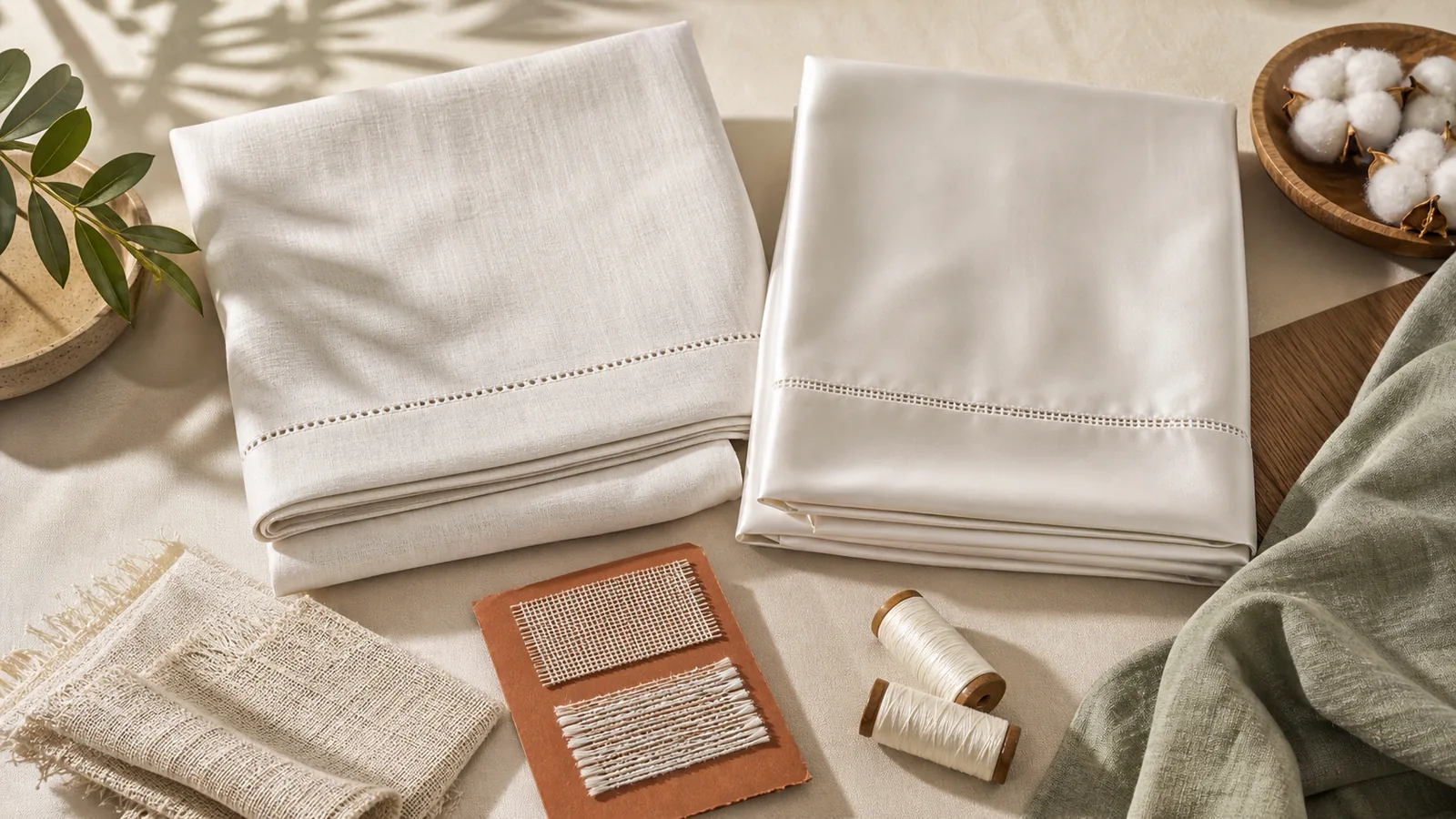
Percale uses a 1-over-1-under weave: one thread crosses over one thread, then under the next, in an alternating grid. This tight, even structure creates a fabric that is crisp, matte, and relatively flat.
Sateen uses a 4-over-1-under weave: four threads float over one thread before going under. Those long surface floats catch the light, producing the signature subtle sheen and silky feel. The trade-off is that more threads sit exposed on the surface, making the fabric denser and less breathable.
Think of it this way: percale is to sheets what a classic Oxford shirt is to dress wear — structured, reliable, airy. Sateen is more like a satin blouse — smooth, lustrous, and warmer against the skin.
Percale sheets: crisp, airy, and breathable
Percale's most functional advantage is airflow. Because the 1-over-1-under weave uses fewer overlapping threads, air passes through the fabric more easily — which is exactly why Sleep Foundation lists percale among the top choices for hot sleepers. Out of the dryer, a quality percale set feels noticeably lighter in your hands than a sateen set at the same thread count.
Pro Tip: Percale sheets feel slightly stiff on the first wash. That crispness softens over time — most people find them notably more comfortable after three to five launderings. If they feel a little boardlike on night one, give them a few weeks before you judge.
What you're signing up for with percale:
- Hand feel: Crisp, cool, matte — often described as the "hotel sheet" feel
- Breathability: High; the weave structure promotes airflow and moisture dissipation
- Durability: Sleep Foundation notes percale is less likely to pill than sateen and holds up well through repeated laundering
- Wrinkle behavior: Wrinkles more than sateen — this is the consistent trade-off
- Starting thread count: Most percale sheets start around 200 thread count, where Sleep Foundation pegs the minimum for this weave
Sateen sheets: smooth, drapey, and softly lustrous
Sateen delivers a sensory experience that percale simply cannot match. Sleep Foundation describes sateen as softer, smoother, and shinier than percale, and that's an accurate description of what you feel the moment you slide under them. The 4-over-1-under weave puts more thread surface in contact with your skin at once, which accounts for the silky sensation.
What you're signing up for with sateen:
- Hand feel: Smooth, soft, subtly lustrous — closer to silk than standard cotton
- Drape: Falls and drapes elegantly; looks polished on a made bed
- Wrinkle resistance: Sleep Foundation confirms sateen resists wrinkles better than percale — pull them out of the dryer and they look presentable with minimal effort
- Breathability: Lower than percale; Sleep Foundation and Good Housekeeping both note that sateen has a heavier hand and traps more heat
- Sheen: The hallmark feature — sateen has a soft glow that makes a bed look styled, not just made
The honest trade-off: sateen's beauty comes at a temperature cost. If you run warm at night, that smooth, dense surface is working against you.
Cooling performance: which weave sleeps cooler in real life?
Percale sleeps cooler — consistently and measurably, not just in theory. Good Housekeeping's textile testing coverage describes percale as lightweight, airy, and crisp, while calling sateen smoother and less breathable. The structural reason is straightforward: the 1-over-1-under grid creates small, consistent gaps in the fabric that allow body heat and moisture vapor to escape. Sateen's floating threads close those gaps.
| Feature | Percale | Sateen |
|---|---|---|
| Breathability | High | Moderate to low |
| Heat retention | Low | Higher |
| Moisture wicking | Better | Less effective |
| Best season | Spring/summer | Fall/winter |
Hot-sleeper rule: If temperature control is your primary concern, choose percale. Sleep Foundation is direct on this: percale is highly breathable and typically preferred for hot climates. Choose sateen only when softness and sheen matter more than staying cool.
If you're still overheating even on percale sheets, linen sheet sets are the next step up in breathability — linen is a separate fiber category that outperforms cotton in heat dissipation, though the trade-off is a rougher texture and a higher price point.
Why percale tends to feel cooler in humid summers
In a humid climate — think the Southeast, Mid-Atlantic, or Midwest in July — the problem isn't just heat; it's moisture buildup. Sleep Foundation's research reinforces that percale's weave structure promotes airflow and breathability, which helps carry moisture vapor away from your skin rather than letting it pool at the surface.
ClimateUseNote: - Humid summers (Atlanta, Houston, Chicago, D.C.): Percale is the clear choice. The airy weave handles both heat and humidity better than sateen. - Dry heat (Phoenix, Denver): Percale still wins on cooling, though the humidity advantage matters less. - Winter layering: When you're adding a heavy duvet or comforter, sateen's reduced breathability becomes a non-issue. The warmth you want is coming from your layers anyway, and sateen's softness is a genuine upgrade.
The practical takeaway: if you tend to kick off your covers or sleep with a fan running, percale is almost certainly the better year-round choice. If you sleep cold in winter and swap to a lighter cover in summer, owning both weaves — percale for warm months, sateen for cold — is a reasonable approach for people who care about both comfort and aesthetics.
When sateen can still work for sleepers who run warm
Sateen isn't an automatic dealbreaker for warm sleepers — it depends on the conditions. If your bedroom stays at or below 68°F through the night, a lightweight sateen set is unlikely to push you over the edge. The heat issue becomes acute in rooms without air conditioning or in warm climates where nights don't cool down much.
TradeoffCallout: Lightweight sateen — thinner constructions in the 300–400 thread count range — traps less heat than heavier sateen sets at 500+ thread count. If you love the feel of sateen but run slightly warm, start with a lighter-weight sateen and manage room temperature with a ceiling fan or programmable thermostat. What you should not do is choose sateen and expect it to perform like percale on a hot, humid night. It won't.
Softness, sheen, and wrinkle resistance: what shoppers actually notice
Sateen wins on softness and visual polish; percale wins on the crisp, clean look of a freshly made bed.
SensoryComparison: - Tactile softness: Sateen feels noticeably smoother against skin on contact. Percale starts crisper but softens over time — the gap narrows with age. - Sheen: Sateen has a subtle luster that makes a bed look styled. Percale has a flat, matte finish — classic and clean, but not glamorous. - Drape: Sateen falls and folds smoothly; it looks polished whether the bed is made or rumpled. Percale holds more structure — the creases and wrinkles show. - Wrinkling: Percale wrinkles more than sateen; Consumer Reports evaluates sheets for wrinkling as a key performance dimension. If you make the bed every morning and care how it looks, this difference is visible daily.
For shoppers who prioritize the look of their bedroom, sateen tends to win. For shoppers who prefer the feel of a crisp hotel bed and don't mind ironing or ignoring wrinkles, percale is more satisfying.
Thread count is not the only quality marker
Stop shopping by thread count alone. Consumer Reports is explicit: thread count is not the only factor when choosing bed sheets. Good Housekeeping reinforces this, pointing to a useful range of roughly 300 to 500 thread count rather than chasing numbers into the 800s or 1,000s. A 400-thread-count percale sheet made from long-staple cotton will outperform a 1,000-thread-count sheet made from short-staple cotton — every time.
ThreadCountRange: The practical cotton sheet range is roughly 300 to 500 thread count. Below that, some sheets can feel too sparse; far above that, density often rises faster than comfort, and airflow usually drops instead of improving.
MythBustingNote: The "higher thread count = better sheet" idea persists because it's a simple number to compare on a product listing. But it ignores the variables that actually determine how a sheet feels and lasts: fiber length, yarn quality, weave structure, and finishing. A sheet with inflated thread count often achieves that number by plying multiple thinner yarns together and counting each ply separately — which produces a denser, heavier fabric, not a finer one.
The useful thread count range for most cotton sheets:
- Percale: 200–400 is the practical range; the weave requires less density to perform well
- Sateen: 300–500 is typical for quality sateen; the weave naturally produces a denser fabric
Going above 500 rarely adds comfort or durability and often sacrifices breathability.
Why very high thread count can mislead shoppers
A sheet labeled 800 or 1,000 thread count is usually either multi-ply yarn being counted multiple times, or it's a marketing claim that hasn't been meaningfully verified. Consumer Reports measures sheets across fit, softness, wrinkling, strength, and shrinkage — none of those performance dimensions correlate reliably with extreme thread counts.
QualitySignalChecklist — what actually determines sheet quality: - Yarn quality: Long-staple or extra-long-staple cotton (like Supima or genuine Egyptian) produces a finer, stronger yarn - Weave: Percale or sateen — each produces a different feel and performance profile regardless of thread count - Finishing: How the fabric is treated after weaving affects softness, sheen, and durability - Breathability: Higher thread counts often reduce airflow — the opposite of what hot sleepers need - Fit and shrinkage: A sheet that loses pocket depth after two washes is a worse sheet regardless of its thread count label
What matters more than thread count when buying cotton sheets
Consumer Reports tests sheets for fit, softness, wrinkling, strength, and shrinkage — use those same criteria when you shop. For shoppers comparing sheet sets, the point is not to chase a big number but to find a weave, fiber, and construction that match how you actually sleep.
BuyerCriteria — what to look for instead of thread count: - Fiber quality: Long-staple cotton produces a finer, more durable yarn than short-staple. Look for Supima (trademarked U.S. extra-long-staple) or verified Egyptian cotton - Weave: Decide percale or sateen based on your sleep temperature and softness preferences — this decision matters more than thread count - Pocket depth: Measure your mattress height (including any topper) before you shop. A listed 15-inch pocket depth on a sheet that shrinks after washing may not hold on a 14-inch mattress - Care label: Check whether the sheet is machine-wash safe and whether it specifies cold or warm water — deviation from care instructions accelerates shrinkage and shortens sheet life - Fiber/weave disclosure: The product page should state both fiber content (e.g., 100% cotton) and weave (percale or sateen). If it only states one, dig deeper or look elsewhere
Cotton fiber, blends, and labels: how to avoid common sheet myths
Percale and sateen describe the weave, not what the sheet is made of. Consumer Reports confirms these are weave terms, not fiber terms. A sheet can be 100% cotton percale, cotton-poly blend percale, organic cotton sateen, or lyocell sateen. The weave and the fiber are independent variables, and both affect how the sheet performs.
MythVsFact:
Myth: "Percale means pure cotton." Fact: Percale is a weave. Cotton-poly percale blends are common, especially at lower price points. Poly blends are more wrinkle-resistant than pure cotton percale but less breathable — which is a real problem for hot sleepers. Always check the fiber content line on the product page.
Myth: "Sateen is a synthetic fabric." Fact: Sateen is a weave structure. It can be made from 100% cotton, lyocell, or blended fibers. Pure cotton sateen breathes better than a poly-blend sateen, though neither will outperform percale on airflow.
Myth: "Egyptian cotton is always the best." Fact: Egyptian cotton is a geographic and varietal claim — and it's frequently abused. The label alone tells you almost nothing without verification.
Label-checking checklist before you buy:
- Does the product page state 100% cotton, organic cotton, or specify the exact fiber blend?
- Is the weave clearly labeled as percale or sateen?
- If organic cotton is claimed, is there an OEKO-TEX Standard 100 certification number listed, or a GOTS (Global Organic Textile Standard) certification you can look up?
- If Egyptian cotton is claimed, is there a third-party verification, or is it just ad copy?
Cotton percale and cotton sateen are weaves, not fibers
Pure cotton percale and pure cotton sateen each bring cotton's natural advantages — breathability, durability, hypoallergenic properties — while the weave determines the feel and performance profile. Cotton-poly blends can reduce wrinkling (helpful for percale) and cut costs, but they sacrifice some breathability. Lyocell (Tencel) blends offer a silky feel similar to sateen with better moisture management, but they're a different fiber category entirely.
FiberVsWeave: - 100% cotton percale: Best breathability, most wrinkle-prone, softens over time - 100% cotton sateen: Smooth and lustrous, less breathable, wrinkle-resistant - Cotton-poly percale blend: Fewer wrinkles than pure cotton percale, reduced breathability - Lyocell/cotton sateen blend: Silky feel with better moisture management than pure cotton sateen, but verify fiber claims on the product page
How to read Egyptian cotton and Supima cotton claims
Egyptian cotton refers to extra-long-staple cotton grown in Egypt — the extra length produces a finer, stronger yarn. The problem is that "Egyptian cotton" has been widely misused on product labels. Some sheets claiming Egyptian cotton contain only a small percentage of it, or use shorter-staple Egyptian cotton that offers no real performance advantage. Verify the claim on the actual product page, not a search-result tile.
Supima is a trademarked designation for American-grown Pima cotton (extra-long-staple). Because it's trademark-controlled, Supima claims are more reliably enforced than generic Egyptian cotton claims — but you should still confirm it on the specific product page, not on a search result snippet or a retailer's category banner.
VerificationChecklist: - Click through to the actual product page — not the search results card, not the retailer's category header - Look for a verifiable certification number (SUPIMA logo with license, GOTS certificate number, OEKO-TEX certificate number) - If the product page says only "Egyptian cotton-feel" or "Egyptian cotton-style," that is not a fiber claim — it's a marketing phrase - For organic cotton claims, check for GOTS or OEKO-TEX Standard 100 certification numbers you can cross-reference on those organizations' public databases - Treat any sheet listing "premium cotton" without specifying staple length or origin as standard commodity cotton
US sheet-set buying details: size, pocket depth, and fit
Getting the right weave and fiber is only half the job. A percale sheet that doesn't fit your mattress is just a frustration. Consumer Reports emphasizes measuring mattress height — including any topper — before shopping, because nominal size and actual fit can diverge significantly after washing. For most buyers, the key question is less about a huge size grid and more about whether the fitted sheet actually matches the mattress dimensions in your home.
SizingAndFit checklist: - Measure first: Use a tape measure to capture mattress length, width, and depth, including any topper - Queen and King are the most common reference points: queen-size and king-size sheets are widely sold, but the fitted-sheet pocket depth still needs to match your mattress height - Cal King requires explicit confirmation: if you need a California king, make sure the listing says it clearly rather than assuming it will fit a standard king bed - Pocket depth matters as much as bed size: a mattress can be the right nominal size and still need deep-pocket construction if it is tall or topped with foam - Check post-wash fit: shrinkage after laundering can change the fit, so the set should leave some margin, not just barely stretch on the first try
Standard pocket depth vs deep-pocket fitted sheets
Standard fitted sheets typically accommodate mattresses up to about 12 inches deep. If your mattress is thicker — or if you've added a mattress topper — you need a deep-pocket fitted sheet, which typically runs 15 to 21 inches of pocket depth.
FitMeasurement note: - Measure mattress height from floor to top surface with a tape measure - If you use a mattress topper, add that height to your mattress measurement - A 10" mattress usually works with standard pocket depth - A 12"–15" mattress or any mattress-plus-topper combination typically needs deep-pocket (15"–17" depth minimum) - A 16"+ mattress or platform bed with a thick topper may need extra-deep pocket (18"–21") - Consumer Reports has noted that even some sheets labeled "deep pocket" can fail to hold on a 10-inch mattress after repeated washing — shrinkage is real, and it compounds
Watch Out: Shrinkage is the silent fit-killer. A sheet that fits perfectly on your first wash may pop off a corner after six months of warm-cycle laundering. Follow care label instructions on temperature — specifically, wash on cold or warm (not hot) and tumble dry on low.
What to check before you buy a sheet set online
Shopping for sheet sets online gives you access to a wider selection than any physical store, but the product page has to work harder to replace the touch-and-feel test.
OnlineShoppingChecklist: - Dimensions listed: Confirm flat sheet, fitted sheet, and pillowcase dimensions — not just nominal bed size - Pocket depth stated: Look for a specific number in inches, not just "deep pocket" - Fiber content disclosed: 100% cotton vs blend should be clearly stated - Weave identified: Percale or sateen should be labeled; "smooth cotton" is not a weave label - Thread count range: Expect 200–400 for percale, 300–500 for sateen; anything higher deserves skepticism - Return policy: Sheets that don't fit or feel wrong after washing should be returnable; check the window (many retailers offer 30-day returns on bedding) - Certification claims: If organic or OEKO-TEX Standard 100 is claimed, a certificate number should be verifiable
Care, durability, and wrinkle differences after washing
Both weaves are machine washable and durable, but they age differently. Consumer Reports evaluates sheets on wrinkling, shrinkage, strength, fit, and softness after laundering — and those categories reveal the real-world difference between percale and sateen ownership.
| Care Factor | Percale | Sateen |
|---|---|---|
| Wrinkling after wash | More prone | Less prone |
| Post-wash appearance | Creased; benefits from prompt removal from dryer | Smooth; more forgiving |
| Durability/pilling | Less likely to pill | Can pill with abrasion |
| Long-term softness | Softens gradually over time | Soft from the start; may dull slightly |
| Shrinkage risk | Present; follow care label | Present; follow care label |
Why percale wrinkles more and sateen drapes smoother
The wrinkle difference comes directly from the weave. Percale is more prone to wrinkling than sateen, per Sleep Foundation, because the 1-over-1-under structure creates a fabric with more distinct thread crossings — and those crossings hold creases when compressed in a dryer.
PostWashAppearance note: - Percale: Expect visible wrinkles if you leave it in the dryer too long. The fix is simple — pull it out while still slightly damp and smooth it on the bed immediately. Some people love the lived-in look; others find it frustrating. It will not iron out to a perfectly flat surface without an actual iron. - Sateen: Comes out of the dryer looking noticeably smoother. The floating threads in the weave resist the kind of deep-set creasing percale shows. It still benefits from prompt removal, but a few extra minutes in the dryer won't ruin it.
Sleep Foundation confirms sateen's smoother weave contributes to a drapier appearance and less wrinkling — which is a genuine daily-life advantage if you make the bed every morning.
How to keep cotton sheets feeling better for longer
CareTips: - Wash temperature: Cold or warm water — not hot. Hot water accelerates shrinkage and degrades cotton fibers faster - Dryer heat: Tumble dry on low. High heat is the fastest way to shrink fitted sheets out of fit and break down fiber integrity - Dryer timing: Remove sheets while slightly damp and smooth onto the bed or fold immediately; this dramatically reduces wrinkling in percale and preserves sateen's surface - Avoid fabric softener regularly: Fabric softener can coat cotton fibers and reduce breathability over time — particularly counterproductive for percale if cooling is your goal. Use it occasionally if you want, but not every wash - Rotate sets: Running the same set through wash cycles every week shortens its life compared to rotating two or three sets. The fibers get a rest, and you're washing each set less frequently - Storage: Store folded in a cool, dry place. Storing while still slightly damp causes mildew; storing compressed under heavy items can set permanent creases in sateen
How to choose between percale and sateen based on sleep style
The decision is simpler than most bedding content makes it. Answer these questions and your choice is clear.
DecisionTree:
Do you sleep hot or sweat overnight? → Yes → Percale. Sateen will make it worse. → No → Either works; move to the next question.
Is it summer, or do you live in a warm/humid climate year-round? → Yes → Percale. The breathability gap is most relevant in warm, humid conditions. → No / you layer heavily in winter → Sateen is a reasonable choice.
Do you care more about how the sheets feel or how they look? → Feel (soft, smooth, silky) → Sateen. → Feel (crisp, cool, clean) → Percale. → Look (polished, minimal wrinkling) → Sateen. → Look (classic, matte, hotel-white) → Percale.
Does wrinkling bother you? → Yes, a lot → Sateen (or a cotton-poly percale blend as a compromise). → Not really → Percale.
Browse current options in cotton percale and sateen bedding sets and bedding collections to compare prices and styles once you've made your call.
Choose percale if you sleep hot or want a crisp hotel feel
HotSleeperRecommendation: - Buy percale if: You sleep hot, live somewhere humid, run the heat low, prefer the cool, crisp feel of a well-made hotel bed, or don't mind ironing or ignoring wrinkles - Skip percale if: You sleep cold, hate wrinkles, and prioritize a smooth, lustrous look over maximum breathability
Plain rule: hot sleeper = percale, full stop. Sleep Foundation and Good Housekeeping both land in the same place — percale's breathability advantage over sateen is consistent and meaningful for temperature-sensitive sleepers.
Choose sateen if you want softness, sheen, and less wrinkling
SoftnessRecommendation: - Buy sateen if: You sleep cool or at a comfortable temperature, love the feel of soft fabric against your skin, care about how your bed looks after it's made, or find wrinkling genuinely annoying - Skip sateen if: You run warm overnight, live in a hot or humid climate, or prioritize breathability above all else
Plain rule: texture-first sleeper or cold sleeper = sateen is the better experience. The softer feel and polished appearance are real advantages — they just come at a breathability cost that cool sleepers won't notice and hot sleepers will.
FAQ: percale vs sateen sheets
Are percale sheets cooler than sateen?
Yes — consistently. Sleep Foundation confirms that percale's 1-over-1-under weave is highly breathable, while sateen's 4-over-1-under construction has a heavier hand and traps more heat. Good Housekeeping's textile coverage describes percale as lightweight and airy versus sateen's smoother but less breathable profile. The cooling difference is most noticeable in warm and humid conditions — in a cool, air-conditioned room, the gap narrows considerably.
Is percale or sateen better for hot sleepers?
Percale. The structure allows more airflow, dissipates body heat faster, and feels lighter against the skin. If cooling is your primary goal, sateen is the wrong choice regardless of how soft it feels. The only situation where a warm sleeper might reasonably consider sateen is in a well-cooled bedroom where room temperature stays below 68°F overnight.
Does higher thread count mean better sheets?
No. Consumer Reports evaluates sheets on fit, softness, wrinkling, strength, and shrinkage — none of those dimensions reliably improve with extreme thread counts. Good Housekeeping points to 300 to 500 as a practical, quality range. Fiber quality, weave, and fit matter more than chasing a four-digit thread count number. Very high thread counts are often achieved by counting individual plies in a multi-ply yarn — producing a denser, heavier sheet, not a finer or more comfortable one.
Is Egyptian cotton better than percale or sateen?
This question mixes categories. Egyptian cotton is a fiber claim; percale and sateen are weave claims. You can have Egyptian cotton percale or Egyptian cotton sateen. The problem is that "Egyptian cotton" labels are frequently unverified. Confirm any Egyptian cotton claim directly on the product page, not from search snippets or category banners. If you want a fiber claim with tighter trademark enforcement, look for Supima (U.S.-grown extra-long-staple Pima cotton) and verify the Supima license on that specific product. Organic cotton is another fiber-label example: it still needs the same product-page verification, even though it says nothing about weave.
Are percale sheets worth it if I hate wrinkles?
Percale is absolutely worth it for hot sleepers — but if wrinkling is a genuine dealbreaker for you, sateen is the better compromise. Percale wrinkles more than sateen consistently, and that difference is visible every time you make the bed or pull sheets from the dryer. If you sleep hot but also hate wrinkles, a cotton-poly percale blend reduces wrinkling somewhat — at the cost of some breathability. It's an imperfect middle ground, but it exists.
Is linen better than percale for hot sleepers?
Linen sheet sets are a separate fiber category — not a weave — and they do outperform cotton percale on heat dissipation and moisture management in most conditions. Linen's hollow fiber structure moves heat away from the body efficiently and gets softer with every wash. The trade-offs: linen is significantly more expensive than cotton percale, it starts rougher (the softening-over-time curve is steeper), and it wrinkles dramatically more. If you sleep hot and want the best possible cooling performance and don't mind the texture and price, linen is worth considering. If you want a cooler cotton option, percale is the right call. For buyers cross-shopping labels, look for organic cotton or OEKO-TEX Standard 100 only as separate quality signals — neither changes the fact that linen, percale, and sateen are different textile choices.
Sources & References
- Good Housekeeping: Percale vs Sateen Sheets — Textile testing comparison of percale and sateen weaves; thread count guidance and breathability notes
- Sleep Foundation: Sateen vs Percale Sheets — Weave definitions, breathability comparison, and hot-sleeper guidance
- Sleep Foundation: Best Percale Sheets — Percale breathability, durability, and pilling resistance
- Sleep Foundation: Best Sateen Sheets — Sateen smoothness, wrinkle resistance, and heat retention
- Sleep Foundation: Best Hotel Sheets — Sateen weave structure (4-over-1-under) and hand feel
- Sleep Foundation: Best Cooling Sheets — Cooling sheet comparison including percale and sateen
- Consumer Reports: Sheets Buying Guide — Weave vs fiber distinction, pocket depth guidance, and fit measurement
- Consumer Reports: Sheet Ratings — Testing methodology for softness, wrinkling, strength, shrinkage, and fit
- OEKO-TEX Standard 100 — Certification standard for textiles tested for harmful substances
- Supima Cotton — Trademarked U.S. extra-long-staple Pima cotton designation
- Egyptian Cotton Reference — Background on extra-long-staple cotton grown in Egypt and label verification concerns
Keywords: 1-over-1-under percale weave, 4-over-1-under sateen weave, thread count, Egyptian cotton, Supima cotton, organic cotton, OEKO-TEX Standard 100, deep-pocket fitted sheet, Queen size sheet set, King size sheet set, Cal King size, cotton percale, cotton sateen, humid summer bedding, wrinkle resistance