A mattress topper can genuinely fix a too-firm or too-hot bed for a fraction of what a new mattress costs — but only if you pick the right material for your specific problem. The wrong topper won't just disappoint you; it can make things worse. This guide maps each material to each sleep problem, gives you exact thickness recommendations, and tells you honestly when a topper isn't enough and you need a new mattress instead.
How we chose the best mattress toppers for side sleepers, hot sleepers, and back pain
Choosing a topper the way most roundups do — by price bracket — leaves out the variables that actually determine whether you wake up rested. Per Sleep Foundation's mattress topper evaluation framework, "performance varies by pressure relief, temperature regulation, edge support, motion isolation, and durability." Those five axes are the filter we applied here.
At a Glance: Our selection criteria - Sleep position: Side sleepers need deep contouring; back sleepers need flatter, firmer support - Heat retention: Dense memory foam traps heat; latex and gel-infused foam sleep cooler - Firmness feel: Toppers shift feel 1–2 firmness levels at most — they don't transform a firm bed into a plush one - Motion isolation: Memory foam absorbs partner movement; latex and down transmit more - Expected lifespan: Latex outlasts memory foam; down compresses fastest
We focused specifically on toppers sold in the US in standard sizing, with real return-policy data from Casper, Saatva, and Tempur-Pedic, and thickness guidance grounded in published sleep research. Every product mentioned is available now (as of May 2026) at a verified US retailer.
Quick comparison of topper materials by sleep problem
Sleep Foundation confirms that memory foam, polyfoam, and latex all redistribute body weight to reduce pressure buildup around wider areas like the hips and shoulders — but each material handles heat and motion differently. Use this table to match your primary complaint to the right material before you spend a dollar.
| Material | Pressure Relief | Cooling | Motion Isolation | Structural Support |
|---|---|---|---|---|
| Memory foam | Excellent | Poor–Fair | Excellent | Low |
| Latex | Good | Good | Moderate | Moderate |
| Feather/down | Minimal | Good | Poor | None |
| Cooling gel/graphite foam | Good–Excellent | Good–Excellent | Good | Low |
No topper scores top marks across all four axes. Pick by your primary problem, not by a composite score.
Best mattress topper material for side sleepers
Memory foam is the clearest answer for side sleepers. It contours around the shoulder and hip — the two pressure points that create the aching, pins-and-needles discomfort that wakes side sleepers up at 3 a.m. Sleep Foundation notes that memory foam toppers offer a plush, pressure-relieving upgrade especially relevant for side sleepers, and Amerisleep's research puts the ideal thickness at 3 to 4 inches for full contouring around those wider body zones.
Pro Tip — Thickness for side sleepers: Choose 3 inches minimum if your current mattress rates firm or medium-firm and your shoulders or hips are causing pain. If your mattress is already medium-soft, a 2-inch topper may be enough. Skip 4 inches unless you're a larger-framed sleeper on a firm innerspring — too much foam on a soft base creates an unstable, hammock-like feel.
Latex is a reasonable second choice if you run hot and find memory foam suffocating — it offers meaningful pressure relief with better airflow. But for a side sleeper whose primary problem is pressure, memory foam's deeper cradle is the better fit.
Best mattress topper material for hot sleepers
Sleep Foundation confirms that cooling toppers can be made of latex, wool, gel memory foam, or other materials that draw heat away from the sleeper, and that they typically run 2 to 4 inches thick. The key is the infusion or surface treatment, not just the base foam.
Cooling Performance Callout: - Gel memory foam: Open-cell foam infused with gel beads; draws heat away from the skin surface. Better than standard memory foam but can still retain heat over a full night. - Graphite-infused foam: Graphite's thermal conductivity pulls heat through the foam layer more aggressively. Saatva's Graphite Memory Foam Topper is a current example: a 3-inch CertiPUR-US® certified layer the brand describes as "an advanced cooling technology that helps regulate body temperature for a restful night's sleep." - Latex: Naturally open-cell structure allows passive airflow — the most consistently breathable foam-adjacent option without any added infusion.
For hot sleepers, thickness matters differently than it does for pressure relief: thicker foam traps more ambient heat regardless of infusion. A 2- to 3-inch cooling topper is usually the sweet spot. A 4-inch dense foam topper, even with gel or graphite, can still run warm if you're a severe hot sleeper.
Best mattress topper material for back pain
Sleep Foundation's guidance on back pain is specific: "The best type of mattress topper for back pain is one that cushions your back and body while keeping your spine aligned." That framing rules out both extremes — a topper so soft it lets your hips sag and one so firm it creates new pressure points.
Latex, memory foam, polyfoam, and even microcoil toppers can address back pain, but the right pick depends on the root cause. As Sleep Foundation puts it, "you should choose one that addresses the root cause of your discomfort, whether that's lack of spinal support or pressure point pain."
Watch Out — Support vs. comfort: A topper improves how a mattress feels; it does not restore broken structural support. If your mattress has lost its support core, a topper may reduce pressure for a while, but it will not rebuild the alignment or firmness the bed no longer has. See the replacement checklist further down before buying a topper for back pain.
For back pain caused by a too-firm mattress creating pressure at the lumbar or hips, a 3-inch medium-feel memory foam or latex topper is the starting point. For back pain caused by a mattress that's already too soft, a firm latex topper (Dunlop latex in particular) can add enough resistance to support spinal alignment without the heat retention of dense memory foam.
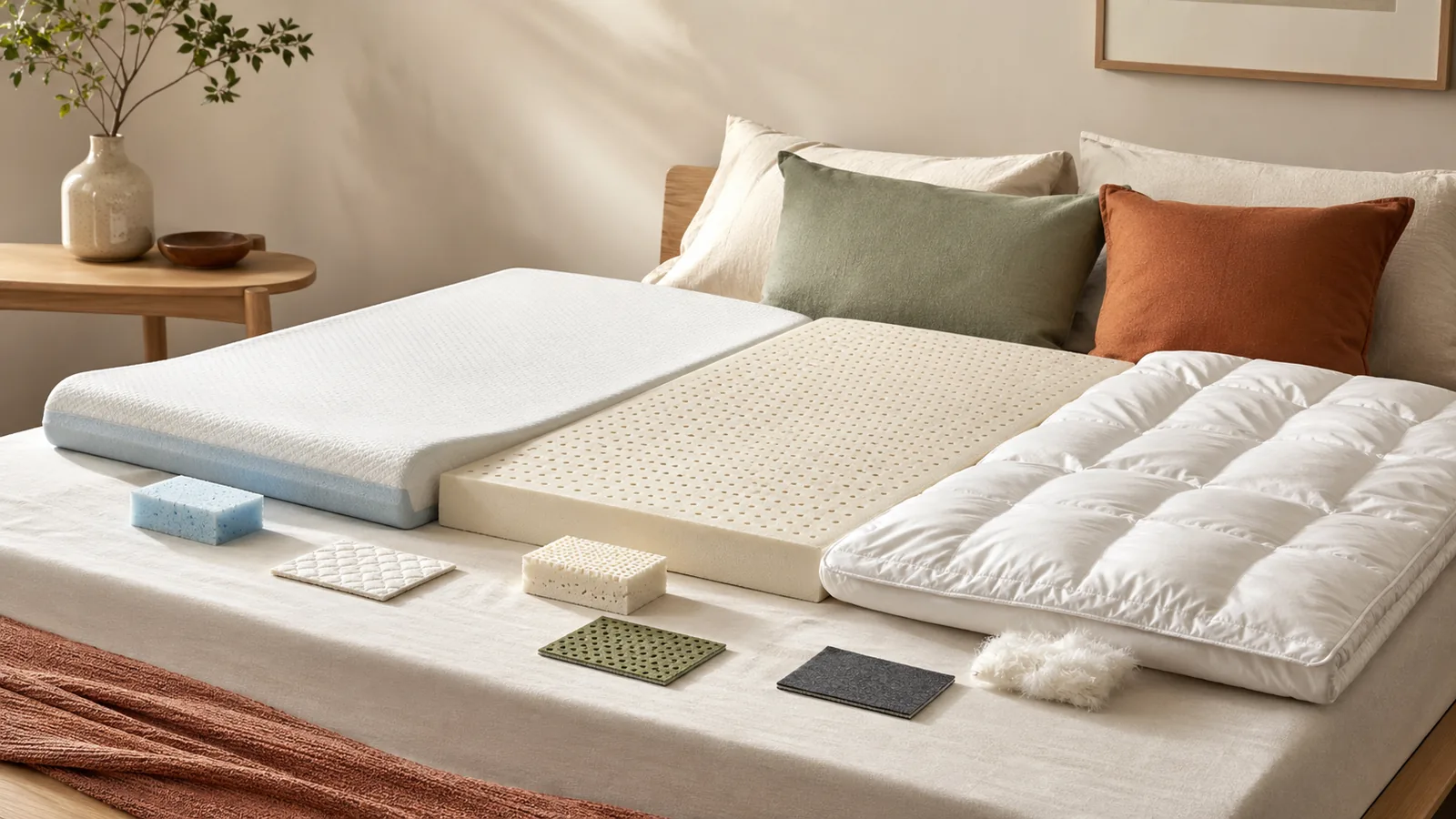
Memory foam vs latex vs feather/down vs cooling foam toppers
Each material has a specific use case where it excels and at least one scenario where it actively underperforms. Here's how they compare in real-world use.
| Material | Firmness Feel | Heat Retention | Motion Isolation | Typical Lifespan |
|---|---|---|---|---|
| Memory foam | Soft–medium | High | Excellent | 3–5 years |
| Latex | Medium–firm | Low–moderate | Moderate | 5–10 years |
| Feather/down | Plush/variable | Low | Poor | 2–4 years (compresses) |
| Cooling gel/graphite foam | Soft–medium | Moderate | Good | 3–5 years |
Lifespan estimates reflect general category expectations. Check individual manufacturer warranties for guarantee terms.
Memory foam toppers: pressure relief and motion isolation
Memory foam is the right call when your two biggest problems are shoulder or hip pain and a restless partner. Tempur-Pedic describes the technology this way: "Our mattress toppers are made with the same one-of-a-kind technology found in all of our mattresses with truly personalized support that instantly responds to your weight, shape, and temperature." The dense, viscoelastic structure absorbs movement — if your partner tosses at 2 a.m., you're less likely to feel it.
The trade-off is heat. Standard memory foam is a closed-cell material that traps body warmth, which is why hot sleepers should look specifically at gel or graphite-infused versions rather than traditional memory foam.
AffiliateProductCard — Memory foam pick: Tempur-Pedic TEMPUR-Topper Supreme — Available at Tempur-Pedic. TEMPUR-Material® construction for pressure-point relief and motion transfer reduction. 10-year limited warranty (original purchaser only; warranty void if foam is cut, burned, or torn). Best for: side sleepers with partner disturbance.
Latex toppers: responsive support with less heat buildup
Latex doesn't cradle the way memory foam does — it pushes back. That responsiveness is exactly what prevents the "stuck in quicksand" feeling that some sleepers hate about memory foam, and it means you can move and reposition without fighting the material.
Saatva's product team notes that "latex foam mattress toppers are often recommended by orthopedists and chiropractors to relieve neck, back, and shoulder pain. They offer resilient yet responsive support and limit motion transfer. They're also more durable and breathable than memory foam toppers." That durability claim tracks with general category expectations — a quality latex topper can outlast two or three memory foam toppers.
The downside: latex costs more upfront, and some people are sensitive or allergic to natural latex (look for synthetic or blended Talalay latex if that's a concern).
AffiliateProductCard — Latex pick: Saatva Latex Foam Topper — Available at Saatva. Dunlop or Talalay latex layer with organic cotton cover. 180-night home trial. Best for: combination sleepers, back pain, hot sleepers who need pressure relief but find gel foam insufficient.
Feather and down toppers: plush comfort but limited support
Down and feather toppers do one thing well: they feel luxurious immediately. Brooklinen's Down Mattress Topper uses a white duck down-filled top and a white duck feather-filled base, and the brand's own description — "tuck into a cloud-like oasis" — is Brooklinen's marketing language for the product's plush feel.
The problems are real, though. Down provides zero structural support and does nothing meaningful for pressure relief. It is a poor fit for people with feather or down allergies, and it transmits partner movement freely.
Watch Out: A feather/down topper won't help shoulder pain, hip pain, or back pain. It will make a comfortable bed feel more indulgent, but it's not a therapeutic product. If you're buying for comfort on an already-good mattress, it's a valid choice. If you're trying to fix a problem, it's not.
Cooling foam toppers: gel, graphite, and phase change materials
For hot sleepers, the material technology inside the foam matters more than the foam category itself. Sleep Foundation confirms that cooling toppers draw heat away from the sleeper through materials like gel memory foam, latex, and wool. In the foam category, gel infusion and graphite infusion are the two most common and well-documented technologies.
Graphite is particularly effective because it conducts heat through the foam rather than just absorbing it at the surface. Saatva's Graphite Memory Foam Topper — a 3-inch, CertiPUR-US® certified layer — is one of the more specific examples currently available from a major US brand.
AffiliateProductCard — Cooling foam pick: Saatva Graphite Memory Foam Topper — Available at Saatva. 3-inch graphite-infused, CertiPUR-US® certified memory foam. 180-night home trial. Best for: hot sleepers who also want pressure relief and don't want to sacrifice the contouring of memory foam.
What thickness mattress topper you should buy
Thickness is where most buyers make the wrong call, usually by defaulting to the thickest option available. Sleep Foundation notes that most toppers run 2 to 4 inches; Amerisleep recommends 3 to 4 inches specifically for side sleepers needing memory foam contouring. Within that range, your choice should be driven by how much cushioning your current mattress needs — not by the assumption that thicker is always better.
2-inch toppers for mild comfort adjustments
A 2-inch topper is the right choice when your mattress is fundamentally sound but slightly too firm at the surface. It softens the sleep feel without dramatically changing the height or firmness profile of the bed, and it adds less material to trap heat. For sleepers who want only a surface-level comfort adjustment, 2 inches is often enough. For side sleepers with real shoulder or hip pain, 2 inches of memory foam usually doesn't provide the depth of cushion needed to fully offload those pressure points.
Pro Tip: If you're unsure whether you need a 2-inch or 3-inch topper, start with 2 inches. It's easier to add a thicker topper later than to return a used one — especially given the hygiene-related return restrictions covered below.
3-inch toppers for stronger pressure relief
Three inches is the safest default for most side sleepers and for anyone with hip or shoulder pain on a medium-firm or firm mattress. Saatva's Graphite Memory Foam Topper hits this mark at 3 inches, and Amerisleep's guidance for side sleepers starts at 3 inches. The additional material gives the foam enough depth to fully absorb pressure from the shoulder without bottoming out.
Three inches also adds meaningful height to your mattress, which affects fitted-sheet compatibility — more on that below. But it stops short of the point where foam starts to destabilize the sleep surface.
4-inch toppers and when they are too much
Four inches sits at the upper end of the 2- to 4-inch range that Sleep Foundation identifies for cooling toppers, and it's often overkill. On an already-soft mattress, 4 inches of foam creates a hammocking effect that lets the hips drop lower than the shoulders — exactly the misalignment that causes lower back pain.
Watch Out: A 4-inch topper on a soft base can leave you sleeping in the bed rather than on it. Edge stability also degrades — sitting on the side of the bed to put on shoes becomes difficult, and the topper tends to shift. If your mattress is medium-firm or firmer and you're a large-framed side sleeper, 4 inches can be appropriate. For everyone else, stop at 3 inches.
Heat retention also increases with thickness. A 4-inch foam layer — even with gel or graphite infusion — is more likely to trap warmth over a full night than a 3-inch version of the same material.
When a mattress topper is not enough and you should replace the mattress
This is the section most competitor roundups skip, and it's the most useful thing we can tell you: a topper cannot fix a failing mattress.
Sleep Foundation is explicit about this: topper choice should address "the root cause of your discomfort, whether that's lack of spinal support or pressure point pain." A topper handles pressure point pain by changing the surface feel. It cannot address a mattress that has lost its structural integrity.
Here is the signal that points to replacement rather than a topper:
When to Call a Pro (or buy a new mattress): - Support that has clearly broken down — if the mattress no longer holds your spine in a neutral position or you can feel the support core failing through the surface, a topper will only mask the discomfort.
If that applies, the honest advice is to put the topper budget toward a new mattress instead. A topper on a failing mattress is money spent on a problem that won't be solved.
Queen, King, and Cal King sizing notes for mattress toppers
Always match your topper size exactly to your mattress size — toppers don't have meaningful overhang or tuck like sheets do. Per Sleep Foundation's standardized US mattress size guide:
- Queen: 60" × 80" — the most common US size; topper availability is widest here
- King: 76" × 80" — four inches wider than a Cal King; do not substitute Cal King toppers (they'll be too narrow)
- California King: 72" × 84" — four inches longer and narrower than a standard King; Sleep Foundation confirms it's 72" wide by 84" long
Watch Out: Cal King and King toppers are not interchangeable. A King topper on a Cal King bed will be 4 inches too short lengthwise and leave your feet on bare mattress. Check the product listing specifically for "California King" or "Cal King" — some retailers list it separately from King, and some don't carry it at all.
For split King configurations (two Twin XL mattresses side by side), you need two Twin XL toppers — not one King topper. A single King topper will bridge the gap between mattresses and bunch up in the middle.
Fitted-sheet depth and topper height
Adding a topper changes the total height of your sleep surface, and Sleep Foundation notes that fitted sheets come in different pocket depths to accommodate a range of mattress profiles.
Here's the practical check: measure your current mattress height, add your topper's thickness, and compare the total to your fitted sheet's stated pocket depth. A 12-inch mattress with a 3-inch topper needs at least 15 inches of pocket depth — ideally a sheet labeled "deep pocket" or "extra deep pocket."
Standard fitted sheets typically fit mattresses up to around 12 inches. If your sheet only just covered your old mattress, a 3- or 4-inch topper will pull it loose by morning. Replacing your fitted sheet with a deep-pocket option before the topper arrives saves you the frustration of a midnight sheet untuck.
Pro Tip: Look for sheets specifically labeled with a numeric pocket depth (e.g., "fits mattresses up to 18 inches") rather than just "deep pocket" — the term isn't standardized across bedding brands.
Return policies, trial periods, and hygiene exclusions for toppers
Topper return policies are more restrictive than mattress return policies, and the details matter before you open the packaging.
Policy Checklist — verify these before you buy: - Casper 30-night trial — Casper offers a 30-night trial on its mattress toppers, and its return policy says returns are only accepted when the merchandise is unused and in its original packaging and condition - Saatva 180-night home trial — Saatva gives toppers a 180-night home trial and states that it does not have an exchange policy for mattress toppers - Tempur-Pedic 10-year limited warranty — Tempur-Pedic covers toppers for 10 years for the original purchaser only, and the warranty is void if the product or cover is physically abused, damaged, burned, cut or torn - Hygiene exclusions — used bedding is frequently excluded from standard return windows, so confirm the policy before removing the topper from the packaging
The specifics, brand by brand:
Casper offers a 30-night trial on its mattress toppers. However, Casper's return policy specifies: "You can return your Casper item and get a full refund within 30 days of delivery... provided the merchandise is unused, and in its original packaging and condition." That "unused" requirement effectively means you can't sleep on it and return it — the 30-night trial exists, but returning a used topper is a different matter. Confirm with Casper directly before assuming the trial covers a slept-on topper.
Saatva offers the most generous trial at 180 nights: "All mattress toppers come with a 180-night home trial, so you have plenty of time to decide whether it's right for your current mattress." The catch: "At this time we do not have an exchange policy for mattress toppers." If it's not right, you return it — you can't swap it for a different thickness or material.
Tempur-Pedic backs its toppers with a 10-year limited warranty, which is the strongest coverage in this category. But the warranty is voided if "the product or cover is physically abused, damaged, burned, cut or torn," and it's valid only for the original purchaser — so buying one secondhand leaves you without coverage.
How to pair a topper with a mattress protector or cooling sheet set
Once you've added a topper, you've also added a surface that's harder to clean and more vulnerable to spills, sweat, and allergens. A mattress protector sits between the topper and your fitted sheet to catch moisture before it reaches the foam or fill.
The correct layering order from bottom to top is: mattress → mattress protector → topper → fitted sheet. Some sleepers put the protector over the topper instead — that works for keeping the topper clean but leaves the mattress unprotected if the topper shifts.
Use a mattress protector for moisture and allergen protection, and choose breathable sheets when temperature management is part of the problem. For hot sleepers who've already chosen a cooling topper, breathable sheets can complement the setup, but they are optional rather than required. Look for sheets made from linen, Tencel (lyocell), or percale-weave cotton — these fabrics are more breathable than sateen-weave cotton or microfiber, which trap warmth against the skin regardless of what's underneath.
Pro Tip: A thin, fitted mattress pad (rather than a full topper) works well as a protective layer over a foam or latex topper — it keeps the topper surface clean without adding significant heat or weight. Brooklinen's mattress pad is one option; look for one without heavy fill that would compete with the topper's feel.
If you're dealing with a partner who runs hot and one who runs cold, a dual-zone approach — separate fitted sheets and individual toppers on a split King setup — gives each person independent control without a single compromise product that serves neither sleeper well.
Frequently asked questions about mattress toppers
What type of mattress topper is best for side sleepers?
Memory foam is the top choice for side sleepers because it contours around the shoulder and hip, the two pressure points that create the most discomfort in this position. Amerisleep recommends 3 to 4 inches of memory foam for full pressure relief. If heat is also a concern, a graphite- or gel-infused memory foam topper gives you the same contouring with better thermal management than standard memory foam.
Are mattress toppers good for back pain?
They can be, with an important caveat. Per Sleep Foundation, "The best type of mattress topper for back pain is one that cushions your back and body while keeping your spine aligned" — and you should "choose one that addresses the root cause of your discomfort, whether that's lack of spinal support or pressure point pain." If your mattress is too firm and creating lumbar pressure, a medium-feel memory foam or latex topper can genuinely help. If your mattress is sagging or structurally compromised, a topper will not solve the problem.
What thickness mattress topper is best for hot sleepers?
Sleep Foundation identifies 2 to 4 inches as the typical range for cooling toppers. For hot sleepers specifically, 2 to 3 inches is the better choice — thicker foam retains more heat regardless of gel or graphite infusion. Prioritize the infusion technology over thickness when cooling is your primary goal.
Can a mattress topper fix a sagging mattress?
No. A topper changes the surface feel; it doesn't restore the structural support underneath. If your mattress has visible body impressions, noisy springs, or is causing pain that worsens over time, those are signs of a failing support core that no topper can address. Save the topper budget and put it toward a mattress replacement.
How do I know what size mattress topper to buy?
Match the topper size exactly to your mattress size. Per Sleep Foundation's size guide: Queen is 60" × 80", King is 76" × 80", and California King is 72" × 84". King and Cal King are not interchangeable — a King topper will be 4 inches too short on a Cal King bed. After adding a topper, check that your fitted sheet has enough pocket depth to accommodate the added height.
Sources & References
- Sleep Foundation — Best Mattress Toppers — evaluation framework covering pressure relief, temperature regulation, edge support, motion isolation, and durability
- Sleep Foundation — Mattress Sizes — standardized US mattress dimensions (primary source)
- Sleep Foundation — California King vs King — dimension comparison for Cal King (72" × 84") and King (76" × 80")
- Sleep Foundation — Best Cooling Mattress Topper — materials and thickness guidance for hot sleepers
- Sleep Foundation — Best Mattress Topper for Back Pain — support vs. comfort distinction for back pain topper selection
- Sleep Foundation — Best Memory Foam Mattress Topper — memory foam topper guidance for side sleepers
- Sleep Foundation — Best King Mattress Topper — pressure redistribution by material
- Sleep Foundation — Bed Sheet Sizes — fitted sheet pocket depth guidance
- Saatva Press Room — New Premium Toppers — Graphite Memory Foam Topper specifications
- Saatva — Product Page (Graphite Topper) — latex topper positioning and comparison to memory foam
- Saatva Help Center — Return Policy — 180-night trial, no exchange policy for toppers
- Tempur-Pedic — Mattress Toppers — TEMPUR-Material® topper product page
- Tempur-Pedic — 10-Year Limited Warranty — warranty terms and exclusions
- Casper — Returns Page — 30-night trial on mattress toppers
- Casper Help Center — Return Policy — "unused, original packaging" return requirement
- Brooklinen — Down Mattress Topper — duck down and feather fill composition
- Brooklinen — Mattress Pad — protective layer pairing reference
- Amerisleep — Egg Crate vs Memory Foam Toppers — 3- to 4-inch thickness recommendation for side sleepers
Keywords: memory foam topper, latex topper, feather down topper, cooling gel foam, graphite infusion, phase change material, Queen 60 x 80, King 76 x 80, Cal King 72 x 84, fitted sheet pocket depth, mattress protector, motion isolation, pressure relief, heat retention, mattress sagging