A duvet insert is not a comforter, and that distinction changes everything about how you shop for one. Get the fill type wrong and you're sweating through August or shivering in January. Get the size wrong and the insert bunches into a lump at the foot of your bed. This guide cuts through the buzzwords — fill power, loft, baffle-box — and maps each decision directly to your climate, sleep temperature, and the duvet cover you already own or plan to buy.
What is a duvet insert, and how is it different from a comforter?
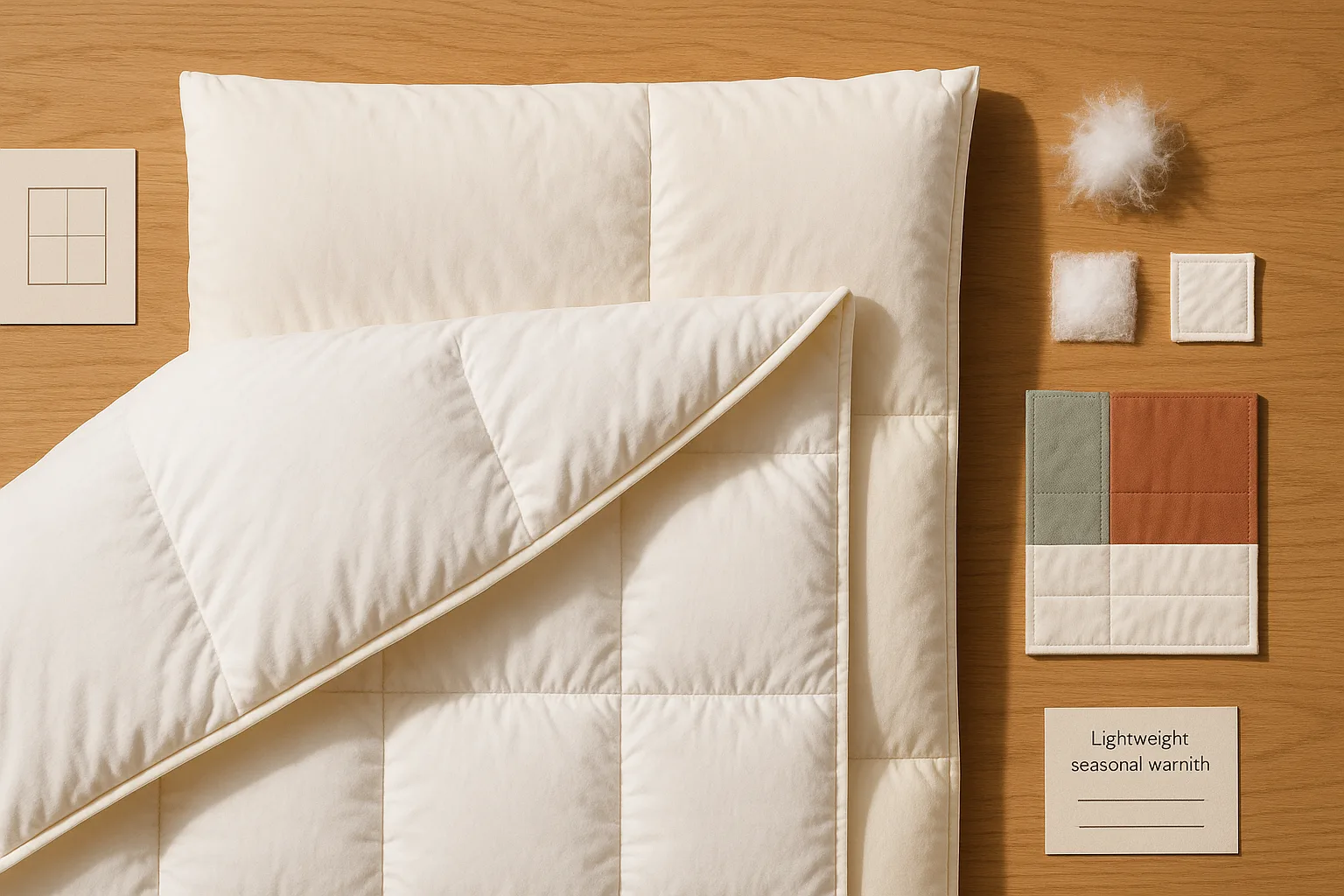
A duvet insert is the inner component — the part with the filling — that slides inside a separate, removable duvet cover. A comforter, by contrast, is a single quilted piece you use on its own, right on top of your bed. As Sleep Foundation explains, "Duvets are very similar to comforters. The main difference is that while comforters are generally one quilted piece, duvets consist of two separate pieces: an insert, which contains the filling, and a cover."
That two-piece system is the whole point. You protect the insert with a washable cover, which means the insert itself stays cleaner longer and only needs occasional laundering or dry cleaning. Inserts are commonly filled with down, feathers, or down alternative fibers, and they're typically secured inside the cover with corner loops, buttons, ties, or snaps at all four corners.
Pro Tip: Because the insert lives inside a cover, always shop for both at the same time — or at minimum, confirm the cover's internal tie placement matches the insert's corner loops before you click "add to cart."
The practical implication: a duvet insert is not a standalone blanket. It needs a cover to function well and look finished. If you're outfitting a new bedroom or replacing worn bedding, buy the insert and the cover as a system.
Down vs down alternative duvet inserts: which fill is better for your sleep style?
The fill decision drives everything else — warmth feel, weight, care requirements, and price. Here's how the two main categories compare:
| Feature | Down Fill | Down Alternative Fill |
|---|---|---|
| Warmth-to-weight ratio | High — lighter for equivalent warmth | Moderate — slightly heavier for same warmth |
| Breathability | Excellent | Good, especially in cotton-shell versions |
| Hypoallergenic | No — natural animal material | Yes — synthetic fibers, no allergens |
| Machine washable | Often dry-clean only | Usually machine washable |
| Price | Higher | More affordable |
| Longevity | 10–15 years with proper care | 5–10 years typical |
Parachute's Down Duvet Insert uses premium European white down at an 85% down / 15% down-and-feather-fibers blend, housed in a 100% sateen cotton shell. That specific ratio gives you genuine loft without the coarser feel of a high-feather-content fill. On the other side, Parachute's Down Alternative Duvet Insert is hypoallergenic and uses baffle-box construction designed to distribute the synthetic fill evenly — more on that construction in the features section below.
When down is worth the premium
Down earns its price when you care most about a lighter feel at equivalent warmth, and when you're willing to handle occasional professional cleaning. Here's a quick buyer-fit checklist:
- You run cold but hate heavy blankets. Down's warmth-to-weight advantage is real — you get more insulation per ounce than synthetic fill, so the insert doesn't feel oppressive.
- You want long-term durability. A well-cared-for down insert can last more than a decade. The Company Store's Luxe Royal line uses 700–750 fill-power goose down with baffled box construction, which helps the insert hold its loft wash after wash.
- You're not allergic. Down is a natural animal material, and even "allergy-friendly" treated down can still irritate sensitive sleepers.
- You'll invest in a good cover. Parachute's down insert includes corner loops designed to align with the interior ties on its covers — that's a system designed for longevity, and it works best when you use compatible covers.
- You prioritize feel over convenience. Down is softer and loftier than most synthetics. If the tactile experience of climbing into bed matters to you, down usually wins.
Watch Out: Down fill power (a measure of loft, not warmth directly) is often marketed as a proxy for quality. Higher fill power means the down clusters are larger and fluffier, which does improve warmth-to-weight ratio — but a 700-fill-power insert in a lightweight cut can still feel cooler than a 550-fill-power insert in a heavier cut. Fill power tells you about the quality of the down, not the total warmth of the insert.
When down alternative is the smarter all-season buy
Down alternative wins on accessibility and convenience. Parachute describes its down alternative insert as "a hypoallergenic alternative to down" that "will keep you comfortable year round" — and that year-round positioning is accurate for most US bedrooms with standard climate control.
The machine-washable factor is not a small thing. If you have kids, pets, or allergies, being able to run the insert through your home washer instead of hauling it to a dry cleaner is a meaningful quality-of-life upgrade. Brooklinen offers down alternative options in multiple warmth levels with breathable cotton shells, and its 365-day return window (subject to a $9.95 return fee) gives you a full year to decide if the weight is right for your room.
Down alternative is the smarter call when: - You or your partner have down or feather allergies - You want a true machine-washable insert - You're buying for a guest room or a kid's room where durability and easy care matter more than premium feel - Your budget is tighter and you'd rather put money toward a high-quality cover
Parachute offers free shipping and returns plus a 60-day trial on its inserts, so if you're unsure whether down alternative suits your sleep temperature, you can test it without risk.
What duvet insert weight is best for year-round comfort?
The all-season or medium-weight insert is the right default for most US households. Consumer Reports put it directly: "I chose the all-season down, a happy medium when it comes to weight." That framing — happy medium — is the honest answer for anyone sleeping in a centrally heated and cooled American home.
The weight category (lightweight, all-season/medium, warm, ultra-warm) determines how much filling is packed into the insert shell, which directly affects how much heat it retains. But here's what most shopping guides skip: warmth level and loft are not the same thing. A high-loft insert can look gloriously puffy while being only moderately insulating, because loft is about fill volume and air trapping, not about raw heat retention. Don't buy a warmer insert just because it looks fluffier in the product photo.
The Company Store uses a three-tier warmth taxonomy across its duvet insert line — lightweight, all-season, and extra-warm — and that range helps shoppers compare products without guessing. Its assortment also spans Twin, Full/Queen, King, and California King sizes, so the same brand language carries across the size and warmth choices.
Lightweight duvet inserts for hot sleepers and warm climates
As The Company Store notes, "A lightweight or all-season down or down alternative duvet insert is breathable and may offer just-right comfort through the summer or in warm climates." If you sleep in the South, Southwest, or in a bedroom that doesn't cool below 68°F in winter, a lightweight insert may be all you need year-round.
Hot sleepers in particular should look for lightweight inserts with cotton or cotton-sateen shells, which breathe better than polyester-blend shells. A down alternative lightweight insert in cotton is often the best call here — it stays cooler than down (which traps body heat more efficiently), and it's machine washable for the warmer months when you're using it more often without a top sheet.
One key distinction: a lightweight insert can still have good loft. You can have an airy, plush-looking bedding setup without the heat retention of a heavier fill weight. If you're buying for summer use only or for a bedroom in Florida or Texas, don't let a flat-looking lightweight insert fool you into sizing up.
All-season duvet inserts for most bedrooms
The all-season weight fits the widest range of sleepers and climates, which is why it's the default recommendation for most US bedrooms. The practical decision rule: if your home has central heat and air conditioning and you keep the bedroom between 65°F and 72°F year-round, an all-season insert is almost certainly the right choice regardless of your fill preference.
Parachute positions its down alternative insert explicitly as an all-season, year-round product, and its baffle-box construction helps the fill distribute evenly rather than clustering to one side of the insert during sleep — a real functional benefit for a insert you're using in every season.
A corner-loop note that matters here: if you're committing to a single duvet insert for year-round use, make sure it has corner loops and that your duvet cover has corresponding interior ties. An all-season insert that shifts and bunches inside the cover becomes uncomfortable fast. The loop-and-tie system is a small feature with outsized impact on daily usability.
Pro Tip: If you're buying an all-season insert as your only insert, size it to your cover's listed dimensions — not your mattress size. The insert needs to fill the cover corner-to-corner without excess fabric pooling.
Warmer duvet inserts for cold rooms and cold sleepers
A warmer or ultra-warm insert makes sense if your bedroom drops below 62°F overnight, if you run cold chronologically (many people's circulation changes with age), or if you're in a drafty older home where central heat doesn't fully reach the bedroom.
Brooklinen offers warmth levels up to ultra-warm, and The Company Store carries extra-warm inserts in its assortment. Both are legitimate options for cold sleepers.
The caution here is important: the warmest-feeling insert at the store or in a product photo is not always the most insulating one at home. A thick, fluffy ultra-warm synthetic insert may feel heavier but trap less heat than a well-constructed warm-weight down insert at half the visual bulk. If warmth is the priority, check whether the product page specifies a fill-weight in ounces and look for genuine warm or ultra-warm labeling rather than just a puffy product photo.
Watch Out: Don't buy an ultra-warm insert thinking you'll "grow into it" in summer. A too-warm insert is genuinely uncomfortable and you'll end up sleeping without it or with the cover half-off — which wastes the investment. It's better to buy all-season and layer a blanket in winter than to overbuy on warmth.
What size duvet insert should you buy for a Queen or King bed?
The single most misunderstood rule in duvet shopping: match the insert size to your duvet cover's listed dimensions, not to your mattress size. A Full/Queen duvet cover is typically cut larger than a standard bed mattress to drape over the sides. If you put a Full/Queen insert into a King cover, you'll have inches of loose, empty cover fabric on every side. The insert will shift, bunch, and feel sloppy within a week.
Sleep Foundation confirms that duvet inserts are secured inside covers with strings, buttons, ties, loops, or snaps at the corners — which means the insert dimensions need to match the cover's interior cut for those attachment points to work correctly. A mismatched insert defeats the whole attachment system. The Company Store's current assortment makes the sizing ladder clear: Twin, Full/Queen, King, and California King are the four standard labels buyers can compare when matching an insert to a cover.
Twin/Twin XL size rules
Twin inserts fit standard Twin covers (typically around 68 × 86 inches) and are the right call for single beds, bunk beds, and daybeds. Twin XL inserts — usually around 68 × 96 inches — are sized for the longer Twin XL mattresses common in college dorms and some platform beds.
The rule is the same here: buy the insert to match the cover label, not the mattress. If your cover says "Twin XL," buy a Twin XL insert. A Twin insert in a Twin XL cover will leave 10 inches of empty fabric at the foot and the corner loops won't align with the cover's ties. The Sleep Foundation is clear that the attachment system depends on correct sizing — mismatched corners mean the insert migrates during the night.
Full/Queen size rules
Full/Queen is the most common shared size category, and most bedding brands — including The Company Store and Parachute — sell a single Full/Queen insert that fits covers labeled for both Full and Queen beds. In practice, a Full/Queen insert in a Queen cover gives you good drape with a few inches of overhang on each side. The Company Store's Full/Queen option is the clearest benchmark here because it is sold directly as part of the brand's standard duvet insert assortment, alongside Twin, King, and California King.
The important warning: Full/Queen dimensions vary by brand. One brand's Full/Queen insert may be cut at 88 × 88 inches while another's is 90 × 90 inches. That 2-inch difference is usually fine, but if you're buying an insert from a different brand than your cover, check the listed dimensions on both product pages before ordering. Parachute's insert dimensions are listed on the product detail page alongside fill weight — that's the number to check.
Watch Out: If your duvet cover is from a European brand or was purchased abroad, the sizing almost certainly doesn't match US standards. Don't buy a US Full/Queen insert for a cover that is labeled in a different regional system and expect it to fill the corners.
King/California King size rules
King and California King are sold as separate sizes at most US bedding brands, including The Company Store and Parachute. A standard King cover and a California King cover are different cuts, and the inserts sized for each follow similar proportional differences.
The fit-and-drape rule: choose King versus California King based on the cover's labeled size and your desired overhang, not the mattress dimensions alone. If your cover has specific interior dimensions listed, match the insert to those numbers.
Parachute's down insert includes corner loops specifically designed to align with interior ties on its covers — that system works correctly only when you're using matching Parachute-to-Parachute sizing. If you're mixing brands, confirm the loop and tie placement is compatible before assuming the insert will stay put.
Which duvet insert features keep the fill in place and make care easier?
Four features separate a well-engineered insert from a budget one: corner loops, construction type, shell fabric, and washability. All four affect how the insert performs daily and how long it lasts.
Corner loops and tie systems
Corner loops are fabric tabs sewn onto the corners of the insert. They're designed to thread through or attach to corresponding interior ties inside the duvet cover. As Parachute states, the loops "align with interior ties on our duvet covers" — the result is that the insert stays anchored corner-to-corner even when you're moving around in your sleep.
Do: Thread each corner loop onto its corresponding tie before closing the duvet cover. Take 30 extra seconds to do all four corners.
Don't: Skip the back corners because they're harder to reach. An unanchored back corner is where insert bunching almost always starts — within a few nights, the fill migrates to the foot of the cover and you're sleeping under a lopsided blanket.
If you're shopping for a duvet insert and your current cover has interior ties, look for an insert that explicitly lists corner loops in the product specifications. Not all inserts include them, and it's easy to miss on a product page.
Baffle-box vs sewn-through construction
These are the two main construction methods that determine how the fill stays distributed across the insert — and they're meaningfully different.
| Feature | Baffle-Box Construction | Sewn-Through Construction |
|---|---|---|
| How it works | 3D fabric walls separate chambers | Top and bottom layers sewn directly together |
| Loft | Higher — fill has room to expand | Lower — fill is compressed at seams |
| Fill migration | Less — chambers contain fill | More — fill can shift within chambers |
| Warmth at seams | Consistent — no cold spots | Cold spots at seam lines |
| Best for | Down and premium synthetics | Lighter fills, lower price points |
The Company Store references both sewn-through and baffled box construction across its comforter lines, and that distinction is the easiest way to separate a flatter, lower-cost build from a loftier one. Parachute uses baffle-box construction in its down alternative insert, which is the right call for a synthetic fill that needs structural help staying in place. The Company Store uses both sewn-through and baffled box construction across different products in its line — the distinction is called out in each product's specifications. Sewn-through construction is less expensive to manufacture and fine for lightweight inserts, but for a medium or warm-weight insert you'll pay for baffle-box in comfort and durability.
Shell fabric, washability, and care labels
The shell is the outer fabric of the insert — the layer in direct contact with the duvet cover interior. Parachute's down insert uses a 100% sateen cotton shell, which is smooth, breathable, and quiet (no rustling). Cotton shells generally breathe better than polyester-blend shells and hold up better through repeated washing.
Care label checklist before you buy:
- Machine washable? Most down alternative inserts are. Many down inserts are labeled dry-clean only or dry-clean preferred. Confirm before purchase.
- Dryer safe? If yes, at what heat setting? Most down inserts require low heat with dryer balls to prevent clumping.
- Shell fabric? Cotton or cotton-sateen is preferable for breathability. Polyester shells are more wrinkle-resistant but trap more heat.
- Certification? Look for OEKO-TEX Standard 100 certification, which verifies the product has been tested for harmful substances. Parachute's down insert carries this certification.
- Warranty? Parachute offers a 5-year warranty on its down insert, requiring proof of purchase to validate. Brooklinen's return policy allows returns or exchanges within 365 days with a $9.95 return fee deducted from the refund.
Parachute notes that "proof of purchase is required to validate warranty" — so keep your order confirmation email. It's also why buying directly from the brand's site or an authorized retailer matters more than saving a few dollars on a third-party marketplace.
How to choose the best duvet insert for your climate, budget, and sleep temperature
Most shopping guides give you a product list. Here's the actual decision tree.
Start with your allergy status. - Allergic to down or feathers → down alternative only. Look at Parachute's down alternative insert or Brooklinen's down alternative options, both explicitly hypoallergenic. - No allergies → either fill type is on the table.
Then match your climate and sleep temperature.
| Your situation | Recommended weight | Fill type preference |
|---|---|---|
| Warm climate (South, Southwest), hot sleeper | Lightweight | Down alternative (machine washable, cooler) |
| Temperate climate, average sleeper, climate-controlled home | All-season / medium | Either — down for feel, alternative for convenience |
| Cold climate, cold sleeper, or drafty bedroom | Warm to extra-warm | Down for warmth-to-weight; alternative if allergies apply |
| Variable — prefer one insert year-round | All-season | Down alternative (easier to wash seasonally) |
Then factor in your care tolerance. - Willing to dry-clean annually → down is a viable option. - Want to wash at home → down alternative wins outright. - Washing machine is small or shared (apartment laundry) → check that the insert fits your washer drum before buying. King-size inserts often require a commercial-size machine.
Then set your budget. - Premium feel and longevity matter → down with a cotton-sateen shell and baffle-box construction (Parachute's down insert, The Company Store's Luxe Royal line). - Best all-around value → a mid-range down alternative with baffle-box construction and a cotton shell. You'll spend less, care for it more easily, and get a genuinely comfortable night's sleep. - Consumer Reports called all-season down "a happy medium when it comes to weight" — that's a fair summary of where most US sleepers land, and either fill type in an all-season cut will serve them well.
What to check before you buy a duvet insert online
Before you click purchase, run through this checklist. These details vary enough by brand that skipping them leads to returns.
- Fill type: Down or down alternative? Confirm it matches your allergy needs.
- Fill construction: Baffle-box or sewn-through? Baffle-box is preferable for medium and warm-weight inserts.
- Fill weight (oz): If listed, higher ounce fill weight generally means more warmth. Compare across similar-weight-category products.
- Fill power (if down): 600–700 fill power is the standard premium range; 700+ is high-end. Higher fill power = lighter feel for same warmth level.
- Shell fabric: Cotton or cotton-sateen preferred. Avoid polyester shells if you run warm.
- Size: Match to your duvet cover's listed dimensions, not your mattress size.
- Corner loops: Listed in product features? Yes or no. Confirm your cover has corresponding interior ties.
- Care instructions: Machine washable or dry-clean only? Check before, not after, purchase.
- Certifications: OEKO-TEX Standard 100 is a verifiable third-party standard. Parachute's down insert carries this certification.
- Warranty: Parachute offers a 5-year warranty on its down and down alternative inserts; keep your proof of purchase. The warranty page states, "Proof of purchase is required to validate warranty."
- Return window: Parachute offers a 60-day trial with free shipping and returns. Brooklinen allows 365-day returns with a $9.95 return fee. The Company Store's return terms are listed per product — confirm before ordering.
- Sold as a set or insert only? Some listings bundle a cover; most sell the insert alone. Confirm what's in the box.
FAQ about choosing a duvet insert for year-round use
What is the difference between a duvet and a comforter?
A comforter is a single quilted piece you use directly on the bed. A duvet is a two-piece system: an insert (the filled inner layer) and a removable cover that encases it. As Sleep Foundation explains, "while comforters are generally one quilted piece, duvets consist of two separate pieces: an insert, which contains the filling, and a cover." The practical difference is maintenance — a duvet cover is easy to wash weekly; the insert stays cleaner longer because the cover protects it.
Is down or down alternative better for a duvet insert?
Neither is universally better — it depends on your needs. Down is lighter for equivalent warmth and tends to last longer, but it requires more care and is not hypoallergenic. Down alternative is hypoallergenic, usually machine washable, and more affordable. For most all-season shoppers without allergies who want easy care, down alternative is the more practical choice. If you prioritize a premium, lighter feel and don't mind occasional dry cleaning, down is worth the upgrade.
What weight duvet insert is best for year-round use?
An all-season or medium-weight insert works for most US bedrooms with central climate control. The Company Store's all-season category and Parachute's year-round-positioned down alternative insert are both well-matched to the 65–72°F temperature range most American bedrooms stay in. Hot sleepers or anyone in a warm climate should consider a lightweight insert instead.
Should a duvet insert be the same size as the duvet cover?
Yes — match the insert to the cover's listed dimensions, not just your mattress size. A Full/Queen insert goes in a Full/Queen cover; a King insert goes in a King cover. Using a smaller insert in a larger cover causes the fill to bunch and the corner attachments to fail. When buying from different brands, compare the actual stated measurements on each product page.
How do you keep a duvet insert from shifting inside the cover?
Use the corner loops. Thread each of the insert's four corner loops onto the corresponding interior ties inside your duvet cover before closing the cover. Parachute's down insert includes corner loops specifically for this purpose. If your insert doesn't have corner loops or your cover has no ties, the insert will migrate — especially with a slippery synthetic shell. In that case, look for a replacement insert or cover that includes the loop-and-tie system. Baffle-box construction also helps by containing the fill within individual chambers rather than letting it shift freely across the whole insert.
Sources & References
- Sleep Foundation — Best Duvet Inserts 2026 — Primary source for duvet vs. comforter definition, fill types, and corner attachment system
- Sleep Foundation — Quilt vs. Comforter vs. Duvet — Supporting definition for duvet insert/cover system
- Parachute — Down Duvet Insert — Verified specs: 85/15 down blend, sateen cotton shell, corner loops, OEKO-TEX certification
- Parachute — Down Alternative Duvet Insert — Verified specs: hypoallergenic, baffle-box construction, year-round positioning
- Parachute — Down & Down Alternative Warranty — 5-year warranty terms, proof of purchase requirement
- Parachute — Returns Policy — 60-day trial, free shipping and returns
- Brooklinen — Comforters & Pillows — Verified: multiple warmth levels, down alternative options, cotton shells
- Brooklinen — Returns Policy — 365-day return window, $9.95 return fee
- The Company Store — Duvet Inserts — Verified sizing assortment, three-tier warmth taxonomy, corner loops
- The Company Store — Luxe Royal Goose Down Comforter — Verified: 700–750 fill power, baffled box construction
- Consumer Reports — Best Duvets for Every Kind of Sleeper — Verified quote: all-season as "a happy medium"
- OEKO-TEX Standard 100 — Certification standard reference
Keywords: duvet insert, comforter, down fill, down alternative fill, baffle-box construction, sewn-through construction, corner loops, shell fabric, OEKO-TEX Standard 100, machine washable, dry clean only, Full/Queen size, King/California King size, Sleep Foundation, The Company Store