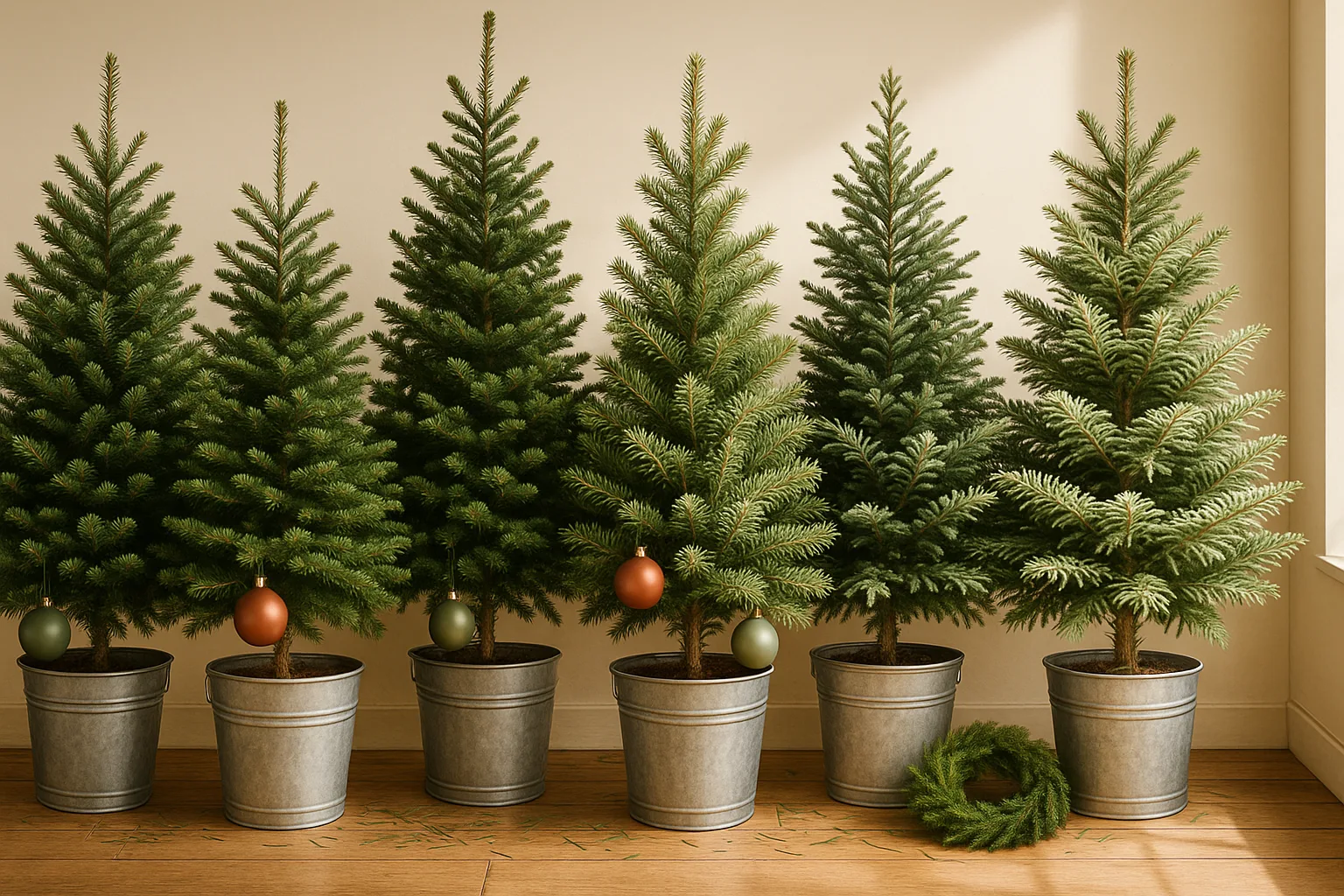
Which real Christmas tree is best for scent, needle retention, and strong branches?
Fraser fir is the most reliable all-around choice for most households — it delivers excellent needle retention, stiff branches that hold heavy ornaments without drooping, and a pleasant fragrance. Balsam fir beats it on scent alone, producing the stronger, more classic Christmas smell, but its branches are softer by comparison. The best final choice still depends on what is fresh and locally stocked at your lot, which is why the Real Christmas Tree Board’s species guide matters as much as the species ranking itself.
Pro Tip: Species rankings only matter if the tree is fresh. A Fraser fir that has been sitting on a sun-baked lot for three weeks will drop needles faster than a freshly cut balsam fir. Always check freshness at purchase — more on that below.
If you want one recommendation you can act on right now: buy a Fraser fir for ornaments and longevity, buy a balsam fir if you walk into a room and want to smell Christmas immediately. And if neither is available at your local lot, the freshest tree in stock will outperform a wilting version of either.
Real Christmas tree delivery services can ship specific species to your door, which is useful if your local lots carry limited variety — but always confirm the cut date before ordering.
How we ranked the best real Christmas trees
This comparison is built around the five traits that actually drive buying decisions at the lot: scent strength, needle retention, branch strength, shape, and freshness at purchase. Those categories come directly from the Real Christmas Tree Board's species guide, which is the most comprehensive consumer-facing authority on US Christmas tree species differences.
At a Glance: - Scent strength — how noticeable is the fragrance in a room? - Needle retention — how long before needles drop under normal indoor conditions? - Branch strength — can the branches carry heavier glass or metal ornaments without bending? - Shape — is the tree naturally full and symmetrical, or does it need fluffing and filler? - Freshness at purchase — how recently was it cut, and does it show signs of dehydration?
One critical note: regional availability matters more than any ranking list. The best species for your setup is the freshest, best-conditioned version of whatever is actually stocked at your local farm or lot. According to Purdue Extension's Christmas tree guidance, local choose-and-cut farms and retail outlets can both provide excellent trees — but the options differ by region and year. Rank this article's recommendations by your priorities, then match them to what is in front of you on the lot.
Real Christmas tree comparison table by scent, needle retention, and branch strength
Most competitor guides list species without telling you which trait wins where. This table fixes that.
| Species | Scent Strength | Needle Retention | Branch Strength | Best Use Case |
|---|---|---|---|---|
| Fraser fir | Pleasant, moderate | Excellent | Strong | Heavy ornaments, longer display season, all-around balance |
| Balsam fir | Strong, classic | Good | Moderate | Fragrance-first households, lighter decor |
| Douglas fir | Mild, sweet | Moderate | Moderate | Fuller look, lighter ornaments, family rooms |
| Noble fir | Mild | Good | Strong | Polished styling, heavier ornaments, premium look |
| Nordmann fir | Very low | Excellent | Good | Low-mess households, extended display season |
| White pine | Very low | Moderate | Soft | Rustic aesthetic, lightweight decor only |
| Colorado blue spruce | Low | Good | Moderate | Color impact, careful handling required |
Per NC State Extension: "It has glossy, dark-green foliage, strong branches which easily support heavy ornaments, and pleasing aroma. It has excellent needle retention, making it suitable for shipping long distances." That quote is about Fraser fir and explains why it consistently tops retailer and extension rankings alike.
The Real Christmas Tree Board confirms: Fraser fir has "excellent needle retention and stiff branches," while Wisconsin Horticulture Extension identifies balsam fir's needles as "very fragrant, which adds to the Christmas tree appeal." For the other species in the table, the rankings above are intentionally conservative and focus on the traits most consistently noted by extension and industry sources rather than overstating any one tree’s superiority.
Fraser fir: best for balanced scent, needle retention, and heavy ornaments
Fraser fir is the right call when you have a mix of heavier ornaments — think glass balls, metal stars, ceramic figures, or a multi-strand light set — and you want the tree to stay clean through New Year's. NC State Extension explicitly states that Fraser fir has "strong branches which easily support heavy ornaments" alongside excellent needle retention. No other commonly available US Christmas tree species has that combination confirmed by extension-level sourcing.
The scent is real but not overpowering. You notice it when you walk into the room, especially in the first week. It reads as fresh and piney rather than intensely medicinal — pleasant for guests, not polarizing.
Shape-wise, Fraser fir tends toward a slightly asymmetrical, natural look with upward-angled branches. That upward angle is actually part of what makes it functional: ornaments seat toward the trunk rather than sliding off the tip.
Pro Tip: If you are hanging heavier ornaments — anything over a few ounces — choose branches closer to the trunk, not near the tip. Even on a Fraser fir, the tips of outer branches have less support than the inner, thicker portions.
Pair your Fraser fir with a quality Christmas tree stand that has adequate water capacity for the trunk diameter. A stand that is too narrow will force you to shave the trunk's bark — which strips the outer layer that absorbs water most efficiently.
Balsam fir: strongest fragrance for a classic Christmas smell
If the reason you want a real tree is the smell — the one that immediately signals the holidays — balsam fir is the species to prioritize. Wisconsin Horticulture Extension describes balsam fir's needles as "very fragrant, which adds to the Christmas tree appeal." That fragrance comes from the resins in the flat, dark-green needles and is noticeably stronger than Fraser fir's more subtle scent.
The trade-off is branch structure. Balsam fir branches are softer than Fraser fir's, which means they will bend under heavier ornament loads. For light-to-medium ornaments — smaller glass balls, paper or felt decorations, ribbon, and lightweight star toppers — balsam fir handles the job fine. Load it with heavy multi-piece heirloom ornaments and you may see branches sag by mid-December.
Balsam fir is also more regionally specific in availability. It is a northeastern and Great Lakes-region species in the wild, so availability at lots in the South and Mountain West can be inconsistent.
Watch Out: Balsam fir is more sensitive to dehydration than Fraser fir once cut. A dry balsam fir drops needles faster. At the lot, flex a needle between your fingers — it should be pliable and stay attached. If it snaps and a handful come loose with one pass of your hand, walk to the next tree. Per Penn State Extension: "look for flexible needles that remain firmly attached when you tug on them."
Douglas fir: soft scent and good fullness for lighter decor
Douglas fir is technically not a true fir (it belongs to its own genus, Pseudotsuga), but it is one of the most widely sold Christmas tree species in the Pacific Northwest and parts of the Mountain West, where it grows abundantly. Its scent is mild and sweet, closer to a general evergreen smell than the sharp resinous aroma of balsam or Fraser fir. The tree also has a naturally full, dense shape that photographs well and fills a corner without a lot of fluffing.
The trade-off is branch strength. Douglas fir works well for lighter ornaments, fabric-and-ribbon styling, or a tree that is more visual backdrop than ornament showcase. Avoid loading it with heavy heirloom pieces on the outer branch tips. For a family room tree that gets kid-friendly ornaments and paper garland, it is a solid fit.
Regional note: Douglas fir is easiest to find in the Pacific Northwest and parts of the Rockies. East Coast lots often do not carry it at all, or carry it in limited supply.
Noble fir and Nordmann fir: sturdy branches and premium shape
Noble fir and Nordmann fir both earn their "premium" reputation for visual impact. Noble fir, a Pacific Northwest native, is prized by florists and decorators for its symmetrical look and sturdy branch structure. NC State Extension identifies Noble fir as "a very attractive Christmas tree species," and it is commonly selected for shoppers who want a polished, catalog-style silhouette.
Nordmann fir — more common in Europe but increasingly available at premium US lots and through online delivery — is widely valued for its low needle drop and clean presentation over a long display period. Scent is minimal; if fragrance matters to you, Nordmann fir will disappoint.
Watch Out: Noble fir's availability is concentrated in the Pacific Northwest. If you are shopping in the Southeast or Midwest, confirm stock before making it your first choice. Nordmann fir may require ordering through a real Christmas tree delivery service, as retail lot availability is limited outside specialty growers.
Both species suit shoppers who want a polished, statement-tree aesthetic and are willing to pay a premium price per foot for it.
White pine and Colorado blue spruce: when softness or color matters more than scent
White pine and Colorado blue spruce occupy specific style niches rather than all-around performance categories.
White pine is a softer-needled option with a light, airy appearance, and it is often chosen for a rustic look or for lightweight ornaments. Scent is minimal. Branch strength is softer than fir species, so keep ornaments lightweight — wire hooks and thin glass balls work; heavy ceramic or metal pieces will droop the branches. White pine also drops needles faster in low-humidity indoor conditions, so consistent watering matters more with this species than with firs.
Colorado blue spruce is often chosen for its distinctive blue-green foliage and strong visual contrast against warm lights and red or gold ornaments. However, spruce needles are sharp-pointed — handling during decoration is uncomfortable without gloves — and the fragrance is low. Branch strength is moderate, but the sharp needles make ornament placement less casual than with fir species.
Neither tree is the wrong choice if the aesthetic fits your decorating plan. Just go in knowing that scent and branch strength are not their strengths.
How to tell if a Christmas tree is fresh at the lot
A fresh tree — regardless of species — will outlast a stale one by weeks. Penn State Extension puts it plainly: "To check a pre-cut tree for freshness, look for flexible needles that remain firmly attached when you tug on them." Here is how to run that check in three steps at the lot:
Freshness checklist:
- Flex the needles — run your palm along a branch toward the tip. Needles should bend without snapping.
- Shake the tree — lift the trunk a few inches and tap it on the ground, or shake a branch. A few brown inner needles falling is normal (evergreens shed old interior growth year-round). A shower of green outer needles is a red flag.
- Check the trunk cut — look at the base. A fresh cut is pale, slightly moist, and resinous. A trunk that looks gray, dried out, or has a dark hardened center has been cut for a while and will not take up water as readily.
Using the right tree care products from the start — specifically a quality tree preservative — can extend a fresh tree's indoor life, but no additive compensates for buying a tree that was already stressed at the lot.
Needles should bend, not snap, when you run your hand along the branch
The tactile test is the fastest single indicator of a tree's hydration status. Run your hand from the trunk outward along a mid-tree branch. Fresh, well-hydrated needles are pliable — they flex under pressure and spring back rather than breaking off at the base.
Pass: Needle bends, stays attached, no significant drop. Fail: Needle snaps, crumbles, or a cluster of green outer needles detaches with light pressure.
A failed needle test on multiple branches means the tree is dehydrated. Even with daily watering and a clean trunk recut, a severely dried tree will not fully recover its needle attachment once it reaches that state. Move on to a different tree.
Shake test: what a few loose needles mean at the tree lot
The shake test is often misread. When you tap the trunk against the ground, some brown needles will fall — these are interior older needles that the tree sheds naturally, and their falling does not indicate a problem. What you are watching for is green outer needles falling in quantity from the branch tips.
If the outer canopy sheds noticeably during a light shake, the tree's exterior growth is already dehydrated. That is the red flag. A tree in that condition will drop green needles indoors within days of setup, regardless of how well you water it.
Look for a fresh-cut trunk and ask when the tree was cut
Turn the tree upright and examine the base cut. A freshly cut trunk is pale, slightly tacky with resin, and shows a consistent color across the cut surface. A trunk that has been cut for a long time will look darkened or grayish, and the resin will have hardened into a crust that seals the uptake channels.
Ask the lot staff directly: "When were these trees cut?" A good lot operator knows — and can tell you whether the shipment arrived last week or three weeks ago. Most commercially sold US trees are cut in late October or November and may sit in cold storage or travel before reaching your region. The fresher the cut relative to your purchase date, the better.
Pro Tip: Some lots will make a fresh base cut for you on the spot before you load the tree. Ask. Even if they just cut it an inch off the bottom, that reopens the trunk's water channels before you get home.
How to keep a real Christmas tree fresh longer
Getting the tree home healthy is step one. Keeping it hydrated and away from drying conditions is what determines whether it makes it to New Year's looking good or whether you are vacuuming needles by December 20th. The care steps below reflect extension guidance: recut the trunk, keep the stand full, and keep heat away from the canopy.
Recut the trunk before you set the tree in water
Within an hour of purchase, make a fresh cut across the base of the trunk — about a half-inch up from the original cut. This step matters because the sap that seals a cut trunk (protecting the tree while it is on the lot) also blocks water uptake. Once you recut, the exposed wood immediately begins drawing up water.
Do this before the tree stands indoors. If the trunk dries out again for more than a few hours after the recut, it will begin to seal again. The sequence: recut → into the stand → water immediately.
Use a hand saw or a reciprocating saw for a clean, flat cut. A diagonal cut does not improve uptake and makes balancing the tree in the stand harder.
Choose a Christmas tree stand with enough water capacity
A Christmas tree stand that is too small will let the reservoir run dry overnight during the critical first days — when a fresh tree can drink the most water.
General sizing guidance: choose a stand with a stable base and a reservoir that matches the tree’s height and trunk diameter. The center opening should grip the trunk snugly without requiring you to shave or taper the bark, since the outer wood is where water absorption is most active.
Look for stands with a wide, stable base. A tree that tips is a safety issue, especially with lights plugged in. Heavy decorators and households with pets or young children should consider a weighted base or one with adjustable stabilizer arms.
Keep the tree away from registers, radiators, and fireplaces
Heat is the primary enemy of needle retention indoors. Warm, dry air — whether from a forced-air heating register, a baseboard radiator, or the ambient heat near a fireplace — accelerates moisture loss through the needles faster than the trunk can replenish via the stand's water.
Placement checklist: - Not within 3 feet of a heating vent or floor register - Not adjacent to a baseboard radiator - Not within the direct heat zone of a fireplace (even a gas fireplace radiates dry warmth) - Not in direct sun from a south- or west-facing window during peak afternoon hours
A cooler room location — even a few degrees difference — measurably extends needle life. A room that tends to run on the cooler side (a formal living room used mostly for company, or a room with north-facing windows) is a better choice than a warm, sunny great room if you want the tree to last.
Refill water every day during the first week
Keep the stand full every day during the first week. Never let the water level drop below the base of the trunk cut. Once the cut surface is exposed to air, it begins to reseal within hours, and you lose the water-uptake efficiency you worked to create with the recut.
Check the stand's reservoir every morning during the first 7 to 10 days. After that, continue checking regularly until the tree comes down.
Pro Tip: A turkey baster makes refilling a deep stand in a tight corner far easier than trying to pour from a watering can. Keep one near the tree during the season.
Plain water is fine; no additives (aspirin, sugar, bleach) have been shown in controlled extension research to meaningfully outperform clean water for most tree species. The best tree care products are formulated preservatives from brands like Keep-It-Green or Miracle-Gro Nature's Care, which can help in specific conditions — but clean, daily water is the baseline.
What to buy for a sturdy, low-mess Christmas tree setup
The tree itself is only part of the equation. The right support products make the difference between a setup that is manageable and one that becomes a daily chore or a cleanup problem.
Tree stands, water reservoirs, and trunk protectors
The Christmas tree stand is the single most impactful purchase after the tree itself. Brands worth considering at major US retailers include Cinco Christmas Tree Stands, Krinner Tree Genie, and NOMA or Zober options, but the better choice is the one that gives you a stable base, a reservoir that stays full, and a trunk clamp that fits your tree without forcing you to shave the bark.
A trunk bag or tree collar (sold at Hobby Lobby, At Home, and HomeGoods) covers the stand for aesthetics and traps any minor drips or overflows before they reach the floor.
Optional care helpers for cleanup and needle control
A few additions make the season noticeably cleaner:
- Tree removal bags — slide the bag under the stand before setup, then pull it up and over the tree at takedown to catch falling needles.
- Needle drop mats — a waterproof mat or tray placed under the stand catches drips from refilling and any fallen needles. A basic rubber utility tray from Home Depot works well for this job.
- Anti-desiccant sprays — products like Wilt-Pruf, available at garden centers and Amazon, can be lightly misted on the interior foliage before you bring the tree inside to slow moisture loss. Use sparingly and keep away from lights.
- Tree preservative additives — Miracle-Gro and Keep-It-Green are the most widely distributed options. Add to the stand water at setup and with each refill per the label.
None of these are essential if the tree is fresh and the stand stays full. But for a tree going up the first week of December and staying through early January, the combination of a high-capacity stand and a needle catcher bag at the base reduces the daily management load meaningfully.
Should you order a real Christmas tree online or buy locally?
Both options work, but they serve different buyers. Local lot or farm purchase gives you hands-on inspection. Real Christmas tree delivery services give you species-specific selection and convenience. The right answer depends on what your local market offers and what you are willing to trade off, as Purdue Extension's Christmas tree guidance notes when comparing choose-and-cut farms with retail lots.
When real Christmas tree delivery makes sense
Delivery is the practical choice when your local lots consistently carry only one or two species and you want a specific species that is not stocked. If you want a Nordmann fir for its long display life, or a Noble fir for its polished shape, delivery from a specialty grower is often the only reliable route.
Watch Out: Confirm the cut date before ordering online. Ask the vendor directly or check their FAQs for the harvest-to-ship timeline. A tree that ships ground freight for five days after a same-week cut is still usable. One that sat in a warehouse for three weeks before shipping is not worth the premium price.
When buying in person is better for branch strength and freshness
For most shoppers, an in-person lot is the better default. You can run the needle flex test, do the shake test, inspect the trunk, and compare trees side by side before committing. No photo or description from an online listing conveys the difference between a tree with stiff, well-spaced branches and one that looks symmetrical in a picture but is lopsided in person.
Purdue Extension notes that local choose-and-cut farms and retail lots both furnish quality trees. Choose-and-cut is the freshest option available — trees cut that day have not had time to dehydrate — but availability depends heavily on regional growing conditions and farm proximity.
Local stock should be the deciding variable. If your lot has a fresh, well-hydrated Fraser fir in the right size, that beats a delivered balsam fir of unknown cut date every time.
Which Christmas tree is best for heavy ornaments, strong fragrance, or low mess?
This is the practical decision matrix. Match your decorating priority to the right species.
Best Christmas tree for heavy ornaments
Fraser fir. This is the most directly sourced recommendation in the article. NC State Extension explicitly states Fraser fir has "strong branches which easily support heavy ornaments." Noble fir is also a strong candidate if available in your region — its branch structure and spacing make it well-suited for heavier ornament loads.
Avoid white pine and Douglas fir for heavy ornament collections. Their softer branch structure will show the strain by mid-season, especially on outer branches loaded near the tips.
Watch Out: "Heavy ornament" load is relative. Even on a Fraser fir, a branch 18 inches long near the top of the tree holds less weight than a thick inner branch near the bottom. Distribute weight from bottom to top, heavier pieces lower and closer to the trunk.
Best Christmas tree for the strongest scent
Balsam fir. Wisconsin Horticulture Extension identifies it as producing needles that are "very fragrant." The scent is the tree's primary attribute — classic, strong, resinous, and room-filling in a way no other commonly available US species matches.
The trade-off: balsam fir does not have the branch strength of Fraser fir. If fragrance matters most and your ornaments are lightweight, balsam fir is the right call. If you want both strong scent and heavy ornament capacity, buy a Fraser fir and add a few drops of balsam fir essential oil to a diffuser nearby.
Best Christmas tree for minimal needle mess
Freshness at purchase matters more than species here. Any species, bought fresh and cared for properly, will drop relatively few needles. The tree that creates the least mess is the one you chose carefully at the lot — flexible needles, minimal shake-test shedding, moist trunk.
That said, if you are choosing between species with mess as a top-of-mind concern: Nordmann fir has low needle drop and is a common choice for extended display. Fraser fir is next. Balsam fir and Douglas fir are further down that ranking when conditions are not ideal.
Penn State Extension emphasizes: needles that are flexible and "remain firmly attached when you tug on them" at the lot are the most reliable predictor of low needle drop indoors. No species overcomes a poor freshness start.
FAQs about choosing real Christmas trees
Is Fraser fir better than balsam fir?
Is Fraser fir better than balsam fir?
It depends on what you need from the tree. For most households, Fraser fir is the stronger all-around performer. The [Real Christmas Tree Board](https://realchristmastreeboard.com/tree-guide/) confirms it has "excellent needle retention and stiff branches," making it reliable for heavier ornaments and longer display seasons. Balsam fir wins specifically on fragrance. [Wisconsin Horticulture Extension](https://hort.extension.wisc.edu/spruce-fir-trees-101/) describes its needles as "very fragrant" — noticeably stronger than Fraser fir's more moderate scent. If you are decorating with lighter ornaments and the smell of the tree is the main reason you choose real over artificial, balsam fir is worth prioritizing. The short version: Fraser fir for ornaments and longevity. Balsam fir for scent. Either choice wins as long as the tree is fresh when you buy it.How long does a real Christmas tree last indoors?
A well-cared-for, fresh tree — properly recut at the trunk, placed in a water-holding stand, kept away from heat sources, and watered daily — can stay attractive through the holiday season if it is managed carefully. A tree that was already stressed at purchase, or one that runs dry in the stand for a day or two early on, will decline much faster. The care steps that matter most are the trunk recut at setup, daily water refills during the first week, and placement away from heating vents and direct sun. Species matters, but freshness and care routines determine actual lifespan more than the species label.What size Christmas tree stand do I need?
Match the stand to two measurements: tree height and trunk diameter at the base. Choose a [Christmas tree stand](https://www.amazon.com/s?k=christmas+tree+stand) with a stable base and a reservoir large enough to keep the trunk cut submerged without constant refilling. The center opening needs to grip the trunk without requiring you to shave the bark — stripping bark removes the outer sapwood where most water absorption happens. When in doubt, size up on water capacity: a stand with more water than you need is far less of a problem than one that runs dry overnight.Sources & References
- Real Christmas Tree Board — Tree Guide — Species profiles covering scent, needle retention, branch strength, and shape for major US Christmas tree types
- NC State Extension — Christmas Tree Species — Extension-level species profiles including branch strength and ornament-holding capacity for Fraser fir and Noble fir
- Wisconsin Horticulture Extension — Spruce-Fir Trees 101 — Balsam fir fragrance characterization and species traits
- Penn State Extension — Tips for Selection and Care of Cut Christmas Trees — Freshness checks including needle flexibility and shake test; interior needle shedding context
- Purdue Extension — Considerations When Choosing a Real Christmas Tree — Regional availability guidance and local lot vs. farm selection context
Keywords: Fraser fir, balsam fir, Douglas fir, Noble fir, Nordmann fir, white pine, Colorado blue spruce, Real Christmas Tree Board, fresh-cut trunk, needle retention, branch strength, ornament weight, tree stand with water reservoir, asymmetrical branch spacing, tree freshness check