The moment a storm clears, two clocks start ticking: one counts down until your damaged roof soaks your insulation, and the other counts down until a scam contractor knocks on your door. The FTC warns that "after any weather event or natural disaster, it's common that unlicensed contractors and scammers may get in touch — they'll call, email, text, or knock on your door, promising to fix your leaky roof, clean up water damage, or remove a fallen tree." The pressure to act fast is real, but so is the risk of handing thousands of dollars to someone who disappears. What follows is a sequence-based playbook — first 24 hours, first bid, first deposit, insurance call — so you can stop the damage without becoming a victim.
What to do in the first 24 hours after storm damage
Your priorities in the first 24 hours are stopping active damage, capturing evidence, and opening your insurance claim — in that order. Do not let urgency override documentation, and do not authorize permanent storm damage repair before you have a written estimate from a verified contractor.
At a Glance: First 24-hour checklist - Hour 1: Walk the property safely; photograph and video all visible damage - Hour 1–2: Separate damaged items from undamaged items; save any destroyed materials - Hour 2–3: Make or arrange for temporary repairs (tarping, boarding) — not permanent fixes - Hour 3–4: Call your insurer to open a claim file and ask about emergency mitigation reimbursement - Hour 4–24: Begin vetting local licensed contractors for permanent repair bids
FEMA is clear that you do not need to wait for a FEMA home inspection or flood insurance claim inspection before you start cleaning up and making repairs. That means you can move on temporary stabilization immediately — and you should. The trap is letting a door-to-door contractor convert that urgency into a rushed, full-scope contract for permanent roof repair, water damage restoration, or any other major work before you have done your homework.
Document damage before anyone starts work
Photograph and video everything before a single piece of debris moves or a tarp goes up. For storm damage repair claims, this documentation is your financial protection as much as it is your insurance record.
What to capture:
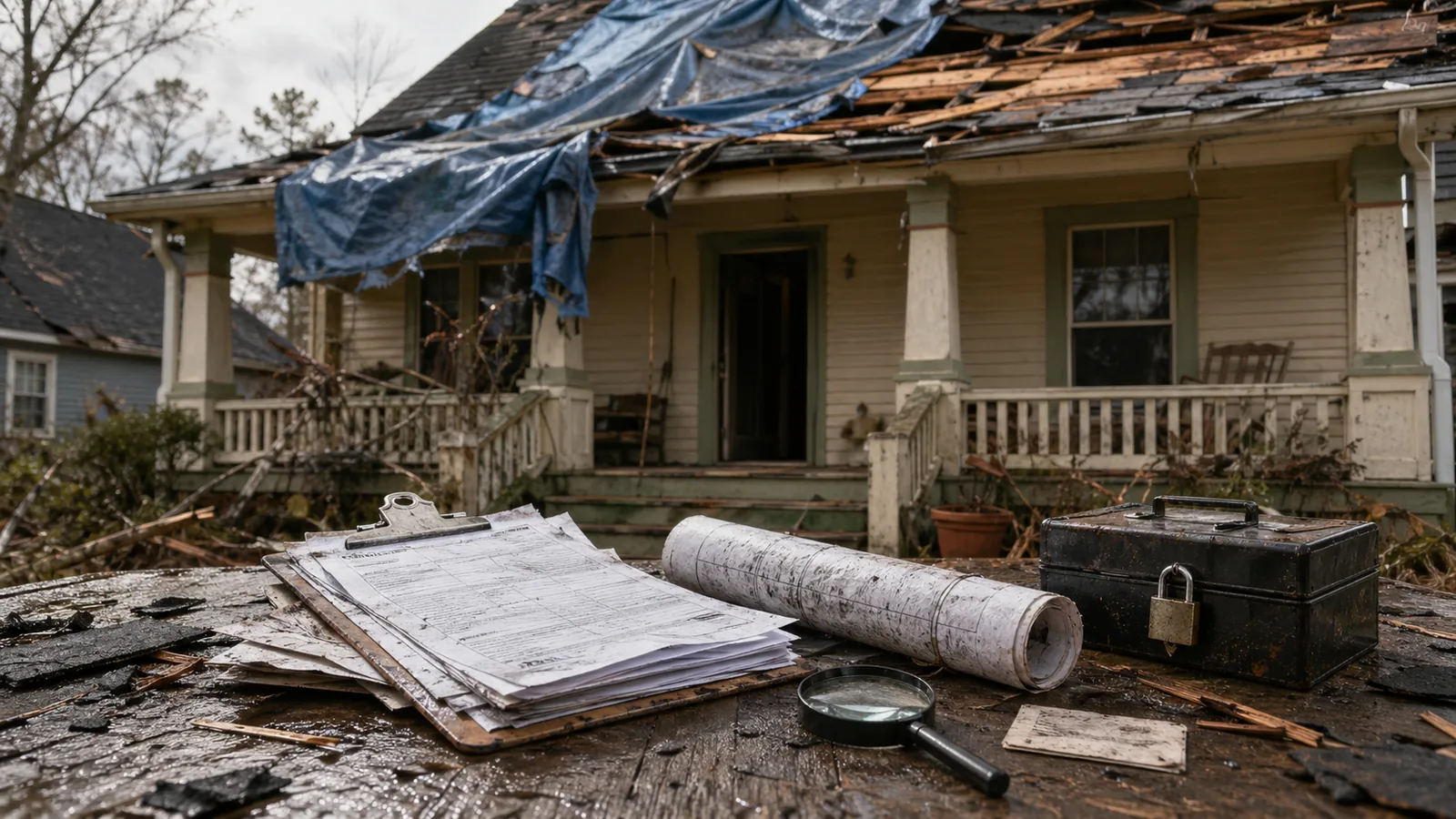
- Roof: Shoot from the ground first (use a zoom lens or smartphone zoom); capture missing shingles, visible decking, displaced flashing, and any areas where the roof line looks compromised. If it is safe to use a drone or access a second-floor window, get overhead angles.
- Siding and exterior: Document every panel crack, hole, dent (especially hail damage), and any area where water could be entering the wall cavity.
- Ceilings and interior walls: Water stains, bubbling paint, and sagging drywall all photograph well; get wide shots to establish location and close-ups to show severity.
- Standing water: Show depth with a ruler or common object for scale; capture the full perimeter of any water intrusion.
- Appliances and personal property: FEMA specifically recommends photographing the make, model, and serial number of any damaged appliances.
As FEMA puts it: "Take photos of your damage before you begin clean up and save repair receipts." If cleanup has already started before you read this, FEMA says to make a detailed list of losses and keep every receipt for disaster-caused expenses. Those receipts matter for both insurance reimbursement and tax purposes.
Mitigate immediate hazards without authorizing permanent repairs
Temporary stabilization is the right move — a signed full-replacement contract is not. The NAIC frames this clearly: "After documenting your damage, make temporary repairs, such as covering holes in your roof or boarding up broken windows." Insurers typically reimburse those costs when the underlying loss is covered by your policy.
Watch Out: The line between emergency mitigation and permanent repair is exactly where scam contractors blur the scope. A crew that shows up to tarp your roof and then hands you a contract for a full roof repair or replacement — before your adjuster has visited — is racing you toward a commitment you are not ready to make.
Temporary vs. permanent: how to keep the line clear
| Scope | Examples | OK before adjuster visit? | Requires written contract? |
|---|---|---|---|
| Emergency mitigation | Roof tarping, board-up, wet-vac standing water | Yes | Short written authorization + price |
| Water mitigation | Dehumidifiers, drying equipment, demo of soaked material | Often yes | Yes — detailed scope required |
| Permanent repair | Shingle replacement, drywall replacement, new windows | No | Yes — full written contract required |
For roof repair tarping, a professional crew typically charges by the square (100 sq ft); get the price in writing before they unroll anything. For water damage restoration, insist that equipment placement and demo scope is listed in writing before the crew starts. Emergency mitigation can bleed into thousands of dollars of permanent-scope work shockingly fast.
Call your insurer and start the claim file
Call your insurer as soon as your documentation is underway — not after permanent repairs begin. Most major carriers have 24/7 catastrophe lines; State Farm, for example, offers weather catastrophe claims via its app, online portal, local agent, or by calling 800-SF-CLAIM (800-732-5246) around the clock.
Insurance call checklist:
- Report the event date, cause (wind, hail, flooding), and affected areas of the home
- Ask whether your policy covers emergency mitigation costs and temporary repairs for water damage restoration
- Confirm how to submit photos and receipts for temporary repair reimbursement
- Ask when the claims adjuster will visit — NAIC confirms the insurer sends its adjuster at no cost to you
- Ask whether you should hold off on any permanent storm damage repair until after the adjuster's inspection
- Get a claim number and the adjuster's contact information before you hang up
Keep a dedicated folder — physical or digital — for every receipt, every photo timestamp, and every communication related to the claim. You will need this if a contractor dispute arises later.
How to tell a storm chaser from a legitimate contractor
A "storm chaser" is a contractor — often from out of state — who follows severe weather events, saturates a neighborhood with door-to-door pitches, collects large deposits, does shoddy work (or no work), and moves on before you can reach them. The FTC recommends getting three written estimates and checking that companies have licenses and insurance before any roof repair or storm damage repair work begins. The three-estimate rule alone disqualifies most chasers — they want to close before you have a chance to compare.
Legitimate local contractors are busy after a storm too, which means they will not pressure you to sign today. They have a physical address you can visit, a license number you can look up online, and references from neighbors in your zip code. Storm chasers have a rental truck, a stack of generic contracts, and a sense of urgency that exists entirely for their benefit.
Red flags unique to post-storm sales pressure
General scam articles warn you about high-pressure sales. What they miss are the specific scripts that appear only after a storm, and which the FTC has documented explicitly.
Storm-specific red flags — walk away if you hear any of these:
-
"Sign today and you get a discount." The FTC states directly: "Scammers say you'll get a discount, but only if you sign a contract right away." No legitimate contractor withdraws a fair price because you took 24 hours to verify their license.
-
"We were already in the neighborhood." This is the storm chaser's opening line. It is not a coincidence — it is a canvassing route following the damage map.
-
"We're insurance-approved." This phrase means nothing legally. No national body certifies contractors as insurance-approved for storm damage repair. An adjuster approves the scope and dollar amount; they do not pre-authorize specific contractors.
-
"We can waive your deductible." This is illegal in most states. A contractor who offers to cover your deductible as part of the deal is likely inflating the invoice to your insurer by the same amount — which is insurance fraud, and you can be implicated as well as them.
-
"Sign over your insurance check to us." The FTC flags this explicitly: "Scammers tell you to sign over your insurance check." Once you endorse that check to a contractor, your leverage to dispute work quality or incomplete roof repair is gone.
-
"We need full payment upfront to order materials." This is the single most common mechanism for contractor fraud after a disaster. A deposit is reasonable; full payment before work begins is not.
Verify license, insurance, and local presence
Before the first bid meeting, spend fifteen minutes confirming three things: the contractor holds a valid license in your state, they carry current general liability and workers' compensation insurance, and they have an actual local address — not just a P.O. box or a phone number.
Contractor verification checklist:
- License lookup: Most states publish contractor license databases online. Search your state's contractor licensing board by company name or license number. For storm damage repair contractors, also check whether the specific trade (roofing, electrical, plumbing) requires a separate specialty license in your state.
- Certificate of insurance (COI): Ask the contractor to have their insurer send you a COI directly — not a certificate the contractor prints themselves. Verify the coverage dates have not expired.
- Workers' comp: If a worker is injured on your property and the contractor has no workers' comp, your homeowner's insurance may be on the hook.
- Physical address: Google Street View the address. Does a real business operate there?
- Local permits: Confirm with your city or county building department whether the scope of work requires a permit. Licensing and permit requirements vary by state and city — there is no single national rule. A contractor who says "we never pull permits for this type of work" may be operating illegally in your jurisdiction.
- References: Ask for two to three local references from jobs completed in the past 12 months, not testimonials on their own website.
The FTC is direct on this point: "Before you pay, ask for their IDs, licenses, and proof of insurance."
What a storm repair estimate should include before you pay a deposit
A verbal quote is not an estimate. An estimate is a written document, and per FTC guidance it must include "a description of the work to be done, materials, completion date, and the price" plus the contractor's contact information. For storm-related work — where the scope can shift and insurance is often involved — a complete written estimate also needs payment milestones, lien waiver terms, and warranty language before you sign anything or pay a dollar.
Written estimate checklist — all fields must be present:
- Full contractor name, license number, physical address, phone, and email
- Scope of work described in enough detail that a second contractor could bid from the same document
- Materials specified by type, grade, and brand where applicable (e.g., "30-year architectural shingles, GAF Timberline HDZ, Charcoal")
- Scheduled start date and substantial completion date
- Total price broken down by phase (emergency mitigation, tear-off, materials, labor, cleanup)
- Payment milestones tied to project phases — not calendar dates
- Lien waiver terms (conditional lien waiver upon progress payment; unconditional lien waiver upon final payment)
- Warranty terms for both materials and labor — in writing, not verbal
- Change-order procedure: any scope changes must be written and signed before the work is done
Compare emergency bids versus permanent repair bids
The most common bidding confusion after a storm is comparing a quote for emergency mitigation against a quote for permanent restoration — they are completely different scopes, and mixing them up can cost you thousands.
The framework: Separate every bid into two distinct columns before you compare a single number.
| Line item | Emergency / Temporary | Permanent / Restoration |
|---|---|---|
| Roof | Tarping, debris removal | Full shingle replacement, decking repair |
| Water | Wet-vac, pump-out, dehumidifiers | Drywall replacement, mold remediation, flooring |
| Windows/doors | Board-up | New window or door installation |
| Typical timing | Within 24–72 hours | After adjuster visit and scope approval |
When one contractor quotes only tarping for your roof repair and another quotes full replacement, you are not looking at a price difference — you are looking at a scope difference. The FTC advises to "ask for an explanation if there's a big difference in price," and the explanation you are looking for is whether the bids actually cover the same work.
For water damage restoration, the same logic applies: a company quoting only equipment rental for drying is not competing with a company quoting full demo, drying, and rebuild. Ask each contractor to mark clearly which line items are temporary mitigation and which are permanent restoration. Get those three written estimates the FTC recommends before you choose — and the FTC explicitly warns: "Don't automatically choose the lowest bidder."
Never sign a blank or incomplete contract
A blank field in a contract is a blank check. If a contractor hands you a contract with the price, start date, scope, or materials fields empty and asks you to sign now and "we'll fill in the details later," refuse. The FTC is unambiguous: "Don't start work until you have reviewed and signed a written contract."
Fields that must be filled in before you sign any storm damage repair contract:
- Full legal name and license number of the contracting entity (not just a doing-business-as name)
- Complete scope of work — no "as needed" or "TBD" language for major line items
- All material specifications — brand, grade, color
- Start date and completion date
- Total price and itemized breakdown
- Payment schedule with specific milestones
- Permit responsibility (who pulls them, who pays for them)
- Warranty duration and what it covers
If any of these fields are blank, dated "TBD," or described in language so vague you could not hold the contractor accountable, do not sign until every field is complete.
How much to pay upfront for storm damage repair
A small deposit may be reasonable if it is tied to a real milestone like materials being ordered and delivered, but the FTC does not give a universal percentage rule. Instead, use the agency's payment warning as your guardrail: "And never make the final payment until the work is done and you’re satisfied." Structure your agreement so the largest payment comes after substantial completion, punch-list items are done, and you have inspected the work.
The FTC's rule on final payment is simple: "Never make the final payment until the work is done and you're satisfied." Structure your payment schedule to keep meaningful money in your hands until meaningful work is complete.
A reasonable payment structure for most storm damage repair jobs:
- Deposit: only after you have a signed contract and a clear written scope
- Progress payment: tied to materials delivered to site or a clearly documented phase of work
- Substantial completion payment: after major work is finished and only a punch list remains
- Final payment: after punch list completion, lien waivers are in hand, and your walkthrough is done
Why cash-only and full-upfront demands are danger signs
The payment method a contractor insists on tells you nearly as much as their license number. The FTC documents the full list of scam payment methods: "Scammers insist you pay by wire transfer, gift card, payment app, cryptocurrency or in cash." Every one of those channels has the same property: the money is gone and nearly impossible to recover once sent.
Use traceable payment methods:
- Personal check (creates a paper trail and can be stopped before cashing in extreme situations)
- Credit card (offers dispute rights under the Fair Credit Billing Act — the strongest consumer protection available)
- ACH bank transfer to a verified business account
Watch Out: If a contractor says they only take Zelle, Venmo, Cash App, wire transfer, or cash — especially for a roof repair or water damage restoration job over a few hundred dollars — that is a hard stop. Legitimate contractors should be willing to provide traceable payment options.
Never pay in full for roof repair or any other major scope before the work is complete. A contractor who cannot float material costs without your full payment is undercapitalized; that is a business risk that can easily become your problem.
Understand insurance checks, deductible rules, and endorsements
Your insurance claim check is your leverage — protect it. When a check arrives made out jointly to you and your mortgage lender, the lender has to co-sign before funds are released; that is standard and expected. What is not standard: a contractor asking you to sign that check over to them before work begins.
The FTC flags this directly: "Scammers tell you to sign over your insurance check." Once you do, you have lost your primary financial leverage to demand completed, quality work. Pay from your own account per the milestone schedule in the written contract; do not route insurance funds directly through the contractor.
On deductibles: your deductible is your financial responsibility under your policy, and a contractor who offers to "absorb" it or "waive" it is not doing you a favor. In most states, this practice is illegal. The contractor is typically absorbing it by inflating the invoice to your insurer — which is insurance fraud. You are responsible for your deductible; any honest bid will reflect that.
Your insurer's claims adjuster visits at no cost to you, per NAIC guidance. A public adjuster — a separate professional who negotiates on your behalf with the insurer — is different, and their services involve fees. If you hire one, make sure the fee agreement is in writing before they contact your insurer.
Do you need permits and licensed trades for roof or water damage repairs
The short answer: almost certainly yes for any permanent structural work, and maybe for some water mitigation depending on your city. There is no single national rule, and a contractor who confidently tells you "we never need permits for this" without checking your local jurisdiction is either uninformed or deliberately cutting corners.
For roof repair, most jurisdictions require a building permit for full shingle replacement or any structural decking work. Some cities exempt like-for-like repairs under a certain square footage threshold; others require a permit for anything beyond maintenance. For water damage restoration that involves demo of walls, ceilings, or flooring, many jurisdictions require permits, especially if electrical or plumbing systems are exposed.
The FTC recommends checking licenses and insurance before any home repair, but permit compliance falls on the contractor to initiate and on you to confirm. Ask your local building department — most have a simple online portal or a 10-minute phone call process — whether the proposed scope requires a permit. A legitimate contractor will pull the permit themselves and post it visibly at the job site.
When temporary tarping is enough and when a permit may be required
Temporary tarping — covering holes in your roof with polyethylene sheeting or a professional tarp system — is stabilization, not construction. Both NAIC and FEMA support doing this immediately after a storm, and in most jurisdictions it does not trigger a building permit requirement.
The permit question activates when temporary becomes permanent. Use this decision rule: if the work involves removing and replacing structural materials, engaging licensed trades (electricians, plumbers), or will be covered by drywall or other permanent finishes, assume a permit is needed and verify before work starts.
Pro Tip: Ask your contractor to include permit costs and the permit-pull process as a line item in the written estimate. If they push back on that request, ask why. A contractor who routinely works in your area will know your jurisdiction's permit requirements for roof repair without hesitation.
Questions to ask before hiring a storm damage contractor
Treat the pre-hire conversation as a job interview. You are the employer. A contractor who bristles at direct questions about their license, subcontractors, or warranty is telling you something important.
Use this interview script before you sign anything:
- References: "Can you give me two to three local references from jobs completed in the past 12 months?"
- Local presence: "What is your physical business address, and how long have you operated in this market?"
- Licensing and insurance: "What is your state license number, and will your insurer send me a certificate of insurance directly?"
- Subcontractors: "Will any part of this job be subcontracted, and are those trades licensed and insured?"
- Scheduling: "What is your realistic start date, your completion date, and what causes a schedule change?"
- Change orders: "If you find additional damage after demo starts, will you put the change order in writing before extra work begins?"
- Warranty: "What does your labor warranty cover, and for how long?"
- Permit responsibility: "Who pulls the permit, who pays for it, and where will it be posted?"
The FTC recommends three written estimates and explicitly says, "Don't automatically choose the lowest bidder." Use those estimates to compare scope, not just price, and choose the contractor who answers these questions clearly and gives you time to verify them.
Ask for lien waivers and warranty terms in writing
A lien waiver is a document in which the contractor (and any subcontractors or material suppliers) confirm they have been paid and waive their right to place a mechanic's lien on your property for that amount of work. Lien-waiver practices vary by state and contract form, so confirm what your jurisdiction requires before you rely on any form. Without signed waiver paperwork, a subcontractor you have never met can still create a payment dispute if the general contractor fails to pass money down the chain.
Lien waiver and warranty checklist:
- Conditional lien waiver: Ask whether one is available at each progress payment and whether it becomes effective only when the check clears.
- Unconditional lien waiver: Request this at final payment if your state or contract form uses it.
- Supplier lien waiver: Ask whether major material suppliers (roofing distributor, lumber yard) have been paid and whether they will provide a waiver.
- Labor warranty: Ask for the duration and scope in writing; a minimum one year is common on many roof repair and water restoration jobs.
- Material warranty: Confirm the manufacturer's warranty terms for shingles, membranes, or other major materials, and verify that the contractor's installation method does not void it.
The FTC requires a reviewed, signed written contract before work begins. Lien waivers and warranty terms belong in that contract, not as a handshake promise after work is finished.
Storm damage scam checklist you can save before the first bid
Screenshot this, print it, text it to yourself — use it the next time a storm hits and a stranger offers to fix your roof repair, water damage restoration, or any other storm damage repair before you have had a chance to think.
Save this in four stages:
1) First 24 hours - [ ] Photograph and video all damage before cleanup or repairs begin - [ ] Separate damaged items from undamaged; save all damaged materials until adjuster visits - [ ] Make or arrange temporary repairs (tarping, board-up) — not permanent work - [ ] Call your insurer; open a claim file; get a claim number - [ ] Save every receipt for emergency mitigation costs
2) First estimate - [ ] Get at least three written estimates - [ ] Confirm each estimate covers the same scope: temporary mitigation or permanent restoration, not both mixed together - [ ] Verify the written estimate includes scope, materials, start date, completion date, price, and contractor contact information - [ ] Check license, insurance, and local address before you compare prices
3) First deposit - [ ] Do not pay a dollar until you have a signed written contract - [ ] Keep the deposit tied to a real milestone, such as materials ordered and delivered - [ ] Use traceable payment: check or credit card - [ ] Collect lien waivers with each progress payment where your state or contract form uses them
4) Red flags — stop and verify if you see any of these: - [ ] Pressure to sign today for a discount - [ ] Claims of being "insurance-approved" - [ ] Offer to waive your deductible - [ ] Request to sign over your insurance check - [ ] Demand for full payment upfront - [ ] Cash-only, wire transfer, gift card, or cryptocurrency payment request - [ ] Blank or incomplete contract fields
FAQ about home repair scams after storms
Should I pay a contractor upfront after storm damage?
A deposit may be reasonable if it is tied to a signed written contract and a real milestone such as materials being ordered or delivered. What you should not do is make the final payment before the work is done. The FTC says: "And never make the final payment until the work is done and you’re satisfied." Use that as your rule for the last check, and keep the payment traceable — check or credit card — so you can dispute a problem if needed.
How do I know if a storm chaser contractor is legit?
Start with the basics: verify the state license number online, ask for a certificate of insurance sent directly from the insurer, confirm a physical local business address, and request two or three local references from the past year. A legitimate contractor will answer without pressure. The FTC recommends getting three written estimates and says, "Don't automatically choose the lowest bidder." If the contractor rushes you to sign, will not provide proof, or offers a discount only if you sign today, treat that as a warning sign.
What should a home repair contract include after storm damage?
Per FTC guidance, a written estimate — which becomes the basis of your contract — must include a description of the work, the materials, a completion date, and the price. For storm-specific work, add payment milestones tied to project phases, permit responsibility, change-order procedures, and written warranty language for both materials and labor. The FTC states clearly: "Don't start work until you have reviewed and signed a written contract." Every field must be complete before you sign.
Is it safe to sign over my insurance check to a storm contractor?
No. The FTC identifies this as a scam tactic: "Scammers tell you to sign over your insurance check." Once you endorse that check to a contractor, you lose the financial leverage to demand completed, quality work. Pay contractors directly from your own account per the written payment schedule; do not route insurance proceeds through the contractor. Your insurer's claims adjuster visits and assesses damage at no cost to you — that adjuster approves the claim amount, not the contractor.
Do I need a permit for emergency storm repairs?
Temporary work — tarping a roof, boarding windows, running dehumidifiers — generally does not require a permit in most jurisdictions. Permanent work almost always does: full roof replacement, structural repairs, drywall replacement involving electrical or plumbing. Because requirements vary by state and city, call your local building department before authorizing permanent work and confirm the scope in writing with your contractor, including who is responsible for pulling any required permits.
Sources & References
- FTC: How to Avoid a Home Improvement Scam — Primary FTC guidance on written estimates, contracts, and payment red flags
- FTC: How to Avoid Scams After Weather Emergencies and Natural Disasters — Storm-specific scam tactics including insurance check endorsement and untraceable payment demands
- FTC: Pass It On — Home Repair Scams — Three-estimate rule, license and insurance checks, written contract requirement
- FEMA: Don't Wait to Clean Up or Make Repairs — FEMA guidance on beginning cleanup without waiting for inspection
- FEMA Disaster 4336 — Damage Documentation — Photo and receipt documentation guidance
- FEMA Disaster 4633 — Cleanup Before Inspection — FEMA guidance on documenting losses when cleanup precedes inspection
- NAIC: Navigating the Claims Process to Recover and Rebuild — Temporary repair reimbursement, claims adjuster process
- NAIC: After a Storm, Read the Fine Print — Insurance check endorsement risks, public adjuster vs. company adjuster
- State Farm: Weather Catastrophe Claims — 24/7 catastrophe claim filing options
Keywords: FTC home improvement scam guidance, weather-related disaster scams, licensed and insured contractor, written contract, scope of work, payment milestones, lien waiver, certificate of insurance, roof tarping, water mitigation, storm damage repair, water damage restoration, deductible, insurance claim adjuster, local permit requirements