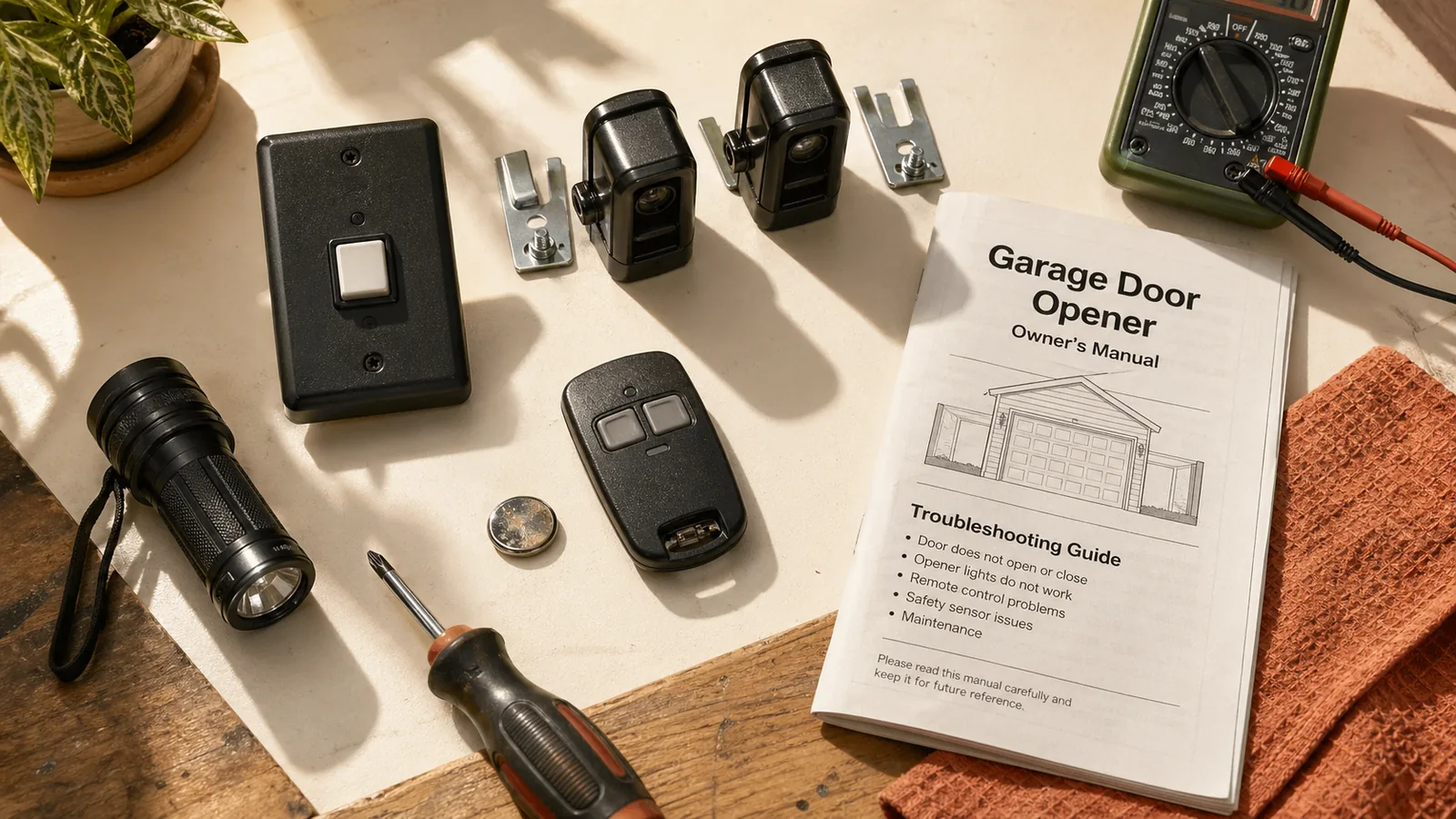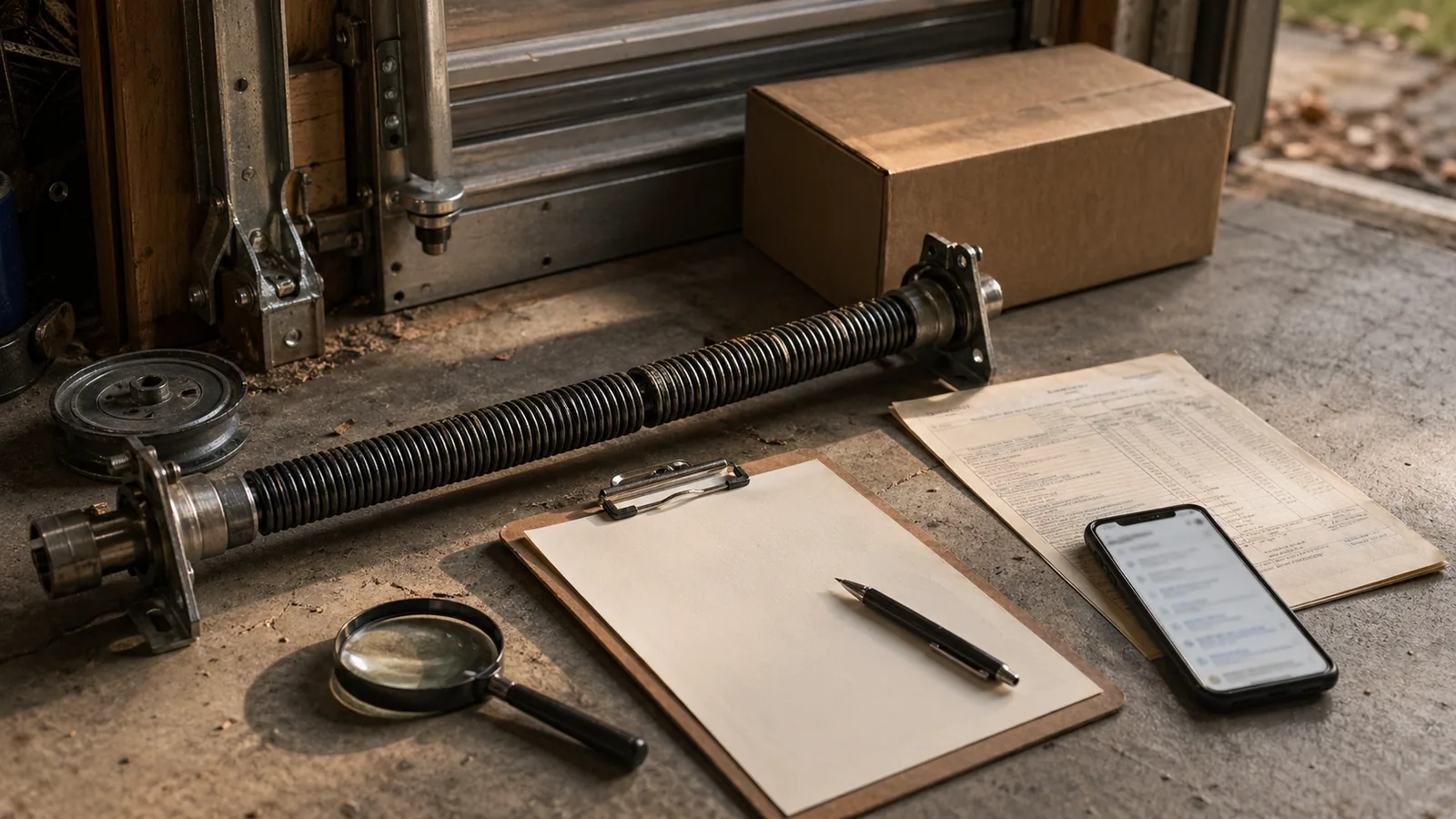
Your garage door stopped working at 7 p.m. on a Tuesday. You search for emergency repair, click the first result, and a tech is at your house within the hour. That speed and convenience is exactly what scammers count on. According to BBB's scam alert on garage door repair, these operations deliberately target homeowners searching for emergency service online — and they often appear at the top of search results. The good news: every one of these scams follows a predictable playbook, and knowing the nine red flags before anyone touches your door puts you back in control.
Garage door repair scams: the 9 red flags to spot before you approve work
A legitimate garage door repair service competes on skill, reputation, and fair pricing. A scam operation competes on urgency and search-result placement. Here are the nine warning signs that tell you which one showed up.
The 9 Red Flags at a Glance:
- Generic or unregistered business name — sounds like "Local Garage Pros" or "City Door Service" with no state registration to back it up
- No physical address — can't give you a street address, or the address doesn't check out
- No uniform or marked vehicle — tech arrives in an unmarked personal truck with no ID badge
- No license or insurance proof — refuses or stalls when you ask for credentials
- Bait-and-switch low service fee — quotes $29 to show up, then the invoice balloons after arrival
- Pressure to replace springs or the opener motor — pushes full replacement without explaining the diagnosis
- Upfront payment demand — wants cash or full payment before starting or completing work
- Refusal to write the estimate — gives you a verbal number only, won't put it on paper
- Refusal to explain the diagnosis — can't or won't tell you specifically what failed and why
As the BBB scam alert puts it: "Unrealistic low prices: Many scams advertise a low fee for the service call, only to demand more money for additional 'repairs.' If a quote seems too good to be true, it probably is."
Any single flag warrants caution. Two or more flags on the same call warrant a firm "let me get back to you" before anyone opens a tool bag.
Generic or unregistered business name
A scammer's business name is designed to rank in search results, not to build a traceable reputation. Names like "All City Garage Repair," "Quick Fix Garage Doors," or "Same Day Door Service" are intentionally generic. BBB warns that these operators often use multiple names — the same crew might operate under three or four names across different zip codes to dilute complaint histories and stay ahead of bad reviews.
The cross-check is simple: search your state's Secretary of State business registration database for the exact name the company gave you on the phone. Most states have a free public lookup online. If the name doesn't appear as a registered entity — or if you find five variations of the same name all registered to the same address — that's your answer. A legitimate local company has one name they stand behind and a registration history you can verify in under three minutes.
Pro Tip: Ask for the company's legal business name, not just what they say on the phone. "We're ABC Garage Doors LLC" is verifiable. "We're your local garage guys" is not.
No physical address or technician identification
A legitimate garage door repair business has a real location — a shop, a warehouse, or at minimum a registered commercial address where parts are stocked and records are kept. BBB flags scam operators who provide no real showroom or use a fake address when pressed. If a dispatcher hesitates, gives you a P.O. box, or gives you an address that maps to a vacant lot or a UPS Store, stop there.
The same logic applies once the tech arrives. Check for all of these before you unlock your side door or garage:
On-site identification checklist: - Marked vehicle with the company name, phone number, and logo on the door or hood - Technician wearing a branded uniform or company shirt (not jeans and a personal hoodie) - Printed or digital job ticket with the company name, your address, and the scope of the call - Photo ID badge with the technician's name and the company name visible - Business card that matches the company name you searched before dispatch
If the tech pulls up in a personal truck and introduces himself only by first name, ask for a business card before you proceed. An inability to produce any of the above items is a firm stop signal.
Bait-and-switch low service fee
The standard pattern: a company advertises a $29, $39, or $49 service call fee. That fee sounds reasonable — comparable to what you'd pay a plumber or HVAC tech just to show up. But the service call fee is the hook, not the price. Once the tech is in your driveway and your door is partially disassembled, the real invoice appears.
Angi's 2026 cost data puts average garage door repair at $264, with labor alone running $150–$450 per job. Angi's spring replacement data puts garage door spring replacement at $150–$350 per spring, plus labor in your area. A $29 service call that turns into a $450+ bill without warning is the scam in action. The reframe usually sounds like: "The service call covers me coming out, but your garage door spring repair is separate — that's parts and labor on top."
That explanation isn't automatically fraudulent. The problem is when no one told you the full price structure before dispatch, and now you're standing in your driveway with a tech who won't leave until you authorize the work. If the number you're hearing is dramatically higher and appeared only after the tech arrived, the low service fee was bait.
Watch Out: Any company that refuses to give you a total cost estimate before dispatch — not just the service fee — is setting up a bait-and-switch. The service fee should always be disclosed as separate from parts and labor, and you should get a full estimated range before the truck rolls.
Pressure to replace springs or opener motor
Diagnosis should always come before a replacement recommendation. A broken torsion spring is a straightforward diagnosis — the spring is visibly separated or deformed and the door won't lift. A failing opener motor is not always straightforward. LiftMaster's diagnostic guidance shows that if a garage door opener travels less than 6–8 inches, stops, reverses, hums briefly, or doesn't move at all, the unit is responding to a fault condition that should be diagnosed — not automatically replaced.
Here's the honest symptom-vs-diagnosis breakdown:
| Symptom | Likely cause | Correct response |
|---|---|---|
| Door won't lift, spring visibly broken | Broken torsion or extension spring | Spring replacement — repair is not an option |
| Door reverses immediately after closing | Safety sensor misalignment or wiring fault | Sensor check and realignment before any replacement |
| Opener hums but door doesn't move | Gear assembly failure or stripped drive | Repair the component first rather than replacing the entire opener |
| Opener unresponsive to remote and wall button | Logic board, remote programming, or power issue | Diagnostic check before any replacement |
| Door travels part-way and stops | Limit setting error or obstruction | Limit adjustment, not opener replacement |
BBB specifically identifies pressure tactics and unnecessary upsells — including pushing spring and opener replacement without clear diagnosis — as core scam behaviors. If a tech recommends replacing your opener or both springs within five minutes of arrival and without explaining the specific failure, ask them to show you the problem and explain why repair isn't possible.
What a legitimate garage door repair company should show up with
A reputable garage door repair service doesn't just pass the red-flag checklist — it proactively provides the information that lets you confirm they're legitimate. According to BBB's garage door repair scam alert, you should verify credentials and insurance, insist on a written estimate, and take time before authorizing work. Here's what that looks like in practice.
At a Glance: Verify the company name, physical address, license number, and insurance certificate before dispatch; then confirm the truck is marked, the technician is ID'd, and the estimate is written before any work starts.
Pre-work verification checklist: - Company name matches state business registration - Physical address verifiable on Google Maps (not a P.O. box or virtual office) - License number provided and checkable on your state's contractor licensing board - General liability insurance certificate available on request - Branded vehicle and uniformed technician on arrival - Written, itemized estimate provided before any work starts - Technician explains the specific failure in plain language before touching parts
A legitimate company won't flinch at any of these requests. A scam operation will push back, rush you, or claim the paperwork "takes too long."
Ask for the company name, address, license number, and insurance certificate
Make these four requests during the phone call — before you schedule dispatch. Licensing requirements for garage door technicians vary by state: California, Florida, Texas, and others have specific contractor license requirements, while some states have no state-level license requirement for this trade. But regardless of what your state requires, a legitimate company can tell you their legal business name, physical address, whatever credentials they hold, and their insurance carrier. If they can't answer basic questions about who they are, don't send them to your house.
Homeowner call script (use this before dispatch):
"Before I schedule, I have a few quick questions. What's the full legal name of your business? What's your physical business address? Do you have a state contractor's license, and if so, what's the license number? Are you insured with general liability coverage? And will you provide a written estimate with parts and labor broken out before starting any work?"
Legitimate dispatchers answer all five questions without hesitation. If there's a pause, a deflection ("we'll go over all that when we get there"), or a refusal, hang up and call the next company.
Check BBB, state licensing board, reviews, and complaint patterns
Run this four-step vetting sequence before the tech arrives — it takes about eight minutes total:
-
BBB search — Go to bbb.org and search the company's exact legal name and city. Check their rating, the volume of complaints filed in the past 12 months, and whether complaints were resolved or closed without resolution. Also run the company name through BBB Scam Tracker — if the same name or phone number appears in scam reports from other cities, you have your answer.
-
State licensing board — Search your state's contractor licensing board (usually found by Googling "[your state] contractor license lookup"). Enter the company name or license number they gave you on the phone. If the license isn't active or the name doesn't match, stop.
-
Google reviews — Search the exact company name plus your city. Look at the one-star reviews specifically. Scam patterns show up in the language: "quoted $39, final bill was $400," "pressure to replace everything," "wouldn't give me a written estimate."
-
Yelp and Nextdoor — Repeat the review scan. Neighborhood-level complaints on Nextdoor are especially useful because neighbors often name the same company after being targeted.
What a real truck, uniform, and technician visit should look like
When the tech pulls up, take thirty seconds before you open the door. A legitimate arrival looks like this: BBB's garage door repair scam guidance says to verify credentials before you agree to repairs, and the vehicle, ID, and written job ticket are part of that check.
- Vehicle: Company name, logo, and phone number are printed or magnetically attached to both front doors. The truck carries visible signage — not a blank white panel van or personal pickup.
- Uniform: Branded shirt or jacket with the company name. Work pants and boots. Not street clothes.
- ID badge: Photo ID with the technician's name and the company name, worn visibly or produced immediately on request.
- Job ticket: A printed or digital work order with your address, the nature of the call, and the company's contact information.
- Communication style: The tech introduces themselves by name and company, asks to see the door before making any pronouncements, and explains what they're observing as they inspect.
A tech who arrives in street clothes, drives an unmarked vehicle, and immediately tells you the spring and opener both need replacing without inspecting either has just shown you three of the nine red flags simultaneously.
What a fair spring repair quote should include
Angi's 2026 data puts garage door spring replacement at $150–$350 per spring, plus labor, with average overall repair costs at $264 according to their broader repair cost data. Those ranges mean a single-spring replacement on a standard single-car door should produce a written estimate in the $200–$450 range for parts and labor combined — and a two-car door with two torsion springs will run more. An estimate that starts at $800 for a broken spring on a standard door, or that doesn't separate parts from labor, warrants immediate questions.
Spring repair cost breakdown:
| Line item | Typical range | Notes |
|---|---|---|
| Service call fee | $75–$150 | Covers dispatch and diagnosis; sometimes waived if you proceed with repair |
| Spring part cost | $15–$75 per spring | Depends on type and cycle rating |
| Labor | $100–$200 | Spring replacement labor |
| Safety adjustment and balance test | Included | Should be part of labor, not a separate add-on |
| Total | Written clearly | Tax noted separately |
If the estimate is a single line that says "spring repair — $450" with no breakdown, ask for the parts-and-labor split before you sign anything.
Torsion spring vs extension spring cost line items
The type of spring on your door determines the complexity and cost of the job, and a legitimate tech explains which system you have before quoting.
Torsion springs sit horizontally above the door on a metal shaft. Most modern single-family homes use them. They're under extreme tension, they're more durable (rated for 10,000–20,000 cycles), and they cost more to replace — but the replacement itself is cleaner and faster for an experienced tech. HomeAdvisor's 2025 data puts average spring repair at $250, with most homeowners spending $150–$350 depending on spring type and whether one or both are replaced.
Extension springs run along the horizontal tracks on each side of the door. They're common on older or lighter doors. Parts cost less, but the cables and pulleys that work with extension springs are more likely to show wear at the same time.
One legitimate recommendation worth noting: Angi advises replacing both torsion springs at once even if only one has broken, because the surviving spring has the same wear history and replacing it proactively avoids a second service call within months. That's real advice — not an upsell — but the technician should explain this reasoning rather than just adding a second spring to the bill.
| Spring type | Typical part cost | Typical labor | Typical total (one spring) |
|---|---|---|---|
| Torsion (standard) | $15–$75 | $100–$200 | $150–$350 |
| Extension (pair) | $15–$45 each | $75–$150 | $150–$250 |
Common spring upsells homeowners should question
A broken spring is a real repair — but it's a contained one. Watch for these add-ons, which sometimes appear on estimates without a clear explanation of why they're needed:
- Bearings and end bearing plates: Legitimate if inspected and worn, but they don't fail simultaneously with every spring. Ask the tech to show you the worn bearing before approving.
- Cables: The lift cables can fray over years of use and should be inspected whenever springs are replaced. Replacing them during the same visit is reasonable if they show actual wear. Replacing them automatically on every spring job is an upsell.
- Cable drums: These rarely need replacement unless cracked or bent. If a tech recommends them without showing you the damage, ask why.
- Bottom brackets: These are under tension and should only be replaced if visibly cracked or bent. They're not a routine replacement item.
The BBB's guidance is clear: demanding more money for additional repairs once on site — without a specific diagnosis to justify them — is the scam pattern. Ask about each added line item: "What did you observe that tells you this part needs replacement right now?"
What a fair opener repair quote should include
Angi's 2026 data shows parts for garage door repairs range from $5 to $200, with labor running $150–$450. A legitimate opener repair — not replacement — should come in well within that range for most common failures. A diagnosis-only call that results in a $1,200 recommendation to replace a five-year-old opener without any attempt at component-level repair is a major warning sign.
Opener repair cost breakdown:
| Line item | Typical range | Notes |
|---|---|---|
| Diagnostic fee | $75–$150 | Should be disclosed upfront |
| Specific part(s) needed | Varies | Named individually — gear kit, logic board, photo-eye sensors, drive belt, chain |
| Part cost | $5–$200 | Itemized per component |
| Labor | $150–$450 | Separate from parts |
| Programming or remote pairing | As needed | Listed if applicable, not buried in a lump labor charge |
| Total | Itemized | So you can compare against a second estimate |
Any estimate that says "opener repair or replacement — $600" without breaking out what's actually wrong and what part fixes it is not a real estimate.
Opener motor, gear, belt, and sensor repairs vs replacement
Most garage door opener failures are component failures, not whole-unit failures. Before approving a full replacement, push for a specific component diagnosis.
Repair-vs-replace decision guide:
- Gear assembly failure (grinding noise, door doesn't move, motor runs): A stripped plastic gear kit is a component-level repair, not a reason to replace the entire opener.
- Drive belt or chain failure (broken, severely worn, or derailed): Belt replacement runs $25–$75 in parts. Legitimate repair on units less than 15 years old.
- Photo-eye sensors (door reverses immediately, one LED off or flickering): LiftMaster's troubleshooting guidance says to check wiring at the motor unit terminals before replacing sensors. Sensor replacement is inexpensive — typically $20–$50 for the parts — and is not a reason to replace the whole opener.
- Logic board failure: This is a legitimate reason to consider replacement, especially on units over 10–12 years old, because logic board cost can approach the cost of a new budget opener.
- Pre-1993 units without safety sensors: LiftMaster notes that openers without functioning safety sensors are not compliant with current federal safety regulations. A tech recommending replacement of a legitimately non-compliant unit is giving you accurate information.
Genie's troubleshooting resources explicitly list Safe-T-Beam sensor issues, wiring faults, and limit-setting errors as things to check before replacing opener components — because these faults mimic motor failure and are far cheaper to resolve.
Brand-specific opener clues homeowners should hear
A tech who knows what they're doing will speak in brand-specific language. Here's what competent diagnosis sounds like for the three most common opener brands:
LiftMaster: The tech should reference the specific diagnostic code (LiftMaster units blink an LED or display a code on the logic board). A statement like "your 8550W is showing a sensor fault — LED is solid on the sending unit but off on the receiving unit, which tells me the alignment is off or the wiring is cut" is a real diagnosis. "Your motor is shot" with no code reference is not.
Genie: Genie units use Safe-T-Beam infrared sensors and have model-specific limit and force settings. A knowledgeable tech mentions the specific model (e.g., 2024, 2042, 1022 series) and references what the unit is doing in relation to the beam system or limits before recommending any part replacement.
Chamberlain: Chamberlain units share a platform with LiftMaster (both are Chamberlain Group products). The tech should note the model, check sensor wiring at the header bracket and motor terminals, and reference whether the unit qualifies for myQ Smart Garage Control compatibility, which works with most opener brands manufactured after 1993 only if safety sensors function.
If the tech can't tell you the model number of your opener or explain what specific component failed based on observed symptoms, they haven't diagnosed anything.
Phone script to use before you let anyone dispatch
The BBB's core advice — verify credentials and insurance, get multiple estimates, insist on a written estimate, and take time before agreeing to repairs — all happen before the tech is in your driveway. The phone call is your filter. Use it.
The most common mistake homeowners make in an emergency situation is treating the phone call as a scheduling call. It's actually a qualification call. You are interviewing the company before you give them your address.
Exact questions to ask the dispatcher
Run through these five questions in order. Each one has a yes/no checkpoint:
-
"What is the full legal business name of your company?" Checkpoint: Does it match what appeared in the search result? Write it down.
-
"What is your physical business address?" Checkpoint: Is it a real street address? Can you find it on Google Maps in under 30 seconds?
-
"Do you hold a state contractor's license, and if so, what is the license number?" Checkpoint: Licensing varies by state — but they should know their status and give you a number if they have one. Hesitation or a vague "we're certified" is not an answer.
-
"Are you insured with general liability coverage? Can you provide a certificate of insurance?" Checkpoint: Yes and yes. A company without liability insurance leaves you exposed if something goes wrong on your property.
-
"Will you provide a written, itemized estimate — with parts and labor listed separately — before starting any work?" Checkpoint: The answer must be yes. "We'll give you a price when we see the door" is not a yes.
Stop-if-they-won't-answer rule: If the dispatcher declines, deflects, or can't answer any of these five questions, don't authorize dispatch. Say "Let me do a bit more research and I'll call you back" and move to the next company on your list. This script takes under two minutes and filters out most scam operations.
What to say if they refuse a written estimate
If a dispatcher or tech refuses to provide a written estimate, use this script:
"I need a written estimate with parts and labor broken out before I can authorize any work. That's my requirement before anyone starts. If that's not something you can provide, I'll need to find a company that can."
Then hang up or end the on-site conversation. BBB is direct on this point: insist on a written estimate that details scope and costs. A refusal to provide one is a scam signal, not a business policy to negotiate around. Do not proceed.
How to verify a company before the door is touched
The fastest scams work because the homeowner authorizes work before checking anything. Five minutes of online verification — run while the tech is still en route — is enough to catch most fraudulent operators. Use this workflow in sequence, and use BBB Scam Tracker as your final cross-check step.
BBB accreditation and complaint history
Search the company at bbb.org. Look at three things, in this order:
- Complaint volume: How many complaints in the past 12 months? More than a handful for a small local company is a signal worth noting.
- Resolution pattern: Were complaints resolved to the customer's satisfaction, or closed without resolution? "Closed without resolution" repeatedly means the company didn't address the problem.
- Accreditation status: BBB accreditation means the company pays a fee and agrees to BBB's standards — it is not a guarantee of honest work. An accredited company with ten unresolved complaints in the past year is more concerning than an unaccredited company with zero complaints.
Use accreditation as one data point, not a green light. A clean complaint history matters more than the badge.
State board lookup and local license checks
Search your state's contractor licensing board for the name or license number the dispatcher gave you. The lookup is free and public in every state that requires licensing. In states like California (CSLB), Florida (DBPR), and Texas (TDLR), you can verify a contractor license in under 60 seconds. If your state doesn't license garage door contractors specifically, search for a general home improvement or specialty contractor license instead.
If the company operates in a state with no relevant licensing requirement, they should still be able to tell you that clearly and provide their insurance certificate instead. A company that hides behind "we don't need a license in this state" as an excuse not to show you any credentials at all is using a loophole to avoid accountability — not a reason to lower your guard.
Pro Tip: Even in no-license states, a legitimate company will carry general liability insurance and workers' compensation for their technicians. Ask for both. Homeowners can be held liable for injuries on their property if a contractor isn't covered.
Review patterns that signal a bait-and-switch operation
Read the one-star reviews on Google and Yelp with this specific language in mind. Bait-and-switch operations produce a very consistent complaint vocabulary:
- "Quoted me $39 over the phone, final bill was $375"
- "Tech said the spring and opener both needed replacing"
- "Refused to give me a written estimate until after the work was done"
- "Felt pressured to approve the work immediately"
- "Different company name on the invoice than who I called"
One review with this language could be an outlier. Three or more reviews with the same pattern from different customers in different months is the scam confirmed. Also note the five-star review pattern: scam operations often have a cluster of generic, short, five-star reviews ("Great service! Fast and affordable!") followed by several detailed, angry one-star reviews. That ratio tells a story.
What to do if a technician starts pressuring you on site
The on-site pressure moment is where most scams succeed — because the homeowner feels trapped. The tech is already there. The door may already be partially open. You want it fixed today. The scammer knows all of this and uses it.
BBB's guidance is clear: take time before agreeing to repairs. You are not obligated to authorize any work you haven't agreed to in writing, and the tech being in your driveway is not a reason to approve a $600 repair you didn't expect.
Pause-and-exit decision tree:
- Tech arrives → request written estimate before any work begins
- If estimate is verbal only → invoke the written estimate requirement; if refused, decline the job
- If estimate seems high → say "I need to review this before I authorize anything; I'll call you back today"
- If tech claims urgency ("the door is dangerous now, you have to decide immediately") → recognize this as a pressure tactic; legitimate safety concerns can be temporarily addressed by manually securing the door
- If tech becomes aggressive or refuses to leave → go inside, do not hand over payment for unauthorized work, and call local non-emergency police if needed
Decline the job, pay only what you authorized, and get names
If you've decided not to proceed, you owe payment only for what was explicitly authorized before work started — typically the stated service call fee. Pay that amount. Do not pay for parts you didn't approve, labor you didn't authorize, or a "diagnostic fee" that was never disclosed before dispatch.
Before the tech leaves, write down: - The technician's full name (or get it from their ID badge) - The company name and phone number on the work order - The truck's license plate number - The amount you paid and the payment method
If you believe a scam occurred — particularly if you were charged for unauthorized work or felt coerced — file a report with BBB Scam Tracker and leave a detailed review on Google. These reports help other homeowners in your area identify the same operator.
When to call a different contractor or the manufacturer
Get a second estimate any time a technician recommends replacing both springs and/or the opener motor without showing you a specific failure and explaining why repair isn't viable. The threshold is simple: if the repair recommendation costs more than $400 and appeared within ten minutes of arrival without a clear written diagnosis, call a second company.
For opener replacement specifically: if the unit is less than 10 years old and a tech recommends full replacement, contact the manufacturer directly before authorizing anything. LiftMaster's safety information and Genie's troubleshooting resources both publish troubleshooting guides and have customer service lines that can help you understand whether the symptoms you're describing warrant replacement or repair. Chamberlain also offers compatibility guidance for its myQ ecosystem that can clarify whether your existing unit can be upgraded rather than replaced.
FAQ about garage door repair scams and emergency replacements
Should a garage door repair company ask for payment upfront?
No — and BBB lists an upfront payment demand as a direct warning sign of a garage door repair scam. Standard practice is payment after work is completed and you've confirmed the door operates correctly.
The only narrow exception: if a company needs to special-order a non-standard part — an uncommon torsion spring size, a discontinued opener component — a partial deposit toward that specific part cost is reasonable. But that deposit should only happen after you've received a written estimate naming the part, its cost, and the expected timeline. Never pay a full invoice upfront, and never pay cash for a job that hasn't been completed and inspected.
Can a technician diagnose the problem without replacing springs or the opener?
Yes — diagnosis absolutely precedes replacement in legitimate service. A broken spring is one of the few items where the failure is visually obvious and repair isn't an option (a broken spring can't be welded back together). But opener failures, sensor issues, cable fraying, and gear wear are all diagnosable conditions that may be repairable rather than replaceable.
LiftMaster and Genie both publish detailed troubleshooting workflows that step through sensor alignment, wiring checks, limit settings, and diagnostic codes before any component replacement is recommended. A tech who skips those steps and jumps to "the whole unit needs to go" hasn't diagnosed anything. Ask them to walk you through the fault code or the specific failure observation before you approve anything.
What should a written estimate include for garage door service?
A proper itemized written estimate for garage door service should include every one of these line items:
- Scope of work: A plain-language description of what will be done ("replace one torsion spring, balance test, lubricate hardware")
- Parts list: Each part named individually with its unit cost
- Labor: Stated separately from parts, as a flat fee or hourly rate with estimated hours
- Service call fee: Listed if applicable, with a note on whether it's credited toward the repair
- Programming or remote work: Itemized if the opener is involved
- Total price: Including tax, clearly stated
- Company name, address, and license number
- Technician's signature
If the estimate you receive doesn't include all of these elements, ask for a revised version before signing. BBB's guidance is that the estimate details scope and costs specifically — a one-line total is not a written estimate.
Sources & References
- BBB Scam Alert: Garage Door Repair Scams — Primary BBB warning with red flags and consumer guidance
- BBB Scam Tracker — Cross-check tool for reported scam patterns by company name and phone number
- Angi: Most Common Garage Door Repair Costs (2026) — Labor and parts cost ranges for garage door repair
- Angi: How Much Should Garage Door Spring Replacement Cost? (2026) — Spring replacement cost data and both-spring recommendation
- HomeAdvisor: Garage Door Spring Repair Cost (2025) — Average cost data by spring type
- LiftMaster: Safety Information — Entrapment protection requirements and post-1992 compliance standards
- LiftMaster: Garage Door Opener Diagnostic Codes — Fault condition interpretation before replacement
- LiftMaster: Safety Reversing Sensor Troubleshooting — Sensor LED diagnosis before component replacement
- Genie: Garage Door Opener Troubleshooting — Safe-T-Beam and wiring fault checks before opener replacement
- Chamberlain: myQ Smart Garage Control Compatibility — Post-1993 sensor-compliant opener compatibility
Keywords: Better Business Bureau (BBB), BBB Scam Tracker, state licensing board, general liability insurance, garage door torsion spring, garage door extension spring, garage door opener motor, LiftMaster, Genie, Chamberlain, Clopay, Wayne Dalton, Amarr, UL 325, itemized written estimate