Which home improvements qualify for the federal energy-efficient home improvement credit in 2026?
The federal energy-efficient home improvement credit (Section 25C of the tax code) covers a specific list of qualifying upgrades — and "energy efficient" on a product box or contractor bid is not enough to get you there. The IRS ties eligibility to exact product classifications and efficiency thresholds, not to marketing language.
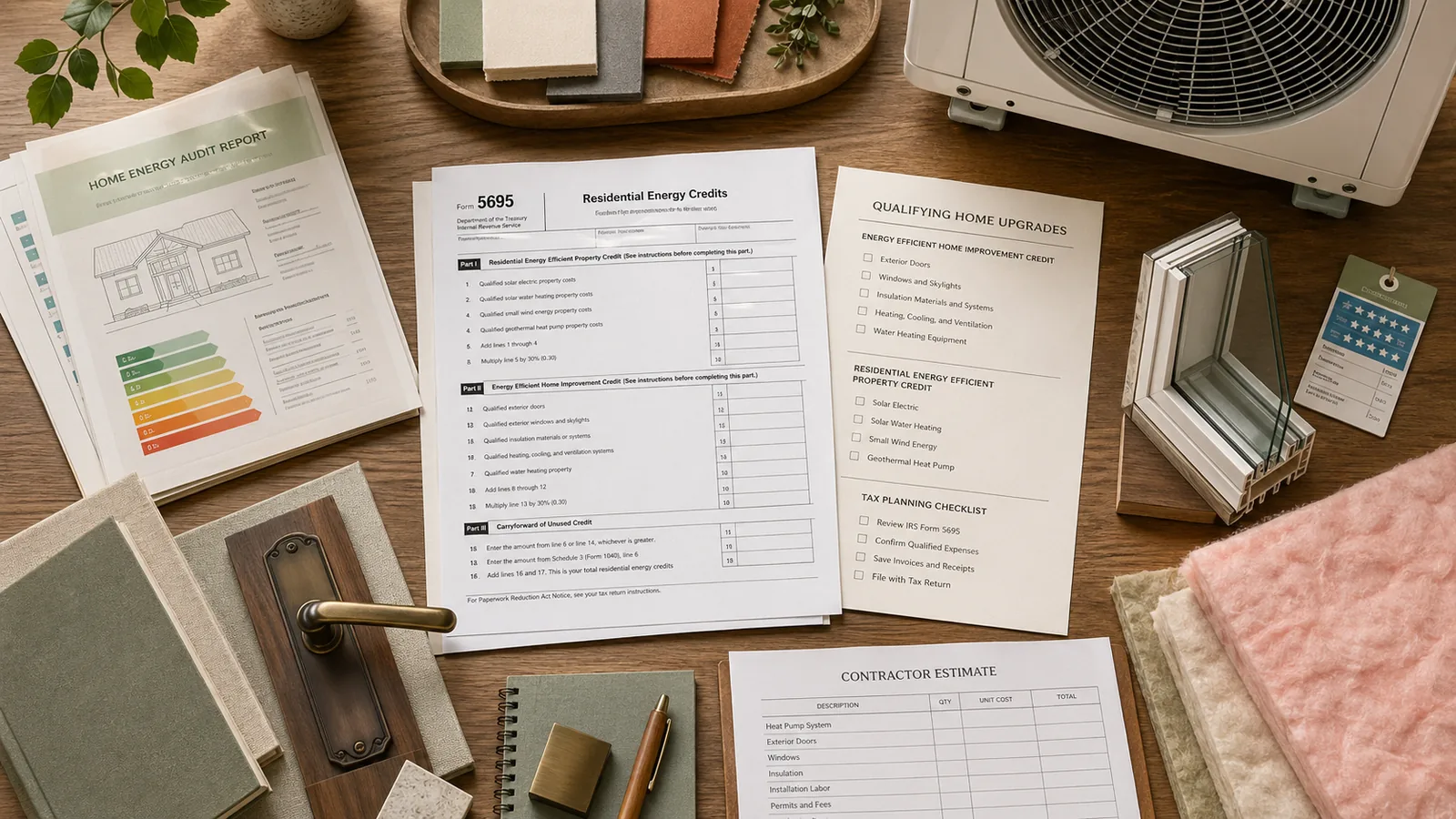
Broadly, the credit applies to these categories when the installed product meets IRS requirements: exterior windows and skylights, exterior doors, insulation and air-sealing materials, heat pumps, heat pump water heaters, central air conditioners, and home energy audits. Each category has its own efficiency standards, and an upgrade that looks identical to a qualifying one can still fail if the model number doesn't check out.
One firm rule: the IRS requires that "the home must be your primary residence (where you live the majority of the year). You can't claim the credit if you're a landlord or other property owner who doesn't live in the home." A vacation cabin or a rental property you own does not qualify.
Important 2026 timing note: The currently verified IRS page shows a placed-in-service window running through December 31, 2025. Before you purchase or schedule installation of anything in 2026, confirm eligibility directly on the live IRS energy-efficient home improvement credit page — Congress has extended and modified this credit before, and the 2026 rules should be verified against the live IRS page before you buy or book work.
How much is the energy-efficient home improvement credit, and what are the annual caps?
The credit equals 30% of your qualifying project costs, but the annual caps are what actually limit most people — not the percentage; see the IRS Home Energy Tax Credits overview and the IRS qualifying expenditures FAQ for the cap structure.
Here is the cap structure, per IRS and ENERGY STAR guidance:
| Category | Annual Credit Cap |
|---|---|
| Most building envelope items (windows, doors, insulation) | $1,200 per year combined |
| Exterior windows/skylights alone | Up to $600 |
| Exterior doors alone | Up to $250 per door ($500 total) |
| Heat pumps, heat pump water heaters, biomass stoves/boilers | $2,000 per year (separate cap) |
| Home energy audits | Up to $150 |
| Overall maximum most homeowners can claim | Up to $3,200 per year (if you max both caps) |
The $2,000 equipment cap is separate from the $1,200 building-envelope cap, which is the detail most people miss. As ENERGY STAR confirms, "Any combination of heat pumps, heat pump water heaters and biomass stoves/boilers are subject to an annual total limit of $2,000."
Practical example: Say you replace your furnace with a qualifying heat pump ($12,000 project) and also add attic insulation ($3,000) and two qualifying windows ($4,000) in the same tax year. Your heat pump credit is capped at $2,000. Your insulation credit is 30% of $3,000 = $900. Your window credit is 30% of $4,000 = $1,200, but that's capped at $600. The building-envelope items together ($900 + $600) land at $1,200 — right at the combined limit. Total credit for the year: $3,200. If you'd planned a third project — say, adding exterior doors — you'd have burned your insulation/window cap and would see no additional credit from the doors that year. Splitting upgrades across two tax years can sometimes yield a higher total credit.
The caps reset annually, so a homeowner who spread qualifying projects over multiple years could claim credits in each year rather than hitting a lifetime ceiling.
What insulation upgrades qualify for the tax credit?
Insulation and air-sealing materials are among the more accessible qualifying upgrades because the projects are often DIY-friendly and don't require expensive equipment. But eligibility is not automatic.
Per IRS FAQ guidance, "the materials installed in each year must meet the applicable IECC prescriptive criteria for such materials." The IECC (International Energy Conservation Code) sets minimum R-value and installation standards by climate zone — so the same fiberglass batt that qualifies in Florida might not meet the prescriptive threshold required in Minnesota.
Commonly qualifying insulation project types:
- Attic insulation — Adding blown-in fiberglass, blown-in cellulose, or batt insulation to bring attic R-value up to code-prescriptive levels for your climate zone
- Wall cavity insulation — Dense-pack cellulose or open-cell spray foam retrofitted into existing walls
- Rim joist and basement band joist sealing — Rigid foam board or spray foam applied to the perimeter of the foundation
- Air-sealing materials — Caulk, weatherstripping, spray foam, and house wrap that reduce infiltration, when installed as part of a qualifying project
- Crawl space encapsulation — Vapor barrier and insulation systems that meet IECC requirements
What does not count: insulation installed solely on a new addition, or products that carry "energy saving" claims but are not installed to meet IECC prescriptive requirements for the climate zone.
Watch Out: A contractor bid that says "energy-efficient insulation" does not guarantee the installed product meets the IECC prescriptive criteria the IRS requires. Ask for the product's R-value per inch, the installed thickness, and the manufacturer's certification statement before signing.
The credit covers 30% of qualifying insulation costs, subject to the $1,200 annual combined cap shared with windows and doors. Keep your invoices, the product data sheet showing R-value, and the manufacturer certification statement with your tax records.
Do exterior windows and exterior doors qualify for the credit?
Yes — but the eligibility standards are stricter than most people expect, and the requirements differ between windows and doors.
For exterior windows and skylights: The product must carry ENERGY STAR Most Efficient designation — not just ENERGY STAR certified. Most Efficient is a higher tier. As ENERGY STAR states, "Exterior residential windows or skylights must meet the ENERGY STAR Most Efficient criteria to be eligible for the 25C Federal Tax Credit." An ENERGY STAR-certified window that does not make the Most Efficient list does not qualify for the 25C credit. ENERGY STAR's product finder at energystar.gov lets you search by brand and model to confirm Most Efficient status before you buy.
For exterior doors: The standard drops one tier — ENERGY STAR certification (not Most Efficient) is required. As ENERGY STAR states, "Exterior doors must be ENERGY STAR certified to qualify for the 25C Federal Tax Credit." That means a wider range of qualifying products are available at entry-level price points.
Window and door qualification checklist:
- [ ] Exterior windows/skylights: confirmed ENERGY STAR Most Efficient for your climate zone
- [ ] Exterior doors: confirmed ENERGY STAR certified
- [ ] Model number verified against ENERGY STAR product finder (not just brand name or product family)
- [ ] Manufacturer certification statement available for download or request
- [ ] Project is a replacement in your primary residence, not a new addition to a secondary home
Credit limits for this category:
- Windows and skylights combined: up to $600 per year (30% of cost, whichever is lower)
- Each exterior door: up to $250 (max $500 total across all doors in a tax year)
Watch Out: Window replacement is a category where marketing language causes the most confusion. "Low-E glass," "triple pane," and "energy efficient frame" are all common selling points that may or may not accompany Most Efficient certification. A replacement window project that installs a well-performing but non-Most-Efficient product gets zero credit, even if the windows genuinely reduce your heating bill. Verify the specific model number before signing any contract.
Is a heat pump eligible for the energy-efficient home improvement credit?
A qualifying heat pump can earn you up to $2,000 in federal tax credit — the single largest available credit under the Section 25C program. But not every heat pump on the market qualifies.
Per ENERGY STAR's air-source heat pump page: "Starting January 1, 2025, air source heat pumps that are recognized as ENERGY STAR Most Efficient are eligible for this credit." Two eligibility pathways exist, and a unit that falls outside both pathways does not qualify regardless of how efficient it is in practice.
Why a similar-looking unit might not qualify:
Heat pumps are sold by efficiency tier, and a unit just below the Most Efficient threshold can look nearly identical to a qualifying model — same brand family, similar price, similar marketing claims — while not appearing on the qualifying list. This happens with both ducted systems (central heat pumps) and ductless mini-splits. The classification lives at the model-number level, not at the brand level.
Heat pump verification checklist before purchase:
- [ ] Look up the exact model number (not the product family) in the ENERGY STAR Most Efficient directory at energystar.gov
- [ ] Confirm which eligibility pathway the unit qualifies under
- [ ] Get the model number in writing from your HVAC contractor before the bid is finalized
- [ ] Verify that the model being installed matches the model on the proposal — substitutions happen
- [ ] Confirm the installation date (placed-in-service date), not just the purchase date, falls within the qualifying tax year
Timing matters: The IRS credit depends on when the equipment is "placed in service" — meaning installed and operational — not when you paid the deposit or ordered the unit. If you order a heat pump in November but installation slips into January, the credit falls to the following tax year. Build schedule buffer into your contractor agreement, and before purchasing or scheduling work in 2026, check the current IRS page to confirm the live eligibility window.
The 30% credit on a heat pump project is capped at $2,000 per year, separate from the $1,200 cap that applies to insulation and windows.
Do heat pump water heaters and central air conditioners qualify?
Both categories appear on the qualifying list, but with conditions.
Heat pump water heaters are listed among the qualifying equipment categories by both the IRS and ENERGY STAR. They share the $2,000 annual cap with air-source heat pumps and biomass stoves — so if you install both a heat pump and a heat pump water heater in the same tax year, their combined credit is still capped at $2,000 total, not $2,000 each.
Central air conditioners are referenced in IRS and ENERGY STAR credit materials, but the homeowner must verify that the specific unit meets the applicable qualification standards. A standard ENERGY STAR-certified central AC replacement does not automatically qualify — the unit must meet the efficiency threshold set for the credit, which is higher than baseline ENERGY STAR certification for most climates.
| Equipment Type | Qualifying Standard | Annual Cap |
|---|---|---|
| Air-source heat pump | ENERGY STAR Most Efficient (two pathways) | $2,000 combined |
| Heat pump water heater | ENERGY STAR qualified for credit | $2,000 combined |
| Central air conditioner | IRS/ENERGY STAR qualifying efficiency level | $1,200 combined |
| Biomass stove/boiler | IRS qualifying efficiency criteria | $2,000 combined |
Watch Out: A standard HVAC contractor replacement quote — even for a well-known brand — is not the same as a credit-eligible installation. The manufacturer certification statement is what proves the unit meets IRS requirements. If a contractor cannot produce one, treat that as a red flag.
Can you claim the credit for a home energy audit?
Yes. A home energy audit is a qualifying category under the Section 25C credit, and it's an underused one. The credit covers up to $150 (30% of cost) for a qualifying audit performed by a certified auditor.
More practically, an audit is often a smart first step before committing to a $15,000+ upgrade project. A professional energy audit identifies where your home loses the most heat or cooling — whether that's the attic insulation, the rim joists, leaky ductwork, or drafty windows — and helps you prioritize projects that will actually move the needle on your energy bills.
What documentation the auditor should provide:
- A written report identifying the home's energy performance issues and recommended improvements
- The auditor's credentials and the date of service
- An invoice showing the cost paid
Keep the written report, invoice, and auditor credentials with your Form 5695 tax records. The audit credit interacts with your larger upgrade credits simply — it falls under the $1,200 combined annual cap along with windows and insulation, so the $150 it contributes leaves room for other qualifying building-envelope claims in the same year.
Pro Tip: Schedule the audit before finalizing your contractor bids. Audit findings occasionally reveal that a planned window replacement is less impactful than air-sealing the attic — and knowing that before signing contracts can redirect spending toward higher-ROI projects.
What does not qualify, even if the product is marketed as energy efficient?
This is the section most competing resources skip, and it's where homeowners lose money. The IRS and ENERGY STAR both make clear that qualifying property must meet specific efficiency requirements — not just carry energy-saving language in the product description.
Common non-qualifying examples:
- Standard ENERGY STAR windows (not Most Efficient) — marketed as energy efficient, pass basic ENERGY STAR certification, but fail the 25C test
- Conventional gas furnaces, even high-efficiency models — not in the qualifying equipment categories
- Standard water heaters (tank or tankless gas) — only heat pump water heaters qualify in this program
- Roofing products (reflective shingles, cool roofs) — removed from the qualifying list in recent program iterations; verify current IRS guidance before assuming
- Smart thermostats — frequently marketed alongside energy-efficient upgrades but not in the Section 25C qualifying categories
- Insulation installed in a new addition, rather than in the existing home envelope
- HVAC equipment in a rental property or vacation home — primary residence rule disqualifies it
Verify before buying — quick checklist:
- [ ] Is the product in a qualifying IRS category (not just described as energy efficient)?
- [ ] Does it meet the category-specific threshold (Most Efficient, ENERGY STAR certified, or IECC prescriptive)?
- [ ] Is the model number — not just the brand or product family — on the qualifying list?
- [ ] Can the manufacturer provide a certification statement for that specific model?
- [ ] Is the installation in your primary residence?
Watch Out: Contractors and retailers sometimes advertise "tax credit eligible" products without verifying the specific model number against the current ENERGY STAR or IRS qualifying list. Do your own lookup before you hand over a deposit.
What records do you need to claim the credit on your tax return?
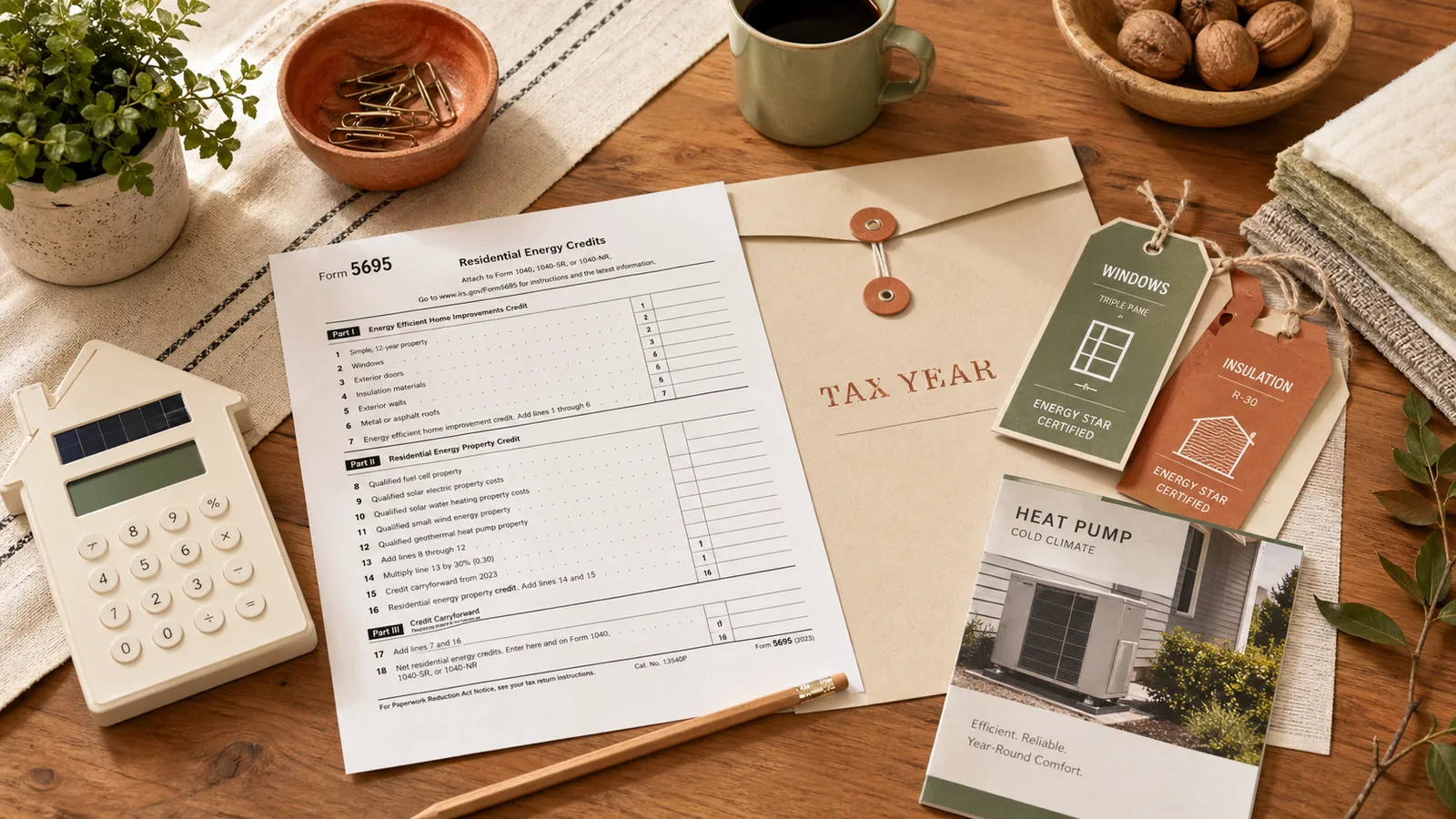
You claim the Section 25C credit on IRS Form 5695, filed with your federal tax return for the year in which the qualifying property was placed in service. The IRS does not require you to submit documentation with the return, but you must keep records to support your claim if you're audited.
Documentation checklist — keep all of these:
- [ ] Manufacturer certification statement — a signed statement from the manufacturer confirming the product qualifies for the tax credit. Per ENERGY STAR's definition, "Manufacturer’s Certification Statement is a signed statement from the manufacturer certifying that the product or component qualifies for the tax credit." Download it from the manufacturer's website or request it in writing from your contractor before installation.
- [ ] Purchase invoice or receipt — showing the product model number, purchase price, and purchase date
- [ ] Installation invoice — showing the contractor's name, scope of work, date of completion (placed-in-service date), and any labor costs that may be included in the qualifying expense
- [ ] Product data sheet — efficiency ratings (R-value, SEER2, EF, etc.) and the model number
- [ ] ENERGY STAR certification confirmation — a printout or PDF of the product's listing in the ENERGY STAR product finder for the applicable category
- [ ] Home energy audit report and invoice — if claiming the audit credit
- [ ] Form 5695 — completed for the tax year; your tax preparer or tax software will use your records to populate this form
New for equipment placed in service on or after January 1, 2026: Per IRS FAQ guidance on PIN requirements, a full 17-character PIN is required in lieu of a QM code for specified property placed in service on that date or after. Ask your contractor and the manufacturer about this before installation — it's a new documentation step that could delay your ability to file the credit if the paperwork is missing.
How do utility rebates and state incentives fit with the federal credit?
Many states and utilities offer rebate programs that overlap with the same projects covered by the federal credit. The good news: in most cases you can receive both — the federal tax credit and a utility or state rebate — for the same project. They operate independently.
What you need to watch: some utility rebates reduce your net out-of-pocket cost, which may affect the expense base you use to calculate the federal credit. If a program has a rule that changes the credit base, follow that program's written terms; otherwise, document the rebate and the federal credit separately and verify the treatment before you file.
Pro Tip: The Database of State Incentives for Renewables and Efficiency (DSIRE) at dsireusa.org is the most comprehensive resource for finding state and utility programs by ZIP code. Run a search before your project kicks off — some programs have funding caps that close mid-year.
The Inflation Reduction Act also created the High-Efficiency Electric Home Rebate Act (HEEHRA) program, administered through states. These rebates target lower- and moderate-income households and cover different product categories than Section 25C in some cases. Check with your state energy office to see if your household qualifies — the programs can stack in some scenarios.
Watch Out: Never assume stacking is allowed without checking the specific terms of each program. Some state or utility programs explicitly prohibit combining their rebate with the federal credit on the same piece of equipment. Document each incentive source separately in your tax records regardless.
Verify before buying: what to check on model numbers and efficiency ratings
The single most preventable mistake in this process is buying a product — or letting a contractor install one — without first confirming the specific model number qualifies. Here is a step-by-step verification process:
| Product type | Qualifying rule | Model-number check | Required record |
|---|---|---|---|
| Windows and skylights | ENERGY STAR Most Efficient | Match exact model in ENERGY STAR product finder | Manufacturer certification statement and product listing printout |
| Exterior doors | ENERGY STAR certified | Match exact model in ENERGY STAR product finder | Manufacturer certification statement and product listing printout |
| Air-source heat pumps | ENERGY STAR Most Efficient | Match exact model and pathway in ENERGY STAR directory | Manufacturer certification statement and installer invoice |
| Heat pump water heaters | ENERGY STAR qualified for credit | Match exact model on the current ENERGY STAR page | Manufacturer certification statement and purchase invoice |
| Insulation and air sealing | IECC prescriptive criteria | Verify R-value, thickness, and installation assembly | Product data sheet and installer invoice |
The verify-before-buying checklist:
-
Identify the exact model number — not the product family or series name. Ask the contractor or retailer for the full model number as it would appear on the unit's data plate and the manufacturer's spec sheet.
-
Look it up in the ENERGY STAR product finder — Each qualifying category has its own finder:
- Windows and skylights: confirm ENERGY STAR Most Efficient status
- Exterior doors: confirm ENERGY STAR certified status
- Air-source heat pumps: confirm Most Efficient recognition and which eligibility pathway applies
-
Heat pump water heaters and central AC: check the applicable ENERGY STAR product page for qualifying models
-
Request the manufacturer certification statement — Download it from the manufacturer's website using the exact model number, or ask your contractor to provide it. This is the document the IRS expects you to retain; if it doesn't exist for your model, the product likely doesn't qualify.
-
Check the efficiency rating on the spec sheet — For heat pumps, look for HSPF2 and SEER2 ratings. For insulation, confirm R-value and installed thickness. For windows, look for U-factor and Solar Heat Gain Coefficient (SHGC) values. These numbers need to match what's on the qualifying list.
-
Confirm with your installer in writing — Before work begins, get written confirmation from the installer that the unit being installed matches the qualifying model number. Substitutions — where a contractor installs an available unit rather than the specified one — are a real risk on large HVAC projects, especially during busy seasons when specific models may be backordered.
-
Check qualified property manufacturer registration — The IRS requires manufacturers to have a written agreement with the IRS and report information for each qualified energy property they make. A manufacturer certification statement should reflect this; if you're in doubt, the IRS qualified manufacturer requirements page is the reference.
Pro Tip: Screenshot or print the ENERGY STAR product finder result showing your model number's qualifying status on the day you verify it. ENERGY STAR lists can be updated, and having a dated record protects you if questions arise later.
How to plan purchases and installations so you do not miss the tax credit
Timing this credit correctly means tracking two dates: when you pay, and when the equipment is placed in service.
The IRS bases credit eligibility on the placed-in-service date — the date the qualifying product is installed and operational in your home — not the purchase date or the date you signed the contract. A heat pump purchased in December but installed in January falls in the following tax year for credit purposes, so check the current IRS page before you purchase or schedule any work in 2026.
Purchase and install timing guide:
| Phase | What to do | Why it matters |
|---|---|---|
| 6–12 weeks before project | Verify model number qualification; request manufacturer cert statement | Lead times on qualifying equipment (especially heat pumps) can run 4–8 weeks |
| At contract signing | Confirm model number and expected install date in writing | Protects against substitution and schedule slip |
| Week of installation | Confirm actual installed model matches the contract | Catch substitutions before work is complete |
| Day of installation | Get signed installer invoice with placed-in-service date | This date determines your tax year for the credit |
| Within 30 days of install | Download manufacturer certification statement if not already in hand | Required for Form 5695 support |
| Tax season | File IRS Form 5695 with your return for the year of installation | The Section 25C credit is claimed here |
Critical 2026 note: The IRS page reviewed during research shows the qualifying window ending December 31, 2025. Before ordering any equipment or scheduling any installation in 2026, check the current IRS energy-efficient home improvement credit page directly. If Congress has extended or modified the program, the live page will reflect it. Do not rely on contractor or retailer claims that the credit applies in 2026 without verifying this yourself.
If you are planning a multi-project renovation, consider sequencing upgrades across tax years to maximize annual caps. A homeowner who installs a heat pump in year one ($2,000 credit) and then replaces windows and adds insulation in year two ($1,200 credit) collects more total credit than one who does everything at once and hits the same annual caps.
What should homeowners ask contractors before signing a bid?
A contractor who handles credit-eligible projects regularly will have answers to these questions without hesitation. One who can't answer them may be offering a product that doesn't qualify — or may not understand the documentation you'll need to file your taxes.
Contractor question checklist — ask before signing:
- [ ] What is the exact model number of the equipment or product you're installing? (Not the product family — the full model number as it appears on the data plate)
- [ ] Is this specific model listed as qualifying for the Section 25C tax credit? Ask them to confirm the ENERGY STAR Most Efficient listing or applicable certification
- [ ] Can you provide the manufacturer certification statement for this model? If they don't know what this is, that's a concern
- [ ] What is the expected installation date, and what happens if it slips past December 31? You need a commitment on placed-in-service date, not just a rough schedule
- [ ] Does the bid include all work needed for a complete installation? Electrical panel upgrades, ductwork modifications, or ventilation changes required for a heat pump or heat pump water heater can add significant cost and affect project timing
- [ ] Are permits required, and who pulls them? Mechanical permits are standard for HVAC replacement in most jurisdictions; a contractor who skips them puts you at risk on resale and can void equipment warranties
- [ ] Will the invoice clearly show the model number, the scope of work, and the installation completion date? You need this for Form 5695 support
Watch Out: Be skeptical of any contractor who guarantees the tax credit as part of a sales pitch without walking you through the specific model's qualification. The credit is yours to verify and claim — no contractor can guarantee the IRS will approve it, and a non-qualifying unit installed because of a sales promise leaves you with no recourse.
Frequently asked questions about the energy-efficient home improvement credit
What home improvements qualify for the energy-efficient home improvement credit?
The qualifying categories are: exterior windows and skylights (must be ENERGY STAR Most Efficient), exterior doors (must be ENERGY STAR certified), insulation and air-sealing materials (must meet IECC prescriptive criteria for your climate zone), air-source heat pumps (must be ENERGY STAR Most Efficient), heat pump water heaters, central air conditioners (must meet qualifying efficiency thresholds), and home energy audits. Product- and category-specific eligibility rules apply to all of them — "energy efficient" as a marketing term does not create eligibility.
Is a new heat pump eligible for the tax credit?
Yes, if the specific model is recognized as ENERGY STAR Most Efficient under one of the two qualifying pathways. The credit equals 30% of project cost, capped at $2,000 per year. Verify the exact model number in the ENERGY STAR Most Efficient directory before purchase, and confirm the installation date falls within the qualifying tax year.
Do windows and insulation qualify for the federal tax credit?
Windows qualify if they carry ENERGY STAR Most Efficient designation — standard ENERGY STAR certification is not enough. Insulation qualifies if the installed product meets IECC prescriptive criteria for your climate zone. Both fall under the $1,200 combined annual cap along with exterior doors, with windows specifically capped at $600 per year.
How much is the energy-efficient home improvement credit in 2026?
The credit is 30% of qualifying costs. The maximum most homeowners can claim in a single year is $3,200: up to $1,200 for building envelope items (windows, doors, insulation) plus up to $2,000 for heat pumps, heat pump water heaters, and biomass equipment. Home energy audits add up to $150, counted within the $1,200 cap. Verify the 2026 program window and caps at the current IRS page before filing.
What records do I need to claim the energy-efficient home improvement credit?
Keep the manufacturer certification statement, purchase invoices, installation invoices with the placed-in-service date, product data sheets showing model numbers and efficiency ratings, and any ENERGY STAR certification confirmations. For equipment placed in service on or after January 1, 2026, the IRS FAQ guidance indicates a full 17-character PIN is required. File IRS Form 5695 with your return for the year the qualifying property was placed in service.
Can the same product be both ENERGY STAR certified and not qualify for the credit?
Yes — this happens with windows most often. A window can be ENERGY STAR certified (meeting baseline requirements) without reaching ENERGY STAR Most Efficient status (a higher tier). Only Most Efficient qualifies for the 25C credit. The same dynamic applies in other categories: qualification is not automatic with any ENERGY STAR label.
Sources & References
- IRS Energy Efficient Home Improvement Credit — Primary IRS page covering eligibility, placed-in-service rules, and primary residence requirement
- IRS Home Energy Tax Credits overview — Summary of the 30% credit structure and annual cap framework
- IRS Form 5695 Instructions — The claim form for the energy-efficient home improvement credit
- IRS FAQ: Qualifying Expenditures and Credit Amount — Category-specific cap details
- IRS FAQ: Energy Efficiency Requirements — IECC prescriptive criteria and product standards
- IRS FAQ: PIN Requirements — 17-character PIN requirement for 2026 and later placed-in-service property
- IRS Qualified Manufacturer Requirements — Manufacturer obligations and certification statement requirements
- ENERGY STAR Federal Tax Credits landing page — Overview of qualifying product categories and annual caps
- ENERGY STAR Windows and Skylights Tax Credit — Most Efficient requirement for windows/skylights
- ENERGY STAR Exterior Doors Tax Credit — ENERGY STAR certified requirement for doors
- ENERGY STAR Insulation Tax Credit — Insulation qualifying guidance
- ENERGY STAR Air-Source Heat Pumps Tax Credit — Most Efficient requirement and two qualifying pathways
- ENERGY STAR Central Air Conditioners Tax Credit — Central AC qualifying standards
- ENERGY STAR Heat Pump Water Heaters Tax Credit — Heat pump water heater qualifying category
- ENERGY STAR Certified Windows Product Finder — Model-specific qualification lookup for windows
- ENERGY STAR Tax Credit Definitions — Definition of Manufacturer's Certification Statement
Keywords: IRS Form 5695, Section 25C, Energy Star Most Efficient, ENERGY STAR, heat pump, heat pump water heater, central air conditioner, exterior windows, exterior doors, insulation, home energy audit, manufacturer certification statement, qualified property, annual credit cap, primary residence