The best-looking home gyms share four design moves: matched flooring, disciplined wall color, hidden storage, and one statement piece. Get those four things right and the space photographs well, stays functional under sweat and dropped weights, and doesn't feel like a janitor's closet between workouts. Here's how to execute each style direction in a basement or garage — with real product types, honest cost tiers, and notes on the durability problems most inspiration posts skip entirely.
Cost Snapshot: HomeGuide's home gym cost guide puts rubber-tile flooring at $400–$3,400 and recessed gym lighting at $700–$1,700 for six can lights — two line items that can push even a "budget" build past $1,000 before a single barbell enters the room.
Pinterest-worthy basement and garage home gym formulas that actually work
Four proven formulas cover the overwhelming majority of home gym Pinterest saves. Each one is built around a specific visual logic that also solves a real functional problem — noise, moisture, clutter, or limited square footage.
| Style | Best Space | Visual Logic | Budget Tier | Effort Level |
|---|---|---|---|---|
| Clean black-and-oak garage | Garage | Dark walls + warm wood tones + steel | $1,200–$3,500 | Moderate |
| Bright basement strength zone | Basement | White walls + daylight LEDs + mirrors | $800–$2,500 | Low–Moderate |
| Minimal mirror wall | Either | Single color + full-wall mirrors | $600–$2,000 | Low |
| Family-friendly multipurpose | Either | Zones + concealed storage + wipeable surfaces | $900–$3,000 | Moderate |
Two non-negotiables apply to every formula: moisture control in basements (ventilation plus a dehumidifier if the space runs damp, per HomeGuide's basement-gym guidance and HomeGuide's whole-house dehumidifier guide) and flooring that handles both impact and sweat without warping or smelling. Costs vary by region, installer pricing, and material availability, so use these numbers as planning ranges rather than fixed quotes.
Clean black-and-oak garage gym
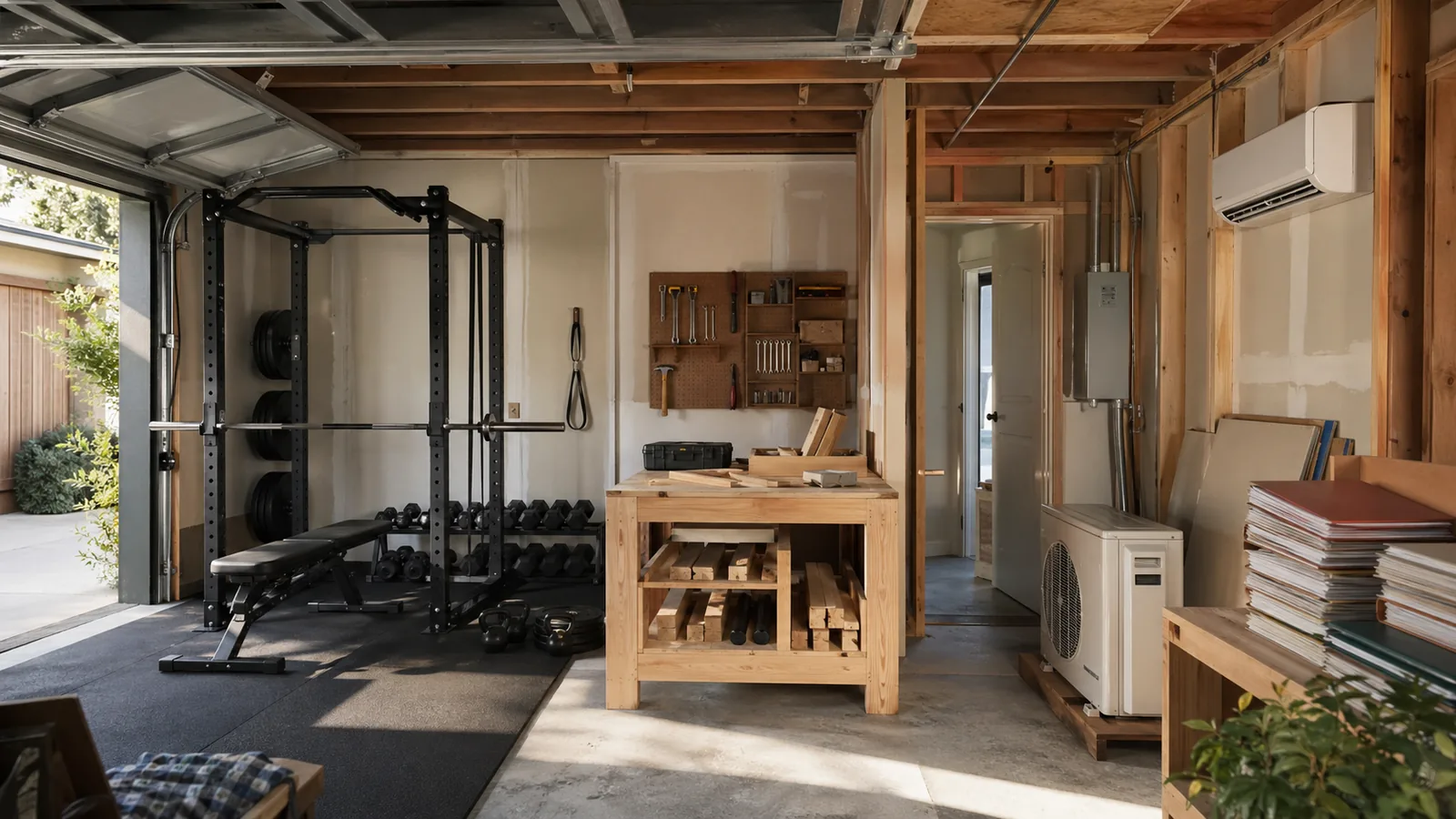
A garage gym looks elevated — not unfinished — when every surface belongs to the same two-tone palette: matte black or charcoal for walls, equipment, and fixtures; warm natural oak for flooring accents or wall shelving. The contrast reads as intentional rather than industrial.
Style card:
| Element | Budget Version (~$1,200) | Premium Version (~$3,500) |
|---|---|---|
| Flooring | 3/4-inch horse stall mats ($1.50–$2/sq ft at farm supply stores) | Rubber tile over LVP border ($3–$6/sq ft combined) |
| Lighting | 4-ft LED shop lights linked in series, 5,000K, ~$40/fixture | Flush-mount black LED panel lights, $80–$150 each |
| Storage | Black powder-coated pegboard system + J-hooks | PRx Performance Fold-In ONE Rack wall-mounted, powder-coated steel |
| Mirrors | Two 48"×72" frameless panels leaned against the wall | Floor-to-ceiling frameless mirror panels, professionally adhered |
| Oak accent | Floating birch-veneer shelf, $40–$60 at IKEA | Custom walnut floating shelves, $200–$400 |
For the PRx Performance Fold-In ONE Rack: your ceiling must be at least 91 inches high, and the wall brackets mount to studs at 16-inch or 24-inch on-center spacing — standard garage framing in most US builds. It ships with all mounting hardware, which removes one trip to the hardware store.
The black-and-oak palette works functionally because dark walls don't show chalk dust or rubber scuff marks between cleaning sessions. The warm wood shelving breaks the visual heaviness and gives you a place to stage a foam roller, water bottle, and Bluetooth speaker without them reading as clutter.
Watch Out: Painting garage drywall flat black amplifies any moisture stains or efflorescence. Prime with a mold-resistant primer (such as Zinsser Bulls Eye 1-2-3) before top-coating.
Bright basement strength zone
The single biggest complaint about basement gyms is that they feel like a dungeon. The fix is not a renovation — it's a lighting and paint decision. Paint the walls and ceiling a warm white (Benjamin Moore White Dove OC-17 or Sherwin-Williams Alabaster SW 7008 both photograph well under artificial light), then push your lighting budget toward high-CRI, high-lumen LEDs rather than recessed cans.
Lighting and wall-color checklist:
- Paint walls and ceiling the same warm white to eliminate shadow lines and make the ceiling feel higher
- Use 4,000K–5,000K LED shop lights or surface-mount LED panels; aim for 50 foot-candles at floor level
- Line the perimeter with plug-in LED strip lights behind equipment as accent — adds depth without wiring
- If you do go recessed, HomeGuide prices six can lights at $700–$1,700 installed; for a budget build, linked shop lights at $40–$60 each produce equal or better lumen output for a fraction of the cost
Moisture-control callout: HomeGuide specifically flags basements as moisture-prone and recommends planning for ventilation and dehumidification before flooring goes down. A portable dehumidifier rated 50–70 pints/day (around $200–$350 at Home Depot or Lowe's) handles most unfinished or semi-finished basements. Whole-house dehumidifier installation runs $1,000–$3,000 for the basement or crawl space, per HomeGuide's dehumidifier cost guide. Don't skip this step — rubber flooring installed over a damp slab will smell within weeks.
Pro Tip: Run the dehumidifier for two weeks before installing any flooring. It reveals how bad the moisture problem actually is and gives you a dry substrate to work with.
Minimal mirror wall setup
A mirror wall in a small space — even 8 to 10 feet wide — eliminates the cramped feeling and gives you the form-check visibility of a commercial gym. The polished look comes from keeping everything else in the room visually quiet: one wall color, no loose equipment on the floor, mirrors that run edge-to-edge on a single wall.
Sizing and placement notes:
- For a standing lift check, mirrors should start no higher than 12 inches off the floor and reach at least 72 inches up — 84 inches is better
- Four 48"×72" frameless glass mirror panels side by side cover an 8-foot-wide wall; two 48"×84" panels work on a narrower run
- Budget option: individual frameless mirrors from Amazon or Home Depot, $80–$150 each, mounted with mirror clips or Z-clips — total cost $320–$600 for an 8-foot wall
- Premium option: continuous glue-up mirror panels installed by a glass company, $600–$1,200 for labor and materials on an 8-foot wall — no visible seams, cleaner in photos
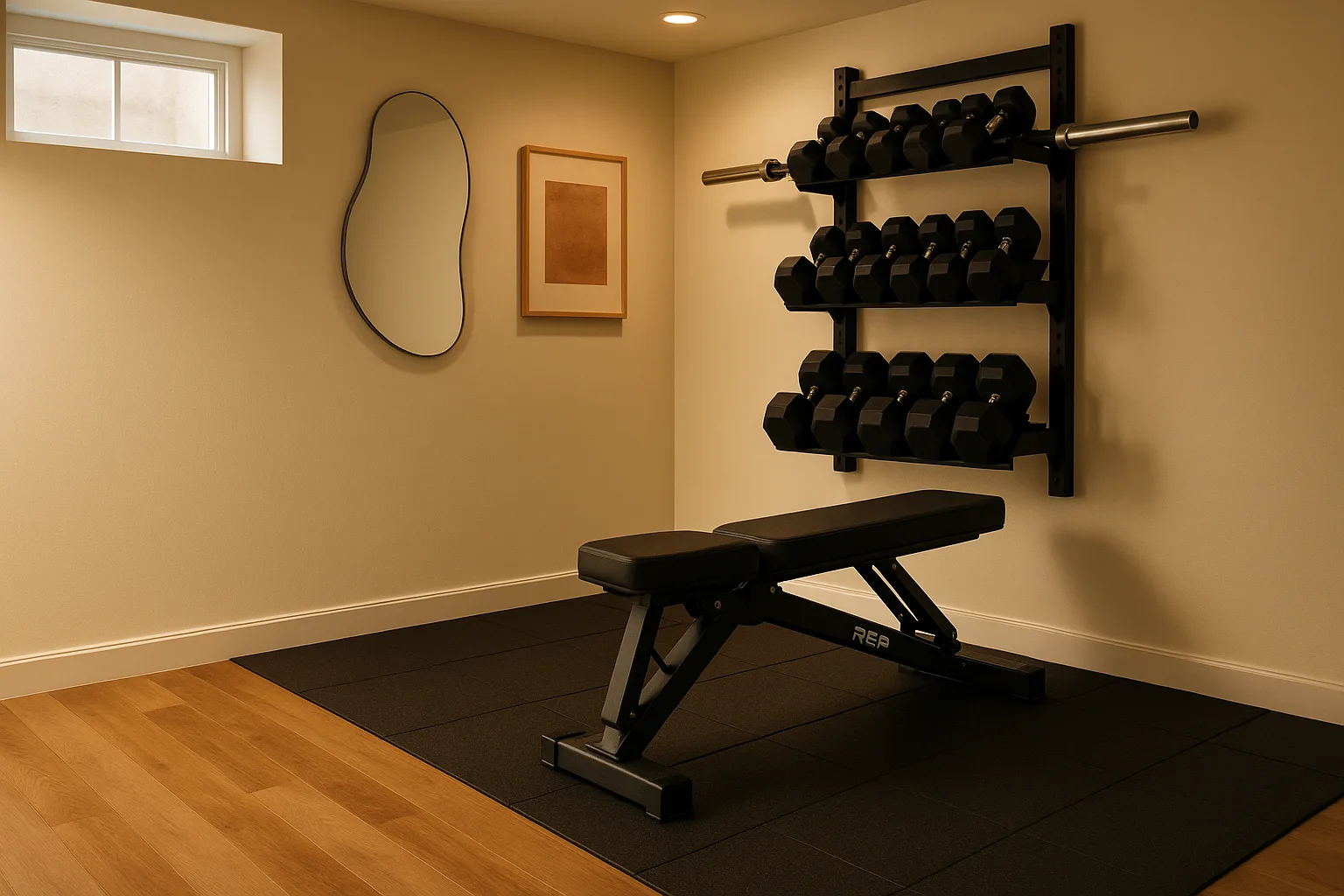
Storage integration: Mount a floating shelf or a wall-mounted dumbbell bracket just below the mirror bottom edge. It keeps floor space clear and keeps small equipment in the frame without cluttering the visual field.
Watch Out: Never install mirrors directly on a concrete or masonry basement wall without a plywood backer — the adhesive or clips won't hold reliably, and a falling mirror is a serious injury risk.
Family-friendly multipurpose gym
A shared gym that also stores bikes, holiday bins, or kids' gear can still look intentional — the key is zone separation and concealed storage. The design goal is that someone can look at the room and immediately see where the gym stops and the rest of life begins.
Zone separation cue: Use flooring as the dividing line. Rubber flooring tiles or horse stall mats define the workout zone; LVP or painted concrete defines the storage zone. The visual boundary is immediate and requires no furniture.
Concealed storage ideas:
- Floor-to-ceiling cabinets (IKEA PAX frames with solid doors, roughly $300–$600 for a 6-foot run) hide everything that isn't gym equipment
- A powder-coated steel dumbbell rack keeps weights vertical and off the floor — REP Fitness and Rogue both make compact A-frame racks under $150 that take up roughly 2 square feet
- Wall-mounted pegboard (1/4-inch tempered hardboard, $25–$40 per 4'×8' sheet) stores resistance bands, jump ropes, and straps with zero floor footprint
- Bins labeled and stored on floating shelves handle foam rollers, yoga blocks, and kids' sports gear without visual noise
Wipeable finishes matter: In a family gym, walls at elbow and shoulder height take constant scuff marks. Use a semi-gloss or satin paint rather than flat — it wipes clean with a damp cloth. Same logic applies to cabinet doors.
What makes a home gym look high-end in a basement or garage
Most Pinterest gym photos that feel aspirational share the same underlying structure, even when the gear changes. It's not the equipment that creates the premium look — it's four controllable design decisions executed with discipline: matched flooring, wall color restraint, hidden storage, and one focal statement piece. The competitive gap in most online inspiration content is that it shows you the photo but never explains the design logic. Here it is.
Matched flooring that hides wear and absorbs impact
Flooring is the single most visible surface in a gym photo and the one most likely to look cheap or random if you piece it together ad hoc. The right choice depends on your subfloor, your workout type, and your moisture situation.
| Flooring Type | Cost (installed) | Best For | Weakness |
|---|---|---|---|
| Horse stall mats (3/4") | $1.50–$2.50/sq ft | Garage, heavy lifts | Rubber smell initially, not decorative |
| Rubber tile (3/8"–3/4") | $2–$6/sq ft | Any gym, looks finished | Higher cost than mats for same coverage |
| LVP (luxury vinyl plank) | $4–$15/sq ft installed | Cardio zones, aesthetics | Not for dropping weights directly |
| Hybrid (LVP border + rubber center) | $5–$12/sq ft blended | Best looking + durable | Requires planning and cutting |
HomeGuide's home gym cost guide shows rubber-tile estimates running $400–$3,400 depending on room size, while HomeGuide's flooring installation guide puts installed flooring broadly at $4–$15 per square foot. The low end covers a small garage corner; the high end covers a full two-car bay. For most 200–400 sq ft gyms, budget $600–$1,400 for rubber tile installed.
In a moisture-prone basement, always lay a subfloor moisture barrier (6-mil polyethylene sheeting, roughly $30–$60 for a roll) before any floating floor system. LVP without a moisture barrier will buckle within one humid summer. Rubber tiles tolerate some moisture better but still benefit from a dry substrate.
Pro Tip: Horse stall mats from a farm supply store (Tractor Supply Co. sells 4'×6'×3/4" mats for around $50 each) are the most cost-effective heavy-lift floor available. The initial rubber smell fades within two to four weeks with ventilation.
Wall color discipline and one statement piece
The rooms that look cluttered in photos — even with good equipment — almost always have too many competing wall colors or a mix of unrelated objects fighting for attention. The fix is a two-color rule: one neutral for every wall in the room, one accent tone or material on the focal wall only.
Color palette rule: - Garage gyms: charcoal or black walls read as intentional; warm white reads as clean and airy - Basement gyms: warm white or light greige (Agreeable Gray SW 7029 works well under artificial light) keeps the space from feeling smaller than it is - Never mix wall colors in a gym — even an adjacent storage area should match
The statement piece: Every high-performing gym photo has one object that anchors the visual. This is usually the power rack or cable station, but it can also be a large-format motivational print in a black metal frame, an industrial clock, or a branded weight plate display. The statement piece works because it gives the eye somewhere to land. Without it, a gym photo reads as a storage room.
Before/after styling cue: Before — loose resistance bands draped over a bar, random water bottles on the floor, three different mat colors. After — bands on a wall hook system, one water bottle on a floating shelf, single-color flooring throughout. Same gear, completely different photo.
Hidden storage that keeps equipment off the floor
A gym floor with equipment on it looks unfinished in photos and creates trip hazards in use. The goal is to return every item to a designated spot on the wall after every session.
| Storage System | Cost Range | Capacity | Best For |
|---|---|---|---|
| Pegboard wall system | $50–$150 | Bands, straps, small accessories | Budget builds, flexible layouts |
| Powder-coated steel dumbbell rack | $80–$300 | Dumbbells up to 50 lbs/pair | Any gym with free weights |
| Floating shelves (2–3 brackets) | $30–$100 | Bottles, foam rollers, speakers | Décor-forward setups |
| Wall-mounted folding rack | $400–$1,200 | Barbell, plates, bench | PRx Performance Fold-In ONE — requires 91"+ ceiling, 16" or 24" stud spacing |
| Cabinet system (IKEA PAX) | $300–$700 | Everything else | Family gyms, shared spaces |
The PRx Performance Fold-In ONE Rack earns its place in a premium small-space build because it folds flat against the wall when not in use — your workout zone effectively disappears. For a one-car garage gym, that reclaimed floor space is significant.
Lighting and mirrors that make small spaces feel bigger
Two cheap improvements move a basement or garage gym further visually than any single piece of equipment: better lighting and a mirror wall.
Lighting checklist: - Replace any single bare-bulb fixture with linked 4-ft LED shop lights; two fixtures running 5,000K output roughly 8,000–10,000 lumens — enough for most 200 sq ft spaces - Position lights so they eliminate shadows in the mirror zone — a shadow falling across your reflection makes the space feel smaller - Professional recessed gym lighting runs $700–$1,700 for six can lights, installed; linked shop lights get you 80% of the visual result for under $200
Mirror placement notes: - Place mirrors opposite the primary lighting source, not perpendicular to it - In a small garage (10'×12'), one 4-foot-wide mirror panel on the short wall doubles the perceived depth - Lean large panels rather than anchoring them if your walls are masonry — safer and removable
Small-space layout tip: In rooms under 150 sq ft, keep one wall entirely clear. A full wall of mirrors on the clear wall plus your main equipment on the opposite wall creates the illusion of twice the space.
Budget basement and garage gym ideas under $1,000
A sub-$1,000 gym can look deliberate and polished if you put the money in the right sequence: flooring first, then lighting, then a single storage solution. Skip mirrors in phase one — a good floor and clean walls photograph better than cheap mirrors and bad lighting.
Cost Snapshot: Rubber-tile flooring alone can run $400–$1,400 for a 200–300 sq ft space. That means a truly budget build needs to use horse stall mats ($150–$250 for 200 sq ft) and plug-in LED shop lights instead of recessed cans to stay under $1,000.
Low-cost garage gym with mats, wall hooks, and LED shop lights
The cheapest garage gym that doesn't look temporary comes down to three product decisions.
Starter kit (approximate costs, DIY):
- Flooring: 4–6 horse stall mats, 4'×6'×3/4" from Tractor Supply Co. — $50 each, $200–$300 total for a 200 sq ft zone
- Lighting: Two 4-ft LED shop lights (Hyper Tough or Commercial Electric, both available at Walmart or Home Depot) — $35–$45 each, $70–$90 total; hang with chain and hook through existing ceiling joists
- Wall storage: A 2'×4' pegboard panel with a starter hook kit — $30–$50; or four heavy-duty J-hooks on the wall studs for $15–$25 total
- Paint: One gallon semi-gloss in a single neutral — $40–$60; painting the garage walls one consistent color is the cheapest single upgrade that makes the space look intentional
Total starter kit: roughly $350–$520, DIY installation. Add a full-length mirror leaned against the wall ($80–$120 at IKEA or Target) and you're still under $700.
Pro Tip: Buy mats in a single batch. Mixing mat batches or brands creates slight thickness mismatches that are visible in photos and create trip edges over time.
Cheap basement gym upgrades that still feel polished
A semi-finished or unfinished basement gym needs three targeted improvements: paint, floor, and light — in that order.
Checklist: 1. Paint first. Walls and ceiling in the same warm white, semi-gloss finish, before any flooring goes down. One gallon covers roughly 400 sq ft; budget $40–$80 for paint and supplies 2. Floor second. Interlocking rubber tiles in a dark charcoal or black (they hide chalk and rubber dust better than grey) — budget $300–$600 for a 200–300 sq ft zone 3. Light third. Two linked LED shop lights ($70–$90) beat a single overhead bulb in both output and appearance 4. One decor anchor. A 24"×36" framed black-and-white motivational print in a black metal frame ($30–$60 at Society6 or AllPosters) gives the room a focal point that reads as intentional
Per HomeGuide, the core basement gym build is flooring, lights, and equipment — and that holds true for budget builds. The moisture caveat still applies: run a portable 50-pint dehumidifier ($200–$350) if the basement has any history of dampness before committing to flooring.
Premium basement and garage gym ideas for $2,000–$5,000
At the $2,000–$5,000 tier, you're buying materials that last longer, look cleaner in photos, and require less maintenance. The biggest visual upgrade dollars go to flooring and the storage wall.
Cost Snapshot: HomeGuide's home gym cost guide shows rubber-tile flooring at $400–$3,400 and recessed lighting at $700–$1,700 for six cans. A premium build that includes both — plus mirrors and storage — can approach the $5,000 ceiling quickly; prioritize flooring and storage over lighting if budget is constrained.
Built-in storage wall and mirror package
A storage wall that looks custom-built is achievable with off-the-shelf components assembled with intentional spacing.
Product stack: - PRx Performance Fold-In ONE Rack as the anchor piece — wall-mounted, folds flat, comes with all mounting hardware; requires ceiling clearance of at least 91 inches and 16" or 24" stud spacing - Flanking the rack: two 12"-deep floating shelves in black-stained or walnut-finish wood, $60–$120 each - Below shelves: two powder-coated steel dumbbell A-frame racks, $120–$200 each - On the open wall opposite: four 48"×72" frameless mirror panels adhered with mirror mastic and secured with polished chrome mirror clips — $80–$130 per panel, $320–$520 total - Concealed accessory storage: two closed-door IKEA BESTA wall cabinets mounted at shoulder height, $150–$200 each, handle foam rollers, bands, and anything visually disruptive
Total storage wall and mirror package: approximately $1,200–$2,200 depending on rack choice and mirror size. This is the single highest-return investment in a premium gym — it's what separates "nice garage" from "actual home gym."
Luxury vinyl plank plus rubber training zone
A hybrid flooring layout — LVP in the cardio/stretching zone, rubber tile or horse stall mats in the lifting zone — solves the one genuine trade-off in gym flooring: LVP looks beautiful in photos but dents and cracks under dropped plates; rubber tile handles everything but looks industrial.
Hybrid layout: - LVP border (perimeter 18–24 inches): warm oak or greige tone, $4–$8/sq ft installed; HomeGuide's general flooring data puts installed flooring at $4–$15/sq ft depending on type - Rubber tile center zone (main training area): 3/8"–1/2" interlocking tiles in charcoal, $2–$5/sq ft; HomeGuide rubber-tile range is $400–$3,400 total depending on room size - Use a rubber transition strip between the two surfaces ($15–$30 for a 6-ft strip) — it looks clean and prevents the edge from curling
Maintenance note: Wipe rubber tile weekly with a diluted white vinegar solution (1:10 ratio) to control odor. LVP sweeps and mops easily — avoid steam cleaners, which can warp the planks over time. In a basement, the moisture barrier under both surfaces is still required; don't skip it even at the premium tier.
How to handle moisture, smell, and noise in basement and garage gyms
This is the section most inspiration posts skip. A gym that looks good on day one but smells like mildew by August, or shakes the living room ceiling during morning deadlifts, isn't a functional space. These three problems are solvable before they start.
Dehumidifier and ventilation basics for basements
Moisture is the primary long-term threat to a basement gym. HomeGuide's whole-house dehumidifier cost guide puts whole-house dehumidifier installation at $1,100–$3,500 for the unit plus $1,000–$3,000 for basement or crawl-space installation. For most single-room basement gyms, a standalone unit is the practical choice.
Dehumidifier recommendation: - For rooms up to 1,500 sq ft: a 50-pint portable unit (Frigidaire FFAD5033W1, Hisense DH-7019KP1WG, or similar Energy Star-certified units) handles typical basement conditions; retail $200–$350 - For chronic moisture or unfinished basements over 1,500 sq ft: a whole-house unit tied to the HVAC system is worth the installation cost to protect flooring and equipment
Airflow tips: - Add a box fan or wall-mount exhaust fan ($30–$80) to move stale workout air toward a window or vent opening during sessions - If the basement has a basement window, open it during workouts and keep the dehumidifier running continuously (not just during sessions) during humid months
Maintenance checklist: - Empty or drain the dehumidifier reservoir every 24–48 hours, or connect to a floor drain for continuous drainage - Replace the filter every 6–12 months - Check the floor for cold spots or condensation every spring — a wet season can overwhelm a correctly sized unit if foundation sealing has degraded
Garage insulation, weather sealing, and odor control
An uninsulated garage gym is comfortable for about four months of the year in most US climates. Garage door insulation kits (Owens Corning EcoTouch or Cellofoam brand, $50–$120 for a standard two-car door) add R-8 to R-10 to the door alone and make a measurable difference in temperature retention.
Sealing checklist: - Replace the bottom garage door seal if it's cracked or gapping — a full-width replacement seal costs $20–$40 and installs in under 30 minutes - Seal the wall-to-floor joint with self-adhesive foam weatherstrip ($8–$15) if air movement is visible - If you're adding new outlets or moving existing ones near the gym floor, have a licensed electrician verify the garage receptacle layout and required protection for the circuit before work begins
Odor control: - Spray rubber mats and floor surfaces with a diluted white vinegar solution after every session; allow to air dry - Keep a small open container of baking soda near the equipment rack — it absorbs ambient odor between cleanings - A wall-mount exhaust fan with a humidity-activated switch ($60–$120 at Home Depot) runs automatically after a sweaty session and prevents the smell from settling into the walls
Noise control for dropping weights and treadmill use
Impact noise travels through concrete and into the rooms above or adjacent to the gym. The most effective fix is layering at the floor — the thicker the flooring under the impact zone, the more energy is absorbed before it reaches the structure.
Underlayment and mat recommendations: - For general lifting: 3/4-inch horse stall mats provide meaningful impact absorption for most dropped weights - For Olympic lifting or heavy deadlifts: use a 3/4" stall mat over a 3/8" rubber tile underlayment — the double layer absorbs the peak impact spike - For treadmills: place the treadmill on a dedicated 1/2"-thick rubber mat (BalanceFrom GoFit or Superfit brand, $40–$80) even if the floor is already rubber; treadmill vibration is sustained, not impact, and benefits from a soft isolating layer - Avoid placing heavy impact equipment directly on LVP — it will crack the locking joints over time
Placement advice: Position the barbell or lifting platform away from the center of the floor span. A floor vibrates most at its center; equipment placed near a wall or over a support beam transmits less vibration to the structure above.
Pro Tip: Under-mat EVA foam puzzle tiles ($0.75–$1.50/sq ft) used as a base layer beneath rubber mats reduce both noise and cold-floor transmission in unheated garages — a bonus in northern climates.
Small-space layout tips for a basement or garage home gym
The most common small-gym mistake is placing the biggest equipment first and building around it. The right sequence is opposite: map your storage first, then your open floor zone, then equipment placement. Every item that doesn't have a wall-mounted home will eventually end up on the floor.
[Image: Zone map for a 12'×12' single-wall gym layout with rack, mirror, and storage positions labeled]
Best layout for one wall of equipment
A single equipment wall — rack or cable station anchored in the center, bench in front, dumbbell rack to one side — is the most photographable and most functional arrangement for a room 10 to 16 feet wide.
Clearance and traffic-flow checklist: - Allow 36 inches of clear floor in front of any barbell for unloading plates and stepping in/out of the rack - Keep 48 inches of clear floor behind the barbell if you're performing overhead press — the bar path needs full vertical clearance - Position the PRx Performance Fold-In ONE Rack on the wall with the largest stud run; the rack requires mounting to 16" or 24" on-center studs and 91"+ ceiling clearance - Dumbbell rack should sit within one arm's reach of the bench — anything further and dumbbells end up on the floor during rest periods - Keep a 24-inch minimum aisle between any two pieces of equipment for safe movement between stations
Best layout for a corner gym in a shared space
A corner gym concentrates all equipment into roughly 25–30% of the room's footprint, leaving the remaining floor open for the family, car, or storage.
Corner-zone diagram cue: Place the tallest or heaviest equipment (rack, cable machine) in the far corner. Shelf storage runs along both walls radiating out from the corner. The bench or mat zone sits in front of the equipment in the L-shaped open zone. This arrangement means the corner reads as a gym and the remaining floor reads as a different use.
Compact storage recommendations: - Wall-mounted plate storage keeps weight off the floor and out of the visual field — vertical plate holders bolt to studs and hold 4–6 45-lb plates each, $25–$60 each - A narrow A-frame dumbbell rack (24"–30" deep) fits into the corner return without blocking the main floor zone - Resistance bands, jump ropes, and straps mount on a 2'×4' pegboard panel in the corner above shoulder height — entirely out of the way during movement
Home gym shopping list by design style
The fastest way to recreate a Pinterest gym look is to buy the same product categories in the right sequence, not the exact items in a photo you can't source. Start with flooring and storage — those two decisions set every other choice.
Flooring, mirrors, storage, lighting, and decor essentials
Five-part essentials list:
1. Flooring - Budget: Horse stall mats, 3/4", $1.50–$2.50/sq ft — Tractor Supply Co., Rural King, or Amazon - Premium: Interlocking rubber tile in charcoal, 3/8"–3/4", $2–$6/sq ft — Rubber Flooring Inc., Greatmats, or IncStores
2. Mirrors - Budget: Frameless 48"×72" glass panels with mirror clips, $80–$130 each — Home Depot, IKEA, or Amazon - Premium: Continuous mirror glue-up by a local glass company, $600–$1,200 for an 8-foot wall
3. Storage - Budget: Pegboard system with hooks and bins, $50–$150 — Home Depot or Amazon - Premium: PRx Performance Fold-In ONE Rack plus flanking shelves, $600–$1,200 combined; requires 91"+ ceiling and 16"/24" stud spacing
4. Lighting - Budget: Linked 4-ft LED shop lights, 5,000K, $35–$50 each — Walmart, Home Depot, Lowe's - Premium: Recessed can lighting, professionally installed, $700–$1,700 for six cans
5. Decor anchor - Budget: One 24"×36" framed print in a black metal frame, $30–$60 — Society6, AllPosters - Premium: Custom neon sign or backlit logo, $150–$400 — Etsy custom neon makers
On the equipment side: the REP Fitness AB-3000 bench is a strong flat/incline/decline bench for a mid-range budget, and REP backs it with a lifetime warranty covering defects in material, functionality, and workmanship — which matters for equipment that takes daily use in a hot garage or humid basement.
What to buy later when the gym grows
A phased buying approach keeps the space looking intentional at every stage instead of feeling perpetually "in progress."
Phase 1 ($0–$500): Flooring, lighting, paint — the room itself. Nothing else goes in until these are done.
Phase 2 ($500–$1,500): Primary equipment plus a storage solution — rack or bench, dumbbell set, wall hooks or pegboard. This is where you add the statement piece.
Phase 3 ($1,500–$3,000): Mirror wall, secondary equipment — cable attachments, kettlebells, cardio machine. At this stage, the storage system from Phase 2 needs to be working or everything falls apart visually.
Phase 4 ($3,000–$5,000): Premium flooring upgrade (hybrid LVP + rubber), built-in cabinet storage, upgraded lighting. The REP Fitness AB-3000 bench fits naturally into Phase 3 or 4 — it's a step up from a basic flat bench, backed by REP's lifetime warranty covering defects in material, functionality, and workmanship, and it holds its place as a durable bench if you ever upgrade to a specialty model.
Pro Tip: Resist adding cardio equipment (treadmill, rowing machine) until the storage system is fully in place. Cardio equipment is large, visually loud, and immediately dominates a small gym — it photographs well only when everything around it is organized.
FAQ: basement and garage home gym design questions
Can a garage be used as a gym?
Yes — a garage converts into a functional gym with flooring, lighting, and basic insulation. The main practical limits are temperature (uninsulated garages swing 30°F+ between seasons in most US climates) and moisture in attached garages with poor drainage. A garage door insulation kit ($50–$120), bottom seal replacement ($20–$40), and a GFCI-protected outlet near equipment are the minimum prep steps before adding any flooring or gear.
How do I make my basement home gym look good?
The four moves that matter most visually: paint every wall (and the ceiling) a single warm neutral before anything else goes in; use uniform-color rubber flooring to define the workout zone; mount all storage on the wall so the floor stays clear; and add one intentional statement piece — a framed print, a branded plate display, or a wall-mounted rack — so the eye has somewhere to land. Per HomeGuide, the functional baseline for a basement gym is flooring, lights, and equipment — aesthetics are built on top of that foundation, not instead of it.
What is the best flooring for a home gym in a basement?
For a basement specifically, 3/8"–3/4" interlocking rubber tiles in a dark neutral are the most practical choice — they handle impact, moisture, and cleaning better than LVP alone. HomeGuide puts rubber-tile flooring at $400–$3,400 for a complete gym, depending on room size. Always lay a 6-mil poly moisture barrier on a concrete slab before any floating floor system. If you're not doing heavy barbell lifts, LVP over a moisture barrier is a legitimate budget option and photographs better — but pair it with a rubber mat in any area where weights could be dropped.
How do you keep a garage gym from smelling sweaty?
Three things control gym odor: surface cleaning, airflow, and humidity. Wipe rubber mats after every session with a diluted white vinegar or enzyme-based cleaner. Add an exhaust fan or open the garage door for 20–30 minutes post-workout to flush humid air. Replace the garage door bottom seal if outside air can't move through freely. Baking soda left in an open container near the equipment absorbs ambient odor between cleaning sessions.
How do you store weights in a small home gym?
Wall-mounted storage is the correct answer in any space under 200 sq ft. A powder-coated steel A-frame dumbbell rack keeps free weights vertical and within reach of the bench without occupying significant floor space. Barbell storage options: a horizontal wall-mounted barbell holder (two J-hooks bolted to studs, $20–$40) or a vertical gun-rack-style bar holder clears the floor completely. For plates, a vertical plate post bolted to the wall holds 100–200 lbs of plates in under 12 inches of wall depth. The PRx Performance Fold-In ONE Rack handles barbell, plates, and bench storage in one wall-mounted system for small spaces — with the requirement that your ceiling clears 91 inches and your studs run 16" or 24" on center.
Sources & References
- HomeGuide — Home Gym Cost Guide — Cost benchmarks for rubber-tile flooring, recessed lighting, and basement gym build requirements including moisture-control guidance
- HomeGuide — Whole-House Dehumidifier Cost Guide — Installation cost estimates for basement/crawl-space dehumidifiers
- HomeGuide — Flooring Installation Cost Guide — Per-square-foot flooring installation benchmarks
- PRx Performance — Fold-In ONE Rack Product Page — Technical specifications including ceiling height requirement (91"+) and stud-spacing requirements (16" or 24" on center)
- PRx Performance — Folding Squat Racks Collection — Overview of space-saving wall-mounted rack options
- REP Fitness — AB-3000 FID Adjustable Bench — Product specifications for the flat/incline/decline bench
- REP Fitness — Warranty Information — Lifetime warranty terms covering defects in material, functionality, and workmanship
Keywords: luxury vinyl plank (LVP), rubber gym flooring tiles, horse stall mats, PRx Performance wall storage, REP Fitness adjustable bench, full-length mirror panels, LED shop lights, dehumidifier, subfloor moisture barrier, pegboard wall system, floating shelves, powder-coated steel storage rack, NEC GFCI outlet, garage door insulation kit