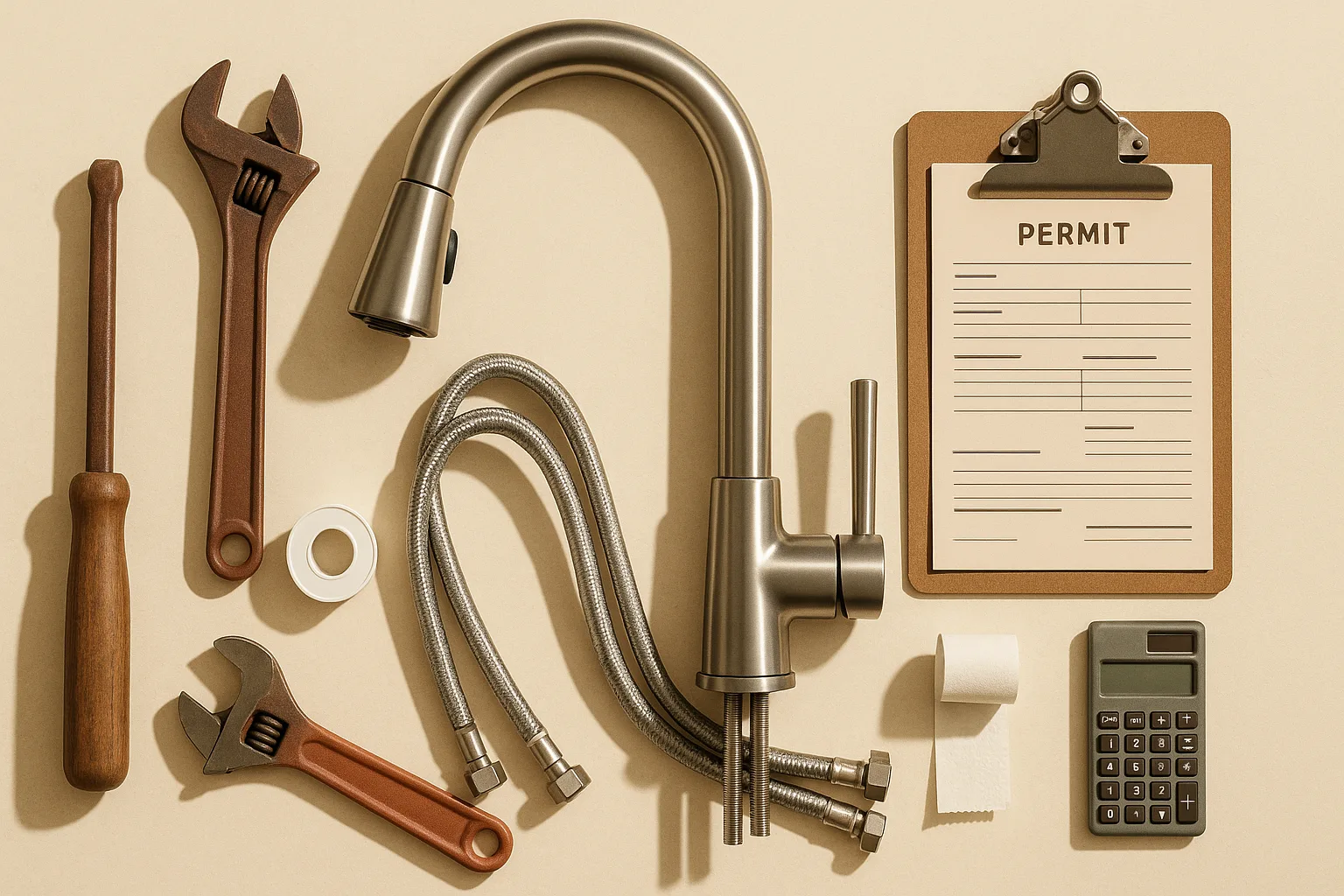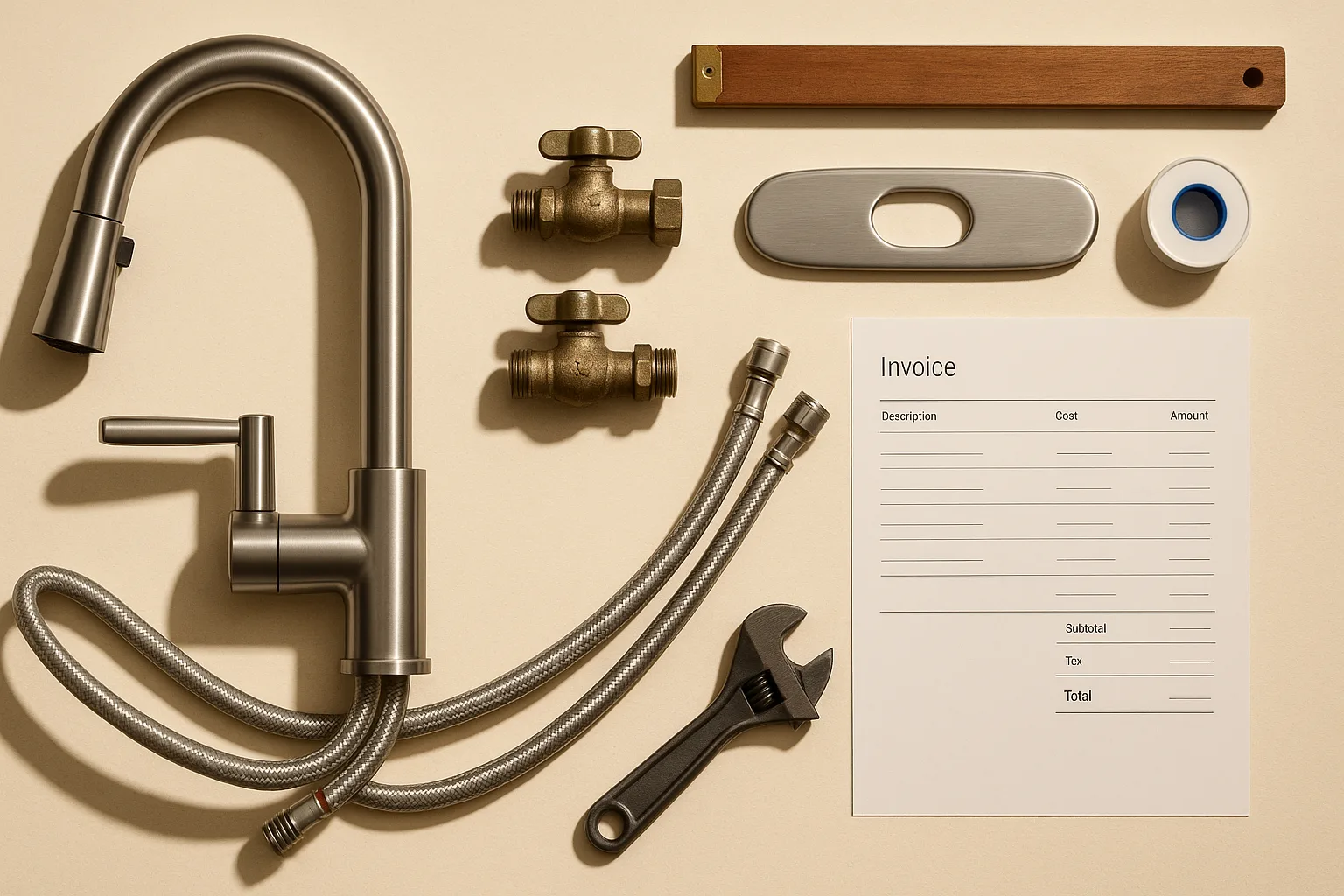
A standard kitchen faucet swap — same holes, existing supply lines, shutoff valves that actually turn — runs $150 to $400 for most U.S. homeowners, with a national average near $300 according to Fixr's 2025 kitchen faucet installation guide. Move the faucet even a foot to the left, or discover that your shutoff valves are frozen solid with mineral buildup, and that bill can double before the plumber finishes writing up the quote.
The reason most cost articles don't help you budget accurately is that they flatten all of those scenarios into one average. This guide separates them into clean line items — faucet unit, labor, supply lines, shutoff valves, permits, and relocation — and gives you a specific decision rule for each one.
Kitchen faucet replacement cost in the U.S. at a glance
At a Glance: - Same-location replacement: $150–$400 all-in, with a national average near $300 - Relocation or new plumbing: $600–$800+ once supply lines or drain work enter the scope - DIY materials only: $30–$100 for a standard swap when the hookups already match - Decision rule: if the faucet stays in the same holes, you're pricing a replacement; if the plumbing moves, you're pricing a project
The $150–$400 range applies when your plumbing hookups already exist and are in good shape: the supply lines are reachable, the shutoff valves close properly, and the new faucet fits your existing hole configuration. HomeGuide's 2026 estimate puts labor-only kitchen faucet replacement at $150–$350, which aligns closely. RateYourPlumber's 2026 guide is slightly broader at $100–$350 for the plumber's portion alone, reflecting how much local market rates move the number.
Once the scope changes — relocated drain, new supply line run, island sink — you're no longer swapping a faucet. You're doing a plumbing project that happens to include a faucet at the end.
Typical national average: $150 to $400 for a standard swap
For a same-location replacement on a kitchen sink with working shutoff valves and intact supply lines, expect to pay $150 to $400 all-in, with most jobs landing around $300. That figure from Fixr's 2025 kitchen faucet installation guide reflects parts and labor combined for a straightforward swap.
The split roughly looks like this: the faucet fixture itself accounts for $50–$200+ of that total (see faucet unit costs below), and labor makes up the rest. A licensed plumber typically handles a standard single-handle pull-out replacement in 1–2 hours — once they're under the sink with a basin wrench, most of the time goes to disconnecting old supply lines, breaking loose the mounting nut, and threading in the new unit.
Pro Tip: If you already own a faucet and just need installation, ask your plumber for a labor-only quote. HomeGuide puts that number at $150–$350, which is a useful benchmark when comparing bids.
When the price jumps to $600 to $800+
According to Fixr's 2025 kitchen faucet installation guide, costs climb to approximately $600 to $800 when the connection must be relocated or new plumbing installed. Three scenarios consistently push jobs into this range:
Relocation Cost Callout: - Lateral move (same counter, new position): Involves extending or rerouting supply lines and possibly cutting a new hole in the countertop or sink deck. Adds significant labor and may require a permit. - Sink moved to a new counter location: Requires running new supply lines and drain lines, opening walls or cabinets, and almost certainly pulling a permit. Costs can exceed $800 depending on distance. - Island sink installation: No existing plumbing below — supply lines and drain must be run under the floor or through cabinetry. This is a full plumbing project, not a faucet swap, and can run $1,000–$2,500+ depending on complexity. - New line from scratch: If your kitchen never had a second sink or a pot filler and you're adding one, the cost of the faucet is a small fraction of the total.
The permit question also comes into play at this tier — more on that below.
Kitchen faucet replacement cost breakdown by line item
Broad averages obscure where the money actually goes. Here's what each component costs and why it matters when you're comparing quotes or deciding whether to DIY.
Cost Breakdown: - Faucet unit: $30–$600+ depending on style and brand - Labor (plumber): $100–$350 - Braided supply lines: $10–$30 per pair - Shutoff valve replacement: $50–$150 per valve (parts + labor) - Escutcheon plate / deck plate: $10–$40 - Permit (if plumbing moves): $50–$300+ depending on jurisdiction - Service call / trip fee: $50–$150 - Subtotal/total framing: a basic same-location swap usually lands around $150–$400, while jobs with failed valves or relocation move into $400–$800+ territory
Note that RateYourPlumber quotes installed replacement at $200–$500 excluding the fixture itself, which is why understanding what's included in any quote matters before you sign off.
Faucet unit cost: budget, midrange, and pull-down models
The faucet you choose sets the price floor for the entire project. Here's how costs break down by tier:
- Budget (basic two-handle or simple single-handle): $30–$80. These handle daily use but typically use ceramic disc or ball mechanisms that may need cartridge replacement sooner. Brands like Moen, Delta, and Kohler all offer solid entry-level options in this range.
- Midrange (single-handle pull-out or pull-down): $80–$250. This is where most households land. Pull-down models with a braided hose, a spray/stream toggle, and a solid lead-free brass body are widely available in this tier. WaterSense-certified models in this range can reduce water use measurably without sacrificing pressure.
- Premium (pull-down with touchless or Touch2O, high-arc, or commercial style): $250–$600+. Delta, Moen, and Kohler each make flagship models here. Expect more finish options, better flow rate control, and additional installation complexity (more on that under pull-down faucets below).
Affiliate Product Card: If you want a durable midrange unit that won't make the install harder than it needs to be, look at Moen pull-downs for straightforward hose routing, Delta Touch2O models for hands-free convenience, or Kohler single-handle faucets for clean fit-and-finish. The value is not just the finish — it is the combination of accessible parts, clear instructions, and fewer surprises under the sink.
Pro Tip: A WaterSense-certified faucet uses no more than 1.8 gallons per minute — older standard faucets often run at 2.2 gpm. Over a year of daily use, that's a modest but real reduction on your water bill.
Labor cost for a plumber to replace a kitchen faucet
Labor is where quotes diverge most. HomeGuide puts kitchen faucet replacement labor at $150–$350, and RateYourPlumber gives a similar $100–$350 range. The national average plumber rate is about $85 per hour per RateYourPlumber's plumber cost guide, though many plumbers bill $50–$150 per hour depending on market.
Most plumbers don't charge hourly for a simple faucet swap — they quote a flat rate for the job. That flat rate bakes in their travel time, service call fee, and an expected 1–2 hours of work. If the job runs longer because of corroded connections or a hard-to-reach under-sink space, some contractors will adjust the bill; others won't. Ask before they start.
Pro Tip: Always ask whether the quote includes a service call fee. Many plumbers charge $50–$150 just to show up, and that fee may or may not be rolled into the labor quote.
Supply lines, shutoff valves, and small parts that add cost
These are the parts that turn a $200 job into a $350 job — and most homeowners don't know to ask about them upfront.
Braided supply lines ($10–$30 per pair): The flexible hoses connecting your shutoff valves to the faucet. Most plumbers replace these as a matter of course when swapping a faucet because old supply lines can harbor mineral buildup or stress cracks. Kohler's installation documentation, including this undercounter and hose-routing guide, specifically instructs installers to route supply hoses carefully and avoid kinking, confirming that hose condition and routing directly affect installation success.
Quarter-turn shutoff valves ($50–$150 per valve including labor): The small valves under the sink that stop water flow. If yours are old compression-style valves or have never been operated in years, they may not fully close — or may break when turned. Replacing them with modern quarter-turn ball valves is a smart upgrade and often necessary before any faucet work proceeds.
Escutcheon plate / deck plate ($10–$40): A cover plate used when your faucet has fewer holes than your sink deck, or when you're switching from a three-hole to a single-hole configuration. Kohler's installation documentation includes escutcheon, washer, spacer, and undercover bracket steps as standard parts of certain faucet installs, and the parts list in Kohler's installation sheet makes that sequence explicit.
Compression fittings and plumber's tape (PTFE): Minimal cost individually — usually under $5 — but necessary for leak-free connections. Any plumber will have these on the truck.
Watch Out: Don't assume your existing supply lines are fine just because they look okay from the outside. Corroded ferrules, mineral-packed compression fittings, cracked braided sleeves, seized shutoff valves, and cramped cabinet access are all hidden until water is running through them under pressure — and each one can turn a simple replacement into a longer repair visit.
Permit and inspection risk when plumbing moves
Permit Risk Callout: - Same-location faucet replacement: Permit generally not required in most U.S. jurisdictions. You're swapping a fixture in place — no pipes move. - Relocating plumbing (new hole position, lateral move, island sink): Permit likely required. Adding or relocating water supply lines or drain lines triggers permit requirements in most cities. Seattle's plumbing code guidance and Albuquerque's permit rules, for example, both treat supply-line relocation as a permitted change. - Who checks: Ask your local building department, not your contractor. Rules vary by municipality, and some areas have explicit exemptions for like-for-like fixture replacement.
The practical risk of skipping a permit on a job that needs one isn't just a fine — it can affect your homeowner's insurance coverage and complicate a future home sale. If a plumber tells you "you don't need a permit" for a job that clearly moves plumbing, verify that independently.
What makes kitchen faucet replacement more expensive
A standard faucet swap becomes an expensive plumbing call when one or more complicating factors are present. Here's the checklist of what drives costs up:
Factors That Drive Cost Up: - Seized shutoff valves: Won't close, won't turn, or break when forced. Must be replaced before faucet work can proceed. Each valve is $50–$150 in parts and labor. - Corroded supply lines: Old braided or chrome-plated supply lines with mineral buildup, stripped fittings, or corrosion at the compression joint. Add replacement cost and potential cleanup time. - Galvanized pipe connections: Older homes may have galvanized steel supply pipes that are partially blocked with rust or have corroded fittings. Connecting new faucet lines to old galvanized requires dielectric fittings or pipe replacement. - Unusual connections: Non-standard hole spacing, old cast-iron sink with deck fittings, or PEX supply lines with incompatible fittings all add time and may require adapters. - New hole drilling: Switching from a three-hole setup to a single-hole faucet (or vice versa) means drilling into porcelain, stainless steel, or stone — a precision job that adds labor time and requires a deck plate or escutcheon to cover unused holes. - Hidden leaks: Water damage behind the cabinet, softened cabinet floor, or evidence of prior leaks indicates a larger problem. Hidden leak detection and repair runs $350–$1,500+ according to RateYourPlumber's leak repair guide. - Tight or obstructed under-sink space: Deep farmhouse sinks, garbage disposals, water filters, and cramped base cabinets all slow down installation. Time under the sink with a basin wrench in a tight space is billed at the same hourly rate as easy work. - Emergency timing: More on this below.
Same-hole replacement vs lateral move vs island move
These three scenarios represent fundamentally different scopes of work:
| Scenario | Scope | Typical Time | Typical Cost |
|---|---|---|---|
| Same-hole replacement | Disconnect old faucet, install new faucet in identical position | 1–2 hours | $150–$400 |
| Lateral move (same sink, new position) | New hole in sink/countertop, reroute supply lines, cover old holes | 3–5 hours | $400–$800 |
| Island sink (new location, no existing plumbing) | Run supply and drain lines, open floor/cabinetry, permit likely | 1–3 days | $1,000–$3,000+ |
The lateral move is the scenario most homeowners underestimate. Moving a faucet even six inches on the same sink deck means drilling into porcelain or stainless steel (which requires a hole saw rated for that material and a steady hand), rerouting flexible supply lines, and potentially covering the old holes with a deck plate. A plumber doing this job cleanly should quote it at roughly twice the same-hole labor rate.
The island move is a different category entirely. Because no existing plumbing serves the island, supply lines must be run from an existing branch, and the drain must connect to either a floor drain or a run back to the main drain stack. Both typically require a permit, inspection, and a meaningful amount of rough plumbing work before the faucet even comes out of the box.
Why pull-down and sensor faucets can take longer
Pull-down and touchless faucets add installation steps that a basic two-handle replacement doesn't have.
For pull-down models, the biggest under-sink issue is hose management. Moen's pulldown faucet installation instructions specifically address this: "To enhance the performance of your pulldown or pullout wand, Moen offers the 159060 Hose Guide to isolate the hose from plumbing lines and other items under the kitchen sink." Moen's installation sheet and the hose guide recommendation show that crowded under-sink spaces — garbage disposals, water filters, cleaning supplies — mean the installer needs to route and secure the retractable hose so it doesn't snag on adjacent plumbing or restrict the wand's reach.
Sensor and Touch2O faucets add a power source requirement. Delta's Touch2O pull-down models can operate on batteries or on an A/C power adapter that replaces the battery pack entirely. If your under-sink cabinet doesn't have an electrical outlet nearby, battery operation is standard — but if you want the A/C adapter for consistent power, that may mean calling an electrician in addition to a plumber. Plan for that coordination cost upfront.
Budget an extra 30–60 minutes of labor for a pull-down installation, and up to 2 additional hours if power routing is involved.
Emergency service vs scheduled installation prices
Scheduling a faucet replacement at your convenience costs significantly less than calling a plumber at 9 p.m. because a fitting failed. RateYourPlumber is direct on this: emergency calls add 50% to 100% to standard rates. Their leak repair guide confirms the same premium applies to urgent plumbing work.
In practical terms: a $300 scheduled faucet swap becomes a $450–$600 emergency call for the same work — before any additional repair costs from the underlying leak or damage. If your faucet is dripping or slow-leaking but not flooding, schedule the repair as a non-emergency and save the premium.
Pro Tip: Most plumbing companies have weekend rates that are higher than weekday rates even for non-emergency calls. If you have flexibility, a Tuesday or Wednesday appointment typically runs at the base labor rate.
When you can replace a kitchen faucet yourself
DIY is a real option for a same-location faucet swap when the conditions cooperate. RateYourPlumber estimates DIY materials at just $30–$100, making the savings over hiring a plumber ($150–$350 in labor) substantial.
DIY vs Pro: DIY is reasonable when you have existing shutoff valves that close fully, matching supply line connections, no signs of corrosion or prior leaks, and at least 2–3 hours of time. Call a plumber when any of those conditions fail — especially seized valves or old galvanized supply lines.
DIY is reasonable when the shutoffs work and the hookup matches
Before you order a faucet and block out a Saturday morning, run through this checklist:
- Shutoff valves close fully — turn them clockwise until they stop, then confirm water pressure at the tap drops to zero. If they spin freely without stopping flow, they're failed.
- Supply line connections match — most modern faucets use 3/8-inch compression or braided supply lines with 3/8-inch female ends. Check what you have before buying replacement lines.
- Existing hole configuration matches the new faucet — single-hole, three-hole, or widespread. If they don't match, you'll need a deck plate at minimum.
- No signs of water damage under the sink — press your hand on the cabinet floor. Soft, spongy, or discolored wood indicates prior leaks that should be investigated before you start.
- You have a basin wrench — this long-handled tool with a swiveling jaw is essentially non-negotiable for loosening the mounting nut above the sink deck. A standard wrench won't reach it.
- The faucet manufacturer provides instructions — Kohler, Moen, and Delta all publish clear installation guides. Pull up the PDF for your specific model before you start (Kohler's guides, for example, walk through escutcheon, spacer, undercover bracket, and supply hose routing in sequence).
If all six conditions are met, a standard single-handle pull-out swap is manageable for a motivated DIYer with basic plumbing comfort. The actual work is mostly mechanical — loosening, removing, inserting, tightening — not complex plumbing theory.
Call a plumber for seized valves, corrosion, or hidden leaks
Some conditions make DIY the wrong call, and recognizing them before you start saves you from a much worse situation mid-project.
When to Call a Pro: - Shutoff valves won't close or are visibly corroded — forcing a seized shutoff valve can snap the stem or damage the valve body, requiring an emergency main water shutoff and a full valve replacement. - Corroded or braided supply lines that won't disconnect — over-torquing old lines with mineral-locked fittings can crack the valve seat underneath. - Galvanized steel supply pipes — visible as dull gray threaded pipe (versus copper or white/blue PEX). Galvanized connections corrode from the inside and may be partially blocked or structurally compromised. - Unusual fittings or non-standard connections — if what's under your sink doesn't look like the diagrams in any faucet installation guide, stop and get a professional assessment. - Drilling a new hole — cutting through porcelain, stainless steel, or stone countertop requires specific tools and technique. A mistake here damages the sink or countertop, not just the faucet. - Evidence of hidden leaks — discolored cabinet floor, water stains on the back wall, soft drywall behind the cabinet. Per RateYourPlumber, simple leak repairs run $150–$350, but hidden leak detection and full repair can reach $350–$1,500+. Don't go further until you know what you're dealing with.
How long a standard faucet swap takes
A same-location replacement by a plumber typically takes 1 to 2 hours from arrival to cleanup. For a competent DIYer doing the same job, budget 2 to 3 hours, mostly because you'll be slower under the sink and may need to make a hardware store run for an unexpected fitting.
Complex jobs run longer:
- Lateral move with new hole and supply reroute: 3–5 hours for a plumber
- Seized valve replacement plus faucet swap: add 1–2 hours
- Pull-down installation with tight under-sink space: add 30–60 minutes
- Sensor faucet with A/C power routing: add 1–2 hours (plus separate electrician visit)
If a plumber quotes you 4–5 hours for a "simple" same-hole swap, ask for a specific explanation of what's driving the time estimate.
How to compare plumber quotes for faucet replacement
Quotes for the same faucet job can vary by $200 or more between contractors. The reason is usually not fraud — it's that different plumbers bundle line items differently. A fair comparison requires you to separate each cost component.
| Line Item | What to Look For | Typical Range |
|---|---|---|
| Labor | Hours × rate, or flat rate | $100–$350 |
| Service call / trip fee | Often separate from labor | $50–$150 |
| Parts (supply lines, valves) | Should be itemized, not buried | $20–$150 |
| Fixture (if they're supplying) | Compare to retail price | Varies |
| Permit (if required) | Who files and pays | $50–$300+ |
| Old fixture disposal | Sometimes charged separately | $0–$50 |
| Labor warranty | How long, what's covered | 30 days–1 year |
RateYourPlumber estimates installed replacement at $200–$500 excluding the fixture — which tells you that quotes bundling in a $250 faucet and $350 in labor should show up as $550–$600, not $350. If a quote seems low, ask what it excludes.
Questions to ask before you approve the job
Before you give the go-ahead, ask your contractor:
- Is the service call fee included in this quote, or added on top?
- Does this include replacing the shutoff valves if needed, or is that extra?
- Are new supply lines included, or will you reuse the existing ones?
- Who is responsible for pulling any required permits, and what's the cost?
- What's your labor warranty? A standard answer is 30–90 days on labor; some plumbers offer up to a year.
- Does the faucet manufacturer's warranty still apply if you install it? Most brands (Moen, Delta, Kohler) don't void their warranty based on who installs the faucet, but confirm this if you have a premium model.
- What's the plan if you find corroded valves or hidden damage once the job starts? Get the hourly rate for added scope in writing before work begins.
How regional labor rates change the final bill
The same faucet swap genuinely costs different amounts depending on where you live. RateYourPlumber's plumber cost guide puts the national average plumber rate at $85 per hour, but the actual range is $50–$150 per hour — a 3× spread from low-cost to high-cost markets.
Regional Cost Note: - Low-cost markets (rural Midwest, parts of the South): $50–$75/hour. A standard faucet swap may come in at $150–$225 total including parts. - Mid-tier markets (mid-size cities, suburban regions): $75–$100/hour. Expect $250–$350 all-in for a standard same-location swap. - High-cost markets (San Francisco, New York City, Seattle, Boston): $100–$150+/hour. The same job routinely runs $350–$500, and complex work with permits can exceed $1,000.
Emergency calls add 50%–100% to any of these regional baselines. If you're in San Francisco and your faucet fitting blows at midnight, a $400 job can hit $700–$800 before any parts are counted.
FAQ about kitchen faucet replacement costs
FAQPage schema can be added as secondary schema if this page format supports it.
Does replacing a kitchen faucet require a permit?
For a same-location swap: almost always no. Replacing a faucet in the same holes with no changes to the supply lines or drain is treated as a like-for-like fixture replacement in most U.S. jurisdictions. No permit is required in most cities for this scope.
For any plumbing relocation: likely yes. Adding or relocating water supply lines triggers permit requirements in most municipalities. Seattle's published plumbing guidance and Albuquerque's permit rules both classify supply-line relocation as a permitted change. Island sink installations, new pot filler rough-in, or any job that requires opening walls to run new pipe almost always needs a permit.
When in doubt, call your local building department directly with the specific scope of work. The answer takes five minutes and can save you significant hassle at resale.
Is it cheaper to replace the faucet or the sink too?
Replacing just the faucet is nearly always cheaper. A faucet-only same-location swap runs $150–$400 all-in. Adding a sink replacement changes the scope substantially: per HomeGuide's sink installation cost data, a kitchen sink itself costs $50–$750, and sink replacement labor runs $230–$650. Combined with faucet replacement, a full sink-and-faucet project can run $500–$1,400 or more depending on sink type and complexity.
That said, if your sink is damaged, stained, or the wrong configuration for a new faucet, doing both at the same time saves you from paying a second service call fee and tearing apart the under-sink plumbing twice. If the sink is fine, replace the faucet only.
What should I budget for a faucet and installation together?
For a standard kitchen faucet replacement with a midrange fixture, budget $250 to $500 total — that covers a $80–$150 faucet plus $150–$350 in labor. If you need supply line or shutoff valve replacement, add $50–$200 to that figure.
If you're doing it yourself, RateYourPlumber estimates $30–$100 in materials for a DIY swap, making the total cost just the faucet plus incidentals like braided supply lines and plumber's tape.
Per Fixr's 2025 kitchen faucet installation guide, the national average for professional installation is $300 — a reliable planning figure for a same-location swap with no complications. Build in a $100 buffer for incidental parts, and you'll be well-positioned regardless of what the plumber finds under the sink.
Sources & References
- Fixr — Kitchen Faucet Installation Cost Guide — National average and range data for kitchen faucet installation, 2025
- HomeGuide — Faucet Installation Cost — Labor-only kitchen faucet replacement estimates, 2026
- RateYourPlumber — Faucet Installation Cost Guide — Plumber and DIY cost ranges for faucet installation, 2026
- RateYourPlumber — Plumber Cost Guide — National average plumber hourly rate and rate ranges
- RateYourPlumber — Leak Repair Cost Guide — Simple and hidden leak repair cost ranges; emergency rate premium
- RateYourPlumber — Bathroom & Kitchen Plumbing — Installed replacement cost estimates excluding fixture
- HomeGuide — Sink Installation Cost — Kitchen sink unit and labor cost ranges
- Fixr — Sink Installation Cost — Kitchen sink installation cost data
- Moen Pulldown Faucet Installation Sheet (INS10294A) — Hose guide reference and pulldown installation details
- Delta Touch2O Faucet Product Page — A/C power adapter details for Touch2O pull-down models
- Bees Plumbing — Seattle Plumbing Code Guide — Permit requirements for supply-line relocation in Seattle
- Wagner Mechanical — Permit Requirements in Albuquerque — Local permit rules for plumbing changes
Keywords: Fixr kitchen faucet installation cost, HomeGuide faucet installation cost, RateYourPlumber faucet installation cost, WaterSense, braided supply lines, quarter-turn shutoff valve, compression fitting, escutcheon plate, basin wrench, Moen, Delta, Kohler, lead-free brass, PEX, galvanized pipe