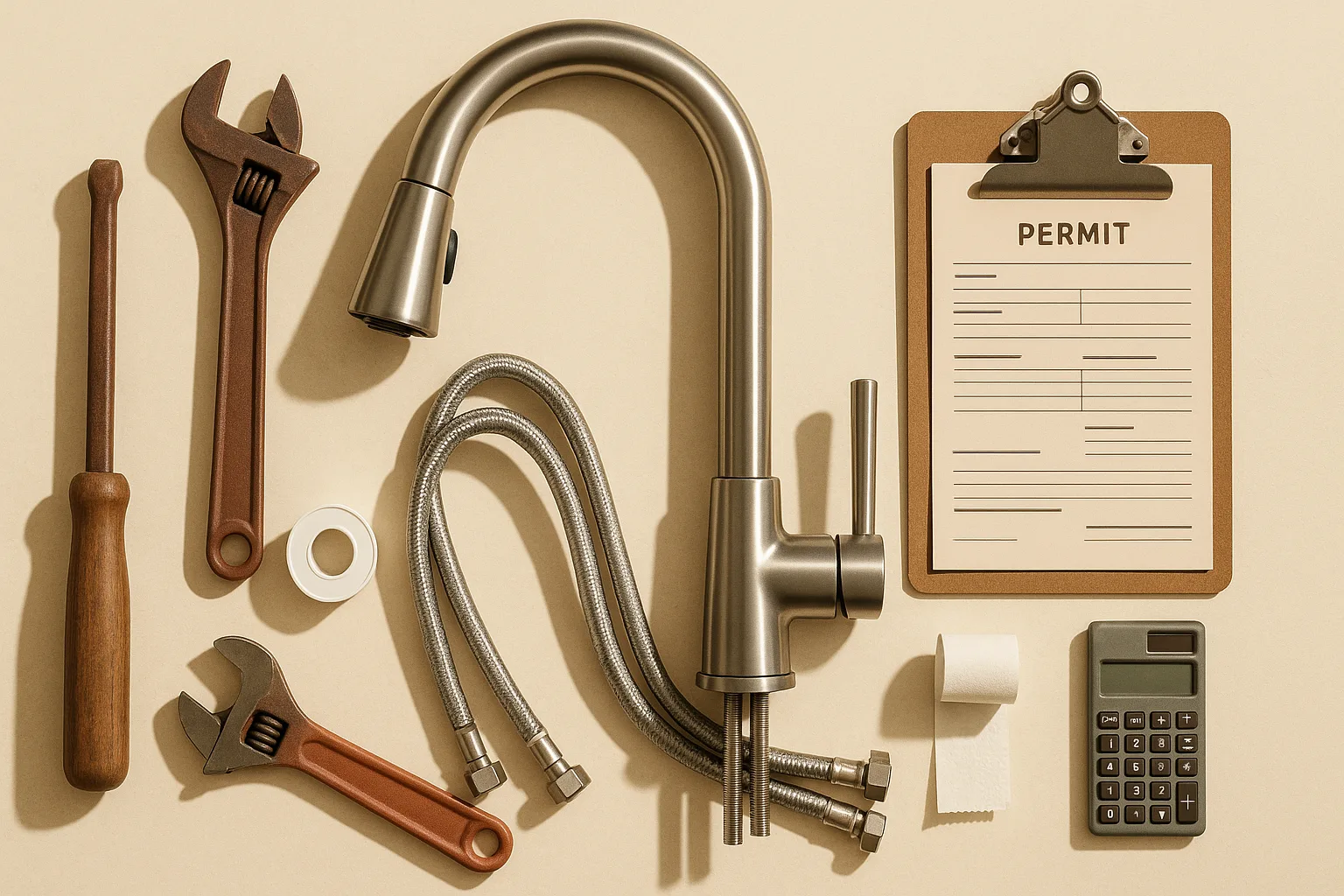
Kitchen faucet replacement cost, time, and permit at a glance
A same-location kitchen faucet swap costs most homeowners between $162 and $364, with an average of $262 according to HomeAdvisor's 2025 cost guide. If you hire a licensed plumber, expect to pay $45 to $200 per hour in labor — and a straightforward job wraps up in one to two hours. A same-location replacement almost never requires a permit. Once you start moving pipes, drilling new holes, or running new supply lines, the rules change and so does the cost.
Pricing and permit rules vary by jurisdiction and local labor market, so these figures are national guidance rather than a fixed local estimate.
At a Glance: - Typical cost: $162–$364 total (faucet + labor); national average $262 - Time: 1–2 hours for a clean swap; up to 8+ hours for complex jobs - Skill level: Beginner-friendly IF shutoffs work and hole pattern matches - Permit: Not required for same-location replacement in most US jurisdictions; required if you relocate plumbing or add new supply lines - DIY vs. Pro: DIY if valves turn freely and connections are standard; hire a plumber if valves are seized, lines are corroded, or holes need drilling
The faucet itself accounts for a big chunk of that budget — anywhere from a $40 builder-grade unit to a $400+ touchless model. Labor, supply lines, and incidental parts make up the rest. The sections below give you a line-by-line budget and a decision tree so you can plan before you ever pick up a wrench.
Kitchen faucet replacement cost breakdown by line item
Cost breakdown
Budget the project in five buckets: faucet, labor, supply lines, shutoff valve replacement (if needed), and permit fees. Here's what each line typically runs.
- Faucet: $40–$600+ depending on brand, finish, and features (pull-down sprayer, touchless, etc.)
- Labor: $150–$350 for a same-location kitchen faucet swap, per RateYourPlumber's 2026 guide. HomeAdvisor puts licensed plumber rates at $45–$200/hr, which aligns with that range for a 1- to 2-hour job.
- Supply lines: $5–$20 per line (braided stainless lines are worth the upgrade over plastic; plan on replacing both hot and cold)
- Shutoff valve replacement: $75–$200 per valve installed by a plumber, if the existing valves are corroded or won't close fully
- Permit fee: $0 for a same-location swap in most jurisdictions; $50–$300+ if plumbing relocation triggers a permit
Total realistic range: - DIY, budget faucet, no complications: $60–$150 (parts only) - Pro labor + mid-range faucet, clean swap: $250–$500 - Pro labor + complications (new valves, nonstandard layout): $400–$900+
That $262 national average sits squarely in the middle-of-the-road scenario — a plumber spending about an hour on an uncomplicated swap with a mid-range faucet. If your job has any of the complicating factors covered below, budget toward the higher end before the plumber arrives.
Kitchen faucet price range and feature add-ons
The faucet itself is the most variable line on your budget. A basic two-handle faucet from a recognizable brand like Pfister can run $40–$80. A single-handle pull-down from Moen or Delta sits in the $100–$250 range for most popular finishes, while a Delta pull-out model like 16953-SS-DST is a good value pick if you want a built-in deck plate and a flexible install. Touchless and voice-activated models push past $300, and the aerator is one of the smaller parts worth comparing if you care about flow, splash, and replacement compatibility.
Delta's model 16953-SS-DST, for example, is a pull-out single-handle in stainless that fits both 1-hole and 3-hole sinks — it includes a 10½-inch deck plate to cover the extra holes, which saves you from buying a separate escutcheon. That kind of built-in flexibility matters when you're not sure how many holes your sink has.
Feature add-ons that push the price up:
- Pull-down or pull-out sprayer: adds $30–$80 over a basic model
- Touchless sensor: typically adds $100–$200 to equivalent non-sensor models
- Finish upgrades (matte black, brushed gold): $20–$60 premium over chrome
- Integrated soap dispenser: $30–$60 extra if included; $15–$40 as a separate add-on
WaterSense-certified faucets use no more than 1.8 gallons per minute, which can trim water bills over time — look for the WaterSense label if efficiency matters to you. ADA-compliant faucets require lever or sensor operation (no twist knobs) and are worth considering if anyone in the household has limited grip strength.
Plumber labor cost for same-location replacement
For a same-location swap — same number of holes, existing shutoffs work, standard supply connections — a plumber typically charges $150 to $350 in labor, taking one to two hours. At the lower end of HomeAdvisor's $45–$200/hr rate, a one-hour job runs $45–$200 in labor alone; most plumbers have a minimum service call fee of $75–$150 that applies regardless of time.
The reason same-location swaps are cheaper than reroutes is simple: no wall opening, no new pipe runs, no additional rough-in. The plumber disconnects two supply lines, loosens one or two mounting nuts, drops in the new faucet, reconnects, tests, and leaves. When the job grows to include moving the faucet to a new sink location, running new hot or cold supply lines, or drilling through a granite or cast-iron sink, the work can easily stretch to four to eight hours — and the invoice grows accordingly.
Pro Tip: If you're getting quotes, ask specifically whether the price includes supply lines and whether the plumber will test for leaks before leaving. Some shops quote labor only; the parts bill arrives separately.
Extra parts that can increase the bill
Most homeowners assume the new faucet comes with everything needed. It usually doesn't. Before you start — or before your plumber quotes the job — run through this checklist:
- Supply lines: Rarely included with a faucet. Plan to buy two braided stainless lines (12–18 inches is standard for most kitchen setups). Avoid the cheap plastic reinforced lines.
- Deck plate / escutcheon: Needed if you're installing a single-hole faucet in a 3-hole sink. Delta's 16953-SS-DST includes one; many models don't. Check the box before you buy.
- Deck plate gasket: Moen's installation instructions specify a deck plate gasket for 3-hole applications — a $2 part that's easy to forget.
- Plumber's putty: Moen explicitly calls for a bead of plumber's putty under the escutcheon rim to seal it to the sink surface.
- PTFE tape (plumber's tape): Wrap the threaded supply line connections to prevent slow seep leaks. A $2 roll.
- Silicone caulk: Some installs benefit from a thin bead around the base after mounting, especially on stainless sinks where water pools.
- Mounting hardware: Gaskets, mounting brackets, and nuts are usually included with the faucet, but verify against the parts list in the box before you start.
Do you need a permit to replace a kitchen faucet?
For a like-for-like faucet replacement in the same location, you almost certainly do not need a permit. Jurisdictions across the US consistently classify same-location fixture swaps as maintenance work rather than new construction. Mississauga's official permit guidance — representative of the logic most North American codes follow — states explicitly that replacing a plumbing fixture in the same location does not require a permit.
The permit risk starts the moment you go beyond "same faucet, same holes, same supply connections."
Same-location faucet swaps versus plumbing relocations
Use this matrix to size your permit risk before the project begins:
| Work Type | Permit Usually Required? | Notes |
|---|---|---|
| Same-location faucet swap | No | Existing holes, existing supply connections |
| New hole drilled in sink | Check local code | May trigger review depending on jurisdiction |
| Faucet moved to new location on same sink | Possibly | Depends on whether supply lines are rerouted |
| New supply lines run (hot or cold) | Yes in most jurisdictions | Seattle plumbing code explicitly requires a permit for adding or relocating supply lines |
| Drain line relocation | Yes | Nearly universally permit-required |
The practical takeaway: if the new faucet drops into the same holes and connects to the same supply valves, pull it out of the box and get started. If anything about the plumbing layout is changing, call your local building department first. A five-minute phone call is cheaper than a failed inspection later.
When a licensed plumber should pull the permit
When the work does require a permit — new supply lines, relocated plumbing, structural changes to accommodate a different faucet configuration — a licensed plumber is typically the right person to pull it. Most jurisdictions allow homeowners to pull permits for work on their own primary residence, but the inspection process is stricter and the liability is entirely yours if something fails.
A plumber who pulls the permit is also staking their license on the work quality, which gives you a layer of accountability. For complex work that HomeAdvisor estimates can run eight hours or more, having a licensed professional responsible for code compliance is worth the added labor cost. Ask your plumber directly: "Will you pull the permit for this job?" If the answer is no for work that clearly requires one, find a different plumber.
DIY or hire a plumber: the right decision tree for faucet replacement
Most home improvement resources send you either to a DIY tutorial or a pro-hire guide — rarely both. The honest answer is that the right path depends on four specific conditions: whether your shutoff valves work, whether your supply lines are corroded, whether the new faucet matches your sink's hole pattern, and whether drilling or rerouting is involved.
DIY vs Pro: DIY is the right call when: - Both shutoff valves (hot and cold) turn fully and stop water flow completely - Existing supply connections are standard (3/8-inch compression or braided lines) - The new faucet matches your sink's hole count, or includes a deck plate for the extra holes - No drilling, rerouting, or new supply lines are needed
Hire a plumber when: - Either shutoff valve is seized, leaking, or won't fully close - Supply lines show corrosion, mineral buildup, or any soft spots - The new faucet requires drilling a new hole or a nonstandard configuration - You're relocating the faucet or running new supply lines - You're dealing with an active leak under the sink
[Image: Decision flowchart — DIY vs. plumber for kitchen faucet replacement]
The cost difference is real but manageable. A clean DIY swap costs $60–$150 in parts. A plumber for the same clean swap runs $250–$400 all-in. That $150–$250 gap is worth it for DIY if the conditions above check out — and worth paying if even one red flag appears.
DIY if the shutoffs work and the hole pattern matches
Three things need to be true before you commit to doing this yourself.
Checklist for a DIY-safe faucet replacement:
- [ ] Hot shutoff valve turns fully clockwise and water stops completely
- [ ] Cold shutoff valve turns fully clockwise and water stops completely
- [ ] Existing supply lines are in good condition — no rust, no green corrosion, no soft spots
- [ ] New faucet matches sink hole count (single-hole sink = single-hole faucet, OR faucet includes a deck plate for extra holes)
- [ ] No drilling required — faucet body fits existing cutout
- [ ] Connections are standard 3/8-inch compression or braided supply lines
| Sink setup | What fits | What to look for |
|---|---|---|
| 1-hole sink | Single-hole faucet | No deck plate needed |
| 3-hole sink, 4-inch spread | 3-hole faucet or single-hole faucet with deck plate | Check that the deck plate and gasket are included |
| 3-hole sink, wide spread | Wide-spread faucet | Separate handles and spout must match the hole spacing |
On hole patterns: a single-hole faucet works in a 1-hole sink with no adapter. In a 3-hole sink, you need either a 3-hole faucet (separate handles, center spout) or a single-hole faucet that includes a deck plate. Delta's 16953-SS-DST includes a 10½-inch deck plate specifically for this scenario, and Moen's 3-hole installation instructions require a deck plate gasket and deck plate. Don't assume — check the box contents before purchase.
If all six boxes above are checked, this is a beginner-friendly project. If even one is uncertain, keep reading.
Call a plumber if valves are seized, lines are corroded, or holes must be drilled
When to Call a Pro: - Seized shutoff valves: A valve that won't turn, turns but doesn't stop water, or leaks when you try to close it is a plumber call. Forcing a seized valve can snap it off and create a much bigger problem. - Corroded supply lines: Green mineral deposits, rust streaking, or any visible corrosion on the supply lines means they're on borrowed time. Per RateYourPlumber's 2026 guide, corroded supply lines are one of the top triggers for a professional service call. - Nonstandard supply connections: If the lines under your sink look unusual — older iron pipe, compression fittings that don't match standard hardware store supply lines, or copper tubing soldered directly to the faucet body — get a plumber. - New holes required: Drilling through porcelain, stainless steel, granite, or cast iron requires specialized equipment and one wrong move can crack a $500 sink. - Active leaks: If there's already water under the sink, the faucet swap is secondary. The leak needs to be diagnosed first.
Complex jobs can run up to eight hours or more, per HomeAdvisor — and at $45–$200/hr in labor, that's the scenario where your $262 average can double or triple. Know your red flags before you start.
Tools and materials needed to replace a kitchen faucet
Pull these together before you turn off the water. Stopping mid-job to run to the hardware store with no water to the kitchen is avoidable.
Tools: - Basin wrench (essential — it reaches the mounting nuts up inside the sink cabinet that no other tool can) - Adjustable wrench (for supply line connections) - Flashlight or headlamp (under-sink visibility is poor) - Bucket (place it under the supply connections before disconnecting anything) - Utility knife or putty knife (to break the old caulk or putty seal) - Penetrating oil (PB Blaster or similar) if connections look corroded
Materials: - New faucet (verify hole compatibility before purchase — see section below) - Two braided stainless supply lines, 12–18 inches - PTFE tape (plumber's tape) - Plumber's putty (if your faucet or escutcheon uses it — check the instructions; some modern faucets use a rubber gasket instead and specifically say do NOT use putty) - Silicone caulk (optional but useful on stainless sinks) - Replacement shutoff valves, if yours are questionable
Per Moen's installation instructions: "Be sure sink or mounting surface is clean and dry." That sentence matters more than it sounds — old putty residue or mineral deposits under the new faucet base will prevent a proper seal.
Before you start: shut off water and clear the cabinet
The most important step happens before you touch the faucet.
Pre-install prep checklist:
- Clear everything out of the cabinet under the sink — cleaning supplies, the garbage bag, all of it. You need room to work and you will not want to discover a surprise leak on top of a cardboard box.
- Locate both shutoff valves (hot on the left, cold on the right when facing the sink). Turn each one fully clockwise.
- Open the faucet handle(s) and let any pressurized water drain out. Moen's instructions specifically caution to "handle [the faucet] to relieve water pressure and ensure that complete water shut-off has been accomplished." This isn't optional — skipping it means water sprays into your cabinet when you disconnect the supply lines.
- Place a bucket under the supply line connections before disconnecting anything.
- Have a towel handy — even with the water off, residual water in the lines will drip.
If you turn the shutoffs and water continues to flow at the faucet after 30 seconds, the shutoffs are failing. Stop here and call a plumber. Do not proceed with a DIY install if you can't reliably shut off the water.
How to match the new faucet to the sink hole pattern
Count the holes in your sink deck before you buy anything. Kitchen sinks typically come in three configurations:
| Sink Configuration | Faucet Match Needed |
|---|---|
| 1 hole | Single-hole faucet (no deck plate needed) |
| 3 holes (standard 4-inch spread) | 3-hole faucet, OR single-hole + deck plate |
| 3 holes (wide 8-inch spread) | Wide-spread faucet (separate valves + spout) |
A single-hole faucet like Delta's 16953-SS-DST works in both 1-hole and 3-hole sinks — but only because it includes a 10½-inch deck plate to cover the side holes. If the faucet you're considering doesn't include a deck plate and you have a 3-hole sink, you need to either buy a matching deck plate separately or choose a different faucet.
Escutcheon plates serve the same covering function and are model-specific. Moen's instructions for 3-hole configurations specify a deck plate gasket that seats under the deck plate — that gasket is what actually seals against water migration, so don't skip it.
Pro Tip: Take a photo of the underside of your sink showing the hole configuration and the existing supply connections before you go to the store. It answers most compatibility questions on the spot.
How to replace a kitchen faucet step by step
With water off, bucket in place, and tools ready, the physical replacement takes most people about 45–90 minutes. Follow the steps in order.
Remove the old faucet and disconnect the supply lines
- Position your bucket directly under the supply line connections.
- Use your adjustable wrench to loosen the supply line nuts at the shutoff valves — turn counterclockwise. Have the bucket ready; water will drain from the lines. Per Delta's support content: "Remove the hot supply line from the shut-off valve and place the line into a bucket."
- Disconnect the supply lines at the faucet end as well (usually another compression nut up inside the sink).
- Use your basin wrench to reach up and loosen the mounting nut(s) holding the faucet body to the sink. On older faucets, these nuts may be corroded — apply penetrating oil and let it soak for 10–15 minutes if they won't break loose.
- Lift the old faucet out from above. Pull the supply lines up through the hole.
- Scrape off any old plumber's putty or caulk residue from the sink surface with a putty knife. The mounting surface must be clean and dry before the new faucet goes in — hardened putty or mineral deposits will prevent a proper seal.
Watch Out: If the mounting nut strips or snaps rather than turning, you have corroded hardware. This is a plumber situation — forcing it further risks damaging the sink.
Install the new faucet and secure the mounting hardware
- Read the faucet's included instructions before you start — this step is model-specific. What follows reflects the general sequence for most single-hole and 3-hole installs.
- If your faucet uses plumber's putty, follow Moen's instruction to "Place a bead of plumber's putty under the rim of the escutcheon". Roll a rope of putty about ¼-inch thick and press it around the underside of the base or escutcheon before lowering it into the hole. If your faucet specifies a rubber gasket instead, skip the putty — using both can prevent a proper seal.
- Feed the supply tubes and any mounting hardware down through the sink hole from above.
- From below, thread on the gasket, mounting bracket, and mounting nut in the order specified by your instructions. For Delta's single-hole models, this typically means gasket → mounting bracket → nut, secured with the included wrench. For a 3-hole install using a deck plate, the deck plate gasket seats first, then the deck plate, then the faucet body.
- Hand-tighten the mounting nut until snug, then give it a quarter-turn with the basin wrench. Do not overtighten — you'll crack the sink deck or strip the nut (see Mistakes section below).
- From above, check that the faucet is centered and aligned before fully tightening.
Connect supply lines, turn the water back on, and test for leaks
- Wrap the threaded supply connection points with two layers of PTFE tape — wrap clockwise (in the direction you'll tighten the nut) so the tape doesn't unravel as you tighten.
- Connect the new supply lines: hot to the hot shutoff, cold to the cold. Hand-tighten first, then snug with the adjustable wrench — about a quarter-turn past hand-tight. Do not use the basin wrench here; the leverage is too much.
- Before fully reconnecting the supply lines, Delta recommends a flush step: place the hot supply line in a bucket, open the cold shutoff, and run cold water through the faucet for one minute. "The cold water should flow through the faucet and out the hot supply tube." This clears debris from the lines before they're fully connected.
- Reconnect the hot supply line to the hot shutoff.
- Slowly open both shutoff valves fully counterclockwise.
- Turn the faucet on and let it run for 30 seconds.
Leak test checklist: - [ ] Inspect both supply line connection points at the shutoff valves — any drips? - [ ] Inspect both supply line connections at the faucet body — any drips? - [ ] Check the underside of the faucet base — any water seeping around the escutcheon? - [ ] Run both hot and cold independently for 30 seconds each - [ ] Leave the cabinet door open and check again after 30 minutes
A slow drip you don't catch today becomes mold under the sink in three months. Take the 30 minutes to actually watch for it.
How long kitchen faucet replacement takes for DIY and pro installs
A clean same-location swap takes one to two hours for a DIY beginner, per HomeAdvisor's 2025 data. An experienced plumber can do the same job in under an hour. Complex jobs — corroded hardware, new supply lines, nonstandard configurations — can stretch to eight hours or more. HomeAdvisor's 2025 guide also says licensed plumbers charge $45 to $200 per hour for faucet installation, which is why a clean hourlong call stays manageable while a complicated half-day job gets expensive fast.
Cost Snapshot: At $45–$200/hr for a licensed plumber, every extra hour of complexity adds $45–$200 to the labor line. A job that grows from 1 hour to 4 hours can add $135–$600 in labor alone before parts.
For DIY, the realistic time breakdown looks like this: - Prep and shutoffs: 10–15 minutes - Removal (assuming nothing is seized): 20–40 minutes - Installation and mounting: 20–40 minutes - Supply line connections and leak testing: 15–30 minutes - Total: 65–125 minutes for a clean job
Add 30–60 minutes if connections are stiff but not seized. Add multiple hours if you discover corroded valves mid-project and need a plumber to bail you out.
What makes a faucet swap faster or slower
Speed factors — scan these before you start:
- Under-sink access: A cramped cabinet with drain pipes and garbage disposal hardware in the way adds time. A clear cabinet with good lighting cuts it.
- Age of shutoff valves: Valves over 15–20 years old often take longer to operate — or don't operate at all.
- Supply line condition: Stiff, corroded supply line nuts that won't break loose can add 30–60 minutes and sometimes require a call to the hardware store for penetrating oil.
- Faucet mounting nut location: Some faucets mount with a single nut centered beneath the deck; others use two side nuts. The single-center nut is harder to reach but faster once you have the right basin wrench.
- Hole pattern complexity: A single-hole swap is faster than a 3-hole install with deck plate and gasket.
- Putty vs. gasket: Putty installs require cleanup time if excess squeezes out; gasket installs are slightly faster.
- Faucet type: A simple single-handle is faster than a pull-down with a separate sprayer hose and weight system that threads through the faucet body.
Common mistakes that cause leaks, water damage, or mold
Watch Out: A DIY faucet install that leaks — even a slow drip — can cause water damage to the cabinet floor, sub-floor, and adjacent wall framing. In a humid cabinet environment, mold can establish itself within 24–48 hours of a slow leak starting. If you're not confident in the leak test result, have a plumber inspect the install before you close the cabinet doors.
Most DIY faucet failures trace to one of three mistakes: skipping the leak test, overtightening fittings, or leaving failing shutoff valves in place. All three are preventable.
Overtightening fittings and damaging supply lines
The instinct when connecting water lines is to tighten hard — water is involved and you don't want it to leak. The problem is that both supply line fittings and mounting nuts have a sweet spot: snug enough to seal, not so tight that the fitting cracks, the washer distorts, or the braided line kinks at the connection point.
Delta's installation instructions for model 116101 specifically direct users to hand-tighten connections with the included wrench — the wrench provided is small by design, which limits how much torque you can apply. The rule for compression fittings on braided supply lines is hand-tight plus a quarter-turn with a wrench, maximum. If it's still dripping after that, the fix is better tape application or a new washer — not more torque.
A cracked fitting, a stripped mounting nut, or a kinked supply line all become leaks. A cracked supply line fitting under pressure becomes a flood.
Skipping shutoff valve replacement when valves are already failing
The single most common mistake experienced DIYers make is treating the shutoff valves as someone else's problem. You're here to replace the faucet, not the valves — except that a valve that barely closed for this project may not close at all the next time you need it.
If either valve was stiff, took more than a quarter-turn to fully close, or leaked slightly when you closed it, replace it now while the supply lines are already disconnected. A shutoff valve replacement by a plumber runs $75–$200 per valve installed — spend it now rather than discover a failed valve during a future emergency when every minute of water flow matters.
A seized valve is also a hard stop for DIY. Don't try to force it. RateYourPlumber's 2026 guide specifically flags seized shutoff valves as a primary reason to call a professional rather than proceed with DIY.
When to call a plumber for kitchen faucet replacement
Call a plumber when the job stops being a clean like-for-like swap. The cost of a plumber service call ($150–$350 for a standard kitchen faucet job, per RateYourPlumber's 2026 guide) is significantly less than the cost of water damage remediation, which can run $1,000–$4,000 for even a modest under-sink leak that goes undetected for a few weeks.
Per RateYourPlumber's 2026 guide, the conditions that most reliably send a DIY job sideways — and that warrant a professional — are seized shutoff valves, corroded supply lines, new-hole installations, and nonstandard faucet layouts. HomeAdvisor confirms that complex jobs can run eight hours or more, a time scale that makes professional labor the economical choice even if the hourly rate is higher.
Seized shutoff valves and corroded supply lines
Red-flag list — call a plumber if you find any of these:
- Shutoff valve won't turn at all, or turns but water doesn't stop
- Valve handle is broken or spins without engaging
- Green or white mineral crust on the valve body or supply line fittings
- Supply line feels soft, shows rust streaking, or has visible cracks
- Water is actively dripping or pooling under the sink before you've touched anything
- Supply lines are soldered copper running directly from the wall (not compression-fitted), indicating older plumbing that may need professional attention
Any one of these conditions changes the scope from "faucet swap" to "plumbing repair plus faucet swap." A plumber handles both in one trip; a DIYer who discovers these mid-project has water off and a partially disassembled faucet with no clear path forward.
Nonstandard layouts, new holes, and permit-triggering work
When the project requires drilling a new hole in the sink deck, moving the faucet to a new location, or running new hot or cold supply lines, you've moved into permit territory in most jurisdictions. Seattle's plumbing code guidance explicitly requires a permit for adding or relocating water supply lines — and Seattle's code is representative of how most US municipalities approach the same question.
At that point, you need a licensed plumber not just for skill reasons but for code compliance reasons. The plumber pulls the permit, performs the work to code, and the inspection confirms it's done correctly. Skipping the permit on work that requires one creates liability when you sell the house — an unpermitted plumbing change can come up in inspection and delay or kill a sale.
Kitchen faucet replacement FAQ
How much does it cost to replace a kitchen faucet?
Most homeowners pay $162 to $364 for a kitchen faucet replacement, with a national average of $262, per HomeAdvisor's 2025 cost guide. That range covers a mid-range faucet plus one to two hours of plumber labor. If you DIY a clean swap with a budget faucet and buy your own supply lines, total out-of-pocket can be as low as $60–$150. Jobs with complications — seized valves, nonstandard layouts, new supply lines — can push total cost to $400–$900 or more.
Can you replace a kitchen faucet yourself?
Yes, if your shutoff valves work, your supply connections are standard, and the new faucet matches your sink's hole pattern. A beginner who has never done plumbing work can complete a clean same-location faucet swap in one to two hours with a basin wrench, adjustable wrench, PTFE tape, and a bucket. The job becomes a professional call the moment a shutoff valve is seized, supply lines show corrosion, or drilling is required.
Do you need a permit to replace a kitchen faucet?
Almost never, for a like-for-like same-location replacement. Mississauga's permit guidance — which reflects the logic most US jurisdictions follow — states that replacing a plumbing fixture in the same location does not require a permit. If the project involves moving the faucet, running new supply lines, or drilling new holes, a permit is likely required. Check with your local building department before starting any work that goes beyond a straight swap.
How long does it take to replace a kitchen faucet?
HomeAdvisor puts simple kitchen faucet installations at one to two hours; complex jobs can take up to eight hours or more. For DIY, budget 90 minutes for a clean beginner-level swap in a clear cabinet with working valves. Add time for corroded hardware, tight spaces, and learning curves. A plumber handling the same clean swap typically finishes in under an hour.
When should you call a plumber to replace a faucet?
Call a plumber when any shutoff valve is seized or leaking, when supply lines show corrosion, when the layout requires drilling or rerouting, or when the project triggers a permit requirement. Also call one if you're mid-project and discover any of those conditions that weren't visible before you started. The labor cost of $150–$350 for a standard job is well below the cost of water damage caused by a failed DIY repair.
Sources & References
- HomeAdvisor 2025 Faucet Installation Cost Guide — primary cost data including average, range, and hourly labor rates
- RateYourPlumber 2026 Faucet Labor Guide — kitchen faucet labor ranges and professional call triggers
- Delta Faucet model 16953-SS-DST product page — hole compatibility, deck plate spec, and supply line flush procedure
- Delta Faucet model 116101 installation instructions — mounting hardware sequence for single-hole install
- Moen installation instructions (INS10205C) — 3-hole deck plate and gasket specifications
- Moen installation instructions (MT161A) — plumber's putty, water pressure relief, and surface prep guidance
- City of Mississauga — When a Building Permit Is Required — same-location fixture replacement permit exemption
- Bees Plumbing and Heating — Seattle Plumbing Code Guide — permit requirements for supply line relocation
Keywords: HomeAdvisor 2025 cost guide, RateYourPlumber 2026 guide, WaterSense, ADA-compliant faucet, basin wrench, adjustable wrench, plumber's putty, PTFE tape, shutoff valve, supply lines, escutcheon plate, aerator, Moen, Delta, Pfister