Which grow light is best for houseplants: Soltech vs. Sansi vs. Spider Farmer vs. Mars Hydro
The best grow light for your houseplants is the one matched to your plant's light class — not the one with the best Instagram presence. A decorative pendant lamp that looks stunning in a living room may be the right answer for your pothos shelf, or it may be a $200 underperformer for your hoya collection depending entirely on beam spread, hanging distance, and how much output your plants actually need.
At a Glance: Choose by plant light class first, then mount style. Low-to-medium light plants (pothos, ZZ, snake plants) work well with a pendant-style bulb hung at 48–60 inches. High-light and full-sun plants (hoyas, citrus starters, most aroids) need either a large-format pendant hung close or a higher-output bar/board fixture. Aesthetic pendants are not automatically underpowered — but they are not interchangeable with utility grow bars, either. The difference is beam spread and output at distance.
Soltech has earned trust with over 85,000 plant enthusiasts in the US by solving the problem most other brands ignore: making a grow light that doesn't look like a garage fixture. But a prettier lamp is not always the best value for indoor plant lighting, and knowing when to choose Soltech Aspect Gen 2 versus a Sansi E26 bulb versus a Spider Farmer SF300 or Mars Hydro TS 1000 requires a clearer framework than most competitor roundups provide.
How we compared these grow lights for houseplants
This comparison is anchored to verified manufacturer documentation and current official retail pricing — not press releases or style photography. Every spec, price, and distance recommendation referenced here comes from official brand pages or manufacturer spec sheets, not from third-party aggregators that frequently run months behind on pricing changes.
Methodology: We evaluated each brand on five criteria — (1) current US retail price, (2) form factor and mount style, (3) intended plant type by light class, (4) beam spread behavior at real hanging distances, and (5) room aesthetics vs. output trade-off. This is the framework most competitor listicles skip, which is why they rank on style but fail you at the point of purchase.
The grow light affiliate market is cluttered with articles that cycle through the same Amazon images without telling you whether the lamp will actually move the needle for a hoya sitting six feet from a north-facing window. This article does not do that. If a spec wasn't on an official manufacturer page, it isn't in here. For Soltech, the comparison is tied to the official grow-light collection page and the Aspect Gen 2 grow guide, which are the current reference points for pricing and placement.
Why current price and hang-height guidance matter more than marketing photos
Most SERP roundups for indoor plant lighting grab a product photo, paste in an old Amazon price, and call it a comparison. That approach breaks down fast: grow light prices shift seasonally, product generations turn over, and the single most important technical detail — how far above your plant the fixture should hang — rarely appears in those articles at all.
Source Note: All Soltech pricing and hanging-distance guidance in this article comes directly from Soltech's official grow-light collection page and the Aspect Gen 2 grow guide, which are the authoritative sources for current US retail pricing and model-specific placement recommendations. These are the numbers to trust for grow light affiliate decisions and actual purchases.
Hanging height determines how much usable PPFD (photosynthetic photon flux density — the measure of light intensity available for plant photosynthesis) actually reaches your plant's canopy. A fixture that's hung too high for a high-light species delivers the equivalent of a cloudy window, no matter what the box says.
Houseplant grow light comparison table: brand, plant type, price tier, and mount style
| Brand / Model | Form Factor | Best Plant Type | Price Tier (US) | Mount Style |
|---|---|---|---|---|
| Soltech Vita | Pendant bulb | Low–medium light | $85 | Pendant / lamp socket |
| Soltech Grove | Pendant | Low–medium light | $130 | Pendant / ceiling |
| Soltech Aspect Gen 2 | Pendant | Low–medium, indirect / bright indirect depending on size | $200 | Pendant / ceiling |
| Soltech Versa | Pendant | Medium–high light | $230 | Pendant / ceiling |
| Soltech Aura | Pendant | Medium–high light | $250 | Pendant / ceiling |
| Soltech Highland | Track system | Multi-plant rooms | $230–$740 | Track / ceiling |
| Sansi 36W Bulb | E26 bulb | Low–high light | Budget | Lamp / E26 socket |
| Spider Farmer SF300 | Board/panel | Veg / tropicals | Budget–mid | Shelf / overhead hang |
| Spider Farmer Glow80 | Board/panel | Tropicals / propagation | Mid | Shelf / overhead hang |
| Mars Hydro TS 1000 | Board/bar | High-light / veg / flower | Mid | Overhead hang / tent |
Soltech prices are current as of June 2026 per the official collection page. Bundles and refurbished options are available directly through the Soltech site, which can meaningfully reduce the per-unit cost if you're outfitting multiple spots. Sansi, Spider Farmer, and Mars Hydro prices shift frequently on retail platforms; check official pages for current figures before purchasing houseplant accessory affiliate links. For the non-Soltech fixtures, the price tiers above are shorthand only — see the linked manufacturer pages in the body copy for the current product details and use cases.
Soltech current pricing and product families for stylish indoor spaces
Soltech's lineup covers a wider price range than most people realize, which means there's an entry point whether you're furnishing one shelf or an entire plant room.
Current US retail pricing from Soltech's grow-light collection page:
- Vita — $85 — entry-level pendant bulb, low-to-medium light plants
- Grove — $130 — mid-tier pendant, low-to-medium light
- Aspect Gen 2 — $200 — the flagship pendant, available in Small (low-to-medium, indirect light) and Large (bright indirect or bright direct light)
- Versa — $230 — designed for medium-to-high light needs
- Aura — $250 — premium pendant, medium-to-high light
- Highland Track Light System — $230–$740 — multi-fixture track system for plant rooms and larger spaces
Bundles are available through Soltech's bundles page, and refurbished units appear in the broader Soltech collections. If you're buying two or more lights, check those pages first — the savings can put a second fixture within reach.
The honest trade-off with Soltech across the board: you are paying a design premium. That premium is justified when the light lives in a visible room where a utilitarian bar fixture would look out of place. It is harder to justify when the lights are on a basement shelf that nobody sees.
Sansi bulb-style grow lights for lamps, pendants, and small plant groups
Sansi occupies a practical middle ground that most roundups overlook. Its grow lights use a standard E26 base — the same socket as a regular household bulb — which means you can drop a Sansi grow bulb into any lamp you already own, any pendant fixture, or any clip light, and immediately have a functioning grow light without buying new hardware.
Sansi's 36W grow bulb family is marketed as a full-spectrum LED grow light for indoor gardening. The E26 format makes it the most renter-friendly option in this comparison: no ceiling drilling, no permanent installation, no landlord conversation required.
AffiliateProductCard — Sansi 36W Grow Bulb - Form factor: E26 bulb (screw-in) - Best for: Low-to-high light plants in existing lamp fixtures, small plant groups, renters - Key advantage: Works in any lamp you already own — zero new hardware - Check current pricing: Sansi official site
The trade-off: bulb-style lights have a narrower beam spread than pendant fixtures purpose-built for plant lighting. A single Sansi bulb covers one plant well; covering a six-plant shelf evenly requires multiple bulbs or a different fixture type.
Spider Farmer and Mars Hydro for stronger utility-first plant lighting
When your plants need more output than a pendant lamp delivers — or when you're running a dense shelf with a dozen pots in 24 inches of space — Spider Farmer and Mars Hydro are the brands to look at. Neither prioritizes aesthetics; both prioritize photon delivery. The Spider Farmer SF300 is a 33W unit built for broad shelf coverage, while the Glow80 steps up to 80W for propagation and indoor tropicals. On the Mars Hydro side, the TS 1000 is a 150W full-spectrum fixture aimed at higher-output plant rooms.
AffiliateProductCard — Spider Farmer SF300 - Wattage: 33W (verified from Spider Farmer SF300 product page) - Best for: Vegetables, indoor tropicals, shelf coverage - Mount style: Overhead hang or shelf mount - Key advantage: Broad coverage for the wattage; lower heat output
AffiliateProductCard — Spider Farmer Glow80 - Wattage: 80W (verified from Spider Farmer Glow80 product page) - Best for: Cloning, vegetable propagation, indoor tropical plants - Bundle note: Available with seed-starting trays and heat mat
AffiliateProductCard — Mars Hydro TS 1000 - Wattage: 150W full-spectrum LED (verified from Mars Hydro TS 1000 product page) - Best for: Indoor plants, veg, flower — high-light species - Mount style: Overhead hang, suitable for tent use or open shelf
The honest caveat for utility-first lights in a living room: they look like what they are — grow equipment. If aesthetics matter at all, they belong in a closet propagation setup, a basement shelf, or a dedicated plant room where appearance is secondary to output.
How far should a grow light hang above houseplants?
Hanging height is the most underrated variable in indoor plant lighting, and it's the detail most competitor articles skip entirely. Getting it wrong means your plant either gets too little light (hung too high) or risks light stress and leaf bleaching (hung too close).
PlantDistanceGuide: Light class and hanging height work together. Low-light plants can live farther from the fixture, while high-light and full-sun plants need the lamp much closer to the canopy. Beam spread matters too: a narrow pendant concentrates intensity over one plant, while a wider bar or panel spreads usable light across a shelf. Always start with the manufacturer's guidance and adjust over two to four weeks.
The key principle is simple: the farther a light hangs from a plant, the lower the light intensity at leaf level. This follows the inverse-square law — double the distance, roughly quarter the intensity. That's why a grow light rated for "high-light plants" at 12 inches becomes a low-light lamp if you hang it 48 inches up to clear your ceiling fan.
Soltech Aspect Gen 2 hanging height for low-light, medium-light, high-light, and full-sun plants
Soltech's Aspect Gen 2 grow guide provides the most specific, houseplant-focused distance guidance available from any manufacturer in this comparison. All distances below assume the fixture is running at full brightness (100%) with no dimming applied — if you dim the Aspect, these ranges shift closer.
Large Aspect Gen 2 — recommended hanging distances:
| Plant Light Class | Hang Distance Above Canopy |
|---|---|
| Full-sun plants | 12 in – 24 in |
| High-light plants | 24 in – 36 in |
| Medium-light plants | 36 in – 48 in |
| Low-light plants | 48 in – 60 in |
In a real room, this means a large Aspect hung 48–60 inches above a pothos shelf (low-light placement) is doing exactly what it's designed to do — you're not wasting money running it "too high." That's the intended geometry for a low-light plant. Conversely, if you have a hoya or a citrus starter that needs high light, the large Aspect needs to be within 24–36 inches of the canopy to deliver. A 9-foot ceiling with a pendant cord that barely gets the fixture to 5 feet above the pot may not be enough for a full-sun species.
The Small Aspect is designed specifically for low-to-medium, indirect light plants — think pothos, snake plants, ZZ plants. It is not recommended for bright indirect or full-sun species. If your collection trends toward hoyas, aroids, or anything that wants bright light, size up to the Large.
Vita and Highland distance guidance for different beam spreads
The Vita and Highland have their own beam-specific distance ranges that differ from the Aspect — Soltech's documentation makes this explicit, so the Aspect numbers above do not transfer directly to those fixtures.
The Vita is a smaller, entry-level pendant designed for lower-to-medium light plants. Its beam is narrower than the Aspect, which affects both the coverage area at a given height and the effective intensity at distance. For tight shelf spacing or single-plant placement, the Vita's narrower beam is actually an advantage — you're concentrating output where you need it rather than spreading it across empty shelf space.
The Highland track system is built for room-scale deployment. Individual head positions and beam angles can be adjusted across the track, which means the effective distance-per-head depends heavily on how you configure the system. If you're running Highland, consult the model-specific guidance on Soltech's site for your exact head configuration rather than applying Aspect distances.
Pro Tip: When switching from an Aspect to a Vita or Highland, don't assume the same cord length works. Measure the distance from your ceiling anchor to your plant's canopy before ordering, and verify it falls within the appropriate range for your plant's light class on Soltech's individual product pages.
Choose a pendant, bar, or track light based on your plant setup
Mount style isn't just an aesthetic decision — it determines coverage footprint, flexibility, and how well the fixture scales with your collection.
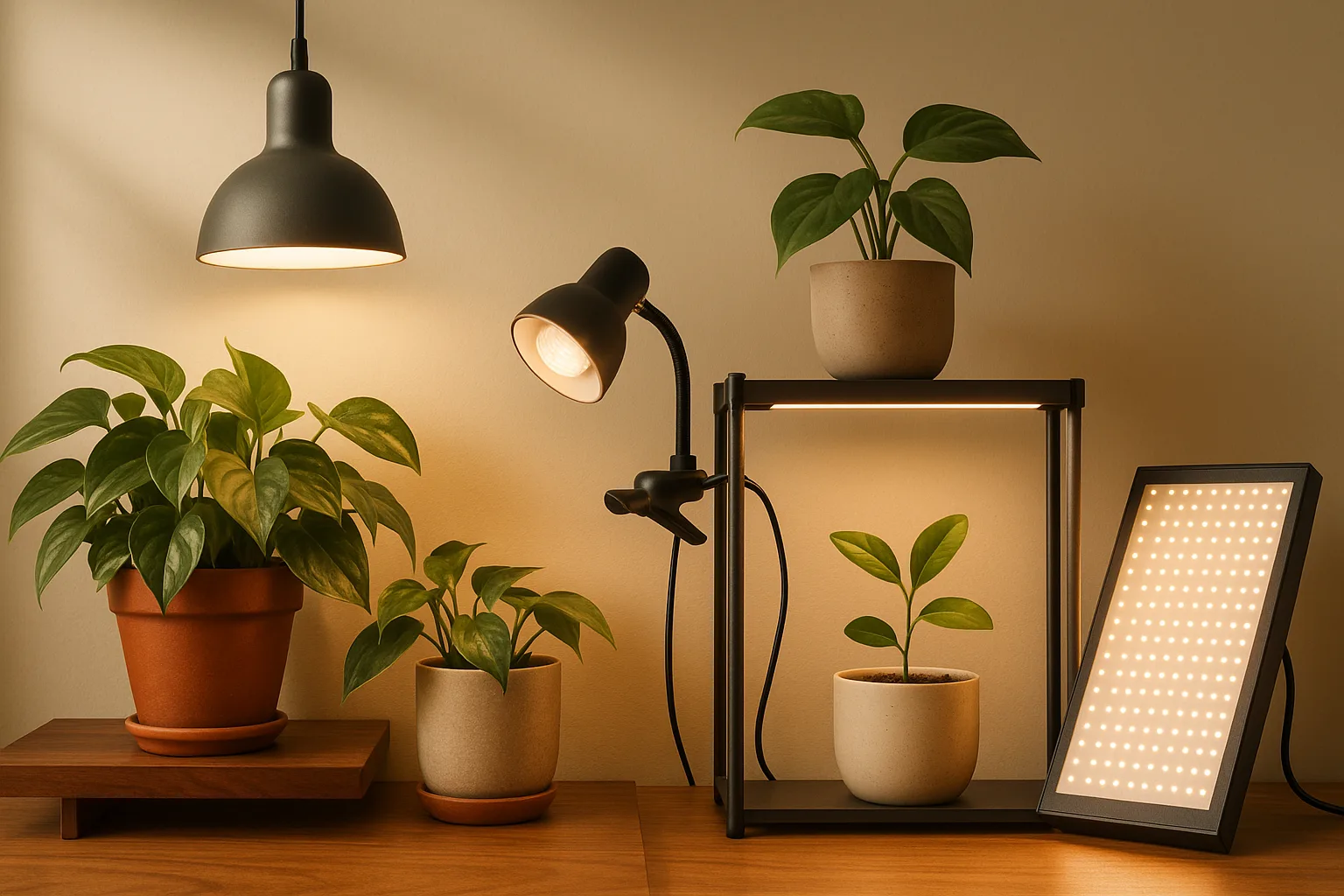
Decision Framework: - Pendant-style lights (Soltech Aspect, Vita, Grove, Versa, Aura): Best for visible living spaces, single plants or small groups, decor-forward rooms. Output is optimized per plant, not per square foot. - Bar or board-style lights (Spider Farmer SF300, Glow80; Mars Hydro TS 1000): Best for shelf density, multiple plants in a confined footprint, or any setup where output-per-dollar matters more than appearance. - Track light systems (Soltech Highland): Best for multi-plant rooms, home offices with plant walls, or collectors who want flexibility to reposition heads as the collection grows.
When a pendant-style grow light is the right choice
A pendant-style grow light earns its price when the light is living in a room you actually spend time in. If your plant sits on a living room side table, a dining table, or a bedroom dresser, a pendant from the Soltech lineup pulls double duty — it's a light fixture that functions as decor and grows the plant underneath it.
This is the scenario Soltech was designed for. The Aspect Gen 2 at $200, the Versa at $230, and the Aura at $250 all look like intentional design choices rather than afterthoughts. If you're renting and want to avoid drilling or major installation, Soltech's pendant cords work with standard ceiling hooks, and the Vita at $85 is a low-stakes starting point before committing to the full Aspect.
The aesthetic-vs-output trade-off is honest here: pendant-style grow lights optimize for one plant or a small cluster. They are not efficient at covering a 4-foot shelf with eight pots. For that job, you need a bar.
When bar or board-style lights are better for shelf density
The moment you're trying to light more than two or three plants from a single fixture over a shelf, a bar or board fixture beats a pendant on raw economics. The Spider Farmer SF300 at 33W and the Glow80 at 80W both spread light across a wider horizontal footprint than a pendant's downward-focused beam.
Shelf-Spacing Note: For a standard 4-foot wire shelf loaded with tropical foliage, one bar-style fixture mounted 6–12 inches above the top shelf edge typically covers the full width. Adjust based on verified manufacturer guidance for your specific fixture.
Bar lights mount directly under a shelf, which keeps them close to the plant canopy — exactly where the light-intensity math works in your favor. This is the practical choice for a dedicated plant shelf in a spare room, a laundry room propagation setup, or anywhere output matters more than room aesthetics.
When track lighting is worth the upgrade
The Soltech Highland system, priced from $230 to $740, makes sense when you have multiple plants spread across a room and want the flexibility to redirect individual heads as your collection changes. A track system lets you position light precisely over each plant cluster without running separate pendant cords to multiple ceiling anchors.
For a home office with a plant wall, a dedicated plant room, or a living space where you're running five or more plants across different light-need categories, Highland's adjustability pays off. The upfront cost is higher, but you're buying a permanent infrastructure rather than committing to fixed pendant positions that become obsolete when you rearrange.
Do houseplants need a grow light or a brighter window?
Before spending any money on indoor plant lighting, check whether your plant's problem is fixable with free light. Moving a plant from a north-facing wall to a spot within three feet of a south or west-facing window often delivers more usable light than a mid-range grow light hung poorly. Light intensity drops sharply with distance from windows — a plant sitting 8 feet from a sunny window may be receiving less usable light than you'd expect.
Decision Tree: 1. Is the plant within 3 feet of a south or west-facing window? If yes, try moving it closer before buying hardware. 2. Is the window blocked by trees, an overhang, or another building? If yes, that window may not be recoverable — a grow light is worth considering. 3. Is the plant in a room with no windows, or only north-facing windows? A grow light is the right solution. 4. Has the plant been in its current spot for less than four to six weeks? Give it time to acclimate before diagnosing a light problem.
Signs your plant needs more light instead of a new fixture
Plants are specific about communicating light stress, and the signals are readable if you know what to look for.
- Leggy growth — stems stretch unusually long between leaves, reaching toward any available light source
- Pale or yellowing new leaves — new growth comes in lighter than mature leaves, sometimes almost white
- Slow or stalled growth — a plant that was putting out a new leaf every few weeks goes quiet for months
- Small new leaves — the plant is growing, but each new leaf is noticeably smaller than the previous ones
- Loss of variegation — variegated plants often revert to solid green when they're not getting enough light to maintain the pattern
If you're seeing two or more of these at once, the plant needs more light. Whether that means moving it, supplementing with a grow light, or both depends on what window options you have.
Which plant types are most likely to benefit from supplemental light
Light need varies by species, and Soltech's distance guidance gives a practical framework for thinking about which category your plants fall into.
- Low-light plants (pothos, ZZ plant, cast iron plant, snake plant): These adapt to low light but don't thrive in it. Supplemental light placed at 48–60 inches will visibly improve growth rate without risk of burning.
- Medium-light plants (most ferns, peace lily, philodendron heartleaf): Benefit from a grow light in rooms that lack a bright window. Position fixture at 36–48 inches for the Large Aspect.
- High-light plants (hoyas, most aroids, monstera, bird of paradise): Supplemental light is often necessary in apartments without south or west exposure. These need a fixture within 24–36 inches.
- Full-sun plants (citrus, succulents, cacti, most herbs): Indoor supplemental lighting for these species requires a fixture within 12–24 inches or a higher-output bar/board fixture. Decorative pendants often aren't sufficient unless hung very close.
Best grow lights by plant type and room setup
Best grow light for pothos and easy-care foliage plants
For pothos, snake plants, ZZ plants, and similar low-to-medium light foliage, the Soltech Vita ($85) is the practical starting point. It's the most affordable entry into Soltech's pendant lineup, and it matches exactly what these plants need — low-to-medium output at a distance that keeps it looking intentional on a shelf or side table.
If you want a screw-in option, a Sansi 36W E26 grow bulb in a clip light or floor lamp above the pot works well and costs less. Hang or position the bulb roughly 12–18 inches above the plant canopy for consistent coverage.
Best grow light for hoyas and bright-indirect light plants
Hoyas need bright indirect light consistently — the kind of light most apartments with north or east-facing windows can't reliably deliver. The Soltech Aspect Gen 2 Large ($200) is the right match here. It's explicitly designed for bright indirect or bright direct light plants, and at 24–36 inches above the canopy (run at full brightness), it delivers the sustained light output hoyas need for robust growth and flowering.
Position the cord so the fixture hangs at the right distance above your largest plant in the group, and let smaller plants cluster nearby. The Large Aspect's beam is wide enough to cover a reasonable spread.
Best grow light for aroids and collector plants
Serious aroid collectors — monsteras, philodendrons, anthuriums, and the rarer variegated forms — often need output that prioritizes coverage and intensity over aesthetics, especially in a dedicated growing space. The Spider Farmer SF300 (33W) and Mars Hydro TS 1000 (150W) both bring verified utility-first output. The Spider Farmer Glow80 is the middle-ground option if you want more spread than a bulb but less footprint than a full panel.
Output vs. Style callout: If your aroids are in a display room you want to look curated, Soltech's Large Aspect is a defensible choice for medium-to-high light aroids. If they're on a dedicated shelf or in a spare room where performance is the only metric, Spider Farmer or Mars Hydro will deliver more photons per dollar.
For high-value variegated plants where growth rate and leaf quality matter financially, do not compromise on output just to protect the room aesthetic. Use a utility bar, get the distance right, and put the Soltech pendant somewhere it can shine on a less demanding species.
Best grow light for full-sun starters and high-light houseplants
Full-sun plants started indoors — citrus seedlings, succulents, cacti, and most herbs — need the strongest output in this comparison. The Mars Hydro TS 1000 at 150W is the verified high-output option here. The Large Aspect hung at 12–24 inches can work for full-sun plants in a visible room, but only if your ceiling height allows that close proximity and you're running it at full brightness.
Watch Out: Do not use a decorative pendant like the Soltech Vita or Grove for full-sun starters. These fixtures are not designed for that light class, and underpowering a full-sun plant leads to leggy, weak growth regardless of how long you leave the light on.
Which grow light gives the best value for the money?
ValueForMoney Callout: - Best aesthetic value: Soltech Vita ($85) — entry-level pendant that looks intentional, right-sized for low-to-medium light plants - Best all-around pendant: Soltech Aspect Gen 2 Large ($200) — the benchmark for decor-forward grow lights with verified distance guidance - Best utility value: Spider Farmer SF300 (33W) — broad shelf coverage at a lower price point than any Soltech fixture - Best high-output value: Mars Hydro TS 1000 (150W) — for collectors and high-light species where output is the only thing that matters - Best flexibility: Soltech Highland ($230–$740) — right for multi-plant rooms, wrong for single-plant setups
When Soltech is worth the premium
Soltech's premium pricing makes sense in any room where the grow light is part of the visual design — a living room, a dining room, a home office, or anywhere guests see the space. The Aspect Gen 2 at $200, the Versa at $230, and the Aura at $250 are the few grow lights on the market that genuinely double as a pendant light fixture. You're not hiding them; you're featuring them.
For someone styling a plant corner who wants the light to look as considered as the planter and the shelf, that design premium is real value. The alternative — a bar fixture duct-taped to the underside of a shelf above your living room fiddle-leaf fig — isn't a trade-off most people want to make in a visible space.
Soltech's Highland is worth the $230–$740 investment specifically for plant collectors who want a permanent room-scale solution. One track replaces multiple pendant cords and ceiling hooks, and the adjustable heads future-proof the setup as the collection grows.
When Sansi, Spider Farmer, or Mars Hydro can save you money
If the grow light lives in a location you don't style for — a closet shelf, a basement propagation rack, a utility room, or a bathroom with no window — there is no practical reason to spend Soltech prices. A Sansi 36W E26 bulb in a $12 clip light delivers real grow-light performance for a fraction of the cost.
For dense shelves with multiple plants, the Spider Farmer SF300 at 33W and the Glow80 at 80W cover more plants per dollar than any Soltech pendant. For high-output needs — full-sun starters, heavy-producing aroids, or a propagation station — the Mars Hydro TS 1000 at 150W is the verified high-output choice in this comparison.
The honest split: buy Soltech when you're also buying a lamp. Buy Spider Farmer or Mars Hydro when you're buying a grow light.
FAQ: grow lights for houseplants
FAQAccordion
What is the best grow light for houseplants? There is no single best grow light for all houseplants — it depends on your plant's light class and where the fixture needs to go. For low-to-medium light plants in a visible room, the Soltech Aspect Gen 2 (Small or Large depending on species) is the strongest all-around choice. For shelf density or high-output needs, Spider Farmer and Mars Hydro deliver more photons per dollar. Sansi E26 bulbs are the best entry point for renters or anyone who wants to use a lamp they already own.
Are Sansi grow lights good for houseplants? Yes, particularly for low-to-medium light plants and for anyone who doesn't want to install a new fixture. Sansi's 36W full-spectrum E26 grow bulbs screw into any standard lamp socket, which makes them practical and renter-friendly. The trade-off is beam spread — a single Sansi bulb covers one plant or a small group well, but won't evenly light a wide shelf.
How far should a grow light be from houseplants? Distance depends on both the fixture and the plant's light needs. Using Soltech's Aspect Gen 2 Large as a reference point (run at full brightness): hang 12–24 inches above full-sun plants, 24–36 inches above high-light plants, 36–48 inches above medium-light plants, and 48–60 inches above low-light plants. Other fixtures have different beam spreads and output levels, so always check the specific manufacturer's distance guidance for your model. Dimming the fixture requires moving it closer to maintain the same effective light intensity.
Do houseplants need a grow light or a brighter window? Try the window first. Moving a plant within three feet of a south or west-facing window is often more effective than a mid-range grow light, and it costs nothing. A grow light becomes the right solution when: there's no viable window position, the window faces north and can't be improved, the room lacks windows entirely, or the plant's light needs exceed what any indoor window can provide (citrus, most herbs, full-sun succulents in northern climates). Light needs vary by species — a pothos can genuinely thrive in a dim room with minimal supplemental light, while a hoya or fiddle-leaf fig will struggle without consistent bright light.
Sources & References
- Soltech Grow Light Collection — Official US Retail Page — Current pricing for all Soltech product families including Aspect Gen 2, Vita, Grove, Versa, Aura, and Highland
- Soltech Aspect Gen 2 Product Page — Small vs. Large Aspect use-case guidance by plant light class
- Soltech Aspect Gen 2 Grow Guide — Official hanging-distance recommendations by plant light class at full brightness
- Soltech Brand Homepage — "Trusted by 85,000+ Plant Enthusiasts" brand claim
- Soltech Bundles Page — Current bundle offerings
- Soltech Highland and Vita Collections — Vita product family
- Sansi 36W Grow Bulb — Official Product Page — E26 bulb-style grow light for indoor gardening
- Sansi Grow Bulb Blog — 36W Family Overview — Full-spectrum LED grow bulb description and use cases
- Spider Farmer SF300 Product Page — 33W verified wattage, use-case descriptions
- Spider Farmer Glow80 Product Page — 80W verified wattage, bundle details
- Mars Hydro TS 1000 Product Page — 150W full-spectrum LED, indoor plants/veg/flower use case
Keywords: Soltech Aspect Gen 2, Soltech Vita, Soltech Grove, Soltech Versa, Soltech Highland Track Light System, Sansi grow light bulb, Spider Farmer LED grow light, Mars Hydro LED grow light, PPFD, full-spectrum LED, E26 base, pendant grow light, bar grow light, track light system