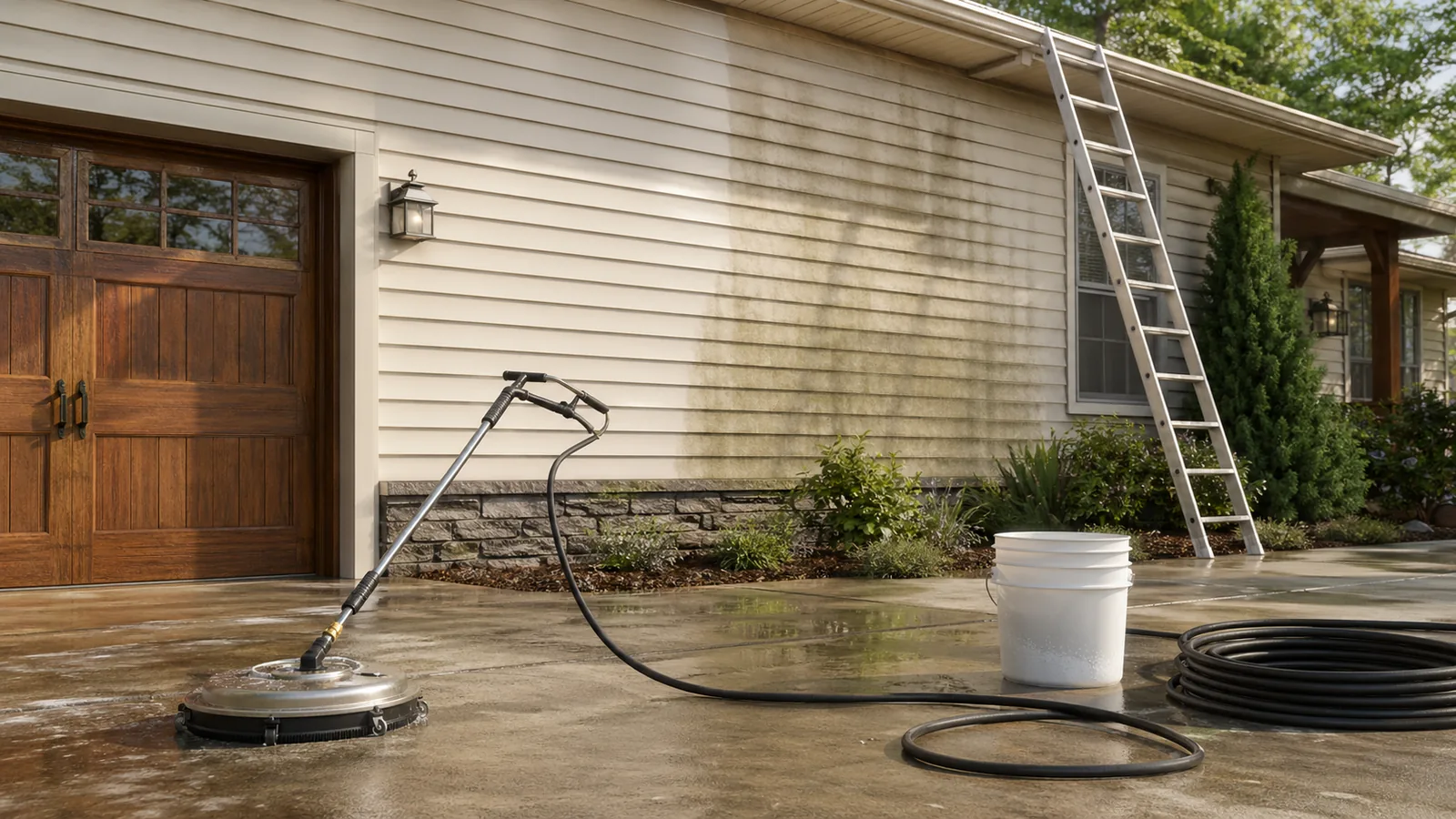
Pressure washing a house in 2026 runs somewhere between $0.15 and $0.75 per square foot, which translates to roughly $250 to over $600 for most homes — though real quotes stretch both lower and higher depending on your house's size, surface material, how dirty it is, and whether a crew needs to work from ladders. That range is wide enough to matter. A 1,400-square-foot ranch with light algae on vinyl siding is a completely different job than a 3,000-square-foot two-story with fiber cement siding that hasn't been touched in three years.
Cost Snapshot: $0.15–$0.75 per square foot | $250–$600+ total for a typical US house | 2–4 hours of active work | DIY saves money on simple homes; a pro is worth it when height, fragile surfaces, or heavy staining are involved.
How much does pressure washing a house cost in 2026?
Cost Snapshot: $0.15–$0.75 per square foot | $250 to over $600 total for most homes
For a standard house wash by a professional pressure washing service, most US homeowners land between $212 and $448, according to Angi's 2026 cost guide. Forbes Home puts the average at about $400 for a 2,500-square-foot, two-story house, while Fixr reports closer to $700 for a 2,000-square-foot vinyl-sided home with moderate grime — a reminder that "average" means very little without knowing the specifics of your home.
Those numbers aren't contradictory; they reflect different inputs. A lightly soiled single-story home in a flat yard cleans up on the low end. A two-story with heavy mildew buildup, a tight side yard, and brick accents pushes into the high end or beyond.
What most homeowners pay for a pro house wash
Current US market pricing for a pro house wash, grounded in Angi's 2026 cost guide, Forbes Home's pricing breakdown, and Fixr's house-wash estimates, tends to land in the ranges below:
| Home Size (sq ft) | Stories | Typical Pro Quote Range |
|---|---|---|
| Under 1,500 | 1 | $150–$300 |
| 1,500–2,000 | 1–2 | $250–$450 |
| 2,000–2,500 | 2 | $350–$600 |
| 2,500–3,500 | 2 | $450–$800+ |
These are whole-house exterior wash estimates. They don't include decks, driveways, or fences — those are add-ons. Angi confirms that the number of stories and the type of material being cleaned are the two biggest labor variables after raw square footage. A 2,000-square-foot single-story home and a 2,000-square-foot two-story home are not the same job.
Why square footage is only the starting point
At a Glance: house size, number of stories, surface material, grime/mildew buildup, and accessibility are the five factors that control the quote.
Square footage sets the baseline, but five other variables determine where your actual quote lands:
- Number of stories: Every foot of additional height means ladder repositioning, slower movement, and more physical risk for the crew — all of which cost money.
- Surface material: Forbes Home notes that brick and stucco require more prep and technique than vinyl. Fiber cement siding has manufacturer pressure limits that force a slower, more careful approach.
- Grime and mildew buildup: Heavy organic growth — green or black mildew streaks, years of road splash, oxidized paint — takes longer to dwell and rinse. Light dust washes off fast.
- Accessibility: A rear elevation behind a fence, a tight 18-inch side yard, or a home surrounded by mature landscaping adds setup time and limits equipment movement.
- Linear footage of the perimeter: Some contractors quote by the foot of perimeter rather than total square footage of living area, which is why the same-sized house on a narrow lot and a wide lot can get different quotes.
Pro Tip: Ask each contractor exactly how they calculate their quote — per square foot of living area, per linear foot of perimeter, or a flat house rate. The method affects how well quotes compare to each other.
DIY pressure washing vs hiring a pro: what each option really costs
The honest answer is that DIY saves real money on the right house and costs you time, stress, and potentially repair bills on the wrong one. The gap between a $300 pro quote and a $120 DIY attempt shrinks fast once you account for pressure washer rental fees, detergent, fuel, accessories, and the time you spend on a Saturday doing physical labor.
CostBreakdown
Here is a clear side-by-side cost breakdown for a typical 1,500–2,000-square-foot single-story home:
| Cost Item | Pro Service | DIY |
|---|---|---|
| Labor / service quote | $250–$450 | $0 |
| Pressure washer rental | — | $60–$100/day |
| Detergent / cleaning solution | Included | $15–$35 |
| Gas (for gas-powered rental) or electricity | Included | $5–$15 |
| Surface cleaner attachment | — | $25–$60 (purchase or included with rental) |
| Extension wand | — | $20–$45 (if needed) |
| PPE (eye protection, non-slip boots, gloves) | — | $20–$40 if you don't own it |
| Total estimated cost | $250–$450 | $145–$295 |
The DIY savings are real — roughly $100 to $200 on a small single-story home — but they come with conditions. You need to be comfortable operating equipment that runs at 2,000–3,200 PSI (pounds per square inch), working around your home's windows and landscaping, and safely managing extension wands at arm's length. If you rent a gas-powered machine and it starts badly or runs inconsistently, you've still paid for the day.
DIY vs Pro: DIY wins on simple, single-story, easily accessible homes with vinyl or painted wood siding and light-to-moderate dirt. The pro wins on two-story homes, fragile or specialty siding, heavy mildew buildup, or any situation where ladder work is involved.
Pro service quote line items and common add-ons
A professional pressure washing service quote for a house wash typically includes a few clear line items:
- Labor / base wash: The crew's time to wash all accessible exterior walls, including setup and breakdown
- Setup and protection: Hose runs, wetting nearby plants, moving a few patio chairs, and protecting sensitive areas before the wash starts
- Materials / detergent: Pre-treatment chemicals and surfactants are almost always included in residential quotes
- Equipment: The contractor's commercial-grade machine (often 3,000–4,000 PSI) and all attachments
- Cleanup: Rinsing overspray off walkways, putting moved items back, and a final walkthrough
What's usually not included in the base quote — and should be asked about upfront:
- Deck or fence washing (typically $0.25–$0.50/sq ft additional)
- Driveway or sidewalk cleaning (often quoted separately)
- Roof washing or soft washing for moss and lichen
- Screen or window cleaning after overspray
- Spot treatment for heavy rust or oil stains
Get every add-on in writing before work starts. A $300 house wash can become a $500 invoice if a second-story soffit, a wraparound deck, and a stained concrete driveway all get added verbally on the day of service.
DIY cost breakdown: rental, detergent, fuel, and accessories
For home exterior cleaning on a manageable single-story property, here's what you're actually spending:
- Pressure washer rental: Expect $60–$100 for a full day from Home Depot Tool Rental, Sunbelt Rentals, or a local equipment yard. Gas-powered machines (typically 2,700–3,200 PSI) are the most common rental option and handle most house washing jobs. Electric rentals exist but tend to run 1,600–2,000 PSI — adequate for light jobs, slower on heavy grime.
- House wash detergent/solution: A purpose-made house wash concentrate — brands like Simple Green House and Deck Cleaner, Zep House & Siding Cleaner, or the generic detergent many rental shops bundle — costs $15–$35 for enough to do a typical house. Don't use straight bleach at high pressure on siding; it can damage finishes and landscaping.
- Fuel: A gas-powered rental machine burns roughly 0.5–1 gallon of regular unleaded per hour. For a 3–4 hour job, budget $10–$15 for fuel at current prices.
- Surface cleaner attachment: This spinning disc attachment sits at the end of the wand and cleans large flat areas (concrete, wide siding runs) faster and more evenly than a bare nozzle. Many rental shops include one; if not, they're $25–$60 to add. Worth every dollar for horizontal surfaces.
- Extension wand: A telescoping or rigid extension wand lets you reach second-story soffits and upper-wall sections without a ladder. If you're cleaning a taller single-story with high eaves, budget $20–$45 to purchase or rent one. Do not climb a ladder while holding a pressurized wand — the kickback is real and dangerous.
- PPE: At minimum: safety glasses or goggles, waterproof or water-resistant non-slip footwear, and gloves. Expect to spend $20–$40 if you're starting from scratch. Water and grit at pressure will find your eyes; this isn't optional.
Watch Out: Never aim a pressure washer nozzle directly at window edges, door frames, electrical outlets, or soffit vents. Water forced through gaps at 2,500+ PSI can enter wall cavities and cause moisture damage that costs far more than the cleaning job.
How much is your time worth on a 2- to 4-hour house wash?
Upgraded Home's research puts the active washing time for most houses at 2 to 4 hours, with the range driven by home size, surface complexity, dirt level, and the power of the machine. A compact 1,000-square-foot two-story home runs closer to 1 to 1.5 hours of trigger time; a sprawling 3,000-square-foot ranch with a lot of horizontal eave runs toward the top of that range.
But active washing time isn't total project time. Factor in:
- Travel to and from the rental shop: 30–60 minutes round-trip
- Loading and unloading the equipment: 15–20 minutes
- Setup, connecting hoses, test-firing, adjusting nozzles: 15–20 minutes
- Actual washing: 2–4 hours
- Cleanup, rinsing the machine, returning it: 45–60 minutes
Realistically, a DIY house wash on a Saturday is a 4–6 hour commitment, not a 2-hour one. If you value your weekend time at $25–$35 per hour — well below most people's actual hourly rate — that's $100–$210 in time cost on top of the out-of-pocket expenses. For simple homes, DIY still makes sense. For complex ones, the math tilts toward the pro.
What changes the cost of pressure washing a house?
Price variation in home exterior cleaning is driven by five factors. Understanding them lets you predict whether your quote will be on the low end of $250 or pushing past $600 before the contractor even walks the property.
| Factor | Effect on Cost | Example |
|---|---|---|
| Square footage | Linear increase | 3,500 sq ft costs roughly 2× a 1,500 sq ft home |
| Number of stories | Moderate to significant increase | Two-story adds 20–40% to many quotes |
| Surface material | Varies by prep and technique | Brick costs more than vinyl |
| Grime/mildew buildup | Increases time and chemical cost | Heavy green buildup may require pre-treatment dwell time |
| Accessibility | Increases labor time | Tight yards, fences, and landscaping add setup friction |
Why two-story homes and hard-to-reach areas cost more
Watch Out: Second-story work, rear elevations behind decks or additions, and tight side yards all increase labor, safety risk, and quote price because the crew has to reposition equipment more often and work at awkward angles.
Two-story work is slower, riskier, and requires more equipment. Angi confirms that the number of stories directly drives labor requirements — not just because of height, but because ladder repositioning around a full house perimeter adds significant time.
Specific situations that push quotes up:
- Second-story and above: Crews need extension equipment or ladders and must reposition constantly. The safety liability alone is a cost driver even for experienced contractors.
- Rear elevations with deck obstructions: A deck full of furniture, a screened porch, or a rear addition with a low roofline creates access puzzles that slow the job.
- Tight side yards: An 18- to 24-inch side yard between your house and a fence means the crew can't walk through upright with equipment; they're feeding hoses sideways and working at awkward angles.
- Landscaping close to the foundation: Dense shrubs or raised beds against the siding require careful rinse work to avoid chemical damage to plants.
Watch Out: If a contractor quotes a two-story home at the same price as a one-story without noting the added labor, ask how they plan to handle the upper elevation. A vague answer ("we have long wands") isn't the same as a clear plan for safe, complete coverage.
How siding type and surface condition affect the quote
The surface itself can change both the method and the price:
- Vinyl siding: The most forgiving material for pressure washing. Standard residential pressure (around 1,500–2,000 PSI with a wide-angle nozzle) and a house wash detergent handle most vinyl jobs efficiently, so it usually anchors the base price.
- Fiber cement siding (e.g., HardiePlank): James Hardie and similar manufacturers specify maximum pressure limits to prevent water intrusion at joints and around trim. Contractors who know fiber cement use lower pressure settings and pay more attention to angles, which usually adds a modest premium over vinyl.
- Painted wood or painted trim: Old or thin paint is easily stripped by high pressure at close range. A contractor worth hiring will reduce PSI and increase standoff distance — which takes longer and costs slightly more.
- Heavily stained exteriors: Black mildew, green algae, rust stains from irrigation systems, or years of exhaust residue near an HVAC unit require pre-treatment, dwell time, and sometimes a second pass. This adds 30–60 minutes of labor to most jobs and can push the price above a standard vinyl wash.
When soft washing is safer than high pressure
When to Call a Pro: High pressure can crack older vinyl siding, peel paint on wood and fiber cement, force water into wall cavities through gaps around windows or vents, and strip protective coatings. If someone quotes your delicate siding and mentions only PSI and not technique, that's a red flag. Soft washing is often the better choice for delicate materials.
Soft washing uses low pressure (typically 60–500 PSI, compared to 1,500–4,000 PSI for standard pressure washing) combined with a cleaning solution — usually a sodium hypochlorite blend with a surfactant — that does the actual killing and removal of biological growth. The chemical does the work; the water rinse is just delivery. This is how roof washing is done on asphalt shingles, and it's the correct approach for several siding types too.
Materials that should not be blasted with high pressure
Keep the pressure low or opt for soft washing on these surfaces:
- Older vinyl siding with thinner profiles or existing cracks
- Painted wood siding where the finish is already chalking, peeling, or bubbling
- Fiber cement siding if you need to stay within the manufacturer's maximum PSI recommendation
- Stucco where the finish layer can be etched or pitted by a narrow nozzle at close range
- Aged brick with soft mortar that can be eroded by direct pressure
What soft washing uses instead of brute force
A soft wash contractor applies a premixed cleaning solution at low pressure — essentially a controlled spray rather than a high-pressure blast — lets it dwell on the surface for 5–15 minutes, and then rinses with a gentle wide-angle stream. The sodium hypochlorite in the solution kills mold, mildew, algae, and bacteria at the root rather than just blasting them loose temporarily. That slower chemical dwell is why soft washing can cost slightly more than a standard pressure wash, even though it uses less pressure.
On cost: soft washing a house generally runs the same price as or slightly more than a standard pressure wash from a licensed contractor, because the chemical mix costs more than plain water and the technique is more time-sensitive. Some contractors price it identically because the slower equipment movement offsets the chemical cost. Either way, the difference is rarely more than $50–$75 for a typical house, and it's worth it to avoid repainting vinyl trim or filing a water-damage claim on fiber cement.
Should you DIY or hire a pressure washing pro?
DIY vs Pro: Single-story home + vinyl or painted wood siding + light to moderate grime + flat yard with clear access = strong DIY candidate. Two-story home + fiber cement/brick/stucco + heavy mildew or staining + tight access or landscaping = hire a licensed, insured contractor.
The line between a smart DIY pressure washer rental and a situation you should hand off isn't about skill — it's about height, surface fragility, and honest damage risk. A first-time homeowner with a single-story ranch can absolutely rent a machine, watch one 10-minute tutorial on nozzle selection, and do a clean, safe job. A homeowner with a two-story Victorian clad in 40-year-old painted wood who wants to blast the upper eaves from a ladder is setting up for a bad outcome.
Best DIY scenarios for first-time homeowners
A DIY pressure washer rental makes the most sense when:
- ✅ Single-story construction — no ladder work required
- ✅ Lightly soiled siding — seasonal dust, light algae, minor mildew, or pollen buildup
- ✅ Easily accessible exterior — you can walk fully around the house with a hose trailing behind you
- ✅ Vinyl siding or sealed painted wood in good condition (no peeling, no cracks, no loose seams)
- ✅ No major landscaping immediately against the foundation — or you're prepared to cover and rinse plants
- ✅ Comfortable operating power equipment — if a gas engine or high-pressure hose intimidates you, that's useful information about fit
- ✅ Time to do it right — rushing a home exterior cleaning job leads to missed sections and water intrusion from angle errors
When to hire an insured and licensed contractor
When to Call a Pro: - Your home is two stories or taller — ladder + pressurized wand is a fall-risk combination - Siding is fiber cement, old painted wood, stucco, or brick — surface damage risk is real - Heavy black mildew, green algae bloom, or rust staining is present — these need soft wash chemistry, not just high pressure - You haven't cleaned the exterior in more than 3 years — buildup this extensive takes experience to remove without streaking or etching - You have visible gaps, cracks, or loose sections around windows, doors, or trim — high pressure will drive water into the wall cavity - Verify general liability and workers' compensation insurance before any work starts, and check your state's licensing rules if your state requires exterior cleaning or contractor licensing for this kind of job
Always verify that a contractor carries general liability insurance (to cover accidental damage to your property or a neighbor's) and workers' compensation insurance (to cover injuries on your property). Ask for certificates of insurance directly — not just verbal confirmation. Licensing requirements vary by state across the US; some states require a contractor's license for pressure washing above certain thresholds, others don't. Check your state's contractor licensing board before hiring.
How to compare pressure washing quotes the smart way
Get at least three written quotes before booking any pressure washing service. Phone estimates are nearly useless for this type of job — a contractor who hasn't seen your siding type, measured your perimeter, and noted access challenges is guessing. The best contractors offer a brief on-site walk-around or, at minimum, ask for photos and square footage before quoting.
When comparing quotes, don't default to the lowest price. A $180 quote that doesn't specify method, materials, or scope is not the same service as a $320 quote that does.
QuoteComparison Checklist
Use this side-by-side checklist to vet each estimate:
- Scope: Which surfaces are included — walls only, or soffits, gutters, and trim too?
- Method: Pressure wash, soft wash, or a combination, with the right approach for your siding type
- Price basis: Square footage, perimeter footage, or flat house rate
- Exclusions: Deck, fence, roof, driveway, window cleaning, or stain treatment listed separately
- Proof of insurance: General liability and workers' compensation certificates available on request
- Payment terms: Deposit, final payment timing, and accepted payment methods
What should be in a written pressure washing estimate
A legitimate written estimate for a house wash should include:
- Scope of work: Exactly which surfaces are included (all exterior walls, soffits, gutters, or just walls?)
- Method: Pressure wash, soft wash, or combination — and at what approximate PSI for your siding type
- Square footage or perimeter footage being charged for (so you can verify the math)
- Detergents and chemicals: What they're using, especially important if you have pets, a vegetable garden, or a sensitive well
- Prep and protection: Whether they'll wet down landscaping, cover outdoor furniture, or rinse surrounding surfaces after
- Cleanup: Who removes overspray residue from windows, walkways, and driveway
- Excluded items: Deck, fence, roof, driveway — listed explicitly so there's no invoice surprise
- Payment terms: Deposit amount, final payment timing, and accepted payment methods
Insurance, licensing, and proof of experience
Before approving a job, verify:
- General liability insurance: Ask for a certificate naming you (the homeowner) as the additional insured, or at minimum confirm the policy is active. A $1M minimum is standard for residential work.
- Workers' compensation insurance: If a worker is injured on your property and the contractor lacks workers' comp, you may be liable. This is not hypothetical — it's the reason to ask.
- Licensing: Check your state contractor licensing board's website. Some states require a contractor's license for exterior cleaning contractors; others regulate this under general contractor licenses.
- References or photos: Ask for before-and-after photos of a recent house wash job on the same siding type as yours. A good contractor has them on their phone. If they hesitate, move on.
- Time in business: A company operating for 3+ years with verifiable reviews on Google or Angi has a track record. Brand-new operators may be skilled, but they carry more uncertainty.
Pro Tip: Search the contractor's name plus your city on Google Maps before hiring. Real customer reviews about a pressure washing company will mention specific outcomes — streaking, water intrusion issues, missing sections — that tell you far more than a price quote.
FAQ: pressure washing house cost, DIY, and soft washing
How much does it cost to pressure wash a house in 2026?
Most US homeowners pay between $212 and $600 for a professional house wash, with Angi's 2026 data putting the typical range at $212–$448 and Fixr reporting closer to $700 for larger or dirtier homes. The per-square-foot rate runs $0.15–$0.75 depending on surface type, stories, and condition. A small single-story ranch can come in under $250; a large two-story with heavy buildup can push past $700.
Is it cheaper to pressure wash a house yourself or hire a pro?
DIY is cheaper on simple homes — typically $145–$295 in out-of-pocket costs versus $250–$450 for a pro on a similar 1,500–2,000 sq ft single-story. The savings shrink when you add accessories, fuel, and your time. On two-story or complex homes, the DIY option introduces real safety and damage risks that can cost more than the pro quote if something goes wrong.
Can pressure washing damage siding or paint?
Yes. High-pressure washing can crack older vinyl siding, strip paint from wood or fiber cement, force water into wall cavities through gaps around windows and trim, and etch soft mortar on brick. Using the wrong nozzle angle (especially zero-degree tips pointed at siding at close range) is the most common DIY mistake. Soft washing at 60–500 PSI with a chemical solution avoids most of these risks on delicate surfaces.
When should you soft wash instead of pressure wash?
Soft wash instead of high-pressure wash any time you're dealing with: asphalt shingle or tile roofing, older painted wood siding, fiber cement siding, stucco, aged brick with soft mortar, or any surface that already shows peeling or cracking paint. Soft washing also produces longer-lasting results on organic growth — mold, algae, and mildew — because the chemical solution kills the organisms at the root rather than just dislodging them temporarily.
How long does pressure washing a house take?
Upgraded Home's data puts active washing time at 2 to 4 hours for most houses, with a small two-story running as low as 1–1.5 hours. Total DIY project time — including rental pickup, setup, washing, cleanup, and return — is realistically 4–6 hours. A professional crew on the same house typically finishes faster due to commercial equipment and two-person teams.
Sources & References
- Surface Pro Power Wash — Pressure Washing House Cost Guide — Primary source for cost framework by house size, surface type, condition, and accessibility
- Angi — How Much Does It Cost to Pressure Wash a House (2026) — Reports typical range of $212–$448; notes stories and material as key labor drivers
- Forbes Home — Cost to Pressure Wash a House — Cites ~$400 average for 2,500 sq ft two-story; explains linear footage and siding-type pricing
- Fixr — Pressure Wash House Cost — Reports ~$700 for 2,000 sq ft vinyl-sided home with moderate grime
- Upgraded Home — How Long Does It Take to Pressure Wash a House — Source for 2–4 hour active work estimate and 1–1.5 hour figure for small two-story homes
Keywords: $0.15 to $0.75 per square foot, $250 to over $600 total, soft washing, pressure washer rental, surface cleaner attachment, extension wand, PPE, mildew buildup, vinyl siding, fiber cement siding, two-story house, insured and licensed contractor