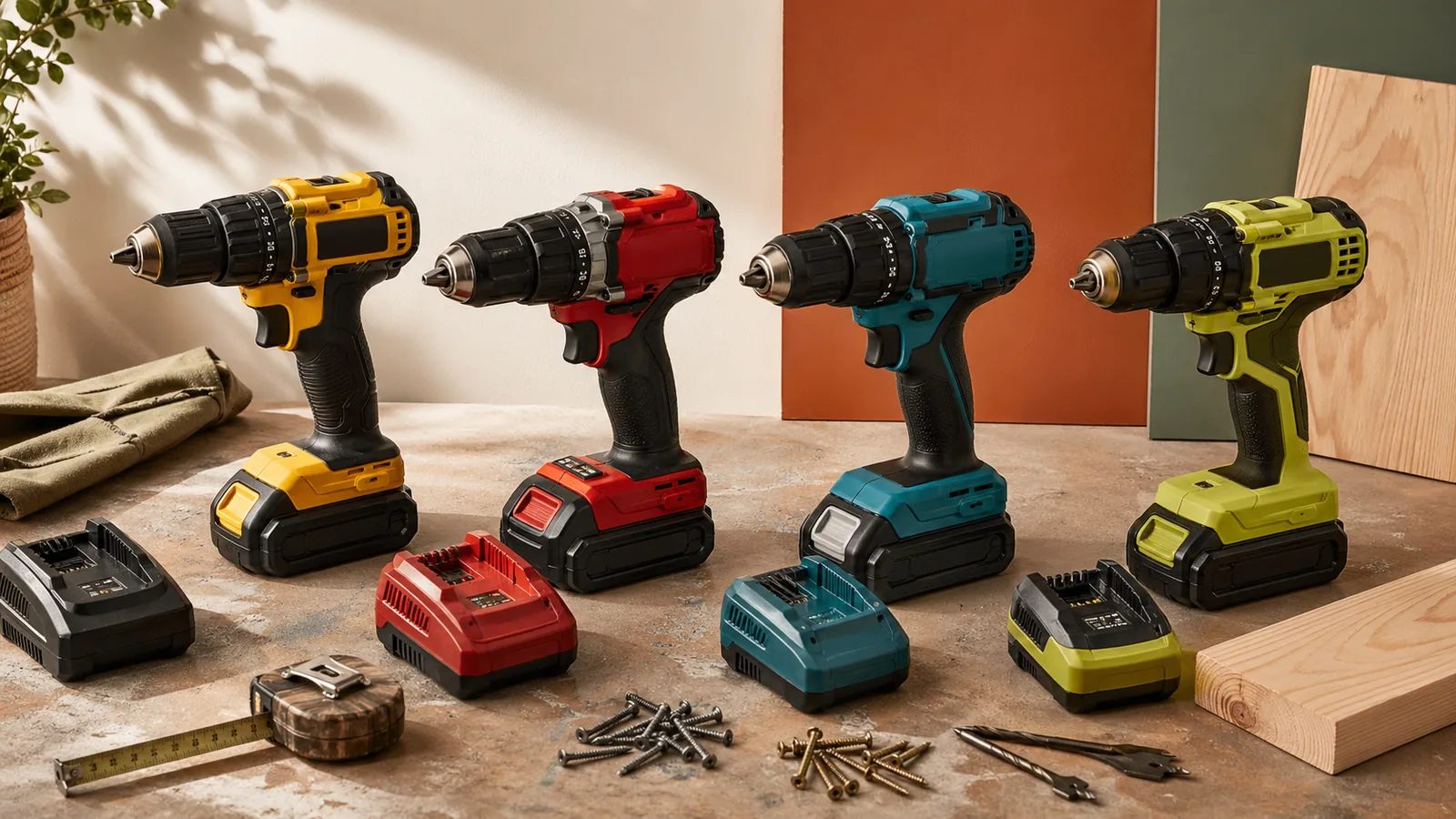
The single biggest mistake first-time tool buyers make isn't buying the wrong drill — it's buying three cheap tools from three different brands and then discovering that none of their batteries are interchangeable. You end up with three chargers, three half-depleted battery packs, and a pile of buyer's regret. The smarter move is to pick one battery platform on day one and buy into it deliberately, starting with a combo kit that already includes batteries and a charger.
Here's the prioritized list of what to buy, what to skip, and how to avoid the platform trap that costs most homeowners an extra $100–$200 before they figure it out.
Home workshop starter tools: the first buys in order
Buy these five tools first, in this order, and you'll be able to handle the bulk of what a homeowner encounters in the first two years.
At a Glance: - Tool 1: Cordless drill/driver — hanging, drilling, driving screws - Tool 2: Impact driver — lag screws, deck boards, stubborn fasteners - Tool 3: Circular saw — cutting lumber, plywood, trim - Tool 4: Oscillating multi-tool — cutting in tight spots, scraping, flush cuts - Tool 5: Shop vacuum or LED work light — cleanup and visibility on every job
The sequence matters. Your drill/driver and impact driver together handle assembly, hanging, and most furniture builds. Add a circular saw and you can cut your own materials instead of relying on the lumber yard. The oscillating multi-tool fills in the gaps — cutting caulk lines, trimming door casings, or making a quick plunge cut where a circular saw can't reach. The shop vacuum or work light isn't glamorous, but you need one before you need a miter saw.
Watch Out: Battery ecosystem lock-in is a real constraint. Once you own two or three tools from a platform, switching means abandoning your existing battery investment. Choose your ecosystem before you buy your first tool — not after.
The Milwaukee M18 system is fully compatible with over 250 solutions, and Milwaukee documents that scale in its own manufacturer materials. That compatibility is why platform choice matters so much at the start.
[Shop workshop tool starter kits →]
The smartest first-tool setup: battery platform plus core kit
Buying a combo kit with batteries and charger included is almost always smarter than buying random individual tools — especially when you're starting from zero.
Here's why. When you buy a bare tool (a drill without batteries), you still need to buy a battery and a charger separately. A quality 18V or 20V lithium-ion battery runs $40–$80 on its own, and a charger adds another $30–$50. A 2-tool combo kit from a reputable brand typically bundles two batteries and a charger alongside the tools, which means you're getting that charging infrastructure at no marginal cost while simultaneously picking your platform.
The Ryobi 18V ONE+ 2-Tool Combo Kit includes a 1/2" drill/driver, a 5-1/2" circular saw, two 1.5Ah lithium-ion batteries, an 18V charger, and a bag. That's a complete starter ecosystem in one purchase. The Ryobi 18V ONE+ 4-Tool Combo Kit steps up to a drill/driver, impact driver, circular saw, and LED work light — with a battery and charger included.
BatteryEcosystemDecision: The four platforms US homeowners should evaluate first: - DeWalt 20V MAX — widely available at Home Depot and Lowe's, strong mid-range and pro-grade tool selection - Milwaukee M18 — 250+ compatible tools, best-in-class brushless performance, premium pricing - Makita LXT 18V — excellent ergonomics, fast charge times, strong professional reputation - Ryobi ONE+ — largest entry-level tool catalog, lowest barrier to entry, sold exclusively at Home Depot
The Craftsman V20 system rounds out the entry-level options, and Craftsman says, "The V20* System has the battery power, range and reliability to get your projects done." The Craftsman V20 Cordless 2-Tool Combo Kit bundles two 1.5Ah batteries and a charger with core drilling and fastening tools, which is exactly why it belongs in the first-kit conversation.
The bottom line: buy a combo kit from one of these platforms and you're set. Buy three tools from three brands and you'll own three chargers you don't need.
[Shop power tool combo kits →] [Shop cordless tool bundles →]
What to buy first for hanging, drilling, and small repairs
A cordless drill/driver and an impact driver together cover the majority of homeowner tasks in the first year.
The drill/driver handles: drilling holes in wood, drywall, and light masonry (with the right bit), driving standard screws, and assembling furniture from flat packs. The impact driver handles: lag screws for deck framing, long self-tapping screws, and any fastener that strips out under a regular drill. The impact driver uses a rapid hammering rotational force that a standard drill/driver doesn't have — that's what keeps long screws from camming out.
For task-to-tool mapping:
| Task | Tool | Notes |
|---|---|---|
| Hanging a shelf | Drill/driver | Pilot hole, then drive screw |
| Assembling IKEA furniture | Drill/driver | Use low torque setting |
| Installing a TV mount | Drill/driver + impact | Drill pilot, impact drives lag |
| Building a deck frame | Impact driver | Long screws, high torque |
| Installing cabinet hardware | Drill/driver | Precision matters more than power |
The Craftsman V20 Cordless 2-Tool Combo Kit is worth a look here because it gives you drilling and fastening coverage in one purchase, with two 1.5Ah batteries and a charger already in the box. If you want a brushless step-up, the Craftsman V20 BRUSHLESS RP Cordless 2-Tool Combo Kit features a brushless RP motor for more runtime and improved performance compared with the brushed version. Brushless motors (no physical carbon brushes making contact inside the motor) run cooler, last longer, and extract more work from each battery charge. For a first-time buyer, that difference in runtime is noticeable on any project that runs longer than 30 minutes.
[Shop workshop tools →]
What to buy next for cutting wood and demolition
After your drill/driver pair, add a circular saw first, then a reciprocating saw, then an oscillating multi-tool.
1. Circular saw — Your workhorse for cutting lumber and plywood. A 6-1/2" or 7-1/4" blade handles framing lumber, shelving material, and most sheet goods. The Ryobi 18V ONE+ 2-Tool Combo Kit bundles a 1/2" Drill/Driver and a 5-1/2" Circular Saw, making it a clean first combo purchase for homeowners who need cutting plus fastening in one box.
2. Reciprocating saw — Built for demolition and rough cuts: cutting through walls, removing old pipes, trimming framing flush. The Milwaukee M18 Cordless LITHIUM-ION 2-Tool Combo Kit pairs a 1/2" High Performance Hammer Drill/Driver with an M18 Sawzall reciprocating saw, so the bundle gives you both drilling and demolition capability in one documented kit.
3. Oscillating multi-tool — Underrated by beginners and loved by everyone once they own one. It makes flush cuts (trimming door casings so flooring slides underneath), scrapes old caulk, cuts grout, and reaches into corners no other tool can. Buy this as a bare tool once you're already in a battery ecosystem — they're available bare from every major platform.
Pro Tip: Both circular saw and reciprocating saw appear in current manufacturer combo kits, which means you can often get one or both bundled at a better effective price than buying each separately. Check current combo pricing before buying either tool solo.
[Shop power tool combo kits →] [Shop workshop tools →]
Cordless tool kits vs bare tools: where to save money
Buy a kit when you're starting from zero. Buy bare tools once you own batteries and a charger that work with the new tool.
That rule covers 90% of decisions. The rest depends on the price spread on a given day and whether the kit includes battery sizes you actually need.
KitVsBareTool Comparison:
| Scenario | Kit | Bare Tool |
|---|---|---|
| Starting from zero (no batteries) | ✅ Kit always | ❌ Wasteful |
| Already own 2+ batteries, same platform | ❌ Pay for redundant batteries | ✅ Bare tool saves money |
| Different platform than batteries you own | ❌ Avoid entirely | ❌ Avoid entirely |
| Gifting to someone with no tools | ✅ Kit | ❌ Useless without charger |
Watch Out: Buying a cheap bare tool from a different brand than your existing batteries isn't just inconvenient — it means buying a new charger and at least one new battery to make it usable. That "cheap" $39 drill can quickly cost $110 once you add the platform infrastructure. Always check the battery voltage and brand compatibility before adding a single tool.
Milwaukee sells the M18 Compact Brushless 1/2" Drill/Driver as a kit — with two M18 batteries and a multi-voltage charger — and separately as a bare-tool listing without any batteries or charger. If you already own M18 batteries, the bare tool is the right call. If you're buying your first Milwaukee tool, the kit is the only sensible choice.
Makita's battery economics also favor the kit approach early on. Makita 18V LXT 3.0Ah batteries (2-pack) carry a 3-year limited warranty and charge in 30 minutes or less. The 4.0Ah 3-pack charges in 40 minutes or less, also with a 3-year warranty. Those charge times matter for anyone doing half-day projects — a 30-minute charge-to-ready window keeps your workflow moving. Per the Makita warranty page, "Every Makita® Lithium-Ion Tool, Battery, Charger, MAKTRAK™ Modular Storage System, and Pneumatic Nailer is warranted to be free of defects from workmanship and materials for the period of THREE YEARS from the date of original purchase."
[Shop power tool combo kits →] [Shop cordless tool bundles →]
When a combo kit beats standalone tools
A combo kit beats standalone tools whenever you need more than one tool and you don't already own compatible batteries. That's the clean rule.
Practically: a 2-tool kit with two batteries and a charger is better than a single drill with one battery and a charger, because you get a second tool at a fraction of what it would cost separately. The Ryobi 18V ONE+ 2-Tool Combo Kit delivers a drill/driver, a circular saw, two batteries, a charger, and a bag. Buying those components individually would cost significantly more.
Pro Tip: When comparing a 4-tool kit to a 2-tool kit, check whether the 4-tool kit includes only one battery versus two. The Ryobi 4-Tool Combo Kit includes only one 1.5Ah battery — which means you'll want to add a second battery early on so you're not waiting for a recharge mid-project.
The Craftsman V20 Cordless 2-Tool Combo Kit also comes with two 1.5Ah batteries and a charger, making it a clean first-purchase kit for entry-level budgets.
[Shop power tool combo kits →] [Shop cordless tool bundles →]
When bare tools make more sense
Once you own two or more compatible batteries and a charger on one platform, bare tools become the smart buy for every new tool you add in that ecosystem.
BareToolBuy rule set: - ✅ Buy bare tool if: you own 2+ batteries on the same voltage platform from the same brand - ✅ Buy bare tool if: the bare-tool price plus a spare battery still beats the kit price - ❌ Don't buy bare tool if: you'd need to buy a charger for it — that eliminates most of the savings - ❌ Don't buy bare tool if: it's a different brand than your existing batteries, even if the voltage matches (20V DeWalt batteries don't fit 20V Craftsman tools)
Milwaukee is explicit about this: the M18 bare-tool drill/driver is sold as a separate SKU from the kit version precisely because buyers who are already in the M18 ecosystem don't need to pay for batteries and a charger a second time.
Makita reinforces the ecosystem warranty value here: per the Makita warranty page, "Every Makita® Lithium-Ion Tool, Battery, Charger, MAKTRAK™ Modular Storage System, and Pneumatic Nailer is warranted to be free of defects from workmanship and materials for the period of THREE YEARS from the date of original purchase." That 3-year warranty on batteries means your existing Makita batteries are still under coverage when you add bare tools later — another reason staying in-platform makes financial sense.
[Shop workshop tools →]
Best cordless tool platforms for US homeowners
No single brand is best for every homeowner. The right platform depends on your budget, your project intensity, and whether you plan to own five tools or twenty.
| Platform | Best For | Ecosystem Size | Entry Kit Price Range | Warranty |
|---|---|---|---|---|
| Milwaukee M18 | Serious DIY, near-pro use | 250+ tools | $150–$300+ | Up to 5 years (tool) |
| DeWalt 20V MAX | Versatile DIY, wide retail access | Large | $100–$250+ | Varies by tool |
| Makita LXT 18V | Long-term use, ergonomics | Large | $150–$300+ | 3 years (tools + batteries) |
| Ryobi ONE+ 18V | Entry-level, occasional use | Very large | $60–$150 | Varies |
| Craftsman V20 | Budget, beginner | Moderate | $60–$130 | Varies |
The Ryobi ONE+ ecosystem is notable for scale — the Ryobi 12-Tool Combo Kit exists as a single-purchase expansion point for homeowners who go all-in on the platform. That kind of kit ladder means you can start cheap and grow without switching ecosystems.
Craftsman positions its V20 platform explicitly around project completion: per the Craftsman system page, "The V20* System has the battery power, range and reliability to get your projects done." That's marketing language, but the underlying point is sound — a platform ecosystem matters as much as any individual tool.
[Shop power tool combo kits →] [Shop cordless tool bundles →]
DeWalt 20V MAX vs Milwaukee M18 for serious DIY
Both DeWalt 20V MAX and Milwaukee M18 are legitimate professional-grade platforms that homeowners can buy into with confidence. The differences are at the edges, and they matter most if you plan to own more than five or six tools.
DeWalt 20V MAX: Broad retail availability at both Home Depot and Lowe's gives DeWalt an edge for in-person buying. The 20V MAX lineup runs from compact brushless drills to full-size miter saws and table saws. For a homeowner doing remodeling projects or building decks, the tool selection is comprehensive and the price points at mid-range are competitive.
Milwaukee M18: The M18 platform's compatibility with over 250 solutions is the most documented ecosystem claim in the industry. Milwaukee also backs some M18 combo kits with a 5-year tool warranty, which is above standard for the category. The brushless motor performance at the M18 tier is frequently cited by contractors as superior for sustained heavy use.
Pro Tip: If you're doing occasional weekend projects, DeWalt's wider price range makes it easier to find good entry points. If you expect to use tools regularly and want the deepest ecosystem for future expansion, Milwaukee M18's documented 250+ tool compatibility gives you more room to grow without worrying about hitting a dead end.
Expansion costs are real on both platforms. A spare Milwaukee M18 battery runs roughly the same as a DeWalt 20V MAX equivalent — budget for at least one extra battery beyond what your starter kit includes.
[Shop power tool combo kits →]
Ryobi ONE+ and Craftsman V20 for entry-level budgets
For a first-time buyer who isn't sure yet how often they'll use tools, Ryobi ONE+ and Craftsman V20 are the honest recommendations.
The Ryobi 18V ONE+ 2-Tool Combo Kit gives you a drill/driver, a circular saw, two 1.5Ah batteries, a charger, and a bag — a complete starter setup. The Craftsman V20 Cordless 2-Tool Combo Kit similarly includes two 1.5Ah batteries and a charger.
The honest trade-off: both platforms use brushed motors in their entry kits, which means slightly less runtime and shorter motor life compared to brushless equivalents in the Milwaukee and Makita tier. For someone hanging a few pictures and assembling furniture twice a year, that doesn't matter. For someone doing weekend builds every month, the brushed motor starts to feel limiting within a year or two.
The other trade-off is resale and professional compatibility. Ryobi and Craftsman tools have minimal resale value and aren't used on job sites — that's irrelevant if you're a homeowner, but worth knowing if you later decide to upgrade. Switching from Ryobi to Milwaukee means your batteries don't transfer; you're essentially starting over.
Pro Tip: Ryobi ONE+ sells exclusively through Home Depot, which makes returns and warranty service straightforward. Craftsman sells at Lowe's and Ace Hardware. Stick to one retailer ecosystem per platform for easiest service.
[Shop cordless tool bundles →] [Shop workshop tools →]
Makita LXT and higher-end options for long-term use
Makita LXT earns its place for homeowners who do serious recurring projects — quarterly builds, annual deck maintenance, repeated tile work — and want tools that feel good in hand over long sessions.
The LXT platform's battery performance is documented: the Makita 18V LXT 3.0Ah batteries charge in 30 minutes or less, and the 4.0Ah batteries charge in 40 minutes or less. Both carry a 3-year limited warranty. For someone who's charging batteries twice a weekend, that charge time translates directly into less waiting and more working.
Makita tools also tend to run quieter and with better ergonomics than comparably priced options — a genuine differentiator when you're running a tool for three hours straight on a weekend build. The brushless motors in LXT tools push the runtime envelope further per charge.
The honest caveat: Makita's entry-level kit pricing sits higher than Ryobi or Craftsman equivalents. If you're not sure how often you'll use the tools, Makita is an oversized investment. But if you know you'll be doing real projects regularly for the next decade, it's money well spent and the Makita warranty policy covers the whole ecosystem: "Every Makita® Lithium-Ion Tool, Battery, Charger, MAKTRAK™ Modular Storage System, and Pneumatic Nailer is warranted to be free of defects from workmanship and materials for the period of THREE YEARS from the date of original purchase."
[Shop power tool combo kits →]
Budget ladder for a home workshop starter stack
Cost Snapshot: - Entry-level (tight budget): $80–$150 — 2-tool combo kit, 2 batteries, charger - Midrange (most homeowners): $200–$400 — 4-tool kit or 2-kit combo, 2–3 batteries - Serious DIY: $500–$900+ — multi-tool kit, 3–4 batteries, oscillating tool, shop vac
| Tier | Price Band | What It Typically Buys |
|---|---|---|
| Entry-level | $80–$150 | 2-tool combo kit with batteries, charger, bag, drill/driver, and circular saw or drill/driver plus basic accessories |
| Midrange | $200–$400 | 4-tool kit or 2-kit bundle, extra battery, drill/driver, impact driver, circular saw, and LED light |
| Serious DIY | $500–$900+ | Larger kit, 3–4 batteries, oscillating multi-tool, reciprocating saw, shop vacuum, and expansion room for specialty tools |
Entry-level starter stack under a tight budget
At the entry tier, your goal is to get batteries, a charger, a drill/driver, and ideally a circular saw — all in one purchase, without splitting them across brands.
The Ryobi 18V ONE+ 2-Tool Combo Kit and the Craftsman V20 Cordless 2-Tool Combo Kit both hit this entry tier with the bundled parts that matter most: the Ryobi kit includes a drill/driver, circular saw, two 1.5Ah batteries, charger, and bag; the Craftsman kit includes two 1.5Ah batteries and a charger alongside the two-tool starter format.
Minimum viable entry stack: - 2-tool combo kit (drill/driver + circular saw), same platform - 1 extra 1.5Ah or 2.0Ah battery (so you always have one charging and one in the tool) - Basic drill bit set and driver bit set - Tape measure, utility knife, and safety glasses
Watch Out: At the entry level, you'll likely be buying brushed motor tools rather than brushless. Brushless motors deliver better runtime and longer life. If your budget allows even a small stretch, look for the word "brushless" or "brushless RP" in the kit description — the Craftsman V20 BRUSHLESS RP 2-Tool Combo Kit is the upgraded version within the same platform and budget range.
[Shop workshop tools →]
Midrange starter stack for most homeowners
The midrange is where most homeowners should land. You're spending enough to get brushless motors, two to three batteries, and four or more tools — without overpaying for contractor-grade performance you'll rarely need.
Recommended midrange stack: - Ryobi 18V ONE+ 4-Tool Combo Kit: drill/driver, impact driver, circular saw, LED light, one 1.5Ah battery, charger, and bag — one SKU covers most of the first-year toolkit - Add a second 2.0Ah or 4.0Ah battery so you're always running while one charges - Milwaukee M18 2-Tool Combo Kit (hammer drill/driver + reciprocating saw) if you step up to the Milwaukee platform - Oscillating multi-tool (bare tool, same platform as your batteries) - Corded shop vacuum (platform-agnostic, buy once)
At this tier, two batteries is genuinely the right number to own. One in the tool, one on the charger. If you're working longer sessions, consider a third battery before adding more tools — running out of charge mid-project is more disruptive than not having the next tool on the list.
[Shop power tool combo kits →] [Shop cordless tool bundles →]
Serious DIY starter stack for larger projects
At the serious DIY tier, you're doing renovations, deck builds, fence installs, or regular weekend projects where tool fatigue and battery capacity start to matter.
Expansion list beyond the midrange stack: - Milwaukee M18 4-Tool Combo Kit — comes with a documented 5-year tool warranty and includes core tools for heavy use - Add a miter saw (or rent one first — see below) - Add a jigsaw for curved cuts - Add a 4.0Ah or 5.0Ah battery for each tool you use most (higher-capacity batteries extend runtime substantially on demanding tools like circular saws) - A corded 5-gallon shop vacuum with a fine-dust filter - Hearing protection and a P100 respirator for sanding and demo
The Ryobi ONE+ 12-Tool Combo Kit exists at this tier for Ryobi buyers who want a single-purchase platform expansion — 12 tools, all ONE+ compatible, in one box.
Pro Tip: At the serious DIY tier, your accessory budget often matters more than your tool budget. Good blades, good drill bits, and good abrasives cost real money — don't underspend on accessories after overspending on tools.
[Shop workshop tools →]
Buy now vs rent now: which specialized tools to skip at first
The tools that tempt beginners most — miter saws, floor nailers, tile saws — are exactly the ones that make the least sense to own before you have a specific project requiring them. Renting from Home Depot, Lowe's, or a local rental yard costs $35–$80 per day for most specialty tools. That's a fraction of owning a tool that sits unused for 11 months a year.
BuyNowVsRentNow: Rent miter saws, floor nailers, tile saws, pressure washers, rotary hammers, and air compressor + nailer combos first; buy cordless drill/driver, impact driver, circular saw, tape measure, LED work light, stud finder, and shop vacuum now because they show up on nearly every project and pay for themselves quickly.
Tools to rent before you buy
These tools fail as first purchases because the occasions that require them are infrequent, the learning curve is real, or the rental unit is better than the homeowner version:
- Miter saw — Essential for finish trim and crown molding, but most homeowners do one trim project every few years. Rent it until you have repeated trim work that justifies the storage space and blade costs.
- Floor nailer — You'll use it for exactly one flooring installation, and then it sits on a shelf. Renting keeps you from paying for a specialty tool tied to a single project.
- Tile saw — Rent. The wet saw at the rental yard is almost always higher quality than a homeowner tile saw anyway, and tile jobs tend to come in bursts rather than every month.
- Pressure washer — Worth renting for an annual driveway clean before committing to the storage footprint. If you only clean patios, siding, or driveways once a year, ownership is hard to justify.
- Rotary hammer / SDS drill — Only needed for drilling into concrete or masonry. Rent the moment the project appears, because most homeowners go years without needing one.
- Air compressor + nailer combo — For trim work and siding, renting makes sense until you're doing repetitive framing or multiple projects a year. Compressor size and hose management also make ownership less convenient for occasional use.
Pro Tip: Most Home Depot and Lowe's tool rental centers will apply your rental fee toward purchase if you decide to buy the same tool within a certain window. Ask before renting if you're on the fence.
[Shop workshop tools →]
Tools to buy now because you will use them constantly
These tools pay for themselves within the first few months because they show up in almost every project:
- Cordless drill/driver — Used on every single project. Non-negotiable first buy.
- Impact driver — Once you own one, you'll reach for it constantly. The Ryobi 4-Tool Combo Kit includes it, making this an easy bundled addition.
- Circular saw — Any time you're cutting lumber or sheet goods, you need this. Present in every major entry combo kit.
- Tape measure — Daily tool. Buy a 25-foot model; a 16-foot runs short on rooms.
- LED work light — Every dim garage, crawlspace, and under-sink job requires one.
- Stud finder — Use it every time you hang something on a wall.
- Shop vacuum — Cleanup after every project. Corded models are reliable and platform-agnostic.
The drill/driver and circular saw appear in current starter kits across Ryobi, Craftsman, and Milwaukee platforms — their presence in first-purchase kits is the market's way of confirming they belong there.
[Shop power tool combo kits →] [Shop cordless tool bundles →]
Home workshop essentials beyond power tools
Power tools get the attention, but four projects in, you'll hit a wall because you don't have a decent level, a clamp, or a stud finder. Don't spend $300 on tools and $0 on the supporting gear.
Hand tools and measuring tools you still need
Every battery-powered workshop still depends on these:
- Tape measure — 25-foot, locking blade. Stanley FatMax or Milwaukee 25' are solid choices under $20.
- 6-foot level — For hanging anything straight. A 4-foot aluminum level works for most wall jobs.
- Stud finder — Electronic models (Franklin ProSensor, Zircon) find studs faster and more accurately than magnetic types.
- Torpedo level — Small enough to keep in your tool bag for quick checks.
- Claw hammer — 16 oz. curved claw for most tasks, 20 oz. for framing.
- Set of screwdrivers — Even with a drill, you'll reach for a hand screwdriver regularly.
- Pliers set — Needle-nose, channel-lock (Channellock 440 or equivalent), and regular linesman pliers.
- Utility knife — Constantly useful for scoring drywall, cutting packaging, marking wood.
- Speed square — Marks 90° and 45° cuts on lumber in seconds; critical for accurate circular saw cuts.
- Clamps — Two or four 6-inch quick-release clamps. Clamps are the "second pair of hands" for solo projects.
[Shop workshop tools →]
Safety gear and cleanup tools worth buying early
Buy this before your first project, not after:
- Safety glasses — Not sunglasses. Rated ANSI Z87.1. Dewalt DPG82-11 or 3M SecureFit are comfortable enough that you'll actually wear them.
- Hearing protection — Foam earplugs for quick jobs, earmuffs (3M Peltor X-Series) for extended power tool use. Circular saws and reciprocating saws hit 100+ dB.
- Dust mask/respirator — An N95 for light sanding, a P100 half-mask respirator (3M 6503QL) for drywall cutting, sanding, or any demolition that releases silica or lead paint dust.
- Work gloves — Mechanix Wear M-Pact gloves protect your hands without killing your grip or feel.
- LED work light — A cordless area light (the Ryobi 4-Tool Combo Kit includes one) or a corded clamp light for any job in a dark garage or crawlspace.
- Corded shop vacuum — A 5-gallon wet/dry vac (Ridgid NXT or Craftsman 5-gallon) handles sawdust, drywall dust, and spills. Corded versions are more reliable than battery vacs for sustained cleanup.
[Shop workshop tools →]
First-tool buying checklist for homeowners
Use this list in-store or online. Everything in the "buy today" column belongs in one transaction from one brand.
What to put in the cart today
Keep your first purchase to one platform. Everything else you add later should be a bare tool in the same ecosystem.
- 2-tool or 4-tool combo kit — Same brand throughout (Ryobi, Craftsman, DeWalt, Milwaukee, or Makita). Must include batteries and charger.
- Extra battery — At least one additional battery in the same voltage and brand as your kit. Buy it now while you're in the store.
- Drill bit set — A 21-piece or 29-piece general-purpose set covers wood, metal, and light masonry bits.
- Driver bit set — Screwdriver bits: Phillips, flat, Torx, and square drive (Robertson). Get 50+ piece sets; bits wear out.
- Tape measure — 25-foot, locking.
- Safety glasses — ANSI Z87.1 rated.
Watch Out: Your kit includes a charger. Do not buy a second charger until you own four or more batteries that need simultaneous charging. Duplicate chargers are the most common wasted purchase in a first toolkit.
[Shop power tool combo kits →] [Shop cordless tool bundles →]
What to save for later
These tools earn their place once a specific project calls for them:
- Oscillating multi-tool — Defer until you have a flush-cut or caulk-removal job. Then buy it as a bare tool in your existing ecosystem.
- Reciprocating saw — Defer until demolition or rough framing appears. The Milwaukee M18 2-Tool Kit bundles it for when you're ready.
- Miter saw — Rent first. Buy only after two or more trim projects where renting felt repetitive.
- Jigsaw — Useful for curved cuts and outlet cutouts in cabinets, but not a first-month priority.
- Random orbit sander — Essential for finishing work; not needed until you're painting or staining furniture.
- Workbench or sawhorses — A folding sawhorse pair is useful early; a full workbench is a later addition.
- Makita LXT battery upgrades — If you started on Makita, upgrading to 4.0Ah batteries extends runtime significantly. Defer until your current batteries feel limiting.
[Shop workshop tools →]
Common first-tool mistakes homeowners make
| Mistake | Why It Happens | Fix |
|---|---|---|
| Buying cheap tools from mixed brands | Headline price looks lower | Start with one platform, buy a combo kit with batteries |
| Buying more tools than you have projects for | Excitement, social media recommendations | Define 3 projects first; buy only what they require |
| Buying bare tools without checking battery compatibility | Bare tools have lower sticker prices | Always check brand + voltage before buying bare |
| Skipping safety gear to stay under budget | Feels optional | PPE is not optional; it's the first purchase |
| Over-investing in tool count, under-investing in blades/bits | New tools feel exciting, accessories feel boring | Budget 20–30% of tool spend for accessories |
Why cheap standalone tools get expensive later
A $39 no-name drill from a mixed-brand assortment looks like a deal until you realize it doesn't run on batteries you own, doesn't work with a charger you own, and performs so poorly under load that you're redoing every job.
Here's the actual cost math. The Milwaukee M18 Compact Brushless 1/2" Drill/Driver Kit includes two batteries and a multi-voltage charger. The M18 bare-tool version costs less, but without batteries and a charger, you've bought an expensive paperweight. Add a compatible M18 battery ($60–$80) and a charger ($30–$50) and you've spent $120+ more than the sticker price suggested.
The same logic applies to cheap standalone tools from unfamiliar brands. Batteries and chargers for obscure platforms cost more, not less — and they're often unavailable as the brand consolidates or exits the market.
The Craftsman V20 2-Tool Combo Kit already includes two batteries and a charger, absorbing that infrastructure cost before you get to the register. That's the correct model.
[Shop power tool combo kits →] [Shop cordless tool bundles →]
How to avoid platform regret when expanding later
Platform regret happens when you're 18 months in, you've added three tools, and you realize the ecosystem you chose doesn't have the tool you need next — or the tool exists but the batteries you own are too small to run it properly.
Platform-compatibility checklist before you commit:
- [ ] Does the platform have a circular saw, jigsaw, and oscillating multi-tool in the same battery voltage?
- [ ] Does it have the next tools you think you'll want (miter saw, track saw, sander)?
- [ ] Are batteries widely available at Home Depot, Lowe's, or Amazon — not just one retailer?
- [ ] How many tools are in the ecosystem? Milwaukee's M18 platform at 250+ compatible solutions and Craftsman's V20 system both have documented platform breadth you can evaluate before buying.
- [ ] Is the platform likely to exist in five years? Stick to established brands with wide retail distribution.
Pro Tip: Search "[Brand] [voltage] bare tool" before committing to a platform. If the bare-tool catalog is thin or hard to find at major retailers, the ecosystem may limit you in 24 months when you want to add your fifth tool.
[Shop workshop tools →]
Home workshop tool FAQ
What tools do I need for a home workshop?
Start with a cordless drill/driver and a circular saw — both tools you'll use on nearly every project. Add an impact driver to handle lag screws and stubborn fasteners. Then build out with an oscillating multi-tool and a shop vacuum. Everything beyond that depends on your specific projects. The Ryobi ONE+ system offers kits from 2 tools through 12 tools in the same battery platform, so you can start small and expand without switching ecosystems.
Should I buy a drill or impact driver first?
Buy both together. Most combo kits at entry and midrange tier pair a drill/driver with an impact driver (or a circular saw). If you can only afford one, start with the drill/driver — it drills holes and drives screws, which covers more tasks. The impact driver becomes essential for longer screws and lag bolts, and is worth adding as your second tool.
Is it better to buy power tools as a kit or individually?
Buy a kit when you're starting from zero. A combo kit includes batteries and a charger, which would cost $70–$130 extra if bought separately. Once you own two or more compatible batteries, switch to buying bare tools — you'll save money by not buying redundant charging infrastructure. Never mix platforms: a 20V DeWalt battery won't fit a 20V Craftsman tool, even though the voltages match.
What power tool brand is best for homeowners?
For most homeowners, Ryobi ONE+ (entry budget), DeWalt 20V MAX (mid-range, wide retail access), or Milwaukee M18 (serious DIY, 250+ compatible tools) covers the range from occasional use to renovation-level projects. Craftsman V20 is a credible entry-level alternative available at Lowe's. Makita LXT is the best choice for longevity and ergonomics if you expect heavy recurring use. The "best" brand is the one whose ecosystem has every tool you'll ever need on the same battery platform — check the bare-tool catalog before you commit.
Sources & References
- This Old House: Best Power Tool Sets (2026) — Frames combo kits as a structured approach to homeowner tool buying; compares 2-tool to 10-tool kits and a 60-piece hybrid set
- Ryobi 18V ONE+ 2-Tool Combo Kit (PCK200B1) — Product page confirming drill/driver, circular saw, two 1.5Ah batteries, charger, and bag
- Ryobi 18V ONE+ 4-Tool Combo Kit — Product page confirming drill/driver, impact driver, circular saw, LED light, one 1.5Ah battery, and charger
- Ryobi 18V ONE+ 12-Tool Combo Kit — Platform expansion reference for serious DIY Ryobi buyers
- Milwaukee M18 Compact Brushless 2-Tool Combo Kit (3693-22CX) — Source for M18 ecosystem compatibility with 250+ solutions
- Milwaukee M18 Compact Brushless 1/2" Drill/Driver Kit (3601-22CT) — Kit version with two batteries and multi-voltage charger
- Milwaukee M18 Drill Driver Bare Tool (3601-20) — Bare-tool reference for in-ecosystem expansion
- Milwaukee M18 2-Tool Combo Kit (2690-22) — Hammer drill/driver + Sawzall reciprocating saw combo
- Milwaukee M18 4-Tool Combo Kit (2691-24) — Source for 5-year tool warranty documentation
- Craftsman V20 Cordless 2-Tool Combo Kit (CMCK200C2) — Entry-level kit with two 1.5Ah batteries and charger
- Craftsman V20 BRUSHLESS RP 2-Tool Combo Kit (CMCK211C2) — Brushless motor upgrade within V20 platform
- Craftsman V20 System — Platform overview and battery compatibility reference
- Makita 18V LXT 3.0Ah Battery 2-Pack (BL1830B-2) — 30-minute charge time and 3-year limited warranty confirmed
- Makita 18V LXT 4.0Ah Battery 3-Pack (BL1840B-3) — 40-minute charge time and 3-year limited warranty confirmed
- Makita Warranty Policy — Source for 3-year warranty on all Makita lithium-ion tools, batteries, and chargers
Keywords: DeWalt 20V MAX, Milwaukee M18, Makita LXT, Ryobi ONE+, Craftsman V20, brushless motor, hammer drill/driver, impact driver, oscillating multi-tool, reciprocating saw, circular saw, LED work light, corded shop vacuum, battery ecosystem, bare tool vs kit