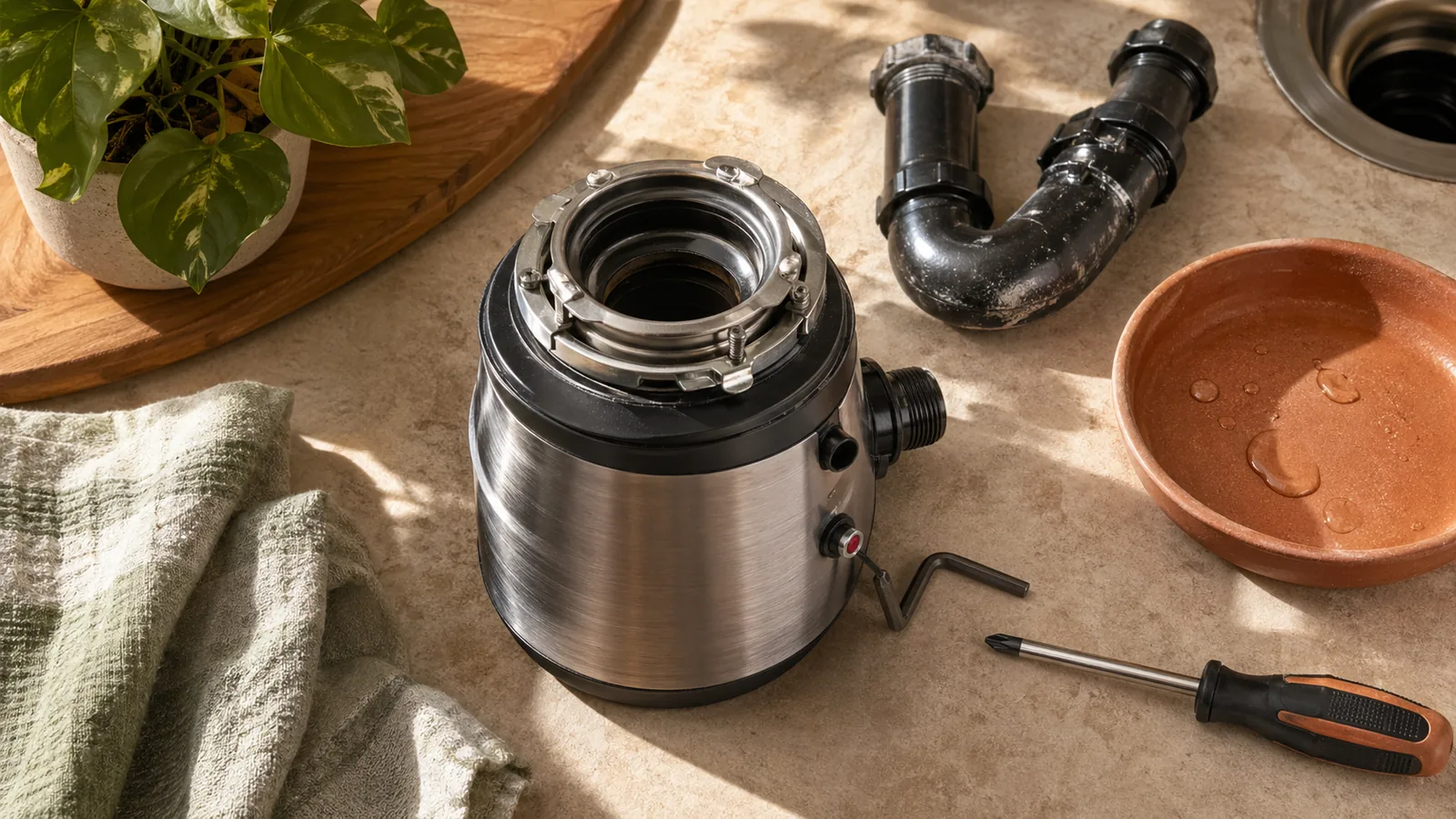
Garbage disposal repair vs replacement: the fastest way to tell
Most garbage disposal problems fall into one of four buckets — and three of them are fixable in under 30 minutes without calling anyone. The fourth one means it's time to shop for a new unit. Here's how to sort yours in about 60 seconds.
[Image: Diagnostic flowchart — garbage disposal repair vs. replacement decision tree]
Quick-answer diagnostic:
| Symptom | Most Likely Cause | Fix or Replace? |
|---|---|---|
| Hums but won't spin | Jammed impeller or tripped overload | Fix — hex wrench + reset |
| No hum, no spin, no response | Tripped GFCI or open breaker | Fix — reset GFCI outlet first |
| Sink drains slowly after disposal runs | P-trap clog, not the unit itself | Fix — clear the P-trap |
| Leak at the top rim (sink flange) | Loose mounting hardware or worn putty | Usually fixable — tighten or reseal |
| Leak from the bottom of the canister | Internal seal failure | Replace the unit |
| Burning smell, repeated tripping | Motor burnout | Replace the unit |
The critical distinction most service-company landing pages skip: where the water is dripping from matters more than the fact that it's leaking. A wet spot under your sink doesn't automatically mean a new unit. A leak at the mounting flange — the ring that connects the disposal to the sink drain — is often a $0 tighten-a-bolt fix. Water weeping from the lower motor housing is a completely different problem. That's an internal seal that has failed inside a sealed assembly. You can't repair it from the outside, and the unit should be taken out of service because the leak is near the electrical components. When water and motor windings share space, the unit needs to go.
Per manufacturer and service documentation, garbage disposals have a typical service life of 8–15 years. If your unit is inside that window and showing a jam or a flange leak, repair is almost always the right call. If it's showing bottom housing leaks or motor failure — or if it's past year 12 and breaking down repeatedly — replacement wins.
If you need a licensed plumber for anything beyond a simple DIY fix, bookmark that link before continuing.
Why a garbage disposal hums but does not spin
A humming disposal is actually a good sign in one specific way: the motor is energized and trying to run. The problem is that the impeller — the spinning plate inside the grinding chamber — is physically blocked and can't rotate. The motor strains against the obstruction, draws too much current, and either trips the internal overload protector or keeps buzzing until you cut power.
Three things cause this, in order of likelihood:
- Jammed impeller — a bone fragment, bottle cap, corn cob chunk, or similar hard object has wedged between the impeller and the grinding ring. This is by far the most common cause.
- Overload trip — the thermal overload protector on the motor has tripped due to the jam strain. The unit may be silent now, not humming. The reset button on the bottom fixes this after the jam is cleared.
- Power interruption to the outlet — a tripped GFCI outlet (those are the outlets with "Test" and "Reset" buttons, common near sinks per NEC 210.8 requirements) can cut power entirely. This causes silence, not humming, but it's worth ruling out first.
Pro Tip: Before touching a single tool, press the "Test" button on the nearest GFCI outlet under or near the sink, then press "Reset." If the disposal suddenly has power again, you've solved it in 10 seconds.
What the humming sound means inside the unit
The hum is the motor's magnetic field engaging — the windings are energized and generating torque, but the shaft they're trying to turn is locked in place. Think of it like holding a power drill's chuck completely still while pulling the trigger. The motor fights the blockage, overheats quickly, and the thermal overload trips to prevent damage.
According to appliance repair documentation, a humming disposer is the motor running against a blocked or stuck grinding mechanism — not a wiring fault, not a dead motor. That distinction is important because it means the fix is almost always mechanical: free the blockage, and the unit runs again.
Watch Out: Shut off the wall switch the moment you hear the hum. Running the motor against a locked impeller for more than a few seconds can burn out the thermal overload or, in older units, the motor windings themselves. Kill the switch first, then diagnose.
Reset button check before you reach for tools
The overload reset button is a small red or black button on the bottom of the disposal canister — you'll need to crouch down and look up to find it. It pops out roughly 1/4 inch when it trips.
Reset button step card:
- Turn off the wall switch for the disposal.
- Wait 5 minutes for the motor to cool down (thermal overloads won't reset if still hot).
- Reach under the unit and press the reset button firmly until you feel it click in.
- Turn the wall switch back on and run cold water.
- If the unit hums again immediately without spinning, the jam is still there — proceed to the hex wrench step below.
Watch Out: Don't keep pressing reset multiple times if the unit keeps tripping. Repeated resets without clearing the underlying jam don't fix anything — they just stress the motor further. One reset, one retest. If it trips again, the jam needs to be cleared manually.
A quality hex key set makes the next step faster — a set like the Bondhus Ball End L-Wrench set keeps the right size ready and the ball-end tip lets you work at an angle under the sink without contorting yourself.
How to clear a jammed garbage disposal with an Allen wrench
This is the repair that saves most disposals from premature replacement — and it typically takes under 10 minutes. InSinkErator's Badger 1 specification sheet references the self-service wrench for homeowner use, which tells you the manufacturer expects this to be a basic maintenance step.
At a Glance: - Time: 5–15 minutes - Cost: $0 (if you have the wrench) or about $8 for a hex key set - Skill level: Beginner - Tools: Allen/hex wrench (verify the exact size on your model manual or the sticker on the unit), flashlight, tongs or needle-nose pliers
Affiliate Product Card: The InSinkErator Badger 5 is a common replacement and a practical benchmark here because its access and service routine are familiar to many homeowners; if you are already shopping after a jam, it is the sort of straightforward unit that makes a future reset-and-clear task easier to understand.
If you need a hex set and don't have one, pick up a standard SAE/metric combination Allen wrench set — most hardware stores carry them for $8–15, and you'll want one on hand for future issues regardless. Confirm the exact Allen or hex size on your model's manual or the sticker on the unit before you start.
Turn off the power at the switch and breaker
Before you put anything near the disposal — including an Allen wrench in the bottom socket — cut power completely.
- Turn off the wall switch.
- Go to your electrical panel and flip the breaker for the kitchen disposal circuit (it's usually labeled; if not, flip it off while a helper confirms the disposal has no power).
- If your disposal is plugged into an outlet under the sink rather than hardwired, unplug it directly from the outlet. This is common in apartments and older homes.
Watch Out: Flipping the wall switch is not enough on its own. Switches control the hot leg, but a disposal wired incorrectly (it happens) could still be energized. Shut the breaker to be certain.
Use the hex key in the bottom drive socket
The bottom drive socket is a recessed hex port centered on the very bottom of the disposal canister. It connects directly to the flywheel shaft — turning it manually rotates the impeller without electricity.
Jam-clearance sequence:
- Locate the center hex socket on the bottom of the disposal unit. It's roughly the diameter of a quarter, recessed about 1/4 inch. [Image: Photo of the bottom of an InSinkErator disposal showing the center hex socket]
- Insert the appropriate Allen wrench into the socket. It should seat firmly with no wobble.
- Work the wrench back and forth — not in one direction only. The goal is to rock the flywheel free from the obstruction, not force it past.
- Continue rocking until the wrench turns a full 360 degrees freely in both directions. That's your confirmation the impeller is no longer locked.
- If the wrench is very difficult to turn, the obstruction is wedged tightly — do not force it. Proceed to the drain-opening inspection in the next step first.
Pro Tip: Many InSinkErator Badger 5 units — one of the most common disposals in US homes — ship with a small offset wrench that fits the bottom socket. Check your unit's installation manual or look in the cabinet for the original box. If it's gone, a standard hex wrench usually works; verify with your model spec before you assume.
If you're approaching the end of your disposal's service life and this is the second or third jam in a year, the InSinkErator Badger 5 is worth a look as a direct replacement — it's a workhorse 1/2 HP unit widely available at Home Depot and Lowe's for around $120–$140.
Clear the drain opening and retest
With the flywheel moving freely, the jam is broken — but the object that caused it is still in the grinding chamber.
- Shine a flashlight into the drain opening from above. You're looking for the obstruction: a bone, a bottle cap, a utensil, a pit, or a clump of fibrous material.
- Use tongs or needle-nose pliers to remove any debris. Do not reach in with your fingers — the grinding ring has sharp edges even when the power is off.
- Restore power at the breaker, plug the unit back in if it's corded, and press the reset button on the bottom if it's still tripped.
- Run cold water into the drain, then turn on the disposal.
- Let it run for 30 seconds. If it spins freely and sounds normal, you're done.
Watch Out: Run cold water — not hot — when retesting. Hot water liquefies grease that can then re-solidify downstream in the P-trap and cause a backup.
How to tell whether the clog is in the disposal or the P-trap
If the disposal itself is spinning normally but water is backing up into the sink basin, the blockage is downstream — in the P-trap or the drain line beyond it, not inside the unit. Replacing or servicing the disposal would accomplish nothing here.
The P-trap is the curved section of pipe directly under the sink that holds a small amount of water to block sewer gases. In a disposal setup, the disposal's discharge tube connects into the side of the P-trap. Grease, food sludge, and small solids that pass through the disposal can accumulate in that curve over time.
Service documentation confirms that when a disposal clears and spins but the sink still backs up, the blockage is in the P-trap or the branch drain, not the disposal itself — and troubleshooting should move downstream before any unit-level decision is made.
What you need: - A bucket (2-gallon or larger) - Rubber gloves - Channel-lock pliers or a pipe wrench - A small brush or old toothbrush for cleanup - Towels for drips
Bucket and tools callout: Before you open the trap, set the bucket directly beneath it and keep the gloves, pliers, brush, and towels within reach. The bucket is there to catch wastewater the moment the trap comes apart.
Disconnect and inspect the P-trap under the sink
- Place the bucket directly under the P-trap before loosening anything — wastewater will pour out the moment the trap opens.
- Put on your gloves. P-trap contents are genuinely unpleasant.
- Loosen the slip-joint nuts on both ends of the P-trap by hand or with channel-lock pliers. On plastic PVC traps, hand-tight is usually enough to open. On older chrome brass traps, you may need the pliers.
- Pull the trap free and dump its contents into the bucket.
- Look inside the trap for a packed layer of gray-brown grease sludge, food solids, or a specific lodged object (a small utensil or chunk of food that made it past the disposal).
- Clean the trap thoroughly with a brush before reinstalling. Reinstall hand-tight on PVC, snug with pliers on metal.
- Run water and check for leaks at both slip joints.
Pro Tip: If you're renting, photograph the condition of the P-trap before you clean it — especially if it's already corroded or the slip joints are cracked. Document the pre-existing condition so you're not held responsible for it at move-out.
When a sink auger or plumber makes more sense
If you've cleared the P-trap and the sink is still backing up, the blockage is deeper — in the branch drain line that runs inside the wall or under the floor. A sink auger, also called a drain snake, available at any hardware store can help with deeper branch-line blockages. Run it in through the open P-trap connection.
But recurring backups — where you clear the P-trap or run the snake and the problem comes back within days or weeks — point to a drain issue that needs a plumber.
DIY vs Pro: A one-time P-trap clog after years of normal use is a 20-minute DIY job. If the same drain backs up repeatedly after clearing, the problem is in the drain line, not the disposal — and a licensed plumber with a camera inspection tool is the right next call. Repeatedly snaking a drain that keeps clogging doesn't fix the underlying problem.
How to find the leak source: flange leak or bottom housing leak
This section is where the advice on most sites breaks down — they either say "call a plumber" reflexively or skip straight to "replace the disposal" without helping you understand which type of leak you actually have. The leak source determines everything.
[Image: Diagram showing three leak origin zones — top flange, side discharge port, bottom motor housing]
Leak-location illustration callout: Use the visual above as your guide: the top flange sits at the sink opening, the side discharge port connects to the drain line, and the bottom housing is the sealed motor area. Pinpointing which zone is wet is the fastest way to decide repair versus replacement.
Leak-origin decision tree:
- Wet at the top rim of the disposal, near the sink drain hole → Sink flange or mounting ring leak. Usually repairable.
- Wet at the side of the disposal, where the discharge tube connects → Discharge gasket or loose connection. Repairable — tighten the connection or replace the rubber gasket.
- Wet at the very bottom of the disposal canister, below all connections → Bottom housing / motor casing leak. Internal seal failure. Replace the unit.
The distinction matters because repair documentation is explicit: a leak from the lower housing indicates internal seal failure, which is structurally different from an external joint leak and cannot be patched from the outside.
To pinpoint the source accurately: dry the entire unit and all connections with a paper towel. Run the disposal for 30 seconds while looking with a flashlight. Watch where the first drip appears — that's the actual origin, not where the pooled water ends up on the cabinet floor.
Top mounting flange leaks are often repairable
The sink flange is the metal collar that sits in the drain hole of your sink basin and connects to the disposal body below via a three-bolt mounting assembly. Leaks here show up as water appearing at the top of the disposal, near where it meets the sink.
Two causes, two fixes:
Loose mounting hardware: The three mounting bolts that secure the disposal to the flange can loosen over years of vibration. Tighten them with a screwdriver working in a star pattern (tighten one, skip one, tighten the next) to keep the flange seated evenly.
Failed plumber's putty seal: The flange seats against the sink basin on a bead of plumber's putty. Over time — or if the disposal was installed without putty, using only the rubber gasket — that seal can dry out and crack. Fixing it requires dismounting the disposal, popping out the old flange, cleaning off the dried putty, applying a fresh 3/8-inch rope of new plumber's putty around the underside of the flange lip, reseating it, and remounting.
Neither of these is the same as an internal seal failure. This is a joint between external components — entirely accessible, entirely fixable.
Water from the bottom housing usually means replacement
Water dripping from the bottom of the motor canister — below the sink flange, below the discharge port, from the sealed lower housing itself — means the internal seal around the motor shaft or the internal water seal between the grinding chamber and the motor has failed.
That seal is inside a factory-assembled, non-serviceable housing. There is no drain plug to replace, no gasket kit available at the hardware store for this location. Per service documentation, bottom housing leaks are treated as a replacement trigger precisely because the seal failure is internal.
More urgently: water dripping from the bottom housing is dripping directly near the motor windings and electrical connections. That's an active electrical shorting hazard. The unit should be de-energized at the breaker immediately and not used again until replaced.
Watch Out: Do not try to seal a bottom-housing leak with epoxy, flex tape, or silicone caulk. The water is already inside the motor assembly. Sealing the outside does nothing for the internal failure — and continuing to run the unit creates a real shock and fire risk.
When to replace a garbage disposal instead of repairing it
The replacement decision comes down to four factors: where the failure is, what type of failure it is, how old the unit is, and how often it's been failing. Manufacturer and service documentation identifies two conditions as non-repairable: internal seal failure and motor burnout. Everything else is at least worth diagnosing before spending money on a new unit.
Affiliate Product Card: If the old unit is done, the InSinkErator Evolution Compact is the step-up replacement in this article because it pairs a higher-capacity motor with a compact body that fits many existing under-sink spaces.
Replacement decision checklist:
- ☐ Water leaks from the bottom motor housing (internal seal failure)
- ☐ Burning smell from the unit (motor burnout)
- ☐ Unit won't restart after reset and jam clearance (motor failure)
- ☐ Unit is 12+ years old and has had two or more jams or leaks this year
- ☐ Grinding performance has permanently declined despite the impeller moving freely
- ☐ Electrical burning smell has appeared even once
Check any of these boxes? Replace rather than repair.
If you're shopping for a replacement, the InSinkErator Badger 5 (1/2 HP, about $120–$140) is the standard mid-range workhorse that fits the EZ Mount system used by many existing installations — meaning if you're replacing an InSinkErator, the new unit often drops onto the existing mounting assembly. The InSinkErator Evolution Compact (3/4 HP, about $180–$200) is worth the step-up if you have a household that regularly puts fibrous vegetables or larger food scraps through the drain.
Signs the motor has burned out
Motor burnout has a specific signature that you don't need to be an electrician to recognize:
- Burning smell — an acrid, electrical burning odor when the disposal runs or tries to run. This is insulation on the motor windings burning.
- Unit won't reset — the thermal overload trips immediately every time you restore power, even with no jam present and after the unit has cooled.
- No response whatsoever — the switch is on, the outlet is live, the GFCI is reset, and the disposal produces no hum, no vibration, nothing.
Repair documentation is clear that the motor is a sealed, non-field-serviceable assembly — there are no replacement brushes to install, no winding repair possible at home. A burned motor is a replaced unit. If the burning smell has appeared even once, don't try to restart the unit.
Watch Out: A burning smell from a garbage disposal isn't like a burning smell from a toaster. It can indicate that insulation is actively degrading near live wires. Shut the breaker off immediately and leave it off until the unit is replaced.
Age matters: 8 to 15 years is the usual service life
Per appliance service documentation, garbage disposals typically last 8–15 years under normal use. What that range means practically: a well-maintained disposal in a household that avoids hard objects and fibrous materials might hit 15 years. A disposal that's been fed coffee grounds, fruit pits, and fibrous vegetable scraps regularly might need replacement at 8.
If you don't know when your disposal was installed, look for a manufacture date stamped on the label inside the cabinet or on the bottom of the unit. If the label is gone, check if the disposal model is still being manufactured — discontinued models are often 10+ years old.
Pro Tip: If your disposal is past year 10 and has just had its second jam or first leak, run the math before you invest time in repair. A 10-minute hex wrench fix is worth trying regardless. But if the unit needs a flange reseal and it's 12 years old with a sluggish motor, the $30 in putty and an afternoon of work might be better applied toward a $130 replacement.
When to call a plumber for garbage disposal repair
Most garbage disposal problems genuinely are DIY-friendly — that's the honest reality that service-company pages rarely lead with. But three specific situations change the risk level enough that professional help is the right answer.
When to Call a Pro: - Electrical burning smell from the disposal at any point - The disposal unit is physically shifting or wobbling at the mounting ring - Water is actively pooling on the cabinet floor or dripping onto flooring below - The GFCI outlet or circuit breaker trips repeatedly when the disposal is tested - The sink backs up consistently despite a clear disposal and clean P-trap
If you hit any of these, a licensed plumber or appliance installer is the right call. Contact a licensed plumber for a site-specific quote if the job goes beyond a simple jam or flange reseal.
Electrical burning smell or repeated tripping means stop now
An electrical burning smell is a hard stop — not a "try one more reset" situation. Per electrical safety guidelines, repeated breaker trips or a unit that won't stay reset after jam clearance point to a motor or wiring fault, not a mechanical clog.
The sequence when you smell burning:
- Turn off the wall switch immediately.
- Cut the breaker for the disposal circuit.
- Do not restore power under any circumstances until the unit has been inspected or replaced.
- If you smell burning and haven't yet found the source, check whether the GFCI outlet serving the disposal has also tripped — that's a separate protection layer that NEC 210.8 requires near kitchen sinks, and it may have tripped before the breaker did.
A disposal that repeatedly trips its own reset button — even without a burning smell — after the jam has been properly cleared is telling you the motor's thermal protection is triggering abnormally. That's a replacement signal, not a reset signal.
If the unit is loose or the cabinet is flooding, get help
A disposal that wobbles or shifts at the mounting ring is a structural failure at the flange connection — and depending on how far it's gone, that can mean the sink flange itself has cracked, the mounting ring has cracked, or the mounting bolts have stripped their seats. None of those are impossible to DIY, but all of them require the disposal to be fully dismounted and the mounting assembly inspected.
More urgently: if water is actively pooling under the sink or you can see it wicking into the cabinet base, get a plumber involved before the water damages the cabinet flooring or anything stored below. Standing water under a sink in contact with electrical components is a direct hazard. The repair cost of a damaged subfloor is far higher than a plumber's service call.
Tools and parts for a quick garbage disposal fix
Having the right tools before a problem happens means you fix a 10-minute jam in 10 minutes instead of making a hardware store run while the disposal sits dead. A quality hex key set is the single most important item — without the right Allen wrench size, you can't reach the bottom drive socket at all.
Affiliate Product Card: A Bondhus Ball End L-Wrench set is a solid match for under-sink work because the ball-end tip lets you reach the drive socket from an angle when cabinet walls, hoses, and the trap leave you very little room.
Under-sink diagnostic toolkit:
- Allen/hex wrench set — SAE sizes cover many InSinkErator models; metric sizes cover some competitor brands. A ball-end L-wrench set lets you work at an angle in tight spaces.
- Flashlight or headlamp — under-sink cabinets are dark; you need both hands free while inspecting
- 2-gallon bucket — for catching wastewater when opening the P-trap
- Needle-nose pliers or kitchen tongs — for removing debris from the grinding chamber without putting fingers in
- Channel-lock pliers — for P-trap slip joints
- Plumber's putty — for resealing the sink flange if needed
- Rubber gloves — non-negotiable for P-trap work
InSinkErator's Badger 1 documentation notes that the unit is designed with homeowner self-service in mind — the self-service wrench is part of the spec. That design intent means the tools above are genuinely all you need for the most common issues.
Pro Tip: Before any repair attempt on a corded disposal, confirm the plug is physically out of the outlet — not just that the wall switch is off. A hardwired disposal requires the breaker to be off. Both cases: verify with a non-contact voltage tester if you have one.
What to keep under the sink for future issues
A small ziplock bag or canvas pouch stored in the back of the cabinet under the disposal takes up almost no space and can save you an hour of scrambling the next time the disposal locks up.
Minimum under-sink kit:
- 1/4-inch Allen wrench (or the disposal's self-service wrench if included)
- Small flashlight (a headlamp is better)
- Folded paper towels
- One pair of rubber gloves
- A tub of plumber's putty
- Pliers or tongs
That's it. With these six items in place, every common disposal problem in this article is solvable without leaving the kitchen.
Garbage disposal repair vs replacement FAQ
Can you run water through a jammed garbage disposal?
No — not while it's jammed. Running the disposal switch while the impeller is locked just stresses the motor. Water can be run freely through the drain basin itself (it will pass around the disposal if the unit isn't spinning), but you should not run the disposal motor until the jam is cleared and the flywheel turns freely. After the hex wrench fix is complete and debris is removed, run cold water before and during the retest — that's the right sequence.
How long should a garbage disposal last before replacement?
Most disposals last 8–15 years under normal household use. The age-based rule: if your unit is under 8 years old, repair first unless there's motor burnout or a bottom housing leak. If it's between 8 and 12 years old, weigh repair cost and effort against a $120–$200 replacement. If it's past 12 years and has repeated problems, replacement is almost always more economical than continued repairs.
Can a leaking garbage disposal be sealed with epoxy or tape?
For a bottom housing leak: no. Epoxy and tape applied externally don't address the internal seal failure — water is already inside the motor assembly, and continuing to run the unit is a shorting hazard regardless of what's on the outside. Replace the unit.
The narrow exception: if water is seeping very slightly at the top sink flange joint and you've confirmed the leak is only at that external surface seal, a temporary fix with fresh plumber's putty and retightened mounting hardware is legitimate. That's an external joint between surfaces, not a failed internal seal — an entirely different situation. Still, treat it as temporary and plan a proper flange reseat within a few weeks.
Schema Note: This FAQ section can be marked up with FAQPage schema as secondary schema, and the questions above are already structured as accordion-ready H3 entries with answers immediately beneath them.
Sources & References
- AppliancePartsPros — When to Replace vs. Repair Your Garbage Disposal — Primary source for service life data, leak-origin repair/replace thresholds, and P-trap guidance
- AppliancePartsPros — Garbage Disposal Hums But Doesn't Work — Technical source for motor behavior, reset button procedure, and Allen wrench jam-clearance guidance
- InSinkErator Badger 1 Specification Sheet — Manufacturer documentation confirming self-service wrench and motor specs for InSinkErator Badger series
Keywords: InSinkErator Badger 5, Allen wrench hex key, reset button, P-trap, mounting flange, sink flange, motor housing, seal failure, motor burnout, GFCI outlet, UL Listed, plumber's putty, wrench set, NEC 210.8