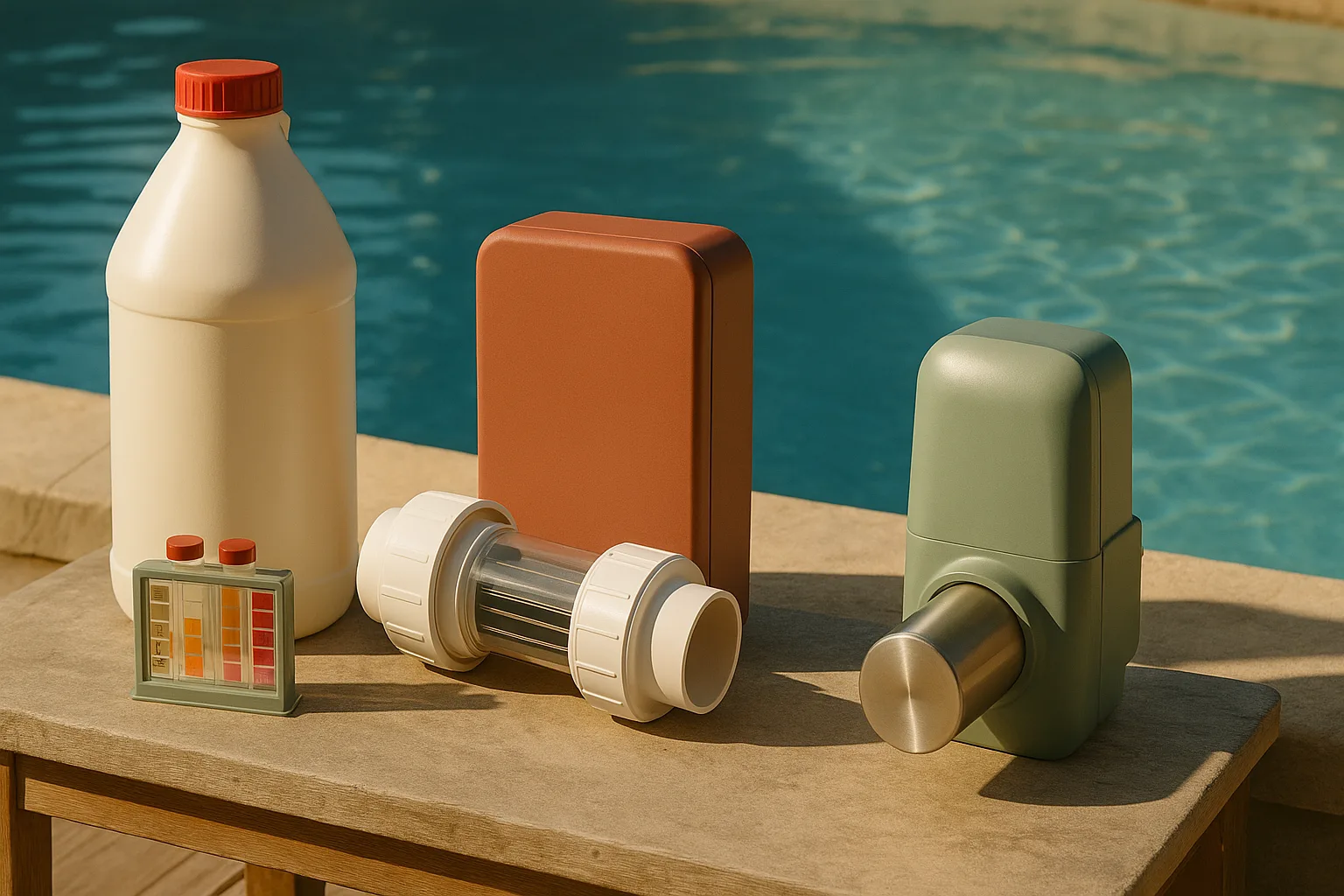
Every pool sanitation decision is really a cost-of-ownership decision. The hardware you install on day one is the smallest part of the equation — what you'll spend every month on pool chemicals, test supplies, and eventually replacement parts is where the real difference shows up. Here's the honest breakdown so you can choose the system that fits your budget, your schedule, and your willingness to turn wrenches.
Chlorine vs salt water vs UV/ozone: the real cost-of-ownership answer
Chlorine is the simplest and cheapest system to start and maintain. A salt chlorine generator adds hardware that converts dissolved salt into chlorine through electrolysis — per Pentair's IntelliChlor product page, "Water and dissolved salt flow through the generator cell. Through electrolysis it is converted into chlorine. Chlorinated water is returned to the pool." You're still chlorinating; you're just making the chlorine on-site instead of buying it at the store. UV and ozone systems reduce some sanitization load and help break down chloramines, but they are supplemental technologies, not replacements for a primary sanitizer.
The table below captures the ownership picture at a glance:
| Factor | Traditional Chlorine | Salt Chlorine Generator | UV or Ozone (Add-On) |
|---|---|---|---|
| Upfront hardware cost | $0–$150 (feeder/floater) | $500–$2,500+ (cell + controller) | $500–$1,800+ (additional to primary system) |
| Monthly chemical spend | $30–$80 (tabs, shock, balancers) | $15–$40 (salt top-off, shock, balancers) | Marginal reduction in chlorine demand only |
| Key replacement part | None specific | Salt cell | UV lamp / ozone component |
| Troubleshooting complexity | Low — add more chlorine, test, adjust | Medium — cell, controller, automation, water chemistry | Medium-High — UV lamp output, ozone injector, plus primary sanitizer |
The competitive gap most articles miss: salt does not erase the ongoing cost of testing, shock, and balancing chemicals, and the cell itself is a recurring ownership item.
Which pool sanitizer is cheapest to own month after month?
Traditional chlorine wins on lowest total hardware outlay, but the answer on monthly cost is closer than most people expect.
With a chlorine system, your monthly spend at retailers like Leslie's Pool Supplies or Pinch A Penny typically runs $30–$80 depending on pool size, sun exposure, and bather load. That covers 3-inch trichlor tabs, periodic oxidizing shock, and your balancing chemicals — pH up, pH down, alkalinity increaser, and cyanuric acid (stabilizer) as needed.
With a salt system, you buy far fewer chlorine tabs because the generator handles daily production. Monthly pool chemical spend often drops to $15–$40 for salt top-offs, shock treatments, and balancers. That sounds like a win, but the salt cell remains a replacement part and the controller can require service. The gap narrows quickly once you include those lifecycle costs.
With UV or ozone added onto either system, the CDC's aquatic venue guidance is explicit: operators should "ensure disinfection, secondary disinfection (such as UV and ozone), and recirculation systems and filters are operating." Secondary. You still buy the same pool maintenance supplies — you just may use slightly less chlorine oxidizer at peak swim season.
Pro Tip: Run a 12-month cost estimate before you buy hardware. Add up chemical spend, cell replacement, and one likely service call per year. For most pools under 20,000 gallons, the total cost between chlorine and salt is often close enough that comfort and maintenance style matter more than raw dollars.
Why UV and ozone are supplements, not full replacements
UV and ozone cannot stand alone as your pool's sanitation system, and spending $800–$1,800 on either expecting to eliminate chlorine management is a common and expensive mistake.
The Pentair BioShield UV System, for example, is marketed specifically as a system that "reduces harmful chloramines" — not as a standalone sanitizer. UV light destroys pathogens as water passes through the chamber, but it has zero residual effect. The moment treated water returns to the pool and a swimmer gets in, biological contamination is addressed only by whatever free chlorine is present. Ozone works similarly: it's a powerful oxidizer in the chamber, but it degrades before it reaches the far end of your pool.
The CDC's Healthy Swimming guidance is plain: "Chlorine and pH are the first defense against germs that can make swimmers sick." That holds true whether or not you have a UV unit mounted in your equipment pad. You still check free available chlorine (FAC), still adjust pH, still balance total alkalinity and cyanuric acid — every week, all season.
What chlorine pool ownership really costs in the US
A chlorine pool is an ongoing regimen, not a one-time purchase. The CDC frames it accurately: chlorine and pH require regular monitoring because they are the first defense against swimmer illness. That means recurring spending on pool chemicals and test supplies, not just a bucket of tabs at the start of the season.
What you're actually buying, month after month:
- Trichlor tabs (3-inch): The workhorse for daily chlorination.
- Chlorine shock: Calcium hypochlorite or dichlor shock, used after heavy rain, parties, or algae threats — roughly $8–$25 per bag depending on type and where you buy.
- Balancing chemicals: pH increaser (soda ash), pH decreaser (dry acid or muriatic acid), alkalinity increaser, and cyanuric acid to stabilize chlorine against UV degradation.
- Testing supplies: A quality DPD test kit or reliable test strips — plan on replenishing strips or reagents every couple of months.
None of this is unusual or alarming. It's just the ownership reality that makes chlorine predictable: you know what you need, you can buy it at Leslie's, Pinch A Penny, or In The Swim, and diagnosing a problem almost never requires a technician.
Monthly chlorine spend: tabs, shock, and testing supplies
Here's a realistic line-item cost breakdown for a typical Sun Belt pool (15,000–25,000 gallons, used April through October):
- 3-inch trichlor tabs, 25–50 lb bucket: $70–$130 per bucket
- Shock (calcium hypochlorite, 1 lb bags): $5–$10 per bag; budget 1–2 bags per month during swim season
- Liquid chlorine (for shock or boosting): $4–$8 per gallon at Leslie's; useful when you want to avoid adding stabilizer
- pH increaser/decreaser: $10–$20 per container; replenish as needed, typically monthly
- Total alkalinity increaser: $10–$18 per bag; used less often, but non-negotiable when alkalinity crashes
- Cyanuric acid (stabilizer): $20–$40 per season; helps chlorine last longer in direct sunlight
- DPD test kit or test strips (Taylor K-2006 or comparable): $20–$60 for a season's worth of reagents or a multi-pack of strips
Realistic monthly average across a full season: $30–$80, landing higher in July and August when heat and UV burn through chlorine faster.
Watch Out: Buying the cheapest trichlor tabs from a big-box store is fine, but avoid stockpiling more than one season's worth — trichlor is corrosive and degrades in heat and humidity. Store it in a cool, dry location, away from other chemicals.
Why chlorine is often the easier troubleshooting choice
When your water turns cloudy, green, or irritates swimmers' eyes, a chlorine pool gives you a short, straightforward diagnostic checklist: test free available chlorine (FAC), check pH, look at cyanuric acid levels, and shock if needed. Most problems resolve with one of those four moves.
Salt systems add layers. The Pentair IntelliChlor quick-start guide warns directly: "Ensure no phosphates or nitrates are in the pool water. These chemicals will consume chlorine as fast as it is produced, causing a low-chlorine condition in the water." That means a low-chlorine reading on a salt pool could mean the cell is failing, the controller is misdialing output, phosphate levels are high, the salt level has dropped, or the pump isn't running long enough to generate adequate chlorine. Each of those requires a different fix — and some require a service call.
UV/ozone troubleshooting adds yet another layer: check lamp output, inspect the quartz sleeve, verify the unit is actually activating during pump cycles, and still test your primary sanitizer and water balance.
Pro Tip: When chlorine pool maintenance supplies like a quality test kit and a bucket of shock can solve most problems, that simplicity has real dollar value. The fewer components that can fail, the fewer service calls you'll need.
Salt chlorine generator systems: what you buy, what you still maintain
A salt pool is a chlorine pool. That sentence is worth repeating, because the marketing language around "salt water pools" makes them sound chemical-free. They are not. A salt chlorine generator — such as the Pentair IntelliChlor or a Hayward AquaRite — converts dissolved salt into chlorine through electrolysis and returns chlorinated water to the pool. You're still sanitizing with chlorine; the generator just eliminates the need to manually dose tabs or liquid chlorine week to week.
Here's what salt system ownership actually includes:
- Salt cell (the electrolytic chamber that converts salt to chlorine)
- Controller/power center (regulates cell output; often integrates with pool automation)
- Salt
- Supplemental shock (salt systems don't eliminate the need for occasional oxidizer shock)
- All standard balancing chemicals (pH, alkalinity, cyanuric acid — same as any chlorine pool)
- Annual cell inspection and periodic cleaning with diluted muriatic acid to remove calcium scale
Compatibility matters. Pentair's IntelliChlor Plus & LT units are designed as drop-in replacements for existing IntelliChlor-equipped pools and require no additional plumbing — but they're built around specific Power Center and Pentair automation compatibility. If your pool runs a different automation ecosystem, verify before you buy.
When a salt pool makes sense for a new buyer
Salt makes sense when comfort is the priority. The Pentair iChlor markets the result accurately: a steady stream of pure chlorine for softer, silkier pool water. Salt water at pool concentration genuinely feels different. It's less drying on skin and eyes, and it eliminates the experience of handling chlorine tabs directly.
BuyerFitCallout: Salt is the right call if you swim daily, have children or guests with chlorine sensitivity, want to minimize how often you physically handle chlorine products, and are prepared to spend $800–$2,000+ upfront on a quality generator plus installation. You should also be comfortable learning to read the controller and performing basic cell maintenance annually.
What salt is not: a lower-maintenance system. You still test weekly. You still shock periodically. You still manage pH, alkalinity, cyanuric acid, and calcium hardness. The cell needs inspection and cleaning at least once a season, and it will eventually need replacement.
Salt cell replacement, controller service, and hidden repair costs
The salt cell is a consumable. Hayward's warranty page is straightforward: "Salt chlorination cells are covered for 3 years parts only." Read that as a signal about expected service life, not just warranty terms — manufacturers know cells are replaced, so they define specific coverage for them.
In practice, replacement cells run roughly $200–$600 depending on brand and model, plus installation if you don't do it yourself. Pentair IntelliChlor Plus & LT cells are designed as drop-in replacements requiring no additional plumbing, which keeps the DIY bar relatively low if you're comfortable with basic equipment pad work.
When chlorine output drops, the troubleshooting sequence is longer than with a tablet-fed system:
- Check salt level — low salt means low chlorine production
- Inspect cell for calcium scale buildup — clean with diluted muriatic acid if needed
- Test for phosphates or nitrates — the Pentair IntelliChlor guide warns these compounds consume chlorine as fast as the cell generates it
- Check controller output setting and pump run time
- Test cell function directly — a failing cell typically triggers an error code on the controller
If the cell is within warranty, you're covered for parts (Hayward: 3 years; verify Pentair's terms at time of purchase). Outside warranty, budget for the cell plus your time or a service call.
Cost Snapshot: Salt cell replacement every 5 years at $400 = $80/year in amortized cost. Add one controller service call every 5–7 years at $200 = another $28–$40/year. That's roughly $100–$120/year in equipment costs beyond chemicals — a real number to include in your ownership budget.
UV and ozone pool systems: where they help and where they do not
UV and ozone systems do real work. The Pentair BioShield UV reduces harmful chloramines — the combined chlorine compounds that cause the "pool smell" and eye irritation most people incorrectly blame on too much chlorine. Ozone generators oxidize organic contaminants in the treatment chamber before water returns to the pool. Both technologies reduce the overall sanitation demand on your primary disinfectant, which means your pool chemical spend may drop modestly.
But neither system works on water that isn't passing through the equipment pad at that moment. UV only treats water running past the lamp. Ozone only treats water in the injection zone. The far end of your pool, the water between pump cycles, and any bather-introduced contamination are all handled exclusively by your residual free available chlorine — which means you need residual chlorine in the water at all times.
The CDC's aquatic venue toolkit lists UV and ozone as "secondary disinfection" alongside — not instead of — primary disinfection and recirculation. That's the framework to use when evaluating these systems.
AdjunctSystemCallout: If a UV or ozone system is being sold to you as a way to "go chemical-free" or "nearly eliminate chlorine," that claim misrepresents how these technologies work. They are load-reducers, not replacements. Budget for the hardware and ongoing parts; still budget for pool chemicals and regular water testing.
UV lamp or ozone component replacement costs to expect
UV and ozone systems carry their own recurring parts costs — which get ignored in the sales pitch.
UV systems (e.g., Pentair BioShield): - UV lamp replacement and sleeve maintenance should be budgeted as recurring service items. - Quartz sleeve cleaning: should be done when the sleeve becomes cloudy; some units make this straightforward, others require more disassembly. - Annual inspection per the manufacturer manual — Pentair's BioShield manual requires that installation, operation, and maintenance be performed only after reading and understanding the manual, and that all work comply with local regulations and codes.
Ozone systems: - Corona discharge (CD) ozone generators need periodic inspection and part replacement depending on model and runtime. - Ozone check valves and injectors can clog or degrade and require periodic inspection. - Parts run $50–$300 depending on component and brand.
None of these costs are prohibitive. But they are real, recurring pool maintenance supplies costs that belong in your annual ownership budget — and they stack on top of, not instead of, your primary sanitation costs.
Why UV/ozone can still leave you with chlorine management
Adding UV or ozone to your pool does not shorten your weekly testing checklist. The CDC's residential pool guidance says it plainly: "Chlorine and pH are the first defense against germs that can make swimmers sick." That's true with a UV unit in-line. That's true with an ozone generator running.
Every week, regardless of your adjunct systems, you need to test and manage:
- Free available chlorine (FAC): Target range typically 1–3 ppm for residential pools
- pH: Target 7.4–7.6; outside that range, chlorine effectiveness drops significantly
- Total alkalinity: Target 80–120 ppm; stabilizes pH swings
- Cyanuric acid (stabilizer): Target 30–50 ppm for outdoor pools; prevents UV degradation of chlorine
UV and ozone may allow you to run slightly lower FAC targets in some conditions. They do not allow you to skip testing, skip adjustments, or stop buying balancing chemicals. The testing kit and the balancing chemicals stay in your budget either way.
New pool buyer vs inherited pool owner: which system is easier to live with?
The right answer for a new pool buyer designing their equipment pad from scratch is different from the right answer for someone who just moved into a house with a pool they've never touched.
New buyer: You control the equipment selection, so consider the full system — sanitizer type, pump, filter, heater, and automation controller — as an integrated decision. Salt chlorine generators that are designed around specific automation ecosystems (like Pentair's IntelliChlor, which integrates with IntelliTouch and EasyTouch controllers) offer the smoothest experience when you spec them together. UV add-ons should be planned into the plumbing layout rather than retrofitted, since the BioShield manual requires code-compliant installation and adequate space in the equipment run.
Inherited system owner: Your first job is to understand what's already there, not to upgrade it. Check whether the pool has a salt system, and if so, what brand and model controller is present. Verify the cell's condition and last replacement date. Understand the automation setup before you add anything or change chemical programs. The worst-case scenario is adding new equipment that conflicts with existing plumbing or automation — a mistake that turns a $500 upgrade into a $1,200 service call.
If you are buying a new pool, what should you prioritize?
Design the sanitation system alongside the rest of the equipment, not after. Here's the compatibility checklist to run through before finalizing your pool package:
- Pump compatibility: Variable-speed pumps must run long enough each day for salt cells to generate adequate chlorine. Confirm daily run-time requirements with your salt system manufacturer.
- Filter type: Sand, cartridge, and DE filters all work with any sanitizer type. No restrictions here, but keep the filter clean — a clogged filter reduces circulation and undermines any sanitizer's effectiveness.
- Heater compatibility: Salt water at pool concentration is corrosive to certain metals. Confirm your heater is rated for salt water use if you're installing a salt system. Titanium heat exchangers handle salt well; some older copper-based heaters do not.
- Automation controller: Pentair IntelliChlor Plus & LT units are compatible with existing IntelliChlor Power Centers and Pentair automation systems. If you're going with a Hayward or Jandy salt system, verify it integrates cleanly with your chosen automation platform before purchase.
- UV/ozone: If adding either as a supplement, plan the plumbing run during construction. Installation must comply with local codes per Pentair's BioShield manual — easier to do during build than retrofit.
If you inherited a pool system, what should you not change first?
Don't change the sanitizer type before you understand the existing equipment ecosystem.
Don'tChangeYetCallout: If the pool has a functioning salt system, spend your first season learning it — reading the controller, testing cell output, and getting a baseline on your monthly pool maintenance supplies cost — before you consider converting to straight chlorine or adding UV. If the pool runs on chlorine tablets and a basic feeder, get one full season of water chemistry data before investing in a salt system upgrade. Swapping sanitizer types mid-season on an unfamiliar pool is a recipe for water balance problems and an unnecessary service call.
Before retrofitting anything: know your existing plumbing layout, identify your automation controller model, pull the service history if the seller left it, and take a water sample to Leslie's or Pinch A Penny for a free analysis. That baseline costs nothing and will tell you more than any hardware purchase.
How to choose the right pool sanitizer for your budget and hassle tolerance
The decision matrix below compares the three systems on the factors that matter most: upfront cost, comfort, troubleshooting burden, and ongoing maintenance. Use it as the practical buyer tool, not as a theory exercise.
| Decision Factor | Choose Chlorine | Choose Salt | Add UV/Ozone |
|---|---|---|---|
| Upfront hardware budget | Under $500 | $1,000–$3,000+ installed | $500–$1,800+ added to primary system |
| Comfort handling chemicals | Fine with it | Prefer minimal direct handling | Still need primary sanitizer |
| Troubleshooting comfort | Simple preferred | Willing to learn cell/controller | Comfortable with multi-system diagnostics |
| Usage level | Any | High — justifies hardware cost | High, sensitivity to chloramines |
| Existing automation | Any | Check compatibility first | Check plumbing/space/code first |
Choose chlorine if you want the lowest hardware cost and simplest repair path
Traditional chlorine is the baseline against which everything else is measured. The CDC says chlorine and pH are the first defense against germs that can make swimmers sick. There is no simpler, more proven sanitation method for a residential pool.
The hardware cost is minimal: a floating chlorine tablet feeder costs $20–$50, an inline feeder runs $50–$150, and that's your equipment investment. When something goes wrong with water chemistry, your fix is almost always available at Leslie's, Pinch A Penny, or In The Swim within a 20-minute drive. No service technician required for the vast majority of problems.
LowHardwareCostCallout: If you're managing a pool on a budget, renting your home out short-term, or maintaining a pool that sees infrequent use, chlorine is the lowest-friction system to operate, explain to house guests, and hand off to a pool service company if you eventually outsource maintenance.
Choose salt if comfort and lower routine chlorine handling matter more
Salt makes the most sense for pools that get used frequently and by swimmers who notice water quality. The Pentair iChlor positions the result as a steady stream of pure chlorine that leaves water softer and silkier. Salt water at pool concentration genuinely feels different. It's less drying on skin and eyes, and it eliminates the experience of handling chlorine tabs directly.
ComfortBenefitsCallout: Salt pools are worth the hardware investment when: you swim at least 3–4 days per week, you want less frequent chemical purchasing runs, and you're willing to do annual cell maintenance (or pay a service tech to do it). Just remember — it's still a chlorine system. Water testing, shock treatments, and balancing chemicals remain non-negotiable.
Verify automation compatibility before purchase. If your pool runs Pentair automation, the IntelliChlor integrates cleanly. If you're on a Hayward or Jandy system, confirm the salt cell and controller work with your existing setup — and buy from an authorized seller, since Hayward's warranty applies only to products purchased from Hayward or Hayward authorized sellers.
Choose UV or ozone only as an add-on to a primary sanitizer strategy
UV and ozone are worth considering if you have swimmers with chloramine sensitivity (itchy eyes, skin irritation that persists even with well-balanced water), you swim heavily, or you want to reduce peak chlorine oxidizer demand. The CDC categorizes UV and ozone as secondary disinfection — supplemental to, not a replacement for, primary disinfection. Buy them for the comfort and chloramine reduction benefits, not to simplify your chemical program. Your chemical program stays.
Compatibility with pumps, filters, heaters, and automation
Sanitizer choice affects your entire equipment pad — and getting this wrong is how a $1,500 salt system turns into a $3,000 project. Run through this checklist before you commit to any system change.
What to check before adding a salt chlorine generator
Pre-install checklist:
- Plumbing layout: The salt cell needs to be installed after the filter and heater in the return line. Confirm you have the right section of pipe, with adequate space for the cell housing and union fittings. Pentair IntelliChlor Plus & LT units are drop-in replacements for existing IntelliChlor cells and require no additional plumbing — but that applies to replacement installs, not new additions.
- Pump run time: Salt cells generate chlorine only when the pump is running. A variable-speed pump set to run 8–10 hours per day is typically sufficient for most residential pools; confirm the target daily output with your cell manufacturer.
- Metal fixtures: Salt water is mildly corrosive. Heater heat exchangers, ladder hardware, and light fixtures should be rated for salt water. If your existing heater has a copper heat exchanger, verify manufacturer approval before converting.
- Existing automation: If you're adding a Pentair IntelliChlor to a Pentair automation system, integration is straightforward. Cross-brand installations require more careful verification — the controller may not communicate output levels to your automation app.
- Phosphate levels: Before start-up, test for phosphates and nitrates. Per Pentair's IntelliChlor quick-start guide, these compounds consume chlorine as fast as it's produced. Treat the water first, then start the cell.
- Service access: The cell needs annual acid-washing and eventual replacement. Make sure it's installed where you can comfortably reach the union fittings.
What to check before adding UV or ozone
UV and ozone retrofits require more advance planning than a salt cell swap.
Integration checklist:
- Plumbing space: UV chambers need to be installed in a straight section of return plumbing, after the filter and before the water re-enters the pool. Confirm your equipment pad has the linear footage available.
- Electrical: UV systems require a dedicated electrical connection. Verify your equipment-pad electrical panel has capacity, and confirm the installation meets local code requirements — Pentair's BioShield UV manual explicitly requires code-compliant installation.
- Ozone air supply: Corona discharge ozone generators need clean, dry air or oxygen feed. Humid equipment rooms can reduce ozone production and shorten component life.
- Primary sanitizer still required: Installing UV or ozone does not change your chemical testing regimen. Budget the hardware cost as an add-on — it does not replace your existing pool maintenance supplies budget.
- Automation integration: The Pentair BioShield UV is designed to pair with IntelliChlor and IntelliTouch/EasyTouch systems. Confirm your control system supports the integration before purchasing.
DIY vs Pro: Salt cell installation is a DIY-accessible project if you're comfortable with basic plumbing unions and electrical connections at the equipment pad. UV/ozone installation involves both electrical and plumbing work with code compliance requirements — most homeowners should at least have a licensed pool technician review the install, if not perform it.
US homeowner maintenance checklist for any pool sanitizer
No pool is maintenance-free. The CDC says it directly: "Pool chemicals help protect swimmers from the spread of germs and help with disinfection. But pool chemicals can also cause injury." That dual reality — necessary and potentially hazardous — means active management is always the homeowner's responsibility, regardless of how automated the sanitizer system is.
Weekly tests every pool owner should keep doing
These tests apply whether you run chlorine tabs, a salt cell, or a salt cell with a UV unit bolted on:
- Free available chlorine (FAC): Target 1–3 ppm. Test twice per week during peak swim season. Use a DPD test kit (Taylor K-2006 is the gold standard; available at Leslie's) or reliable test strips.
- pH: Target 7.4–7.6. Test every time you test chlorine. pH drifts constantly, and outside the target range, chlorine is significantly less effective.
- Total alkalinity: Test weekly. Target 80–120 ppm. Low alkalinity causes pH to bounce; high alkalinity locks pH high.
- Cyanuric acid (stabilizer): Test monthly in outdoor pools. Target 30–50 ppm. Too low and UV burns through chlorine fast; too high and chlorine becomes less effective.
The CDC's guidance confirms that chlorine concentration and pH should be checked regularly — not once a month, not whenever the water looks off. Weekly, all season.
Pro Tip: Take a water sample to your local Leslie's or Pinch A Penny for a free computerized water analysis at the start of each season and once mid-season. Their systems test for more parameters than most home kits and will flag imbalances before they become problems.
Parts, supplies, and consumables to budget for each year
Here's a realistic annual consumables list by system type:
All systems: - Chlorine tabs or liquid chlorine (even salt pools need shock) - Oxidizing shock (calcium hypochlorite or non-chlorine shock) - pH increaser and decreaser - Total alkalinity increaser - Cyanuric acid - Test kit reagents or test strip refills
Salt system add-ons: - Pool-grade salt (top-off) - Salt cell cleaning (muriatic acid) - Salt cell replacement - Controller service (infrequent but real)
UV system add-ons: - UV lamp replacement - Quartz sleeve cleaning supplies - Ozone component replacement (if ozone)
The Pentair BioShield UV is designed to pair with IntelliChlor salt generators and IntelliTouch/EasyTouch control systems, so if you run the full Pentair ecosystem, annual budgeting may span chemicals, salt cell, UV lamp, and automation maintenance in a single service visit. That integration is a real convenience; just make sure you're accounting for all of those line items when comparing total annual cost.
FAQ: chlorine, salt water, and UV/ozone pool sanitizer costs
Is salt water better than chlorine for a pool?
Salt water pools feel better to swim in — softer on skin and eyes — and they reduce how often you handle concentrated chlorine products. But they are chlorine pools: the generator converts salt into chlorine through electrolysis, so you're still sanitizing with chlorine. Whether salt is "better" depends on your priorities. If you want the lowest hardware cost and simplest maintenance, chlorine tabs win. If you swim frequently and want reduced daily chlorine handling, a salt chlorine generator is worth the added hardware and cell upkeep.
Does UV or ozone replace chlorine in a pool?
No. UV and ozone are secondary disinfection technologies. The CDC's aquatic venue guidance states explicitly that operators should "ensure disinfection, secondary disinfection (such as UV and ozone), and recirculation systems and filters are operating" — disinfection and secondary disinfection are separate requirements. UV treats water as it passes through the chamber; it has no residual effect in the pool itself. You still need free available chlorine in the water at all times, and you still test and balance weekly.
How much does it cost to maintain a saltwater pool versus a chlorine pool?
Monthly chemical spend on a salt pool typically runs $15–$40, compared with $30–$80 for a straight chlorine pool. The salt system adds cell replacement and periodic controller service, so total operating costs are usually in the same general range once equipment is included. The salt system requires a larger upfront hardware investment ($800–$2,500+ installed) that may take several seasons to offset through lower chemical spending.
What is the downside of a salt water pool?
The main downsides are upfront hardware cost ($800–$2,500+ installed), the need for annual salt cell maintenance and eventual cell replacement, potential corrosion concerns with certain metal fixtures and heaters, and added troubleshooting complexity compared with a simple chlorine feeder. You also still test weekly, still buy shock and balancing chemicals, and still manage water balance. It's a comfort upgrade with added equipment obligations — not a simplified maintenance path.
Can I add a salt chlorine generator to an existing pool?
Yes, in most cases. Pentair IntelliChlor Plus & LT units are designed as drop-in replacements requiring no additional plumbing when replacing an existing Pentair salt cell. For a new salt system installation on a chlorine pool, you'll need a section of return-line plumbing after the filter for the cell housing, plus an electrical connection for the controller. Check metal fixture and heater compatibility for salt water before converting. If your pool runs a specific automation system, verify the salt controller integrates with it before purchase.
Do I still need to test my pool water if I have UV or ozone?
Yes. The CDC advises residential pool owners to regularly check chlorine concentration and pH regardless of what supplemental systems are installed. UV and ozone reduce sanitation demand but provide no residual protection in the pool water between pump cycles. Test free chlorine, pH, total alkalinity, and cyanuric acid on a weekly schedule throughout the swim season — the same testing regimen applies whether or not you have adjunct systems running.
Sources & References
- CDC Healthy Swimming — Home Pool and Hot Tub Water Treatment and Testing — CDC guidance on chlorine and pH monitoring for residential pool owners
- CDC Healthy Swimming — Operating Public Pools, Hot Tubs, and Splash Pads — CDC aquatic venue toolkit defining UV and ozone as secondary disinfection
- CDC Pool Chemical Safety — CDC guidance on handling pool chemicals safely
- Pentair IntelliChlor Salt Chlorine Generator — Manufacturer product page; electrolysis process description
- Pentair IntelliChlor Plus & LT Salt Chlorine Generators — Drop-in replacement compatibility and automation integration details
- Pentair iChlor Salt Chlorine Generator — iChlor product page; softer, silkier water positioning
- Pentair BioShield UV System — UV system product page; chloramine reduction description
- Pentair BioShield UV Sanitizer Manual — Installation and code compliance requirements
- Pentair IntelliChlor Quick Start Guide — Phosphate/nitrate warning and low-chlorine condition guidance
- Hayward Warranty Page — Salt chlorination cell warranty terms (3 years parts only)
- Leslie's Pool Supplies — Pool care ecosystem context; chemicals, equipment, and maintenance as integrated ownership
Keywords: free available chlorine (FAC), salt chlorine generator, salt cell, UV sanitizer, ozone generator, primary sanitizer, pool water balance, DPD test kit, pH, total alkalinity, cyanuric acid (stabilizer), pool shock, chlorine tabs, Leslie's Pool Supplies, Pinch A Penny