Finding a vacuum that handles pet hair without scratching your hardwood floors takes more than sorting by suction power. You need the right brush head, a filtration system that actually traps dander instead of exhausting it back into the room, and a design you'll realistically maintain week after week. This guide cuts through the specs to tell you which models deliver on all three.
How we picked the best vacuums for hardwood floors and pet hair
Most vacuum roundups rank models by Pascal suction scores measured in a lab. That number tells you almost nothing about how your floors will look after six months of daily use, or how long you'll spend untangling a Labrador's fur from a brush roll on a Tuesday night.
Our selection criteria focused on six factors that actually matter at home:
- Wood safety — brush head type and whether the agitator can be switched off or swapped
- Pet-hair pickup — suction at the floor-to-nozzle interface and brush roll behavior with long fur
- Filtration — sealed system versus open system, and whether dander recirculates into the room
- Maintenance cost — the real annual cost of replacement bags, filters, and brush roll upkeep
- Weight — how the vacuum feels carried between rooms or up stairs
- Warranty — what's actually covered and for how long
Pro Tip: The single biggest gap in competitor coverage is long-term maintenance cost. A vacuum priced at $300 can easily cost $80–$120 per year in replacement bags and filters on top of the purchase price. We call those numbers out for each model below.
Per consumer testing at RTINGS, top-rated hardwood-floor vacuums succeed by giving owners the ability to turn off the agitator or switch to a dedicated hard-floor head — and by delivering active suction power right at the nozzle, not just inside the motor housing. Sealed filtration is the separator for pet owners specifically, because an unsealed design can exhaust captured dander back through the body of the machine.
Best vacuum for hardwood floors and pet hair: quick comparison
The short answer to "what type of vacuum is best for hardwood floors and pet hair" is a cordless stick with a dedicated soft-roller head, a sealed anti-allergen filtration system, and either a self-cleaning brush roll or an easy-to-remove one. The table below shows how our three picks stack up on every spec that actually matters.
| Feature | Dyson V12 Detect Slim | Shark Pet Pro Cordless | Miele Classic C1 Cat & Dog |
|---|---|---|---|
| Brush roll type | Soft roller (hard floors) + High-Torque head | Self-cleaning anti-hair-wrap | Electrobrush bristle (agitator off for bare floors) |
| HEPA / sealed-filtration level | Whole-machine HEPA filtration | HEPA & Anti-Allergen Seal | Multi-stage AirClean + Active AirClean filter |
| Maintenance cost | Washable filter; genuine Dyson parts required | Washable filter; no bags | Replacement AirClean FJM bags (ongoing cost) + Active AirClean filter |
| Weight | 5.22 lb | Not specified by manufacturer | Not specified in sourced pages |
| Warranty | 2-year (Dyson) | Check Shark Clean | Check Miele USA |
| Bin emptying ease | No-touch point-and-shoot; 0.09 gal bin | Easy-empty dust cup; 0.83 qt capacity | Bag swap — nearly no dust exposure |
Watch Out: The Miele C1 is a corded canister, not a cordless stick. If you need to cover stairs or move between multiple rooms quickly, that changes the daily experience significantly compared to the Dyson and Shark.
Dyson V12 Detect Slim for lightweight hardwood-floor cleaning
The Dyson V12 Detect Slim is the right pick if you want a single vacuum that handles hardwood floors gently and picks up pet hair daily without becoming a maintenance project. At 5.22 lb on Dyson's product page, it's the lightest model in this guide, and the 0.09-gallon bin with no-touch emptying — you point the bin at the trash and press a lever — means you never actually touch the debris.
AffiliateProductCard - Model: Dyson V12 Detect Slim - Weight: 5.22 lb - Bin capacity: 0.09 gallon (no-touch point-and-shoot emptying) - Warranty: 2 years - Best for: Apartments, hardwood-primary homes, daily pet-hair maintenance
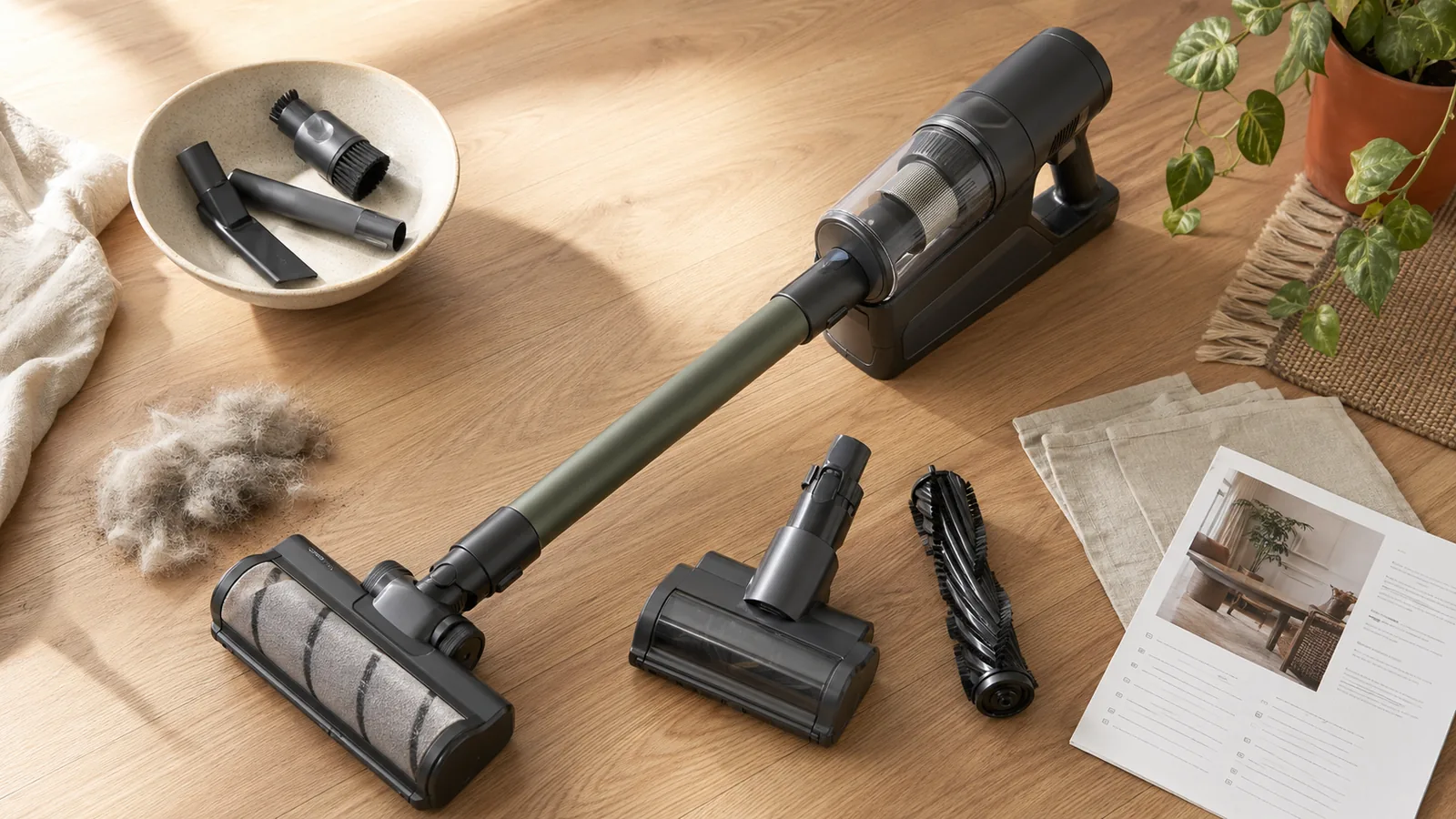
The V12 Detect Slim ships with both a soft roller cleaner head (for bare floors) and an illuminated cleaner head with a 250mm-wide brush bar. For pet owners, the practical maintenance note is this: the soft roller head resists tangling better than a stiff-bristle roll because fur tends to slide off the velvety surface rather than wrap around it. The filter is washable — cold water rinse, 24-hour dry — so there is no recurring filter purchase unless you damage it. Per Dyson's parts guidance, use only genuine Dyson replacement parts to keep the warranty intact.
Why the soft roller head protects hardwood from micro-scratches
Standard bristle brush rolls spin at high RPM and make direct, stiff contact with the floor surface. On hardwood, that repeated impact can leave micro-scratches — fine marks that don't show up immediately but dull the finish over months. A soft roller head replaces the stiff nylon bristles with a dense, velvety material that makes gentle, sweeping contact instead.
Dyson's soft roller cleaner head for the V12 Slim uses soft nylon fibers and anti-static carbon fiber filaments — the carbon fiber draws fine dust away from the surface electrostatically while the soft nylon lifts it. That combination is why the V12's dedicated hard-floor head is safe for unsealed wood, engineered hardwood, and lacquered floors where a stiff agitator would pose real risk.
Pro Tip: If your vacuum has a bristle roll and you're using it on hardwood, check whether there's an "agitator off" mode. According to RTINGS testing, turning off the agitator is the minimum requirement for hardwood floor safety. A dedicated soft-roller head is the better option for daily use.
The Dyson V12's illuminated cleaner head — the one with the built-in green laser — is a bristle-style head designed primarily for carpet and mixed surfaces. Use the soft roller head on hardwood, and switch to the illuminated head only when you move to rugs or upholstery. This two-head setup is the main floor-safety advantage the V12 holds over single-head designs.
Who should buy the Dyson V12 Detect Slim
The V12 Detect Slim fits one profile well: a single-level apartment or a home that is predominantly hardwood or hard floor surfaces, with at least one medium-shedding pet.
At a Glance: - Best for: Apartments, condos, townhomes with hardwood throughout - Great on: Stairs (5.22 lb is easy to carry one-handed) - Daily routine: Quick 10-minute sweep for fur before guests arrive - Not ideal for: Homes with heavy carpet throughout, or households needing a single vacuum to deep-clean both pile carpet and bare floors daily
The no-touch bin emptying is worth emphasizing for anyone dealing with pet allergies or dust sensitivity — you never need to put your hands near the debris. The compact cordless form factor means you can hang it on the included wall dock inside a closet rather than storing a canister in a utility room.
Shark Pet Cordless for easy hair cleanup and tangle control
The Shark Pet Pro Cordless is the value pick for pet owners who want less brush-roll maintenance without paying Dyson prices. Its self-cleaning brushroll is the headline feature: fur and hair detach from the roll automatically as the vacuum runs, so you rarely need to stop and cut tangled hair out with scissors.
AffiliateProductCard - Model: Shark Pet Pro Cordless (model UZ351H) - Dust cup capacity: 0.83 qt (easy-empty design) - Filtration: HEPA & Anti-Allergen Seal - Key feature: Self-cleaning brushroll, MultiFLEX compact storage - Best for: Pet-hair-heavy households, renters, quick daily cleanups
The 0.83 qt dust cup is meaningfully larger than the Dyson V12's 0.09-gallon bin, which helps if you're vacuuming a whole-home sweep with a heavy shedder and don't want to stop mid-room to empty. The HEPA and Anti-Allergen Seal means the filtration system is designed so that air can only exit through the filter — allergens captured inside stay inside. The filter is washable, so there's no recurring filter purchase here either.
How Shark anti-hair-wrap brush rolls reduce detangling time
With a standard bristle brush roll, long pet hair wraps around the axle within a few passes. After a full room sweep, you're looking at two to four minutes of picking or cutting hair out of the roll — every single time. Multiply that by five sessions a week and it adds up to noticeable maintenance time.
Shark's self-cleaning brushroll is engineered so that as the roll spins, a comb-like mechanism strips hair off the bristles and pulls it into the suction path rather than letting it accumulate around the axle. Per Shark's product page, the design is purpose-built for "powerful pet hair pickup with no hair wrap." In practice, you'll still occasionally see a small amount of hair collect at the brush end caps — that takes seconds to remove — but the dense mat of tangled fur that plagues standard rolls essentially disappears.
Watch Out: "Anti-hair-wrap" is not a universal Shark feature. Confirm the specific model you're buying includes the self-cleaning brushroll. The Pet Pro Cordless (UZ351H) and the PowerPro Cordless (IZ372H) both carry this feature, but budget Shark models may not.
For households with multiple pets or long-haired breeds, the Shark's self-cleaning roll makes the vacuum genuinely more sustainable to use daily. The Dyson V12's soft roller resists tangling on hard floors, but switch to the bristle head for carpet and you'll still need to pull fur from it periodically.
Best for renters who want fast emptying and low fuss
Renters managing pet hair need a vacuum that stores small, empties without making a mess, and doesn't require special cleaning products or hard-to-source replacement parts.
The Shark Pet Pro Cordless earns its place here through MultiFLEX technology: the wand bends at the mid-point, so the vacuum can lie flat under furniture without you bending down, and it stores upright in a slim closet or coat-cupboard corner without a wall dock. The 0.83 qt dust cup empties with a bottom-release lever over the trash can — no reaching inside. There's no bag to replace, and the washable filter keeps recurring costs near zero.
The Dyson V12's no-touch bin mechanism is arguably more elegant, but its 0.09-gallon bin means you'll empty it more often per session with a heavy-shedding pet. For renters vacuuming a full apartment in one go, the Shark's larger dust cup reduces interruptions.
Miele C1 Cat & Dog for sealed filtration and long-term reliability
The Miele Classic C1 Cat & Dog is the right pick if allergen control is the priority and you're willing to pay for a corded canister's superior filtration architecture. It retailed at $599 at launch and earns that price through a multi-stage AirClean filtration system that keeps 99.9% of fine dust filtered even during bag disposal — meaning the moment you swap the bag is not a cloud-of-dander event.
AffiliateProductCard - Model: Miele Classic C1 Cat & Dog Powerline (SBBN0) - Price: $599 (Miele press release, launch pricing) - Cleaning radius: 29.5 ft (stainless steel telescopic tube + power cord) - Filtration: Multi-stage AirClean System + Active AirClean filter - Best for: Allergy households, cat owners, owners who prefer bagged vacuums for dust control
The 29.5-foot cleaning radius matters more than it sounds. On a single outlet, you can cover a full living room, a hallway, and part of a kitchen without unplugging — a real advantage over cordless models that require mid-room battery swaps on larger floors. The Active AirClean filter (standard in Cat & Dog series models) is specifically designed to neutralize pet odors as air passes through it, not just capture particles.
Why bagged vacuums can lower dust exposure during emptying
Every time you empty a bagless vacuum's dust cup, you agitate the collected debris and push some of it back into the air — fine dander, pollen, and dust that was just captured now has a path back to your lungs and your floors. In a household managing pet allergies, that brief emptying moment can undo some of the air-quality benefit of vacuuming.
Miele's bagged design specifically addresses this. The AirClean System keeps 99.9% of fine dust filtered during the bag disposal process, per Miele's product announcement. The bag self-seals when you remove it, so the debris stays inside the bag and goes straight into the trash. For households where one person has asthma or a cat allergy, this one difference can make the post-vacuuming air quality noticeably better.
Bagless models handle this with anti-allergen seals — Shark's Anti-Allergen Seal and Dyson's whole-machine HEPA filtration both reduce dander exhaust during normal operation. The gap is specifically at the emptying moment. If that matters to your household, the Miele's sealed bag design is the cleaner solution.
Maintenance costs to expect from filters, bags, and replacement parts
This is the section most buying guides skip. Here's what annual ownership actually looks like across all three models:
Dyson V12 Detect Slim - Filter: Washable. Rinse monthly with cold water, dry 24 hours. Replacement cost: $0 unless damaged. - Brush rolls: Soft roller and illuminated head brush bars are replaceable. Per Dyson's parts guidance, only genuine Dyson parts maintain the warranty — budget for genuine Dyson pricing if a head degrades. - Battery: Lithium battery packs do degrade over time. Out-of-warranty battery replacements are the largest long-term cost; check Dyson's support site for current pricing when that time comes. - Estimated annual cost (filter only): ~$0
Shark Pet Pro Cordless - Filter: Washable. Rinse and air-dry. No replacement purchase under normal use. - Brush roll: Self-cleaning design extends the service life. If the brushroll does need replacement, Shark sells model-specific parts through their site. - Bags: None. - Estimated annual cost (filter only): ~$0
Miele Classic C1 Cat & Dog - Bags: AirClean FJM bags (or Type GN depending on model compatibility — confirm with Miele's bag guide). Sold in multi-packs; plan around regular replacement based on use. - Active AirClean filter: Periodic replacement required (less frequent than bags, but a real cost). - Estimated annual cost (bags + filter): Budget $40–$80 per year depending on usage and bag pack pricing.
Pro Tip: The Miele's $40–$80 annual bag-and-filter cost is real money, but spread over ongoing use, it's a reasonable ownership cost compared to replacing a cheaper vacuum every few years.
What to look for in a hardwood-floor vacuum with pets
The specs that separate a good hardwood-and-pet-hair vacuum from a frustrating one go well beyond suction wattage. Here's the checklist to run before you buy.
Core specifications checklist: - Soft roller or rubberized brush head for hardwood, OR an agitator-off mode - Sealed filtration system (not just a HEPA filter cartridge in an otherwise open housing) - Self-cleaning or anti-tangle brush roll for pet hair pickup - Weight under 6 lb for cordless stick models you'll carry between floors - Runtime of at least 30 minutes on a mid-power setting (cordless models) - Noise level below 75 dB if you have infants, light-sleeping pets, or shared walls
Brush roll type: soft roller vs bristle
Use a soft roller or dedicated hard-floor head on hardwood, always. Use a bristle or high-torque head on carpet and rugs, and either switch heads or turn the agitator off when you return to bare floors.
| Brush Type | Good for | Risk on hardwood | Tangle risk with pet fur |
|---|---|---|---|
| Soft roller | Hardwood, tile, LVP | Minimal | Low — fur slides off |
| Anti-hair-wrap bristle | Carpet, pet hair | Moderate if no "off" mode | Very low by design |
| Standard bristle (no tangle tech) | Carpet | High without agitator-off | High — requires regular cutting |
| Rubberized squeegee | Hardwood, tile | Minimal | Low |
Per RTINGS' hardwood-vacuum testing, the ability to switch off the agitator or use a dedicated floor head is the non-negotiable criterion for hardwood-safe vacuuming. If a model doesn't offer either, don't use it on wood floors.
HEPA certification and sealed filtration explained
"HEPA filter" and "sealed HEPA system" are not the same thing, and the difference matters for pet owners.
A HEPA filter cartridge traps 99.97% of particles 0.3 microns or larger — that includes pet dander. But if the vacuum housing isn't sealed, air finds gaps around the filter and exhausts unfiltered air back into the room. You've captured the dander in the filter, but some bypasses it entirely.
A sealed system — what Shark calls "Anti-Allergen Complete Seal" on the PowerPro Cordless, and what Miele builds into the AirClean multi-stage architecture — forces all exhaust air through the filtration path before it exits the machine. This distinction matters because the product-page wording tells you whether the seal is part of the design, not just a loose HEPA cartridge claim.
Watch Out: Marketing language like "HEPA-style" or "HEPA-level" without a sealed system claim is a signal to read the fine print. Those terms do not guarantee the machine meets true HEPA performance in use. Look for language specifically stating a sealed or anti-allergen system.
Miele's Cat & Dog series addresses this through the multi-stage AirClean system plus an Active AirClean filter, which Miele specifically recommends for house dust allergies. The combination of bag + multi-stage filter + sealed housing is why allergy-focused households consistently return to Miele despite the higher ongoing cost.
Weight, corded vs cordless, and bin-emptying convenience
For everyday pet-hair maintenance — a quick run through the kitchen and living room before the fur builds up — cordless wins on convenience. The Dyson V12 Detect Slim at 5.22 lb is light enough to carry in one hand up a flight of stairs. You grab it, vacuum, and hang it back on the dock. Total time: 8–12 minutes.
Cordless trade-offs: smaller bins (the V12's 0.09-gallon bin will need emptying mid-session on a full-home sweep), and battery life that degrades over several years of regular use. If you have more than 1,500 square feet of hard floor, a cordless stick's runtime may require a mid-session recharge on a whole-home clean.
Corded canisters like the Miele C1 never run out of charge, and the 29.5-foot cleaning radius means you're not constantly searching for an outlet. The trade-off is storage (canister plus hose plus wand takes more space than a stick-dock setup) and the physical cord management during cleaning.
Pro Tip: For renters in apartments under 800 square feet, cordless is almost always the right call. The compact storage, no cord to trip on, and easy-empty dust cup outweigh the bin-size limitation at that scale.
Warranty terms and return policies to check before you buy
Dyson covers all vacuum cleaners with a 2-year warranty. Importantly, that warranty requires genuine Dyson parts — if you replace a brush roll or filter with a third-party part and something fails, Dyson can deny the claim. Buy your replacement parts directly from Dyson to stay protected.
Watch Out: Miele and Shark's full warranty terms were not available in the sourced product pages at the time of writing. Check the current warranty documentation on Miele USA and Shark Clean directly before purchasing — warranty lengths and coverage details can change between model years.
Warranty and return checklist — run this before you check out:
- What is the exact warranty length? (2-year is standard; some premium models carry 5-year)
- Does the warranty cover the battery on cordless models, or just the motor?
- Are third-party replacement parts allowed, or do they void coverage?
- What is the retailer's return window? (30 days is typical; some retailers charge restocking fees on opened appliances)
- Does the brand offer a trial period with free return shipping?
- Is there a separate labor vs. parts warranty structure?
Keep the warranty paperwork and your order confirmation in one place so you can prove purchase date if you ever need service.
FAQs about vacuums for hardwood floors and pet hair
What type of vacuum is best for hardwood floors and pet hair?
A cordless stick with a dedicated soft-roller head is the best all-around type for most hardwood-and-pet-hair households, especially if you want daily cleanup without dragging out a full-size machine. If allergies are the bigger issue than portability, a sealed bagged canister like the Miele Classic C1 Cat & Dog is the better match; if tangle control matters most, a cordless Shark with a self-cleaning brushroll is the practical middle ground.
Do vacuums with a brush roll scratch hardwood floors?
A standard bristle brush roll spinning at high speed can scratch hardwood floors over time, especially if it picks up fine grit and drags it across the surface. The solution is either a dedicated soft-roller head — like the one included with the Dyson V12 Detect Slim — or an agitator-off mode that disables the brush entirely and relies on suction alone. Per RTINGS' hardwood testing, using a dedicated hard-floor head is the safest approach for daily maintenance. If your vacuum only has one bristle head and no soft-roller option, at minimum confirm there's a switch to turn the agitator off before using it on wood floors.
Are HEPA filters worth it for pet dander?
Yes — with one condition. The filter has to be part of a sealed system, not just a HEPA cartridge in an open housing. Unsealed vacuums can exhaust unfiltered air around the filter, sending dander back into the room through gaps in the body. The Shark PowerPro Cordless pairs its filter with an Anti-Allergen Complete Seal that claims to capture and trap over 99.97% of dust and allergens down to 0.3 microns, and Miele's Cat & Dog models use a multi-stage AirClean system with an Active AirClean filter that Miele specifically recommends for house dust allergies. If you or anyone in your household is sensitive to pet dander, prioritize the sealed system claim over the filter rating alone.
Is a bagged or bagless vacuum better for pet hair?
Both can handle pet hair well. The difference is in the emptying experience and ongoing cost. Bagless vacuums — like the Dyson V12 and Shark Pet Pro Cordless — are more convenient for daily use and cost nothing to "refill," but the moment you empty the dust cup, you disturb the collected debris and some dander escapes into the air. Bagged vacuums like the Miele Classic C1 Cat & Dog keep debris sealed inside the bag; Miele's AirClean System maintains 99.9% fine-dust filtration during bag disposal, so the swap is much cleaner for allergy-sensitive users. The cost tradeoff is real: expect to spend $40–$80 per year on Miele replacement bags and filters versus near-zero ongoing cost with a washable-filter bagless model.
Sources & References
- RTINGS — Best Vacuums for Hardwood Floors — Consumer testing methodology and selection criteria for hardwood-floor vacuums
- Dyson V12 Detect Slim product page — Official specs: weight, bin capacity, heads included
- Dyson vacuum overview and warranty — 2-year warranty statement
- Dyson genuine parts guidance — Third-party parts and warranty implications
- Dyson Community — V12 Slim Detect Absolute heads — Cleaner head configuration details
- Dyson illuminated cleaner head — Soft nylon and carbon fiber filament description
- Shark Pet Pro Cordless (UZ351H) — Self-cleaning brushroll, HEPA & Anti-Allergen Seal, MultiFLEX specs
- Shark PowerPro Cordless (IZ372H) — Anti-Allergen Complete Seal, 99.97% filtration claim
- Shark cordless vacuum overview — Anti-hair-wrap and easy-empty design details
- Miele Classic C1 Cat & Dog press release — $599 price, 29.5 ft radius, 99.9% fine dust filtration during disposal
- Miele Classic C1 Cat & Dog product page — Stainless steel telescopic tube and operating radius
- Miele Cat & Dog series overview — Active AirClean filter, allergen and pet-owner focus
- Miele bags and filters guide — AirClean FJM bag compatibility and replacement guidance
Keywords: soft roller brush head, Motorbar cleaner head, anti-hair-wrap brush roll, HEPA filtration, sealed system, dustbin emptying, bagged vacuum, bagless vacuum, Miele C1 Cat & Dog, Miele Guard L1, Dyson V12 Detect Slim, Dyson V15 Detect, Shark Pet Cordless, Shark NeverTouch self-cleaning brushroll