Gas backpack blowers still win on uninterrupted runtime — fill the tank in under two minutes and you're back at work. Battery models have closed the power gap enough to handle most suburban yards, and if you already own an EGO, Ryobi, or Greenworks tool ecosystem, you may already have the battery sitting in your garage. The decision comes down to how long your cleanup sessions run, how wet your debris gets, and whether your municipality is quietly phasing out your gas equipment for you. Wirecutter noted in its March 2026 leaf blower review that some cities and towns regulate or ban gas blowers outright or limit when they can be used.
Gas vs battery backpack leaf blowers for big yards: which power type fits your property
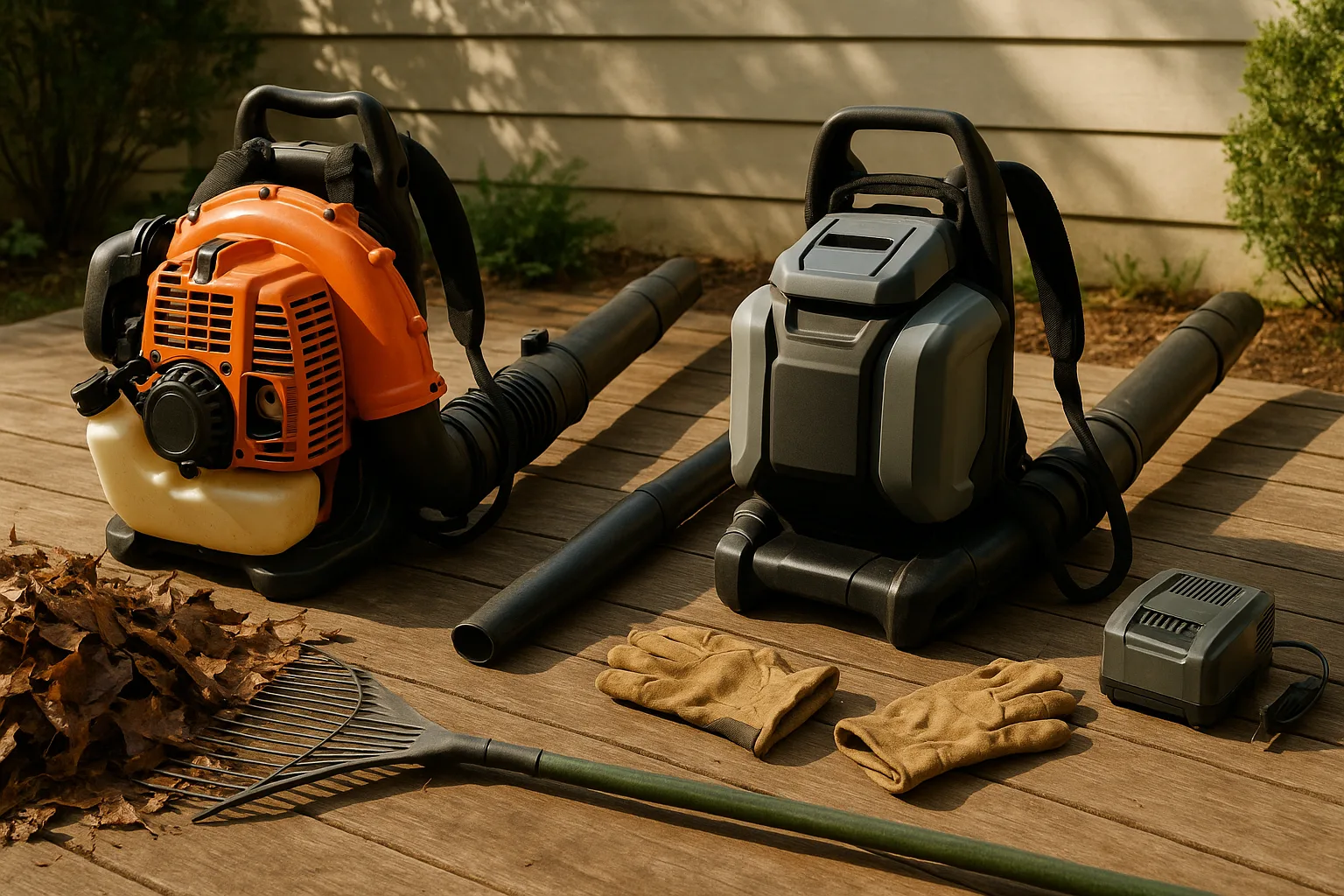
For properties under half an acre with weekly cleanup windows of 30–45 minutes, a battery backpack blower handles the job cleanly and quietly. For anything larger — a full acre of mature hardwoods, a long gravel driveway flanked by leaf-dropping oaks, or back-to-back commercial accounts — gas gas outdoor power equipment still earns its place because you can refuel in 90 seconds and keep working without waiting on a charger.
At a Glance: - Under ½ acre, weekly cleanup: Battery backpack blower — EGO LB6504 or Ryobi 40V Whisper Series - ½ to 1 acre, heavy seasonal leaf drop: Battery premium or gas — Husqvarna Leaf Blaster 350iB or gas 63–79cc unit - 1+ acres, wet leaves, long driveways: Gas backpack blower — 63cc or larger preferred - Pro daily/commercial use: Gas backpack blower with dealer support - Noise-restricted neighborhood: Battery backpack blower, any platform
QuickDecision: If your yard is under half an acre and your cleanup sessions stay around 30–45 minutes, a battery backpack blower is the cleaner fit; the EGO POWER+ LB6504 runs up to 90 minutes on a 5.0Ah battery, and the Husqvarna Leaf Blaster 350iB runs about 45 minutes continuously in normal mode. If you have an acre or more, wet leaves, or back-to-back properties, gas is the safer choice because the runtime ceiling is effectively your fuel supply.
The specific runtime numbers matter here. The EGO POWER+ 650 CFM LB6504 delivers up to 90 minutes of average runtime on a single 56V 5.0Ah ARC Lithium battery with variable output from 225 to 470 CFM — honest and competitive. The Husqvarna Leaf Blaster 350iB delivers approximately 45 minutes of continuous runtime on normal mode with its included BLi30 battery; engaging Boost mode drops that figure. A gas unit has no such ceiling — runtime is limited only by your fuel supply.
As Wirecutter noted in their March 2026 leaf blower review: "Cordless blowers can now offer portability and power without emissions, maintenance, or a two-stroke engine's noise." That's accurate — but it's not the full picture for large-property owners, and this article fills in what that summary leaves out.
How we compared backpack blowers: runtime, weight, power, and downtime
Marketing specs on backpack leaf blowers are optimistic almost without exception. CFM and MPH figures are typically measured at the nozzle tip under controlled, low-load conditions. Real cleanup — wet matted leaves on a long driveway, acorns in gravel, pine needles in wet mulch — pulls harder from both gas throttles and battery packs. We compared models on four criteria that actually predict performance on a large property: output power, runtime under load, downtime to refuel or recharge, and carrying weight with a full tank or installed battery.
| Model | Platform / Output | Runtime (loaded) | Recharge / Refuel | Carry Weight |
|---|---|---|---|---|
| EGO LB6504 | 56V / 650 CFM | Up to 90 min (5.0Ah) | 100 min standard charger | Not listed with battery |
| EGO LB8803-2 | 56V / 880 CFM, 200 MPH | Shorter than LB6504 | 80 min dual-port charger (2 × 5.0Ah) | Not listed |
| Husqvarna 350iB | 36V / 800 CFM, 200 MPH | ~45 min normal mode | Varies by charger | 15% lighter vs comparable |
| Ryobi 40V Whisper (730 CFM) | 40V / 730 CFM, 190 MPH | Up to 52 min (2 × 6Ah) | System-compatible charger | — |
| Ryobi 40V Whisper (850 CFM) | 40V / 850 CFM, 180 MPH | 2+ hours on low (2 × 8Ah) | System-compatible charger | — |
| Greenworks Pro 60V (730 CFM) | 60V / 730 CFM, 185 MPH | Per 8.0Ah battery | System-compatible charger | — |
| Gas (63–79cc class) | Two-stroke / 700–900+ CFM | Unlimited with fuel | 90 seconds to refuel | 22–26 lb with fuel |
A few numbers need unpacking. The Ryobi 40V HP Brushless 850 CFM Whisper Series quotes "over 2 hours of runtime" — but that figure is on low speed with two 40V 8Ah batteries installed. Running the blower at high speed or using the turbo button on wet debris will cut that well below two hours. The EGO 5.0Ah dual battery reaches full charge in 80 minutes with EGO's Dual-Port Charger, or 100 minutes with the standard charger included in most kits. Gas refuel time: under two minutes if you pre-mix your fuel.
Watch Out: Never compare a battery blower's low-speed runtime against a gas blower's full-throttle output. The fair comparison is performance-matched conditions — both units moving the same pile of wet leaves at similar CFM. At matched output, gas runtime is effectively unlimited and battery runtime drops materially.
Why uninterrupted runtime matters for wet leaves, long driveways, and pro cleanup
Wet leaves are the hardest test for any blower. They mat together, stick to pavement, and require sustained high-volume airflow to break the suction. This is precisely where the gas advantage is most concrete: you can pin the throttle for as long as the job demands. Gas outdoor power equipment in the 63–79cc range produces the sustained CFM — typically 700 to 900-plus — needed to push wet debris without pausing for a battery swap.
Among battery options, Wirecutter specifically noted the Husqvarna 350iB for wet-leaf work: "The powerful Husqvarna pairs unmatched run time with easy-to-use controls, a sleek design, and a scraper tip to dislodge damp, matted leaves." That scraper tip is a genuine differentiator — a physical plastic blade at the nozzle tip that you can drag under matted leaves to break them free before the airstream moves them. No other battery backpack blower in this category includes it.
For a long driveway or parking lot, the math is simple: if one pass takes 20 minutes and you have debris to move in multiple directions, a 45-minute battery will get you two passes before you're swapping cells or stopping to recharge. A gas unit just keeps going. The Ryobi 730 CFM Whisper Series is positioned as ideal for wet leaves and heavier debris, but at 45 minutes of runtime with two 6Ah batteries, it's a single extended session — not a pro-all-day tool.
Pro Tip: If you're using a battery backpack blower for wet-leaf seasons, buy a second battery in the same platform. EGO's 5.0Ah charges fully in 100 minutes standard or 80 minutes with the dual-port charger. One battery charges while you work with the other — close to continuous if your sessions are under 90 minutes.
Why battery platforms matter if you already own EGO, Ryobi, or Greenworks tools
The strongest argument for battery outdoor power equipment isn't the blower itself — it's the battery you already own. EGO's 56V platform spans its entire product line: string trimmers, lawn mowers, chainsaws, and snow blowers all draw from the same ARC Lithium battery family. As EGO's own battery page states: "Only 56V can provide the optimal voltage and necessary power for the most demanding commercial & residential equipment." If you own an EGO mower, your 5.0Ah or 7.5Ah battery plugs straight into the LB6504 or LB8803-2 blower without any adapter.
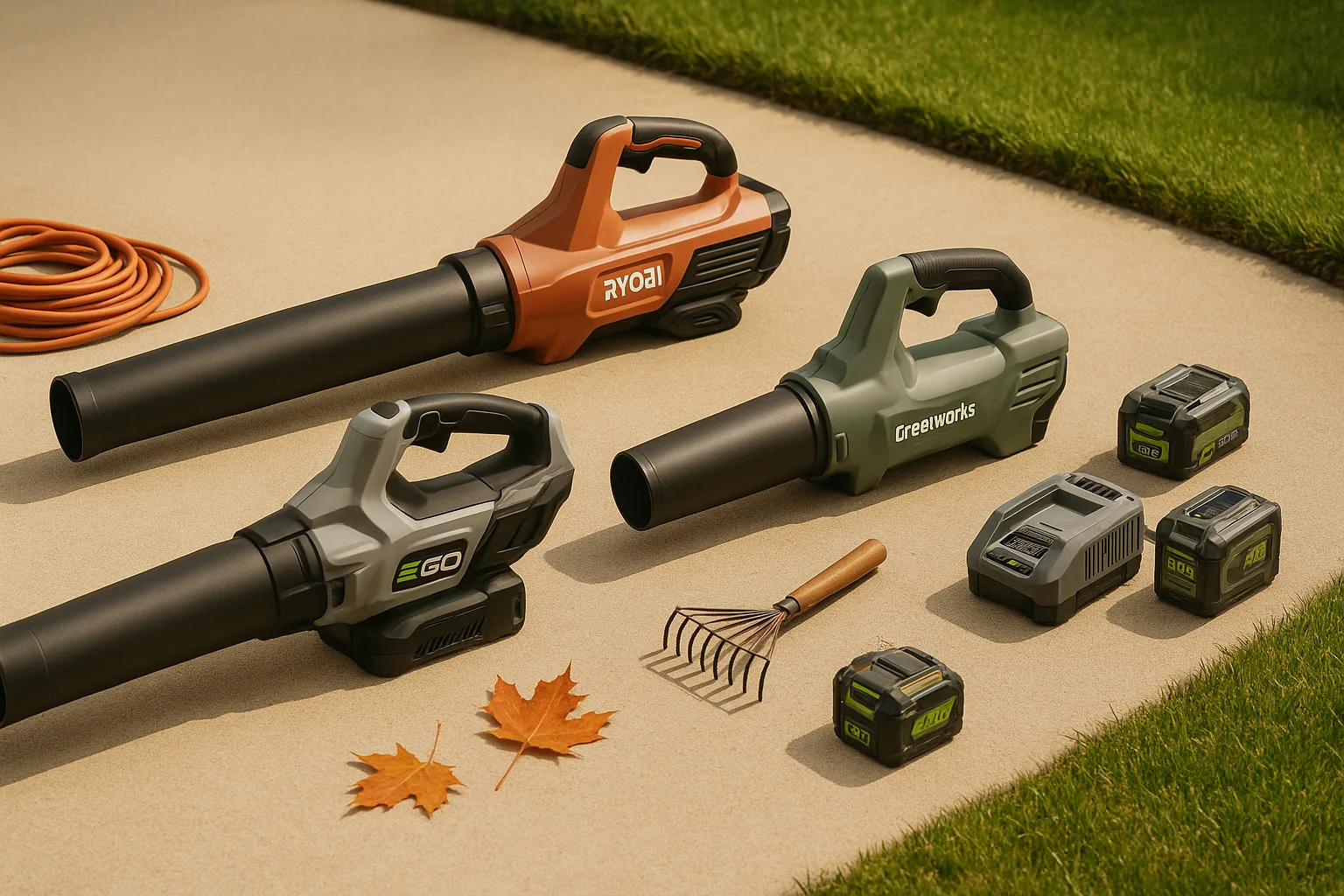
Ryobi operates the same logic across its 40V ecosystem. Per Ryobi's support documentation, the 40V backpack blower is "compatible with all Ryobi 40V tools and chargers" — so a battery from your Ryobi 40V mower or trimmer works in the blower and vice versa. Greenworks runs its backpack blower lineup on its 60V platform, emphasizing zero-emissions, no fuel mixing, and no pull cords across the entire product family.
PlatformFit: Check what voltage your existing outdoor tools use before buying a blower. Mixing platforms (e.g., Ryobi 40V tools with a Greenworks 60V blower) means buying new batteries that won't cross over. Staying within one ecosystem means every battery you already own adds blower runtime — and every blower battery doubles as backup power for your mower.
Best gas backpack leaf blower for big yards and wet debris
Gas wins on a large property when three conditions align: the cleanup session runs longer than 90 minutes, debris is wet or heavy, and downtime for recharging is not acceptable. Gas outdoor power equipment in backpack form typically weighs 22–26 lb with a full tank, runs on a 50:1 or 50:1 mix of gasoline and two-stroke oil, and delivers continuous high-CFM airflow limited only by your fuel supply.
AffiliateProductCard — Gas Backpack Blower Class: - Engine displacement: 63cc to 79cc (most productive class for large residential and light commercial) - Typical output: 700–950 CFM, 175–230 MPH - Fuel capacity: 40–60 oz (roughly 30–60 minutes at wide-open throttle before refuel) - Refuel time: Under 2 minutes with pre-mixed fuel - Starting system: Primer bulb + pull-start; some models offer reduced-effort Smart Start - Carry weight with fuel: 22–26 lb depending on harness design - Pro-use suitability: High — serviceability through dealer network, OEM parts availability - Top brands in class: Husqvarna (570BTS, 580BTS), STIHL (BR 600, BR 700), RedMax (EBZ8550), Echo (PB-8010)
What engine size and blower-force range to look for in a gas backpack blower
For a yard over half an acre or any property with mature deciduous trees, the 63–79cc engine displacement range is the practical floor. Smaller engines (42–50cc) are sold as mid-range backpack blowers and they're fine for light seasonal cleanup, but they underperform on wet leaves and struggle on long continuous runs at full throttle.
Spec checklist for gas backpack blowers on big yards:
- Engine displacement: 63cc minimum; 75cc+ for heavy daily use or commercial work
- CFM at nozzle: 700 CFM minimum; 800+ CFM preferred for wet debris
- Air speed: 175 MPH minimum; 200+ MPH for packed or wet material
- Newton force (where listed): 30N+ for large-area clearing; some pro models exceed 40N
- Tank capacity: Look for 40 oz or larger — smaller tanks mean more frequent refueling
- Harness: Padded shoulder straps and hip belt; a lumber support plate reduces fatigue on long sessions
The two-stroke engine requires a 50:1 fuel-to-oil mix ratio (always confirm in your model's manual — some older or European-spec models use 40:1). Pre-mixed fuel such as TruFuel 50:1 eliminates guesswork and stays fresh in the tank longer than pump gas mixed at home, which is worth the premium if you store the blower between seasons.
Best for pro daily use: durability, serviceability, and dealer support
For landscape pros running a blower 5–6 days a week, the service question matters as much as the specs. Gas backpack blowers from Husqvarna, STIHL, Echo, and RedMax are sold through a dealer network that stocks OEM parts and offers same-week or same-day service in most metro areas.
ProUse callout: - Air filter: Clean or replace every 25–30 operating hours — more often in dusty or dry-debris conditions - Spark plug: Replace annually or per manufacturer schedule - Fuel filter: Replace at the start of each heavy-use season - Harness inspection: Check straps and buckle hardware for wear every season; a failed harness on a 25 lb unit is a safety event, not just an inconvenience - Dealer vs big-box: Buy from a dealer if you need next-day service turnaround. Big-box units (often a different spec or SKU than dealer models) may require shipping for repairs, leaving you without a blower mid-season - Warranty: Confirm commercial-use coverage — many consumer warranties specifically exclude commercial applications
Best battery backpack leaf blower for quieter suburban cleanup
The two battery backpack blowers that consistently earn top recommendations for suburban use are the EGO POWER+ LB6504 and the Husqvarna Leaf Blaster 350iB as a premium step-up. Wirecutter's March 2026 review named the EGO LB6504 its top cordless pick and the Husqvarna 350iB its premium upgrade — both running on battery outdoor power equipment platforms that integrate across multiple tools.
AffiliateProductCard — EGO POWER+ LB6504: - Platform: 56V ARC Lithium - Output: 225 to 470 CFM - Runtime: Up to 90 minutes on the included 5.0Ah battery - Value prop: Best fit for half-acre suburban cleanups with one battery and low maintenance
EGO POWER+ LB6504 runs on the 56V ARC Lithium platform and delivers up to 90 minutes of average runtime on the included 5.0Ah battery with variable output between 225 and 470 CFM. That runtime at the low-to-mid dial setting is genuinely useful for a half-acre yard — enough for a full cleanup session including driveway, sidewalks, and patio on a single charge. Turning the dial to maximum output shortens runtime, but most suburban weekly maintenance doesn't require maximum output on dry, freshly fallen leaves.
EGO POWER+ LB8803-2 steps up to 880 CFM and air speeds up to 200 MPH — matching gas performance at peak — but the higher output comes at the cost of shorter runtime. The LB8803-2 is the right choice if you occasionally face heavy seasonal drops and want to run through them fast; it's the wrong choice if you need sustained 90-minute sessions on a single charge.
AffiliateProductCard — Ryobi 40V HP Brushless Whisper Backpack Blower Kit: - Platform: Ryobi 40V Whisper Series - Output: 730 CFM / 190 MPH - Runtime: Up to 52 minutes with the included two 40V 6Ah lithium batteries - Value prop: Good for quieter weekly cleanup and users already invested in Ryobi 40V tools
Husqvarna Leaf Blaster 350iB is positioned as "the industry's most powerful handheld blower, gas or battery" on Husqvarna's US product page, with 800 CFM and 200 MPH. That's a strong claim and the specs support it in the battery class. The trade-off is runtime — 45 minutes continuous on normal mode with the included BLi30 battery, with Boost mode cutting that further. The scraper tip for dislodging matted leaves makes it particularly useful in fall conditions.
AffiliateProductCard — Husqvarna Leaf Blaster 350iB: - Platform: Husqvarna BLi / 36V battery system - Output: 800 CFM / 200 MPH - Runtime: ~45 minutes continuous (normal mode, included BLi30 battery) - Boost mode: Available; reduces overall runtime - Notable feature: Scraper tip for wet, matted leaves - Weight: 15% lighter than comparable blowers (per Husqvarna CA product page) - Best for: Premium suburban use, seasonal heavy leaf drops under 45-minute sessions, EGO premium alternative
EGO vs Ryobi vs Greenworks: which battery platform fits the buyer best
Platform choice is a longer-term investment decision than any single blower purchase. Here's how the three main battery outdoor power equipment ecosystems compare for buyers choosing a backpack blower as part of a broader tool suite:
| Platform | Voltage | Blower Output Range | Ecosystem Breadth | Recharge (5.0Ah) | Price Tier | Warranty |
|---|---|---|---|---|---|---|
| EGO 56V | 56V | 650–880 CFM | Mowers, trimmers, chainsaws, snow blowers, pressure washers | 80 min (dual-port) / 100 min (standard) | Premium | 5-year tool / 3-year battery |
| Ryobi 40V | 40V | 625–850 CFM | 80+ tools in 40V lineup | Up to 52 min (2 × 6Ah included) | Mid / value | 5-year tool / 3-year battery |
| Greenworks 60V | 60V | 550–730 CFM | Mowers, trimmers, pressure washers | Per model/battery | Mid | Varies by model |
EGO's 56V system has the most expansive lineup of high-output tools. If you're also buying a battery mower or snow blower, EGO's ecosystem delivers the most cross-platform power per battery dollar.
Ryobi's 40V lineup is the most accessible entry point — the tools are widely available at Home Depot, and the ecosystem compatibility across all Ryobi 40V tools and chargers means a single battery platform covers a very wide tool library at a lower per-tool cost. The 850 CFM Whisper Series backpack blower with two 8Ah batteries offers over 2 hours of runtime at low speed, which is competitive for larger suburban properties when you're not running at full throttle.
Greenworks' 60V platform positions at mid-tier pricing with strong no-fuss messaging. Options run from 550 CFM / 155 MPH up to 730 CFM / 185 MPH, both running on the same 60V battery family. If you already own Greenworks 60V tools, the platform addition makes sense — if you're starting fresh, EGO or Ryobi offer more tool depth.
Watch Out: Batteries are not cross-brand compatible even when voltage appears similar. A Ryobi 40V battery will not fit an EGO 56V blower. Choose your ecosystem before your first purchase and stay consistent.
Best for homeowners who want low maintenance and no fuel storage
Battery backpack blowers eliminate three friction points that frustrate casual users of battery outdoor power equipment: no fuel mixing, no pull-start cord, and no stale-gas problems from sitting unused for months. EGO's blower page explicitly notes it "delivers power without the noise, fuss, and fumes." Greenworks summarizes the appeal bluntly: "Kick gas to the curb this spring and go green with no fumes, no mixing, no maintenance and no pull cords."
MaintenanceCallout — Battery Backpack Blower: - Charging: Store batteries at partial charge (20–80%) for long-term storage; full discharge or full charge held for months degrades lithium cell life - Winter storage: Keep batteries indoors above freezing — lithium batteries discharge faster and can be damaged by storage below 32°F - Seasonal readiness: Pull the blower out in fall, charge the battery, and you're working in minutes — no carburetor cleaning, no fresh-fuel purchase, no priming - Tube and nozzle: Wipe clean; no oil residue from exhaust - Air intake filter: Some battery blower models have a small foam intake filter — check annually and clean with compressed air
How local gas blower rules can change your buying decision
Before you buy gas outdoor power equipment, check your city or county ordinances. As Wirecutter's March 2026 review notes, "some cities and towns regulate or ban gas blowers outright or limit when they can be used." This is no longer a California-only issue.
MunicipalRestriction: Gas blower regulations take several forms — outright bans on residential gas-powered blowers (common in several California cities), seasonal restrictions (no gas blowers during summer Spare the Air days in parts of the Bay Area and Los Angeles), time-of-day limits (some municipalities prohibit use before 8 a.m. or after 6 p.m.), and HOA rules that mirror or exceed local codes. Check your city's municipal code and your HOA rules before purchasing. If your area restricts gas blowers now or is likely to within the next few years, a battery platform is the forward-compatible choice even if gas would otherwise meet your power needs.
What backpack leaf blower specs matter most: CFM, mph, weight, and runtime
Spec sheets for backpack leaf blowers use at least four different metrics to describe the same basic question — how much air can this blower move, and how fast. Here's what each metric actually means for your yard:
SpecGlossary:
-
CFM (cubic feet per minute): Volume of air the blower moves. Higher CFM moves larger piles and wet material. For large yards, 650 CFM is a practical floor; 800+ CFM handles wet leaves and heavy debris. The EGO LB8803-2 peaks at 880 CFM; the Husqvarna 350iB at 800 CFM; the Ryobi 730 CFM Whisper Series at 730 CFM; the Ryobi 850 CFM model at 850 CFM.
-
Air speed (MPH): Velocity of the airstream at the nozzle. Higher MPH breaks the bond between wet leaves and pavement. The EGO LB8803-2 reaches 200 MPH; Husqvarna 350iB reaches 200 MPH; Ryobi 730 CFM Whisper at 190 MPH; Ryobi 850 CFM at 180 MPH; Greenworks 60V 730 CFM at 185 MPH.
-
Newton force (N): The combination of CFM × MPH expressed as a single force figure, useful for direct comparison. Increasingly found on pro-grade gas blowers (30N+ is considered high-output). Not universally reported on battery models.
-
Runtime under load: How long the blower sustains useful output moving actual debris, not how long it technically operates at its lowest dial setting.
-
Carry weight with battery or tank: The weight you actually strap on, not the stripped product weight.
How much weight feels manageable once the tank or battery is installed
Weight is cumulative over a long session. A blower that feels fine for ten minutes becomes fatiguing at 45 minutes if the harness is poorly padded or the weight sits high on your back. The Ryobi 40V 625 CFM backpack blower lists a product weight of 21.1 lb — that's with batteries installed, which is the only number that matters when you're wearing it. Husqvarna claims the 350iB is 15% lighter than comparable alternatives, though they don't specify the comparison model.
CarryWeight note: Gas units with full tanks run 22–26 lb, but the weight decreases as fuel burns. Battery units with dual large-format batteries (two 8Ah packs) can approach or exceed gas unit weight without the benefit of getting lighter as runtime progresses. For sessions over an hour, harness quality — padded shoulder straps, hip belt, and ideally a lumbar support plate — matters as much as the weight number itself. Try the harness loaded in-store before buying if possible.
Why advertised runtime and real runtime under load are not the same
The Ryobi 850 CFM backpack blower's "over 2 hours" claim is honest — at low speed, with two 40V 8Ah batteries installed. Run the same blower on high speed into wet leaves and that figure drops significantly. Husqvarna explicitly states that engaging Boost mode on the 350iB reduces overall runtime from the stated 45-minute figure. This isn't a manufacturer trick — it's physics. Higher airflow demands more current, which drains battery cells faster.
RealWorldRuntime: When comparing battery blower runtime, always ask: runtime at what mode and with what battery? A manufacturer's headline runtime figure is almost always at the lowest useful speed setting with the largest available battery. Your real-world runtime — running at 70–100% output on a stubborn pile of wet leaves — will be 30–50% shorter than the headline number. The EGO 5.0Ah battery includes a built-in fuel gauge with indicator lights showing remaining charge in 20% increments, which at least lets you manage the session rather than being surprised by a shutdown. Buy the largest battery your budget allows and plan for one swap per heavy-use session.
Best backpack leaf blower by use case: acreage, wet leaves, suburban cleanup, and pro crews
UseCaseMatrix:
| Use Case | Power Type | Recommended Models | Key Reason |
|---|---|---|---|
| Large property, frequent wet debris | Gas preferred | 63–79cc gas (STIHL BR 600, Husqvarna 570BTS) | Unlimited runtime, sustained high CFM for wet material |
| Pro daily use, commercial accounts | Gas | 75–79cc gas with dealer support | Serviceability, downtime cost, OEM parts |
| Quiet suburban cleanup, weekly | Battery | EGO LB6504, Ryobi 40V Whisper | 45–90 min runtime sufficient, lower noise |
| EGO ecosystem owners | Battery | EGO LB6504 or LB8803-2 | Shared 56V battery across tools |
| Ryobi 40V ecosystem owners | Battery | Ryobi 40V Whisper 730 or 850 CFM | System-compatible batteries, 5-yr warranty |
| Greenworks ecosystem owners | Battery | Greenworks Pro 60V 730 CFM | Shared 60V platform |
| Premium one-blower-for-all | Battery | Husqvarna 350iB | Best battery CFM class + scraper tip |
Large property with frequent wet debris
Gas outdoor power equipment is the clear first choice here. On a property over one acre with mature oaks, maples, or other heavy-leaf trees, you're likely looking at 2–4 hour sessions in fall, often in damp conditions. No battery backpack blower currently offers that kind of continuous runtime at full output. A 63cc or larger two-stroke gas backpack blower lets you refuel in under two minutes and continue — a battery unit requires 80–100 minutes of charger time for the same energy.
Best for: Gas backpack blower, 63cc+, with a second fuel canister pre-mixed and ready. Plan for 30–40 minutes at full throttle between refuels; carry a pre-mixed 1-gallon container and you're stopping twice over two hours — total downtime under 5 minutes.
Pro daily use on driveways, lots, and commercial accounts
For landscape crews and contractors, gas backpack blowers remain the industry standard because downtime costs money. A battery failure mid-job, a drained pack with no charger access, or a blower sidelined for recharging while a crew waits costs more than the price difference between gas and battery equipment.
Durability and downtime callout: Choose a brand with a local dealer who stocks parts. STIHL, Husqvarna, Echo, and RedMax all have dealer networks in most US metro and suburban areas. Service turnaround at a dealer is typically 1–5 days on common repairs; mail-in service for big-box units can take 2–4 weeks. Confirm your model is covered under commercial-use warranty terms before purchase — most consumer warranties explicitly exclude professional use.
Quiet suburban use and short weekly cleanup
Battery is the right choice for weekly 20–45 minute sessions on lots under half an acre. Noise restrictions — formal municipal rules or informal neighborhood norms — matter here. Battery backpack blowers run significantly quieter than two-stroke gas units; that matters if you're working early morning or in a neighborhood with close-set houses.
Neighborhood-noise and convenience callout: The EGO LB6504's 90-minute runtime on a single 5.0Ah battery covers a full suburban cleanup including driveway, sidewalks, porch, and rear patio without a battery swap. The Ryobi 40V Whisper Series lineup earns its name — noticeably quieter than comparable gas units. If your sessions are short and predictable, battery is not a compromise; it's the correct tool.
Price, warranty, and return policy checks before you buy
PurchaseChecklist: - EGO tools: 5-year limited warranty on outdoor power equipment; 3-year limited warranty on EGO Power+ System batteries and chargers — but only when purchased from authorized EGO retailers. Buying from an unauthorized third-party seller (common on marketplace platforms) voids warranty coverage. - Ryobi 40V Whisper Series kits: 5-year manufacturer warranty on the blower unit; 3-year warranty on the included batteries. - Gas equipment: Warranty terms vary by brand and intended use (residential vs commercial). Confirm coverage before purchase. - Return windows: Most big-box retailers (Home Depot, Lowe's) offer 30–90 day return windows on outdoor power equipment. Check whether the window is open — fall blower purchases made in October often see the return window close before buyers have used the equipment enough to confirm satisfaction. - Pricing check (mid-2026): Battery backpack blower kits with batteries included typically range from around $200 for entry Ryobi/Greenworks to $400–$600 for EGO LB8803-2 and Husqvarna 350iB kits. Gas backpack blowers in the 63–79cc class range from approximately $350–$700 depending on brand and dealer. Prices shift seasonally — fall shipping demand and spring landscaping season both create price spikes. - Kit vs tool-only: If you already own platform batteries, buy tool-only and save $100–$200. Confirm battery compatibility before ordering.
FAQs about backpack leaf blowers for big yards
Are backpack leaf blowers worth it for large yards?
Yes. For a yard over a quarter acre, a backpack blower is worth the step up from a handheld because it spreads the load across your shoulders and back instead of your arm and wrist. For anything over half an acre, the backpack format is the practical choice for a session that lasts more than 20 minutes.
Is a gas backpack blower better than battery?
Gas is better when you need uninterrupted runtime past 90 minutes, wet-leaf performance, or daily commercial use. Battery is better for short suburban cleanups, lower noise, and buyers who already own EGO 56V or Ryobi 40V batteries. The right choice depends on runtime, debris type, and whether your yard is likely to face gas-blower restrictions.
How long do battery backpack leaf blowers last?
It depends on the battery and output setting. The EGO POWER+ LB6504 runs up to 90 minutes on a 5.0Ah battery. The Ryobi 40V HP Brushless Whisper Backpack Blower Kit runs up to 52 minutes with its included two 40V 6Ah batteries. The Husqvarna 350iB runs about 45 minutes on normal mode. Real runtime is shorter on high output and wet debris.
What CFM do I need for a large yard?
For a large yard, 650 CFM is a sensible floor, 700–800 CFM is better for wet or packed debris, and 800+ CFM is the battery class to look at if you want top-end performance. The EGO LB8803-2 reaches 880 CFM, the Husqvarna 350iB reaches 800 CFM, and gas backpack blowers in the 63–79cc class typically run 700–950 CFM.
Are gas leaf blowers being banned?
In some places, yes. Some cities and towns regulate or ban gas blowers outright or limit when they can be used. Check your local municipal code and HOA rules before buying gas equipment; if your area already has restrictions or is likely to add them, battery is the safer long-term purchase.
Sources & References
- Wirecutter: Best Leaf Blowers (March 12, 2026) — Primary consumer test review; source of top cordless picks and gas ban context
- EGO POWER+ LB6504 Product Page — Runtime, CFM, and battery specs for EGO 650 CFM blower
- EGO POWER+ LB8803-2 Product Page — Specs for EGO 880 CFM blower
- EGO 5.0Ah Battery with Fuel Gauge — Dual-port charger recharge time: 80 minutes
- EGO 5.0Ah Battery + Standard Charger Starter Kit — Standard charger recharge time: 100 minutes
- EGO 56V Battery Platform — Platform description and ecosystem positioning
- EGO Warranty Policy — 5-year tool / 3-year battery warranty terms and authorized retailer requirement
- Husqvarna Leaf Blaster 350iB (with battery and charger) — Runtime, Boost mode warning, BLi30 battery specs
- Husqvarna Leaf Blaster 350iB (tool only) — CFM/MPH specs and performance claims
- Husqvarna Leaf Blaster 350iB (Canada) — Weight comparison claim (15% lighter)
- Ryobi 40V HP Brushless Whisper Backpack Blower Kit (730 CFM) — CFM, MPH, runtime with 2 × 6Ah batteries
- Ryobi 40V HP Brushless Whisper Backpack Blower Kit (52 min) — Runtime with included 2 × 6Ah batteries; warranty terms
- Ryobi 40V HP Brushless 850 CFM Whisper Backpack Blower — 2+ hour runtime on low with 2 × 8Ah batteries
- Ryobi 40V Backpack Blower Support Page — Ecosystem compatibility statement
- Ryobi 40V 625 CFM Backpack Blower (weight) — Listed product weight: 21.1 lb
- Greenworks Pro 60V Cordless Backpack Blower (550 CFM) — Platform and spec page
- Greenworks Pro 60V Cordless Backpack Blower (730 CFM) — 730 CFM / 185 MPH specs; maintenance-free messaging
Keywords: CFM, air speed (mph), two-stroke engine, cc displacement, runtime under load, fuel mix ratio, battery platform, 56V EGO POWER+, Ryobi 40V, Greenworks 60V, Husqvarna Leaf Blaster 350iB, EGO POWER+ LB6504, EGO POWER+ LB8803-2, wet leaves, municipal gas blower restrictions